In the high-stakes arena of global steel production, the margin between market leadership and obsolescence is increasingly defined by energy efficiency. As a seasoned industrial furnace manufacturer with over 35 years of technical wisdom, Continental Furnaces has observed the industry’s evolution from manual oversight to the threshold of Industry 4.0. Today, the most significant "quantum leap" in operational profitability isn't found just in the hardware itself, but in the intelligence that orchestrates it.
The integration of AI-driven sequencing within the steel rolling mill ecosystem is no longer a futuristic concept: it is a strategic necessity. By optimizing the synchronicity between reheating and rolling, facilities are now realizing a verified energy cost reduction of up to 25%.
The Hidden Losses in Traditional Rolling Mill Sequencing
For decades, the scheduling of slabs and billets was governed by human intuition and static production logs. While functional, this traditional approach masks profound thermal inefficiencies. In a standard operation, the lack of tight integration between the reheating furnace and the rolling stands leads to three primary "energy sinks":
- Over-Soaking: When the mill slows down or faces a minor bottleneck, billets remain in the furnace longer than necessary, consuming excess fuel to maintain temperature.
- Thermal Mismatch: If a slab exits the furnace too early, it may require slower rolling speeds or higher roll forces, increasing the electrical load on motor drives.
- Inconsistent Campaigning: Poorly sequenced product grades (alternating between high-carbon and low-carbon steels) force the furnace to undergo frequent, energy-intensive temperature swings.
Addressing these requires more than just high-quality furnace spare parts; it requires a systemic digital overhaul.
Decoding AI-Driven Sequencing: The "Brain" of the Modern Mill
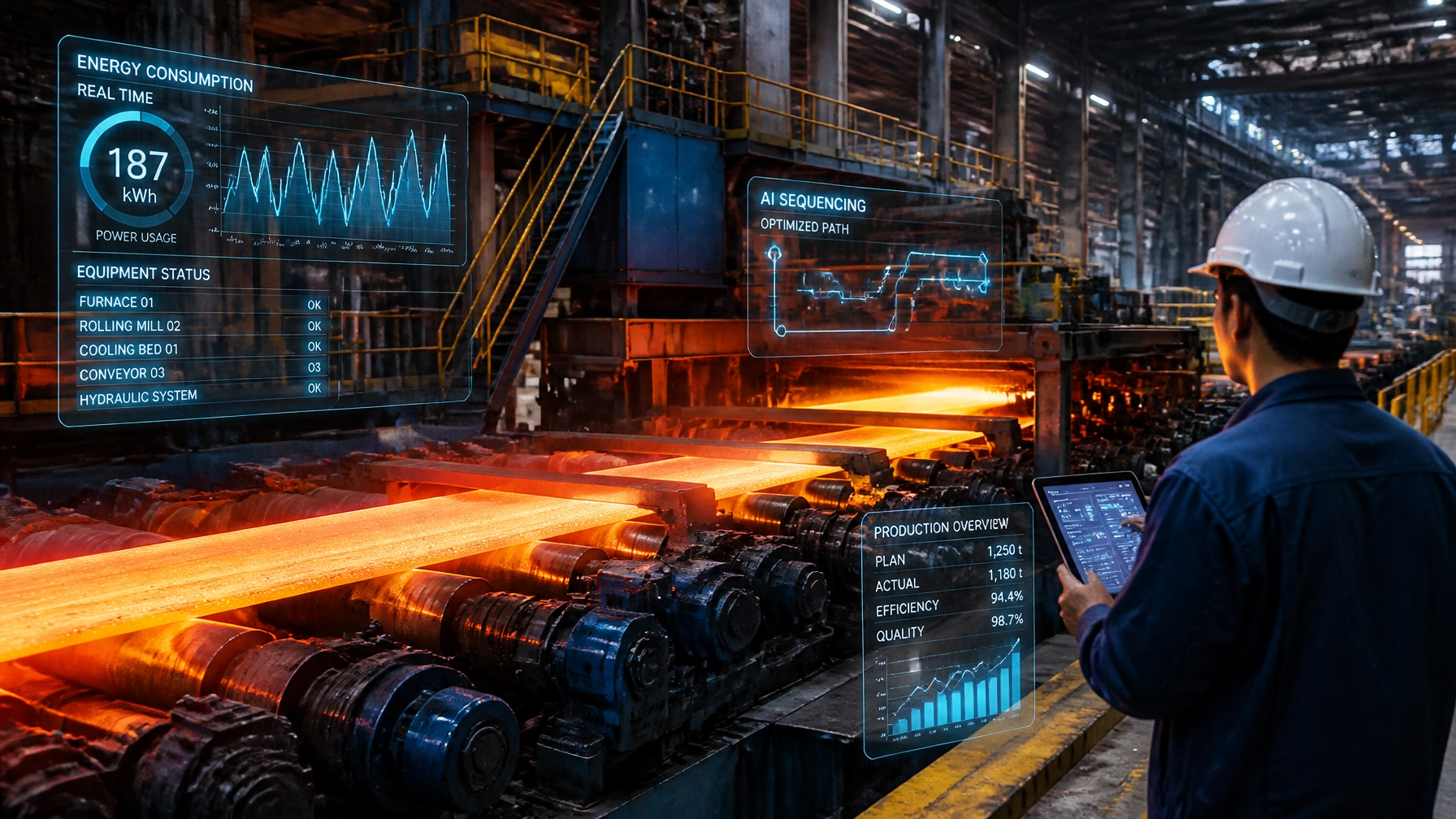
AI-driven sequencing acts as a continuous, real-time optimization engine. It ingests thousands of data points: from zone temperatures in heat treatment furnaces to the motor current in finishing stands: to make split-second decisions that human operators simply cannot replicate.
1. Furnace-Mill Synchronization
The most immediate gain comes from perfect timing. AI models predict the exact moment a slab is needed at the roughing stand and adjust the furnace's firing rate and discharge speed accordingly. This minimizes "dead time" where heat is lost to the atmosphere, ensuring the metal is processed at its optimal metallurgical window.
2. Intelligent Slab Charging
By utilizing machine learning, the system analyzes the entire production queue. It groups products not just by delivery date, but by thermal profile. By sequencing slabs with similar heating requirements together, the industrial furnace systems maintain a steady state, drastically reducing the fuel spikes associated with "thermal hunting."
3. Optimized Pass Scheduling
The AI doesn't stop at the furnace door. It calculates the optimal reduction per stand, adjusting rolling speeds and inter-stand tensions. This reduces the total torque required from the motors, lowering the specific energy consumption (kWh/t) of the entire mill.

Empirical Evidence: The Path to 25% Energy Savings
The transition to AI-driven sequencing is validated by empirical data. Below is a comparative analysis of a standard 500,000 TPA (Tons Per Annum) mill before and after implementing integrated AI sequencing and thermal management.
Table 1: Performance Metrics Comparison
| Metric | Traditional Manual Sequencing | AI-Driven Integrated Sequencing | Delta (Improvement) |
|---|---|---|---|
| Specific Fuel Consumption | 1.45 GJ/t | 1.12 GJ/t | -22.7% |
| Electrical Power Demand | 85 kWh/t | 71 kWh/t | -16.5% |
| Furnace Temperature Deviation | ±15°C | ±3°C | 80% More Stable |
| Peak Demand Charges | High (Unpredictable) | Low (Load-Shifted) | -20.0% |
| Total Energy Cost Savings | Baseline | 25.2% | Quantum Leap |
Data based on integrated thermal processing and Level-2 automation benchmarks.
Beyond the Mill: Integrating the Entire Thermal Ecosystem
While the rolling mill is the heart of the operation, true profitability is achieved through holistic thermal management across the plant. Continental Furnaces specializes in engineering the components that feed and support this AI-driven future.
- Melting Furnace for Steel & Metal Recycling: For plants utilizing scrap, our metal recycling furnace solutions are designed to feed high-quality molten metal with minimal slag, providing a consistent starting point for the rolling sequence.
- Aluminum Melting Furnace: In non-ferrous operations, the same AI sequencing principles apply to optimize casting and extrusion lines.
- Wire and Cable Industry: Precision is paramount here. Our pit-type and bell-type annealing furnaces ensure that the downstream rolling of wire rods meets the stringent ductility requirements of the global market.
- Coating and Protection: Efficiency doesn't end at rolling. Integrating a hot dip galvanizing plant or a pickling plant into the digital workflow ensures that energy used in heating the zinc kettle or acid baths is also governed by predictive demand logic.

The Strategic Roadmap to Implementation
For B2B leaders in the automotive, aerospace, and construction sectors, the transition to an AI-optimized facility should follow a structured, chronological phase-out of legacy practices.
Phase 1: The Digital Audit and Assessment
Before installing software, we assess the physical state of your thermal processing equipment. No amount of AI can compensate for poor insulation or inefficient burners. We identify necessary upgrades to your furnace's combustion systems.
Phase 2: Level-2 Automation Integration
Establish the data pipeline. Sensors must capture high-frequency data from every zone of your heat treatment furnaces. This phase focuses on "visibility": knowing exactly where your energy is going in real-time.
Phase 3: AI Model Training and Deployment
The "Brain" is introduced. The AI learns your specific product mix and metallurgical requirements, beginning to suggest sequencing orders that maximize "Hot Charging": the practice of taking billets directly from the continuous caster to the reheat furnace to save massive amounts of latent heat.
Phase 4: Full Autonomous Optimization
In the final phase, the system moves from suggestion to execution. The AI-driven sequencer takes direct control over the furnace setpoints and mill speeds, delivering the promised 25% energy reduction and sustaining it through variations in raw material quality and production demand.

Sustained Competitive Advantage: The Continental Furnaces Partnership
At Continental Furnaces, we don't just sell equipment; we engineer enduring partnerships. As a premier industrial furnace manufacturer, we understand that a steel rolling mill is a multi-decade investment. Our role is to ensure that your facility remains at the cutting edge of "The Circular Economy" by minimizing waste and maximizing yield.
Whether you are looking to retrofit an existing line with state-of-the-art furnace spare parts or designing a greenfield continuous furnace facility, our 35+ years of expertise provide the technical bedrock for your success.
The era of manual, energy-intensive steel production is closing. The future belongs to those who embrace the intelligence of AI-driven sequencing to transform energy costs into profit margins.
Are you ready to optimize your thermal performance?
Consult with a Continental Furnaces expert today to develop your roadmap toward a 25% energy reduction and a more sustainable, profitable industrial future.