The 2026 Agenda: Precision Metallurgy, Measurable Reliability, and Lower Lifecycle Cost
The industrial furnace sector is entering 2026 with a clear priority: thermal performance must be controlled, documented, and continuously improved.
For manufacturers, a furnace is no longer simply a heat source. It is a metallurgical control system that determines hardness, ductility, surface quality, dimensional stability, yield, energy intensity, and regulatory readiness.
The most important technology agenda for 2026 includes:
- Controlled and protective atmospheres for carburizing and bright annealing
- Temperature uniformity verification across the qualified work zone
- Sensor-rich instrumentation and digital process analytics
- Advanced refractory and insulation systems
- Energy recovery and emissions-compliance readiness
- Reliability-driven maintenance supported by strategic furnace spare parts
As an experienced industrial furnace manufacturer, Continental Furnaces approaches these developments as an enduring engineering partnership. The objective is not to install isolated equipment. It is to develop integrated industrial furnace systems that deliver repeatable metallurgy and predictable profitability.
Controlled Atmospheres: The Foundation of Precision Heat Treatment
In atmosphere-sensitive applications, temperature alone does not determine quality. The furnace must also maintain the correct gas chemistry, circulation pattern, pressure, and dew point.
Carburizing Control
Carburizing requires controlled carbon potential to produce the specified case depth without excessive carbide formation, surface oxidation, or inconsistent hardness. A modern furnace should continuously manage:
- Carbon potential and oxygen probe response
- Endothermic gas or low-pressure carburizing gas flow
- Furnace pressure and leakage
- Temperature uniformity
- Load spacing and gas circulation
- Quench transfer timing
For many production applications, temperature uniformity targets are engineered within approximately ±3°C to ±5°C. However, the applicable acceptance limit must be established according to the process, customer specification, and governing standard. CQI-9, for example, identifies process-specific uniformity requirements that may be wider than the design target.
Bright Annealing
Bright annealing depends on a clean, oxygen-controlled environment. Nitrogen-hydrogen protective atmospheres are commonly selected according to alloy, surface-finish requirements, safety conditions, and plant standards.
The performance indicators include:
- Surface brightness and absence of scale
- Controlled dew point
- Stable hydrogen concentration
- Uniform heating through the work zone
- Minimal air infiltration at entry and exit
- Consistent cooling conditions
A bright-annealing furnace with poor sealing can consume more process gas while still producing discoloration. Atmosphere integrity is therefore both a quality KPI and an operating-cost KPI.
Temperature Uniformity and Instrumentation in 2026
Temperature uniformity must be demonstrated rather than assumed. A qualified heat treatment furnace should be supported by a documented Temperature Uniformity Survey (TUS), System Accuracy Test (SAT), and calibration programme appropriate to the application.
Typical 2026 best practice includes:
- Calibrated test thermocouples with documented traceability
- Calibration across the actual operating temperature range
- Independent survey instrumentation
- Sensor placement at corners, centre, top, bottom, front, and rear of the working zone
- Data recording at intervals of approximately 2 minutes during a TUS
- Periodic surveys after major rebuilds, refractory work, or control modifications
- Recipe-level records linking temperature, atmosphere, load, and result
For automotive applications, CQI-9 is a critical reference. Aerospace operations commonly work to AMS2750 requirements. Typical thermocouple accuracy expectations are approximately ±2°F or 0.4% of reading, whichever is greater, subject to the applicable standard and instrumentation category.
Digital Process Analytics
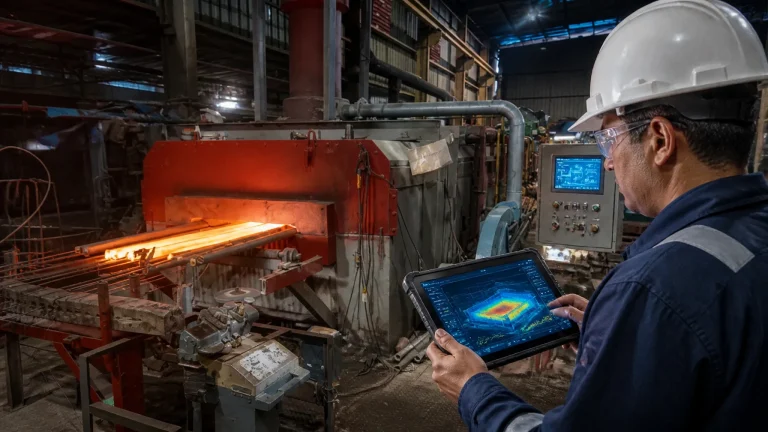
The next generation of thermal processing equipment converts furnace data into operational decisions. A plant should track more than chamber temperature.
Important analytics include:
- Energy consumed per tonne, batch, or cycle
- Temperature deviation by zone
- Carbon potential and dew-point trends
- Burner or heating-element duty cycle
- Furnace pressure and excess-air conditions
- Door-opening frequency
- Refractory shell temperature
- Fan vibration and motor loading
- Alarm frequency and downtime by failure mode
- Scrap, rework, dross, and surface-defect trends
This data creates a digital process history. It allows engineers to identify drift before it becomes a metallurgical nonconformance and to compare performance across shifts, products, and recipes.

Refractory and Insulation: The Quiet Drivers of Furnace Efficiency
Refractory failure is rarely sudden. It usually begins as a gradual loss of thermal efficiency, local hot spots, shell-temperature increase, gas infiltration, or contamination of the working atmosphere.
Next-generation refractory and insulation systems combine:
- High-alumina hot-face materials for demanding thermal zones
- Low-thermal-mass ceramic-fibre modules
- Insulating castables engineered for mechanical strength
- Microporous or composite insulation in selected low-loss areas
- Improved anchoring and expansion-joint design
- Replaceable burner blocks and wear components
- Layered linings matched to temperature and abrasion exposure
A properly specified lining can reduce wall losses and shorten heat-up time. In high-temperature applications, advanced insulation and heat recovery can support 10–20% reductions in energy consumption compared with poorly insulated legacy configurations, although actual results depend on furnace load, operating schedule, openings, and baseline condition.
Refractory inspection should measure more than visible cracking. Maintenance teams should also review:
- Hot-face erosion and spalling
- Burner-block condition
- Fibre shrinkage
- Door and vestibule seals
- Shell temperatures using infrared thermography
- Expansion joints and anchor exposure
- Localized atmosphere leakage
Energy Recovery and 2026 Compliance Readiness
Energy recovery is moving from an efficiency upgrade to a core design requirement. Recuperators, regenerators, flue-gas heat exchangers, and charge-preheating systems recover energy that would otherwise leave through the stack.
A complete energy-recovery assessment should examine:
- Exhaust-gas temperature and composition
- Available operating hours
- Fuel or electricity cost
- Heat demand from incoming combustion air or charge material
- Pressure drop and fan-power requirements
- Corrosion, fouling, and maintenance access
- Emissions-control performance
Modern furnace projects are also being evaluated against evolving requirements for:
- Nitrogen oxide and particulate emissions
- Carbon-accounting and energy reporting
- Safe gas handling and interlocking
- Electrical safety and arc-flash protection
- Hydrogen-ready or electrification pathways
- Waste-heat utilization
- Environmental management systems
Research activity in 2026 includes high-performance electric heaters capable of temperatures approaching 2,000°C, with testing focused on replacing or supplementing natural-gas burners. The practical implication is clear: new furnace designs should preserve future flexibility without compromising present process stability.
Modern Furnace Technology Compared with Legacy Operation
| Performance area | Legacy approach | 2026-ready approach |
|---|---|---|
| Atmosphere control | Manual gas adjustment | Closed-loop gas, pressure, and dew-point monitoring |
| Temperature control | Limited analogue feedback | Multi-zone PLC and SCADA control |
| Uniformity verification | Infrequent or undocumented | TUS, SAT, calibrated sensors, and digital records |
| Refractory strategy | Repair after visible failure | Condition-based inspection and planned replacement |
| Energy management | Total fuel or power bill | Energy per tonne, batch, and production recipe |
| Heat recovery | Stack losses | Recuperators, regenerators, and charge preheating |
| Maintenance | Reactive breakdown response | Risk-based inspection and critical spares |
| Business outcome | Variable quality and higher OPEX | Higher yield, uptime, compliance, and traceability |
Application Spotlights
1. Steel Rolling Mill
In a steel rolling mill, reheating uniformity directly affects rolling force, surface quality, dimensional accuracy, and mill stability. Zone control, billet tracking, recuperative heat recovery, and calibrated discharge measurement should be specified together.
A typical billet reheating design may operate across approximately 700°C to 1,320°C, depending on steel grade, billet geometry, and rolling requirement. Temperature variation at discharge must be controlled tightly enough to prevent under-heating, over-heating, and excess scale.
2. Hot Dip Galvanizing Plant
A hot dip galvanizing plant depends on disciplined thermal control across pre-treatment, drying, zinc-bath management, and auxiliary heating zones.
The furnace and plant package should address:
- Stable strip or component temperature
- Uniform coating response
- Zinc-bath temperature control
- Reduced dross formation
- Safe fume and exhaust handling
- Heat recovery from exhaust streams
- Reliable rollers, seals, and thermocouples
Integration between the furnace, pickling plant, fluxing section, and zinc bath is essential for consistent corrosion protection.
3. Aluminum Melting and Metal Recycling
An aluminum melting furnace or metal recycling furnace must prioritize metal recovery as well as energy efficiency. Charge density, furnace atmosphere, door-opening frequency, burner geometry, dross control, and melt holding time determine the economics of the operation.
Recycling aluminum requires approximately 5% of the energy used for primary aluminum production, making efficient remelting a central Circular Economy strategy. The correct furnace design protects metal yield while reducing fuel consumption and contamination.

4. Melting Furnace for Steel
A melting furnace for steel must be evaluated through the full cost per tonne of liquid metal. Scrap quality, electrical demand, refractory life, tap-to-tap time, electrode or burner performance, and tapping losses all affect profitability.
The engineering scope should include:
- Charge and scrap-handling method
- Furnace capacity and melting rate
- Refractory selection
- Fume extraction and compliance
- Temperature and chemistry measurement
- Tapping and transfer safety
- Critical replacement components
5. Wire and Cable Industry
The wire and cable industry requires continuous, repeatable thermal processing. Annealing quality influences ductility, conductivity, surface condition, line speed, and downstream drawing performance.
Continuous annealing systems should control:
- Wire residence time
- Temperature uniformity across the line
- Protective-atmosphere flow
- Entry and exit sealing
- Cooling rate
- Tension and line synchronization
Continental Furnaces’ wire-industry resources and continuous annealing furnace portfolio provide a practical reference for these applications.
Reliability-Driven Maintenance Strategy
A high-performing furnace requires a maintenance programme built around failure risk.
Daily and Weekly Controls
- Review temperature and atmosphere trends
- Check burner flame stability and ignition response
- Inspect doors, seals, fans, and visible refractory
- Record energy consumption per tonne or batch
- Review alarms and abnormal cycle durations
Monthly and Quarterly Controls
- Tune burners and verify air-to-fuel ratios
- Inspect recuperators, dampers, and control valves
- Perform infrared surveys of the shell and refractory
- Check thermocouple drift and instrument response
- Inspect circulation fans, drives, and bearings
- Review critical furnace spare parts consumption
Annual or Major-Intervention Controls
- Complete TUS and SAT as required
- Recalibrate thermocouples and pyrometers
- Inspect refractory thickness and hot-face condition
- Review control logic, safety interlocks, and emissions data
- Revalidate process recipes after major repairs
- Update the strategic spare-parts inventory
Critical inventory should include thermocouples, burner assemblies, ignition transformers, control valves, seals, heating elements, refractory modules, fan components, fuses, relays, and PLC or HMI modules. A planned spare costing hundreds can prevent downtime costing thousands per hour.

A Four-Phase 2026 Technology Roadmap
Phase 1: Assessment and Planning
Establish baselines for:
- Energy per tonne or cycle
- Temperature uniformity
- Atmosphere stability
- Yield, scrap, and dross
- Downtime and failure modes
- Refractory and burner condition
Phase 2: Precision Engineering
Specify the correct combination of:
- Protective-atmosphere controls
- Zoned heating
- Advanced refractory
- Heat recovery
- Digital instrumentation
- Safety and emissions systems
Phase 3: Commissioning and Qualification
Complete TUS, SAT, calibration, recipe validation, operator training, and documented performance acceptance before full production release.
Phase 4: Lifecycle Optimization
Use service audits, analytics, refractory inspections, burner tuning, and strategic spares planning to preserve performance throughout the equipment lifecycle.
Build the Next Stage of Furnace Performance
Continental Furnaces brings more than 35 years of expertise to customized heat treatment, melting, recycling, galvanizing, pickling, and rolling-mill applications. Our portfolio includes precision heat treatment furnaces, melting systems, hot dip galvanizing plant solutions, metal recycling furnace projects, and dependable furnace spare parts.
Review our industrial furnace solutions, explore heat-treatment applications, or request a technical consultation.
Contact Continental Furnaces now to benchmark your furnace, define your 2026 modernization priorities, and convert precision thermal control into sustained competitive advantage.
Further Reading