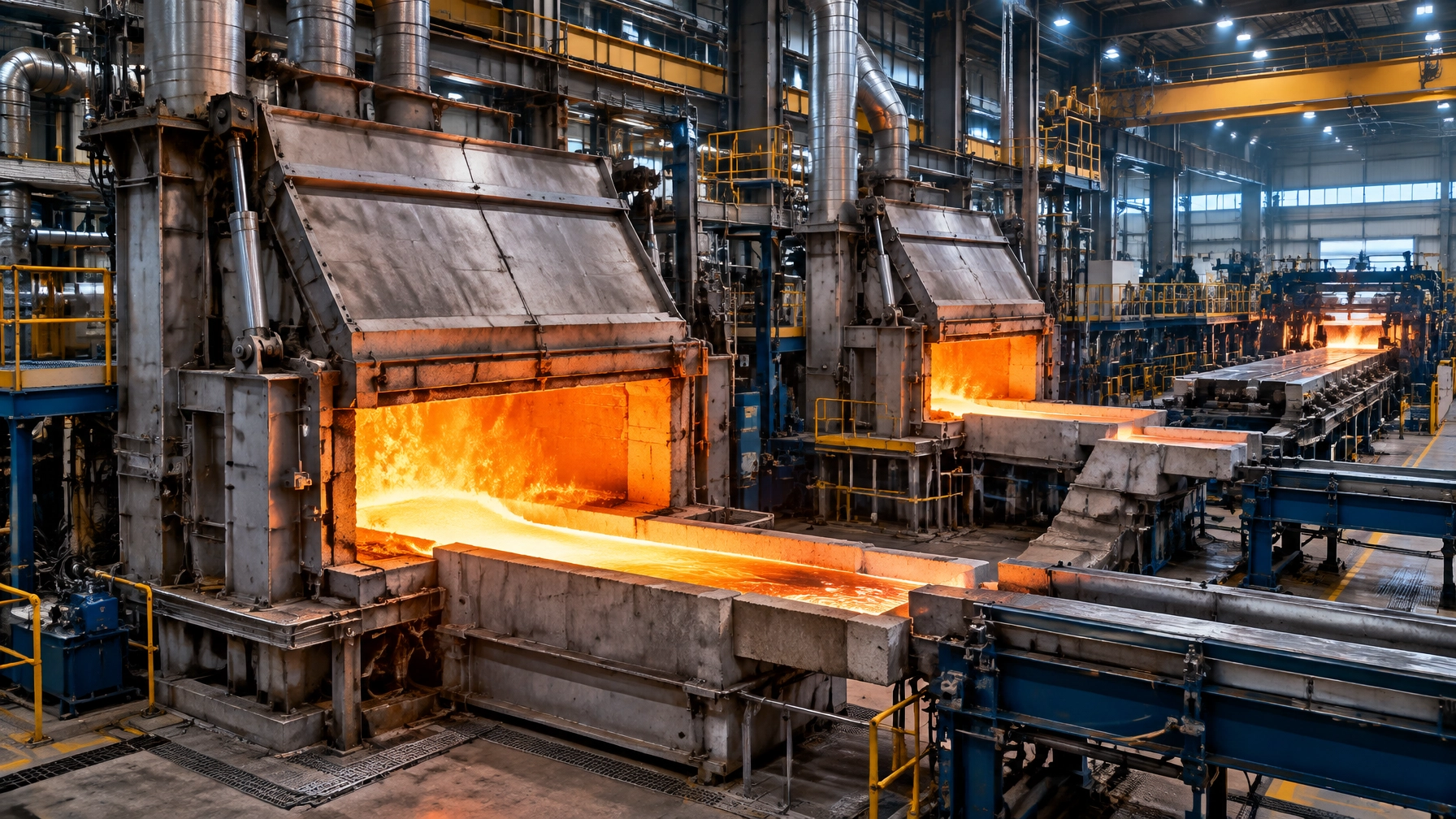
In an aluminum remelt casthouse, scheduling, not burner hardware alone, is often the largest controllable influence on energy cost. If the caster waits, production suffers; if metal is melted too early, it sits hot and consumes energy while the plant pays to hold it. Melting is only half the scheduling problem; holding time, utilization and avoidable reheating complete the economics.
Benchmark caveat: All figures below are indicative benchmarks drawn from published surveys, plant audits, supplier references and research papers. They vary by plant, feed, alloy, furnace type, throughput and local regulation. Treat them as comparison points, not guaranteed outcomes or directly interchangeable measurements.
Why the caster must never wait for metal
A practical planning rule is two furnaces per caster: one supplies the caster while the second is filled, alloyed, sampled and prepared for its next turn. The intent is continuity, not excess inventory. In larger layouts, a trio of furnaces serving two casters can provide more flexibility for maintenance, alloy transitions and demand variation.
The operating team should coordinate three clocks:
- Caster drop time: when the line needs its next metal supply.
- Furnace melt rate: how quickly the standby unit can prepare that supply.
- Transfer and changeover time: the time needed to sample, confirm and deliver metal.
A useful planning target is 80–90% utilization, balanced against availability for planned cleaning and maintenance.[9] The right level is plant-specific: driving utilization higher without enough buffer can turn a minor delay into a caster interruption. Review aluminum remelt and recycling furnace systems in the context of the entire caster cycle, not simply furnace capacity.
Melting vs holding: the split that decides your energy bill
The holding furnace is not a passive buffer. When metal arrives early or waits through a production interruption, energy and capacity are tied up without increasing output. A Sunderland foundry audit found melting and holding together represented 52.3% of audited foundry electricity, with holding alone at 43.7%.[2] That audit describes one small electric foundry, not a universal casthouse benchmark.
Indicative remelt casthouse furnace scheduling and energy benchmarks
| Measure | Indicative benchmark | Operational interpretation |
|---|---|---|
| Regenerative-burner reverberatory aluminum melting furnace | 710–775 kWh/t (1,100–1,200 BTU/lb), versus 1,160–1,290 kWh/t (1,800–2,000 BTU/lb) for cold-air burner systems | Schaefer furnace-facts references; verify furnace type, production rate and system boundary before comparing.[1] |
| Melting plus holding; holding alone | 52.3% and 43.7% of audited foundry electricity, respectively | Sunderland audit of a specific aluminum sand-casting foundry.[2] |
| Uncovered versus covered holding | Uncovered furnace used roughly 155–158% more electricity at 1,100–1,400°F | DOE tests on specific holding furnaces; a useful reminder to manage covers and idle periods, not a universal saving guarantee.[3] |
| Utilization planning target | 80–90% | Indicative operating target; confirm against caster demand and planned downtime.[9] |
| Refractory maintenance intervals | Relining at 12–36 months; furnace-wide rebuilds at 5–7 years | Indicative maintenance references; inspection history and operating severity determine actual intervals.[8] |
| AI scheduling research | 23.9% lower peak demand in simulation | A 2026 study result, not a guaranteed plant saving or casthouse deployment.[11] |
Compare data only after confirming the measurement boundary: fuel or electricity, melt-only or melt-plus-hold, and tonnes charged or tonnes delivered. For an aluminum melting furnace, schedule performance should be evaluated alongside energy per tonne, caster continuity and holding duration.
The two-furnace cycle and campaign planning
Alternating duties works when the daily metal plan is tied to caster capacity and furnace availability. Sequence similar alloys into campaigns where product and quality requirements allow; schedule alloy changes and furnace wash-outs only when the unit is empty, outside casting windows.
A disciplined plan accounts for:
- Daily metal requirement, caster rate and planned downtime.
- Scrap delivery timing and staging to avoid starving the melt unit.
- Short, safe metal-transfer paths and coordinated launder cleaning.
- A prepared standby furnace with required checks completed before changeover.

Downstream capacity matters too. Coordinate casthouse campaigns with downstream heat treatment furnaces for extrusion and rolled product so that upstream output does not become unplanned inventory.
Refractory and cleaning discipline as a scheduling input
Cleaning is a planned production activity, not an interruption to be postponed indefinitely. Include routine access and inspection windows in the campaign calendar:
- Daily skimming and sidewall scraping at the metal line.
- Weekly floor and launder scraping, as permitted by furnace design and safe work procedures.
- Inspection for corundum growth, which reduces usable capacity and can constrain cleaning access.[7]
- Planned total relines when condition trends show repeated partial patches are no longer dependable.
- Controlled dry-out schedules after repair, verified with external thermocouples and the refractory supplier’s procedure.

A planned cleaning or reline window is easier to manage than an unplanned loss of a furnace during a casting campaign. Keep appropriate spares for burners, seals, thermocouples and launder components available to reduce repair delays.[6][8]
Scheduling symptom -> root cause -> first corrective action
These symptoms can overlap; use the table to guide investigation, not to substitute for an operating review.
| Symptom | Likely root cause | First corrective action |
|---|---|---|
| Caster waiting for metal | Melt rate slower than drop time, or single-furnace operation | Re-sequence campaigns and verify second-furnace availability |
| Excessive holding energy | Covers left open or holding inventory oversized | Reinforce cover and lid discipline; plan metal levels to demand |
| Alloy changeover overruns | Wash-outs scheduled inside casting windows | Move wash-outs to empty-furnace intervals |
| Falling melt rate over a campaign | Corundum and other buildup on hearth and walls | Schedule a hot cleaning cycle and inspect the hearth |
| Frequent unplanned relines | Repeated partial patching or damaging thermal-shock patterns | Plan a reline campaign with controlled dry-out |
| Peak energy demand spikes | Simultaneous melt-downs | Stagger charging and optimize the schedule |
2026 technology and market updates
Digital twins and autonomous casthouse programmes
Casthouse digital programmes are increasingly connecting equipment status, material flow and operator decisions. Constellium’s SmartMelt account describes real-time furnace monitoring and digital-twin guidance; EBNER presents a modular autonomous-casthouse concept; and SECO/WARWICK reports using a digital twin to test control logic before installation.[12][13][14] These examples indicate a broader shift toward better coordination and safer, more predictable operations, not a single required technology package.
AI melt scheduling research matures
A 2026 Journal of Current Science and Technology study combined reinforcement learning for batch-level power control with a genetic algorithm for just-in-time synchronization. In its evaluated system, scheduling eliminated 2,833.3 kWh of reheat energy and reduced peak demand by 23.9%.[11] These are study results, not proof of equivalent savings in a production casthouse. The practical lesson is to align melt release with downstream demand.
Scheduling-ready furnace hardware
A well-designed layout makes a disciplined schedule achievable: suitable furnace count, short transfer routes, launder heating, covers and instrumentation all support reliable changeovers. An industrial furnace manufacturer specifying an industrial furnace system today should design around the production schedule. Buyers of thermal processing equipment and a metal recycling furnace should likewise request a layout review against campaign timing, maintenance access and caster demand.
What this means across your furnace fleet
The same scheduling principle applies beyond aluminum. A steel rolling mill depends on matching billet availability and reheating campaigns to rolling sequence. A hot dip galvanizing plant benefits from coordinating kettle pace with upstream preparation and line demand; see galvanizing kettle pacing. In the wire and cable industry, rod-and-billet casting schedules shape downstream continuity, while a melting furnace for steel at a scrap yard must be aligned with charge availability and dispatch plans. Further downstream, heat treatment furnaces and downstream pickling and surface preparation also depend on planned, balanced workloads. Across the fleet, condition-based maintenance and ready furnace spare parts help protect the production plan.
A four-phase roadmap for scheduling maturity
- Phase 1: Audit and baseline (30–60 days). Time the two-furnace cycle, meter energy separately for melting and holding, and establish utilization and caster-wait baselines.
- Phase 2: Quick wins (1–2 quarters). Improve cover discipline, cleaning routines, wash-out timing and scrap delivery coordination.
- Phase 3: Scheduling optimization (3–6 months). Formalize campaign plans, alloy-changeover windows and staggered charging.
- Phase 4: Digital scheduling and capital planning (6–18 months). Evaluate AI or digital-twin applications, furnace count, launder layout and a planned reline programme.
Build an enduring partnership around uptime
Scheduling improvements deliver their strongest value when equipment design, maintenance planning and operating practice work together. Continental Furnaces brings more than 35 years of industrial furnace experience to customized solutions and lifecycle support. Consult our team to strengthen uptime, melt economy and scheduling discipline as an enduring partnership, and take a strategic step toward sustained competitive advantage. Request a quote.
Technical references
- Schaefer Group, “Furnace Facts, ROI’s & Energy Use Numbers”
- Mehrabi and Usher, “Energy Audit and Cost Saving in an Aluminum Sand Casting Foundry”
- U.S. Department of Energy, “Melting Efficiency in Die Casting Operations”
- DOE ITP, “Energy Efficiency in Aluminum”
- Light Metal Age, “Lessons Learned from 30 Years of Engineering Secondary Aluminum Remelters”
- Schaefer Group, “Aluminum Furnace Cleaning Guide”
- F.S. Sperry, “The Hidden Cost of Corundum Growth in Aluminum Furnaces”
- Schad Refractory, “Aluminum Melting Furnace Maintenance”
- Modern Casting, “Utilization Is Everything”
- Dynamo Furnaces, “Molten Aluminum Transfer Planning, Holding and Launders”
- Pawadee and Keeratipranon, “Energy-Efficient Scheduling and Control of Aluminum Melting Processes Using Genetic Algorithms and Reinforcement Learning” (2026)
- Constellium, “Smarter and More Efficient Casthouses”
- EBNER, “The Autonomous Casthouse”
- SECO/WARWICK, “Digital Twin in Practice”