Steel pickle lines consume acid and water as one linked balance sheet. Drag-out is the bridge between them: solution carried from the pickle tank becomes acid loss, rinse contamination and additional treatment load. Improving the water side of a steel rolling mill pickle line therefore supports acid economy as well as discharge control.
All figures below are indicative benchmarks drawn from published surveys, plant reports, regulatory texts and supplier references. Actual values vary with plant scale, product mix, acid type, line speed, rinse configuration and local discharge regulation.
Why water and acid are one balance sheet
Drag-out is the film of pickling solution carried out of a tank on strip or parts. Every litre of acid solution dragged out must be replaced with fresh acid and, unless captured, washed out with fresh water. That makes rinse design a production-cost decision, not just a utility or wastewater concern.
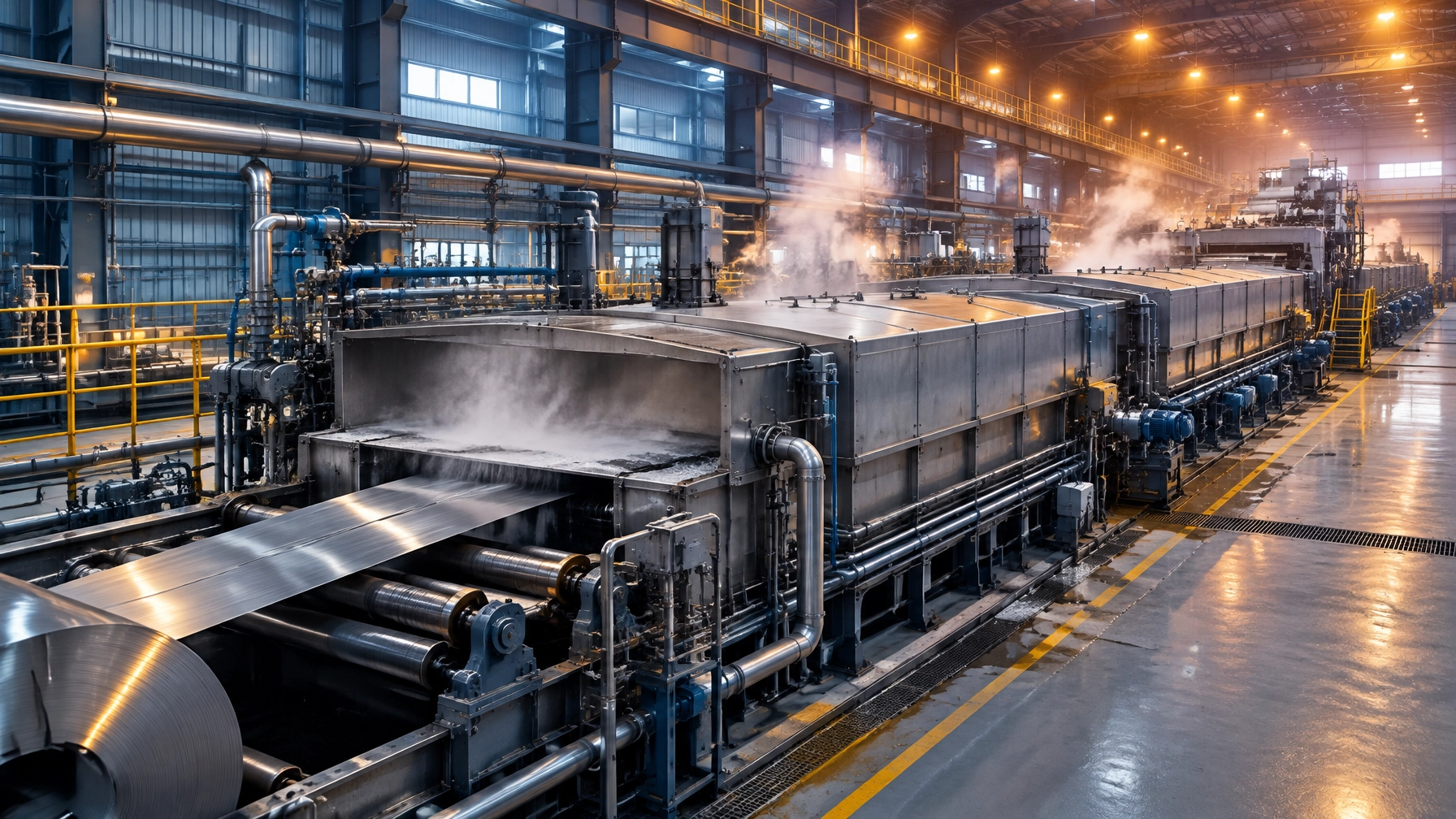
In a counter-current rinse, fresh water enters the cleanest, final rinse stage. Overflow then travels backward toward the first rinse, opposite to the strip’s direction. The first rinse receives the most contamination and can be recovered or treated as a smaller, more concentrated stream.
The order of action matters: source control first, rinsing efficiency second, treatment last. Reducing drag-out and containing it at the tank reduces the load on every downstream stage.
Process windows and indicative benchmarks
Table 1. Indicative pickle-line water and acid benchmarks
| Measure | Indicative value | Caveats |
|---|---|---|
| HCl fresh acid consumption without regeneration | 18–30 kg/t | ANDRITZ guide values for low-carbon strip; plant-specific [1]. |
| HCl fresh acid consumption with regeneration | 0.5–1 kg/t | Regeneration-enabled guide value, not a universal guarantee [1]. |
| Counter-current rinse water reduction vs. single/dunk rinse | Two stages: ~90–97%; three stages: ~95–99% | Design, drag-out and required final cleanliness affect results [4][5]. |
| Published continuous-line cascade example | Effluent fell 95%, from 500 gpm to ~25 gpm | Six-compartment retrofit example, not a general design promise [6]. |
| Sulfuric acid recovery | Ferrous-sulfate crystallization | Feasibility depends on liquor composition and process economics [7]. |
| Diffusion dialysis HCl recovery | 68–90% single pass; metal rejection often >85% | A published spiral-wound test measured 68–77% HCl recovery; metal separation varies by ion [8]. |
| US acid-pickling BPT pH window | 6.0–9.0 | 40 CFR Part 420 Subpart I; applicability depends on operation and jurisdiction [2][3]. |
| Lime neutralization and solids separation | Treatment target pH 9–11, then flocculation, sedimentation and filtration | Reuse and final discharge require site-specific controls and pH adjustment as required. |
These figures vary with plant, feed, line type, throughput and local regulation. Confirm them with a measured mass balance and the applicable permit before using them in a business case.

Drag-out source control: the cheapest litres you will ever save
Start with practical controls at the tank and product interface:
- Extend drain or drip time over the source tank where line timing permits.
- Fit and maintain squeegee or wipe rolls to remove solution from strip.
- Optimize strip orientation and drainage so liquid returns rather than follows the product.
- Install drip trays and drain boards sloped back to the source tank.
- Maintain a negative water balance in process baths. Use indirect steam heating instead of live steam injection, which dilutes the bath.
- Consider spray rinsing above the bath where the rinse can return captured liquid to the tank.
- Meter fume-scrubber makeup water. Control fresh-water flow while maintaining duct seal loops and scrubber performance [12].
The best control is the one that captures liquid before it reaches a rinse stage or floor drain.
Rinse-stage engineering and counter-flow cascades
Counter-flow outperforms parallel flow because the cleanest water meets the cleanest product, while more contaminated water is reused upstream. Recirculation pumps provide the spray volume for effective washing; the fresh-water makeup rate sets the cascade overflow. Conductivity or pH-based control can help regulate overflow to match changing line speed and production load.
Table 2. Water symptom → what it is telling you → first corrective action
| Water symptom | What it is telling you | First corrective action | Caveat |
|---|---|---|---|
| Rising acid carry-over into final rinse | Rinse stages overloaded or drag-out has increased | Check drain time, roll condition and cascade flows | Indicative; symptoms may overlap. |
| High fresh-water use at constant throughput | No effective counter-flow or manual valves left open | Meter each inlet and verify overflow direction | Indicative; symptoms may overlap. |
| pH excursions in discharge | Neutralization dosing or mixing is uncontrolled | Check pH instrumentation, dosing and tank mixing | Indicative; symptoms may overlap. |
| Rising total dissolved iron in effluent | Acid recovery may be bypassed or first-rinse streams mixed | Verify recovery routing and sample streams separately | Indicative; symptoms may overlap. |
| Poor scale or flocculation in ETP | Lime dosing, reagent preparation or mixing may be inadequate | Review dose, mixing sequence and sludge settling | Indicative; symptoms may overlap. |
| Conductivity drift in final rinse | Cascade flow balance or sensor calibration may be wrong | Check sensor calibration, makeup and overflow rates | Indicative; symptoms may overlap. |

Acid recovery and the acid-water nexus
Recovery technology should match acid type, throughput, site utilities and the cost of water and effluent treatment. Thermal spray-roast or fluid-bed HCl regeneration is typically considered for large, continuous operations with sufficient spent-liquor volume. Sulfuric acid recovery through ferrous-sulfate crystallization suits lines where that recovery route aligns with liquor characteristics and by-product handling. Diffusion dialysis offers a modular membrane option for partial acid recovery, including operations that cannot justify a large thermal plant.
Recovered acid changes rinse-water duty. For example, rinse water can serve as absorption water in some HCl regeneration systems, linking recovered acid and the line’s water balance. The rinse cascade must still be engineered to control carry-over and protect product quality. This discussion complements, rather than repeats, acid-regeneration fundamentals covered in previous editions.
2026 technology and market updates
Water reuse and near-closed loops on pickle lines
Closed-loop designs combine source reduction, neutralization, solids separation and fit-for-purpose water reuse. The 2026 UrFU paper describes treatment of iron-bearing pickling wastewater sludge, including neutralization and a magnetite-formation route, as part of closed-loop water management [9]. Indian and Chinese steel clusters are pursuing tighter water reuse and ZLD pathways, but the right sequence depends on water quality, energy costs, sludge handling and local discharge requirements.
Membrane acid recovery goes modular
Diffusion dialysis and bipolar electrodialysis are being developed as modular approaches that can be piloted before production-scale integration. Indian metal-finishing SME demonstration literature highlights the importance of testing actual process liquor and planning for filtration, membrane life and operator support [10]. Pilot results should establish both recovered-acid quality and the remaining effluent load.
Digital water balance monitoring
Flow and conductivity instruments can show where fresh water enters, where cascade overflow is lost and how final-rinse quality changes with line speed. Comparing acid makeup with tonnes processed also helps estimate drag-out. These data can feed plant historian dashboards, connecting water balance monitoring with wider KPI dashboard practice.

What this means across your furnace fleet
Water and acid discipline can be coordinated with the wider thermal processing equipment fleet. A steel rolling mill may link pickle-line performance with reheating and downstream production. The same operating focus applies around wash stages for heat treatment furnaces, pre-kettle cleaning in a hot dip galvanizing plant, and washing or pretreatment lines near an aluminum melting furnace or metal recycling furnace. It also matters in the wire and cable industry where wire pickling and descaling are part of the production chain.
As an industrial furnace manufacturer, Continental Furnaces supports integrated industrial furnace systems and upstream and downstream handling. Whether a plant uses a melting furnace for steel or other thermal equipment, the spares strategy should also account for rinse-system pumps, seals and instruments. A planned inventory of furnace spare parts reflects the same principle: protect uptime by making critical components available.
Four-phase roadmap
- Phase 1: Water/acid balance audit, 30–60 days. Meter key flows, measure drag-out and sample rinse and discharge streams.
- Phase 2: Source control retrofit, 1–2 quarters. Add or optimize drip trays, squeegee rolls, drain-time discipline and counter-flow conversion.
- Phase 3: Recovery and treatment, 3–6 months. Select recovery technology, upgrade ETP capacity and strengthen discharge monitoring.
- Phase 4: Closed-loop and ZLD roadmap, 6–18 months. Develop reuse loops, membrane polishing and digital water-balance monitoring.
All timelines are indicative and depend on engineering scope, procurement, operating windows and permitting.
Build the next water-efficiency gain into your plan
Treating water and acid as one balance sheet creates a practical path to lower consumption, reduced ETP loading and more reliable compliance. Request a consultation with Continental Furnaces to assess your line and develop an enduring partnership around uptime, water discipline and acid economy.
Outbound references
- ANDRITZ HCl regeneration systems PDF
- 40 CFR 420.92, BPT effluent limitations
- 40 CFR Part 420, Subpart I: Acid Pickling Subcategory
- Counter-current rinsing reference
- Envirowise GG303 rinse cascade guide
- US3938214A, Cascade rinsing system and method
- EPA capsule report: Recovery of spent sulfuric acid from steel pickling operations
- Diffusion dialysis HCl recovery using a spiral-wound module
- UrFU 2026 paper on closed-loop wastewater sludge treatment
- Demonstration of acid and water recovery systems in Indian metal-finishing SMEs
- Cleaner production ideas for metal finishing
- Pickle-line fume scrubbers and water management
- Wire & Cable India: Pickling, rinsing and effluent treatment efficiency
- Diffusion dialysis acid purification