All figures in this post are indicative benchmarks drawn from published surveys, plant reports, regulatory texts and supplier references. They vary by plant, kettle size and age, alloy, line type, throughput and local regulation, verify them against plant-specific data and applicable codes before acting. A kettle failure in a hot dip galvanizing plant is among the most expensive events in thermal processing equipment operation. The governing principle is simple: a kettle failure is managed by design and drill, not improvisation. Detection layers buy time; a rehearsed first-hour playbook directs the response; and a prepared kit, code-compliant containment, drilled team and fire-service liaison can help convert a potential catastrophe into a controlled repair. Readiness audits matter as much as monitoring.
The Leak You Detect Early Is a Repair; the Leak You Detect Late Is a Loss Event
Layered detection combines physical alarms, operator observation, process accounting and wall-condition trending. No single layer is a substitute for the others.
A leak port with a sacrificial lead shield and flame-rod circuit can detect zinc at a designed low point: zinc burns through the shield, contacts the rod and triggers an alarm, then drains toward the kettle’s revisors or catch basins. The AGA/V&S lessons-learned document also identifies white smoke at a burner port as a classic human-detection sign of molten zinc spraying onto a burner. Practitioner reports warn that steel heated above 1,000°F can corrode up to approximately 1,000 times faster. A useful warning, not a universal corrosion-rate constant.
Use zinc reconciliation as an independent check. A practical balance is:
- Consumption = additions − bath inventory change
- Inventory change = Δlevel × L × W × 6,620 kg/m³
Investigate when calculated consumption exceeds the coating-mass target plus a 0.5–1.2% dross/ash allowance. Unexpectedly high use, white smoke from the chimney or localized dross accumulation may indicate a leak. Continuous bath- and dross-level instruments, including Galvalibs/Tecnar-type systems, can add another layer; one supplier-reported bath-level accuracy is ±0.4 mm. A sustained downward level trend warrants prompt investigation.
UT and EMAT thickness maps support kettle-life planning and emergency readiness. One example covers a 49 ft kettle with 528 points (231 per wall), reporting K.I.D. readings of ±0.059 in. on walls and ±0.06–0.08 in. at corners. Comparison maps from 2021–2023 showed red readings near burners. Arrange dross removal 2–5 days before inspection, rather than on the inspection day, so readings can be taken under consistent conditions. Warwick research reports EMAT measurement around ±0.5 mm above 450°C; commercial K.I.D. average error is reported at approximately 0.7 mm. These are indicative figures: follow the inspection provider’s method and the kettle engineer’s acceptance criteria.
Pre-leak alarms are another developing layer. A May 2026 PFO product report describes Goad TANKeyePlus as detecting conditions before exterior leakage, potentially shifting an emergency repair into a scheduled repair. ZEHAO’s 2026 guide claims three pre-installed high-temperature bottom alarm sensors as a new standard feature; treat this as a supplier claim, not an industry-wide requirement.

Kettle leak detection layers compared
| Detection layer | What it detects | Response it buys | Watch-outs |
|---|---|---|---|
| Leak port with lead shield + flame rod | Zinc reaching the designed port | Alarm and drainage toward revisors | Requires engineered drainage, inspection and proof testing |
| Pre-leak alarm system (TANKeyePlus-type) | Supplier-described pre-leak condition | Time to plan a controlled repair | Verify detection principle, setpoints and site fit |
| Operator observation, including white smoke at burner ports | Visible zinc spray, smoke or unusual dross | Fast escalation and isolation | Visibility, lighting and human factors vary |
| Zinc consumption mass-balance reconciliation | Unexplained zinc loss | Investigation before a leak becomes obvious | Requires reliable inventory and coating data |
| Continuous bath/dross level monitoring | Downward bath-level trend or abnormal dross trend | Earlier confirmation and trend history | Validate sensor installation, drift and alarm logic |
| UT/EMAT wall-thickness grid | Local thinning and change over time | Maintenance, derating or replacement planning | Periodic NDT is not a guaranteed rupture alarm |
Leak Categories Shape the Response
Mario Ubiali’s AGA Tech Forum taxonomy distinguishes burner leaks with localized flame influence, flow leaks with stagnant or turbulent heat patterns, dross leaks with continuous accumulation, and “weird” leaks near the kettle bottom, including micro-cracks in older kettles. The category informs the first move: isolate affected burner influence where appropriate, assess flow and level trends, investigate dross build-up, or prioritize safe access and containment at a bottom leak. Site procedures and qualified engineering judgment govern every intervention.
The First Hour: A Playbook, Not an Improvisation
The sequence below synthesizes published galvanizing response guidance and V&S practitioner experience. It is a planning framework, not permission to approach a leak or perform a repair outside the site emergency plan.
- Stop heating and galvanizing immediately. Use the designed burner-management-system (BMS) master fuel trip and approved interlocks for leak, over-temperature or flame-failure conditions, consistent with the applicable design and code.
- Clear the kettle. Lift racks and work out of the kettle only if this can be done without exposing personnel to the hazard.
- Evacuate the splash radius. Raise the alarm, account for personnel and establish the exclusion zone.
- Begin zinc transfer if the procedure and conditions permit. Start the dedicated pump to prepared holding vessels; do not stall a pump mid-transfer, because zinc may freeze in the discharge pipe. Lower the zinc below the leak where the engineered system allows.
- Triage the leak category. Confirmed leak response belongs to trained, authorized personnel under the site plan. Some practitioner accounts describe a controlled high-velocity water spray directed at the leak point only to freeze zinc temporarily; this is not a general instruction. Use it only if a site-specific written procedure authorizes it, and never spray water into the bath or onto molten zinc.
Transfer logistics matter. Submerged zinc pumps are supplier-reported at roughly 1–8 t/min; holding-vessel examples include GIMECO mobile units up to 90 t and Zinco 60 t/80 t vessels with emergency pump-out services. V&S identifies pipe preheating as a critical, stressful stage: infrared-check flanges, up-pipe and elbows. A frozen line can cost 1–2 hours. Keep an electrician in sight to monitor speed, amp draw and emergency stop. One plant transfers at about 865°F (463°C) for a thermal cushion; this is a reported practice, not a universal setpoint.
A documented planning example for a 29 ft kettle containing about 690,000 lb of zinc used three 150,000 lb holding vessels, with approximately 37 pans of 6,500 lb needed for the remainder. When the pump failed, two scoops and two bridge cranes filled about 120 pans in five hours. Below the burners, zinc can cool quickly. In one kettle-change account, removing top plates and controlled water cooling took about eight hours before safe rigging. These logistics require advance engineering, trained operators and suitable lifting plans.
Containment Options: Patch, Sandbox, or Pump-Out
For an outside hole, a radius-corner patch was used successfully in a Columbiana case. A sandbox repair may use a fabricated steel box, fiber wool as a gasket and dry sand, anchored with 1.5 in. all-thread to press against the kettle; a V&S example remained in place for two years until kettle change. A sharpened bolt hammered into a hole has been tried, but practitioner experience found it insufficient: there may not be enough sound steel at the leak point.
In-kettle welding is a specialized repair, not a routine first response. One reported platform used wool and plywood, with the wool kept wet; work was done in 15–20-minute shifts with high-velocity fans for fume and temperature control. Welding guidance calls for low-silicon rods, ≤0.10% Si in Nilsil-type electrode guidance, because silicon can accelerate zinc attack. Full pump-out to holding vessels is the other major option. The kettle manufacturer, competent welding engineer and site emergency authority must approve repair selection and execution.
Emergency failure modes, first-line response and escalation
| Failure mode | Floor symptom | First-line response | Escalate to |
|---|---|---|---|
| Leak alarm activation or confirmed leak | Alarm, falling level, smoke or visible zinc | Trip heat, evacuate and initiate approved containment plan | Incident commander, EHS, maintenance and fire service |
| Pump freeze or pump failure mid-transfer | Falling flow, rising amp draw or blocked pipe | Do not improvise restart; use the approved pump-failure fallback | Electrical lead, pump specialist and incident commander |
| Zinc fire in pit or furnace area | Flames, smoke or burning adjacent materials | Isolate area; use approved Class D media or dry sand | Fire service and site emergency coordinator |
| Splash/steam event from stray water or sealed hollow part | Sudden pressure release or zinc splash | Evacuate, account for people and treat as major incident | Fire service, EHS and process leadership |
| Zinc-fume exposure during repair | Fume, symptoms or respiratory alarm | Withdraw to fresh air; activate exposure and medical response | EHS, occupational health and emergency services |
| False alarms or operator distrust | Repeated alarms ignored or bypassed | Keep protection in force; investigate, repair and retest | Controls engineer, operations manager and EHS |
The ARIA 58199 incident in France in 2021 involved an unpierced hollow part rupturing in a 450°C bath. About 15 t of zinc was projected over an approximately 200 m radius. The investigation identified a failed inspection process that did not detect the non-conforming sealed part, not just a part defect.
Zinc Fire and Fume Discipline: What Water Never Touches
Never apply water, CO₂ or foam to molten or burning zinc. Water can cause a steam explosion and hydrogen generation. Use only site-approved Class D media, graphite powder or dry sand for metal fires. Zinc dust can form explosive clouds; damp dust can ignite spontaneously. Do not clean it with compressed air.
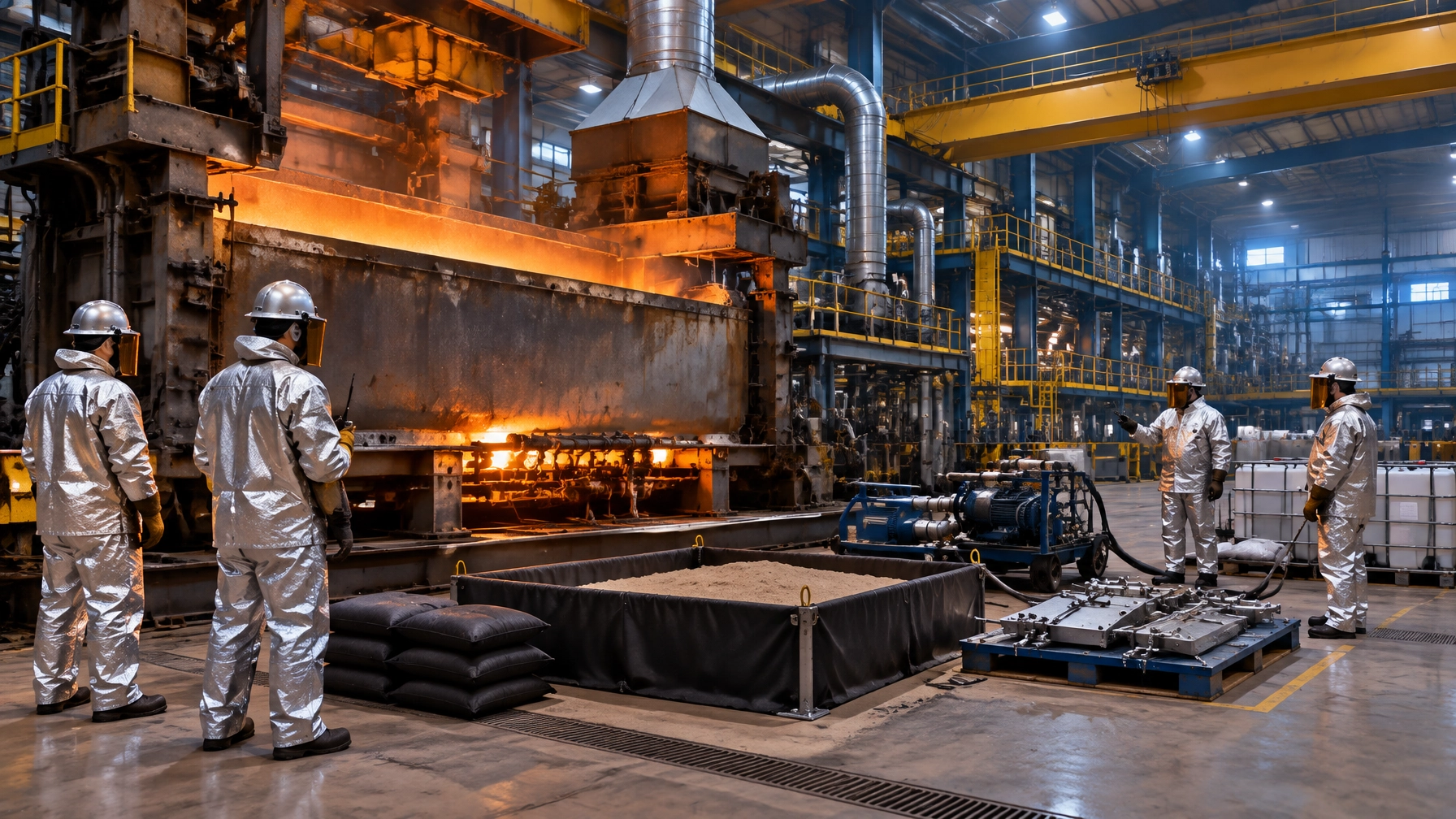
Molten zinc is around 450°C. Molten-splash PPE literature indicates second-degree burns may occur in 0.8–2.4 seconds. Use aluminized or other suitable high-temperature suits, face shields over safety glasses, metatarsal boots and trouser legs over boots. For fume control, use local exhaust ventilation (LEV); gas-cutting workers may require respirators or supplied air under the exposure-control plan. NIOSH and OSHA guidance should inform hazard controls. For a burn, remove the person from the kettle area and cool the burn with running water for 15–20 minutes; obtain medical care.
Containment by Design: Codes and the Kettle Pit
Apply the edition and requirements adopted by the jurisdiction and the plant’s authority having jurisdiction; confirm the design with qualified fire-protection and process-safety professionals.
- FM Global DS 7-33: liquid-tight breakout containment should hold the vessel’s total contents plus 4 in. freeboard, extend beyond its footprint, and limit weep holes and trench drains. Protect pits and drainage systems against water ingress.
- UK PGN 2/02(13): bunds should be impermeable and resistant to molten zinc, have no outlets and provide capacity of at least 110% of the largest tank. The guidance calls for regular visual and annual maintenance inspections; clear spills by vacuuming, not dry sweeping.
- EN 746-4: use fail-safe or automatic shutdown devices, including temperature limiters. Kettle height plus reach should be at least 0.9 m (minimum height 0.7 m) or use barriers.
- OSHA 29 CFR 1910.38: maintain a written emergency action plan covering evacuation, accountability and shutdown duties. Incorporate leak ports, revisors/catch basins, clear grating and drains, and a strict no-water-ingress rule in pit housekeeping.
The Emergency Kit: Spares You Hope Never to Use
Treat leak-response equipment as criticality-A inventory, distinct from routine furnace spare parts. A V&S emergency-container checklist provides a useful starting model; customize it to kettle geometry, pump capacity, local codes and the site response plan:
- About 200 clean, unpainted drums; a zinc pump with control panel; and kettle-sized pipes and fittings.
- Radius-corner patches; six ¼ in. × 8 in. × 24 in. plates for sandbox fabrication; three 1.5 in. × 6 ft all-thread rods with 12 heavy hex nuts.
- 100 lb of dry, sealed 6012 low-silicon welding rod: 50 lb ⅛ in. and 50 lb 5/32 in.
- Two 4 ft × 8 ft × ½ in. steel plates and three 4 in. × ⅜ in. angles for an inside-kettle platform; two 4 ft × 8 ft × ¾ in. plywood sheets.
- Four boxes each of 1 in. and 2 in. fiber wool; 200 ft of water hose and two spray nozzles; about 2,000 lb of dry bagged or supersack sand.
- Silver high-temperature PPE for at least four employees; welding PPE for six; two large rosebud torch setups (no cutting torches); two high-velocity fans; and a welding fire blanket at least 6 ft × 6 ft.
- A qualified welder on call, needle gun, two full fuel tanks plus oxygen, and at least 25 zinc pans per plant.

Keep the checklist secured and the complete kit accessible in its designated container, not assembled after an alarm.
Drills, Liaison and the Readiness Audit
Check the kit quarterly. Run mock drills roughly every six months, or a full-scale exercise annually, as jurisdiction and risk require. Tabletop exercises should assign a coordinator, facilitators, players and observers; involve the local fire department in joint training and pre-incident plans. Umicore Galvanotechnik’s annual exercises with its local fire brigade are one example of this practice.
The ARIA 58199 case reinforces a broader lesson: emergency readiness starts with incoming-part inspection and process controls, not only the emergency kit.
Readiness audit items
- Kit sealed, complete and checked against the site checklist.
- Pump-pipe preheat test completed and logged.
- Roles assigned on every shift, including electrician and welder.
- Containment capacity checked against applicable DS 7-33 and PGN 2/02(13) criteria.
- BMS interlocks function-tested and alarm cause-and-effect documented.
- Continuity plan in place, including subcontract galvanizing agreements and capacity-sharing contracts. Insurance extensions for molten-metal breakout may cover property damage and debris while excluding escaped equipment and metal value; an outage can also threaten customer retention for up to 24 months, an indicative insurer-market warning.
A Four-Phase Roadmap to Emergency Readiness
Phase 1: Baseline audit (30–60 days)
Inventory detection layers, check kit completeness, start zinc mass-balance reconciliation and verify containment capacity against the applicable codes.
Phase 2: Hardware and instrumentation (1–2 quarters)
Install leak ports and alarms where missing; verify BMS interlocks, pump and preheat readiness; procure kit items and protect pit drainage from water ingress.
Phase 3: Pilot (3–6 months)
Drill the first-hour playbook on one shift pattern. Run a tabletop exercise and joint fire-brigade session, record findings and set response-time targets.
Phase 4: Scale and integrate (6–18 months)
Extend the program across shifts and sites. Feed detection data into the SCADA historian, conduct annual readiness re-audits, secure continuity contracts and use periodic UT/EMAT trends in kettle-life planning.
2026 Technology and Market Updates
Pre-Leak Alarms and Continuous Monitoring Go Mainstream
The May 2026 TANKeyePlus report describes continuous pre-leak warning; ZEHAO’s three-sensor feature remains a supplier-reported claim. Automated UT/EMAT kettle-wall NDT research is active in 2026, including work reported by Manakov in the Russian Journal of Nondestructive Testing (October), ELCON (February) and SCM (May). SENSEVEN has also described portable EMAT inspection. Research and product announcements do not remove the need to validate accuracy, coverage and alarm response for each kettle.
Fume and Emission Surveillance at the Kettle
An October 2026 field study of low-cost continuous particulate monitoring reported a three-month hot-dip galvanizing deployment and treated sensor outputs as screening indicators, not substitutes for reference sampling. XRF zinc-vapor sensors, including Scentroid-type instruments, can support airborne zinc trend surveillance when selected and validated for the plant’s application.
Insurance, Continuity and the Cost of Being Unready
AGA’s kettle-failure mitigation and workplace-safety resources emphasize learning from incidents and building measurable controls. Review breakout-extension exclusions alongside property cover, business interruption and customer-continuity exposure. The AGA “Kettle Failures lessons learned” document remains a practical industry reference; the possible 24-month customer-loss horizon cited by insurer material is indicative, not a forecast for every plant.
What This Means Across Your Furnace Fleet
For the hot dip galvanizing plant, layered leak detection, dry containment, safe transfer logistics and practiced response protect people, yield and uptime.
On steel rolling mill pickling and galvanizing lines, molten-metal breakout discipline has direct parallels. For heat treatment furnaces, quench-oil or salt-bath fire interlocks under FM DS 7-41 follow the same playbook shape: detect, isolate, evacuate and control ignition sources, never apply water to a hot liquid hazard.
A melting furnace for steel and a metal recycling furnace need clear tap-out and breakout emergency procedures. An aluminum melting furnace requires disciplined dross handling, crucible-leak readiness and dry-hearth controls.
The wire and cable industry may use smaller bath-type pots for strand annealing and coating, but the leak and fire logic remains relevant. From an industrial furnace manufacturer perspective, leak ports, revisors, containment and BMS interlocks belong in the design of complete industrial furnace systems from day one, not as afterthoughts.
Build Your Emergency Readiness with Continental Furnaces
Continental Furnaces brings 35+ years of expertise, ISO-certified quality, customized engineering and super prompt service to help keep downtime minimal. We invite plant managers and operations engineers to request an emergency-readiness and leak-containment audit tailored to their kettle, procedures and site risks.
Request a Quote as the start of an enduring partnership and a strategic move toward sustained competitive advantage.
References
- AGA/V&S, Kettle Failures Lessons Learned: https://galvanizeit.org/uploads/default/Kettle-Failures-LL-with-notes.pdf
- Mario Ubiali, AGA Tech Forum 2010, kettle leaks: https://www.slideshare.net/slideshow/aga-tech-forum-2010-mario-ubiali-on-kettle-leaks/5374155
- AGA kettle failure mitigation and workplace-safety resources: https://galvanizeit.org/knowledgebase/article/now-available-kettle-failure-mitigation-and-remediation-and-the-workplace-safety-metrics-2023-survey-report
- Annuo Galvanizing, zinc-kettle leak response: https://www.annuogalvanizing.com/news-how-to-do-if-zinc-kettle-is-leaking-zinc-solution.html
- CIC Pittsburgh kettle repair information: https://www.cicpittsburgh.com
- FM Global Data Sheet 7-33: https://www.fmglobal.com/assets/pdf/fm-data-sheets/fmds0733.pdf
- UK HSE, COMAH guidance and PGN 2/02(13) reference: https://www.hse.gov.uk/comah/
- EN 746-4 preview: https://www.evs.ee/products/en-746-4-2013
- NUTEC Bickley, galvanizing furnaces and BMS: https://www.nutecbickley.com
- Emerson, burner management systems: https://www.emerson.com/en-us/automation/automation-solutions/burner-management-systems
- OSHA emergency preparedness: https://www.osha.gov/emergency-preparedness
- OSHA 29 CFR 1910.38: https://www.osha.gov/laws-regs/regulations/standardnumber/1910/1910.38
- NIOSH Pocket Guide, zinc oxide: https://www.cdc.gov/niosh/npg/pgd0675.html
- OSHA welding, cutting and brazing guidance: https://www.osha.gov/welding-cutting-brazing
- ARIA 58199 incident record: https://aria.developpement-durable.gouv.fr/accident/58199_en
- Amerex, Class D extinguisher guidance: https://www.amerex-fire.com/class-d-fire-extinguishers
- FM Global Data Sheet 7-41: https://www.fmglobal.com/assets/pdf/fm-data-sheets/fmds0741.pdf
- PFO, continuous pre-leak alarm report: https://www.pfonline.com/products/alarm-system-facilitates-continuous-pre-leak-detection
- ZEHAO galvanizing equipment and guide: https://www.zehaogalvanizing.com
- Warwick Research Archive, hot-kettle EMAT: https://wrap.warwick.ac.uk
- ELCON automated UT paper: https://doi.org/10.1109/elcon-ee69794.2026.11453118
- SCM automated UT paper: https://doi.org/10.1109/scm71573.2026.11625894
- Continuous particulate monitoring field study: https://doi.org/10.1016/j.cscee.2026.101511
- HDG Community zinc reconciliation resources: https://hdgcommunity.com
- GIMECO kettle management and holding vessels: https://www.gimecoitaliana.com
- Zinco zinc transfer and storage: https://www.zinco-gmbh.de/en/
- Precimax galvanizing pump solutions: https://www.precimax.com.au
- HiTemp pump preheat guidance: https://www.hitemp.com
- Lincoln Electric welding products and electrode guidance: https://www.lincolnelectric.com
- Gen Re, galvanizing business risk: https://www.genre.com/knowhow/genre-article/galvanikbetriebe-ein-unterschaetztes-risiko-en