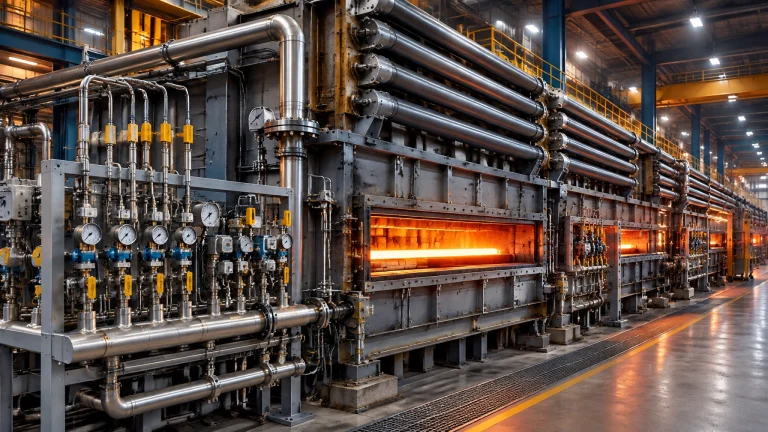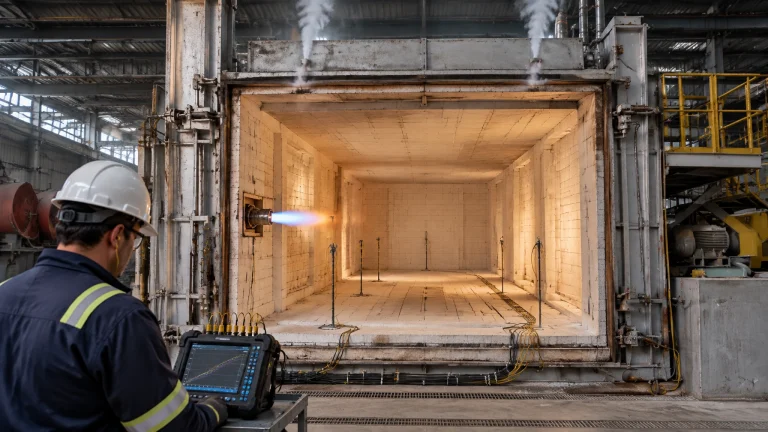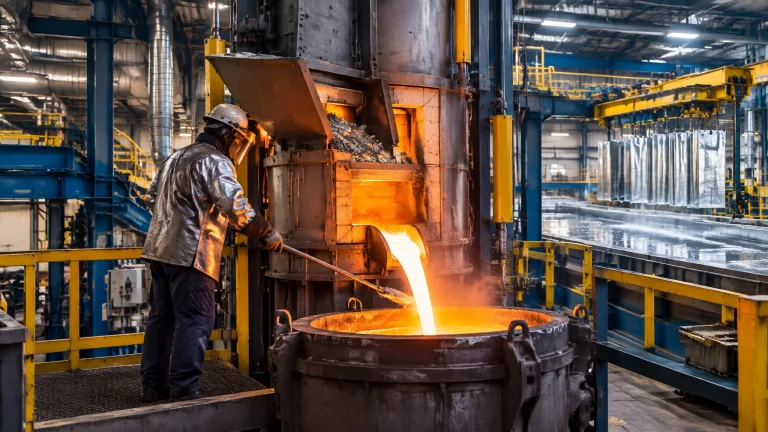
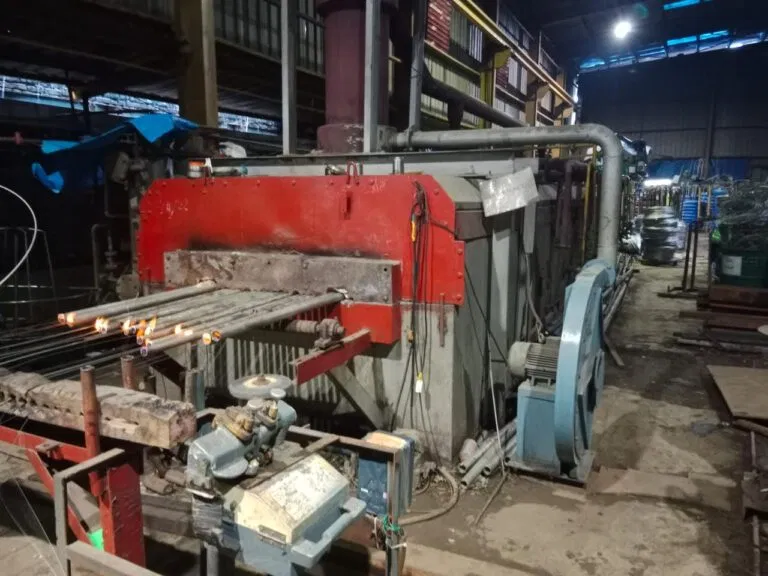
You pay for the heat twice: once in the fuel used to bring the product to process temperature, and again when excess heat leaves the discharge door in a product that waits, travels, cools, or exits hotter than the next operation needs. Yet many furnace heat balances quantify flue-gas loss and leave product exit heat unmeasured.
This is an important distinction: heat in the discharged product is not automatically waste. In a steel rolling mill, it is useful process energy, if the mill can use it on time and at the right temperature. But an unnecessarily high drop-out temperature or an unplanned delay can turn useful sensible heat into avoidable fuel, yield and emissions costs. A tonne of steel discharging near 1,200°C carries substantial sensible heat, of the order of hundreds of kWh per tonne relative to ambient. The exact quantity depends on grade and reference temperature; this is an order-of-magnitude description, not a precise heat value.
Where exit loss sits in the heat balance
A useful furnace balance accounts for fuel and combustion-air input, heat absorbed by the load, flue-gas losses, and losses from the structure and the material-handling system. The DOE process-heating brief names heat storage, walls, conveyors and fixtures, radiation from openings, cooling media, and waste gas among the loss categories.[2]
Flue gas remains a major competitor for fuel energy. A SAIL RDCIS review reports flue gases carrying 35–55% of heat input in reheating furnaces; that is a published reference range, not a guarantee for a particular installation.[3] The product stream is the other side of the accounting: it receives heat by design, but heat that exceeds the process requirement or is lost during discharge and delay deserves scrutiny.
The DOE brief offers a useful illustration of the multiplier effect. At a process temperature of 1,500°F, combustion products may still hold about half the thermal energy supplied. At 2,000°F, available heat is about 45% at stoichiometric air; with 20% excess air, it falls to about 38%, requiring roughly 18% more fuel for the same duty. Where available heat is 50%, every 1 Btu lost through walls, conveyors or radiation can require about 2 Btu of fuel to replace.[2] These are published reference values, not guarantees.
For a first-pass exhaust estimate, the brief gives: W × Cp × (T_exhaust − T_ambient), where W is exhaust-gas mass flow and Cp is approximately 0.25 Btu/lb·°F for most gaseous fuel-fired furnaces.[2] A complete audit should account for the product and handling streams as well, not only the stack.
Discharge-temperature discipline
The target is not “as hot as possible.” It is the lowest, most consistent drop-out temperature that meets downstream metallurgical and rolling requirements. The SAIL review gives a typical walking-beam discharge temperature of about 1,230°C, and recommends minimizing surface-to-core and along-length temperature differences to 15–25°C. These published reference values must be validated against the product grade, process route and mill specification.[3]
A control model also has to respect the coldest-slab rule: the coldest or slowest slab can set the pace for the entire furnace charge. One cold entry can erase the throughput advantage of several hot slabs. Furnace models that track individual material temperatures, mill status and delays can help maintain the required thermal regime without holding the whole load unnecessarily hot.
Over-discharge has several costs:
- More fuel: every unnecessary degree raises the heat duty delivered to the product.
- More scale and lower yield: SteelOnTheNet cites gas-fired reheat scale formation of 0.5–1.0% of charged slab weight; the SAIL review reports reheating scale yield losses of 1.50–2.50% in its reference discussion. These figures describe different published contexts and are not interchangeable plant guarantees.[3][4]
- More CO₂: excess fuel increases combustion emissions, while longer high-temperature residence also raises oxidation risk.
- Delay exposure: reheating strategy should respond to mill interruptions. The SAIL review notes that Level-2 and combustion-control models have reduced energy use by 3–6% in published reference cases; actual outcomes depend on operating conditions and control implementation.[3]
Maintaining 1–2% oxygen in flue products is cited by the SAIL review as a way to minimise scale. It also reports that reducing excess air can cut steel lost to scale by about 35%, again, a published reference value, not a guaranteed result.[3]

Comparing practical levers
The table summarises published reference values, not guarantees. Any potential effect must be confirmed through site measurements, product requirements and engineering review.
| Measure | What changes | Indicative effect (published reference values, not guarantees) | Control required | Best fit |
|---|---|---|---|---|
| Discharge-temperature and delay discipline | Match drop-out temperature and firing strategy to actual mill demand | 15–25°C temperature-uniformity target; Level-2 models report 3–6% energy reductions in cited review | Piece tracking, pyrometry, delay logic, coordinated mill status | Reheating furnaces with variable schedules or interruptions |
| Hot charging / entry-side heat retention | Raise slab or billet entry temperature, reducing the temperature rise the furnace must supply | 650–700°C versus 110°C entry is associated with residence-time reduction from 135 to 105 minutes (about 28% higher productivity). Each 100°C entry-temperature increase corresponds to 0.086 MMBtu/ton saved in a published rule of thumb.[4] | Consistent hot sequences; coldest-slab pacing; matched furnace and mill throughput | Mills able to maintain hot-charge sequences and roll at a corresponding pace |
| Load preheating with flue gas | Transfer exhaust heat to incoming material or combustion air | Recovery opportunity depends on exhaust conditions, load and exchanger performance; no universal saving is implied | Gas analysis, temperature monitoring, fouling and emissions management | Suitable fired furnaces with a compatible heat sink |
| Post-discharge recovery | Capture heat from cooling streams, or correct temperature variation with induction | Cooling-water heat can be evaluated for reuse or, where suitable, an ORC; induction correction is an emerging option. No universal recovery figure is implied.[1][4] | Sink matching, quality safeguards, safe cooling design, load profile | Operations with recoverable cooling heat or local temperature non-uniformity |
For hot charging, SteelOnTheNet gives a published example of a 600°C hotter charge corresponding to about 0.52 MMBtu/ton saved and about 27.8 kg CO₂/ton reduction at 700°C. Its cost illustration, about US$2.14/ton, uses stated 2023 North American gas prices of US$4.12/MMBtu; it is a historical example, not a current price or a forecast for another plant. The source also reports Erdemir’s published US$13 million/year savings example for hot charging 50% of slabs at an average 586°C (2011–2013); this is a reported case, not a promise of project savings.[4]
Recovering heat after the discharge door
The DOE’s 2008 waste-heat report estimates that 20–50% of industrial energy input may be rejected as waste heat. It attributes roughly 600 TBtu/year of unrecovered heat in the iron and steel processes studied to hot solid streams; the combined figure rises to about 700 TBtu/year when primary-aluminium cell sidewalls are included.[1] These are sector-level estimates, not a prediction for an individual furnace.
Hot solids are an unconventional recovery source: unlike a ducted gas or liquid, a slab is difficult to access and transport to a heat exchanger. Its recoverable heat also changes as it cools, and the product may be dirty, intermittent or moving on a production schedule that leaves no convenient recovery window. The DOE report specifically identifies hot products as unconventional and notes that recovery is less mature for dirty, small-scale and unconventional sources.[1]
Screen recovery by matching the heat source to a usable sink:
- Cooling-water heat: assess whether heat from product cooling can be reused in a compatible process or water system. Protect product quality and comply with cooling and safety requirements.
- ORC or other power recovery: assess only where the temperature, flow and operating profile justify evaluating a power-generation cycle. It is not a default solution for every product stream.
- Induction correction: induction can correct temperature variation or skid marks after discharge; it is a process-correction option, not the same as recovering and reusing product heat.[4]
The DOE report notes that facilities generally seek payback in under about three years for recovery projects.[1] That is a reported investment expectation, not a guaranteed payback period. A sound business case needs measured heat availability, equipment and operating costs, maintenance requirements, and a verified end use.

Execution discipline: measure the product stream
- Instrument drop-out temperature per piece or defined product group; record measurement location and method.
- Log entry temperatures and connect them to product identity, grade and schedule.
- Keep the coldest-slab rule visible to scheduling and operations teams.
- Track scale percentage and yield alongside fuel per tonne.
- Audit conveyor, fixture and transfer losses: the DOE identifies material-handling losses as a named category.[2]
- Review temperature and firing strategy after mill delays, not only during steady operation.
Five-phase roadmap
- Exit-loss audit: establish a heat balance, including product discharge temperature, throughput, delay time and handling.
- Discharge-temperature governance: define product-specific drop-out limits and temperature-uniformity criteria with quality and mill teams.
- Entry-side heat retention: assess hot-charging readiness and whether the operating sequence can sustain hot entries. Hot charging reduces the temperature rise the furnace must supply; it does not replace discharge discipline.
- Recovery-options screening: quantify available heat and match it to a real, timed heat sink before selecting equipment.
- Institutionalise KPIs: review kcal/t, exit-temperature histograms, delay minutes and scale percentage as routine operating measures.
This approach applies beyond the reheat line. Material temperature and handling matter in heat treatment furnaces, melting operations and broader thermal processing equipment. The same heat-balance discipline can inform a melting furnace for steel, an aluminum melting furnace or a metal recycling furnace. In the wire and cable industry, a hot dip galvanizing plant, and other industrial furnace systems, process-specific temperature limits and downstream timing still govern whether product heat is useful or wasted. A capable industrial furnace manufacturer should engineer these constraints into the application rather than treat them as afterthoughts.
Support the exit line before you need it
Exit-temperature discipline depends on reliable measurement and handling. Review the condition, calibration and availability of:
- Pyrometers and thermocouples for product and furnace measurements.
- Material-tracking and Level-2 instrumentation components.
- Recuperator spares and related monitoring components.
- Water-cooled components and connections.
- Door and extractor seals exposed to repeated thermal cycling.
Maintaining suitable furnace spare parts supports reliability and reduces the risk that instrumentation or discharge-line problems compromise production. Continental Furnaces’ prompt-service approach is designed to help customers minimise downtime and sustain lifecycle performance.
Build a sustained advantage from the heat you already paid for
Exit-heat accounting is not a mandate to recover every joule. It is a disciplined way to distinguish useful process heat from avoidable excess temperature, waiting and transfer losses, and to make recovery decisions only when a real sink exists.
With 35+ years of expertise, ISO-certified quality, customised solutions and responsive service, Continental Furnaces works with customers on enduring thermal-processing partnerships. Discuss your furnace, operating profile and exit-temperature priorities with our team through the Continental Furnaces consultation and quote request. It is a strategic step toward sustained competitive advantage.
References
- U.S. Department of Energy, BCS, Inc. (2008), Waste Heat Recovery: Technology and Opportunities in U.S. Industry. Read the report.
- U.S. Department of Energy, Industrial Technologies Program (2004), Waste Heat Reduction and Recovery for Improving Furnace Efficiency, Productivity, and Emissions Performance, DOE/GO-102004-1975. Read the technical brief.
- Thakur et al. (2014), A Review on Efficient Energy Optimization in Reheating Furnaces, SAIL RDCIS review, IRF Pune. Read the review.
- Hesling, S.W. (2025), Hot Charging of Steel Billets & Slabs, SteelOnTheNet. Read the article.