Introduction
All figures are indicative benchmarks drawn from published surveys, plant reports, regulatory texts and supplier references; they vary by plant, load mix, line type, throughput and local regulation. They are reference points for investigation, not universal setpoints or guarantees.
In galvanizing, combustion control connects fuel cost, temperature stability, emissions and equipment reliability. A disciplined approach begins with measured as-found performance, then addresses air-fuel ratio, zone balance, radiant-tube condition and opportunities to reuse exhaust heat.
Why combustion discipline is the cheapest fuel-saving lever
Many plants continue to operate burners at commissioning settings long after linkage wear, changes in draft, repairs or years of service have shifted the air-fuel relationship. The result can be excess-air creep: more combustion air than required leaves with the flue gas, carrying useful heat out of the furnace.
For galvanizing furnaces, approximately 10–15% excess air is commonly cited as a practical compromise between reducing stack losses and maintaining complete combustion. Each avoidable increment of excess air adds heat to the exhaust stream. The appropriate setting depends on the burner and operating range; reducing air without confirming combustion quality can increase CO.
A proper annual as-found tune-up records flue-gas oxygen (O₂) and carbon monoxide (CO), along with firing rate and operating conditions. Tune each zone at representative high, intermediate and low firing, not only at one convenient operating point. The WesTech gas-savings paper and a galvanizing-furnace field service example both underline the value of periodic inspection, cleaning and re-tuning [1, 12].
Why prioritize it: an instrumented tune-up is usually a lower-cost first step than a major retrofit, and measured before-and-after fuel data helps identify whether further investment is justified.

Process windows and energy balance
Furnace exhaust must remain hot enough to support heat transfer through the furnace and kettle wall. Zinc melts at about 420 °C; operating bath temperature is commonly around 450 °C (about 840 °F). As a result, flue-gas exit temperature should stay above the actual bath temperature to maintain the intended heat flow. Do not confuse the zinc melting point with the operating temperature.
In jobbing furnaces, practical thermal efficiency is often reported in the 65–70% range. For radiant-tube zones, published optimization work reports an O₂ criterion of approximately 5–6 vol% and 6–9% fuel reduction, with CO elimination in the reported study. This is not a universal setpoint: confirm it against burner design, CO, emissions requirements and manufacturer limits. A separate 2–3% flue O₂ value is cited as a tune target in some radiant-tube contexts; readings must be compared at equivalent sample locations and operating conditions.
Published plant references also give 250,000–300,000 m³ of annual gas for a jobbing operation producing roughly 40,000–50,000 t/y. Track fuel by production and separate furnace, dryer and site-wide consumption where possible. The AGA survey reports zinc consumption benchmarks of 4.8–5.7% of steel weight; treat this only as a broad process indicator, not a direct measure of furnace efficiency [1, 2, 10, 11].
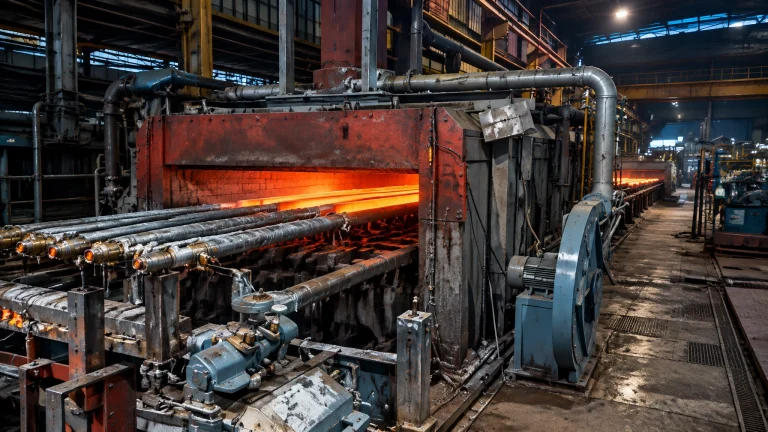
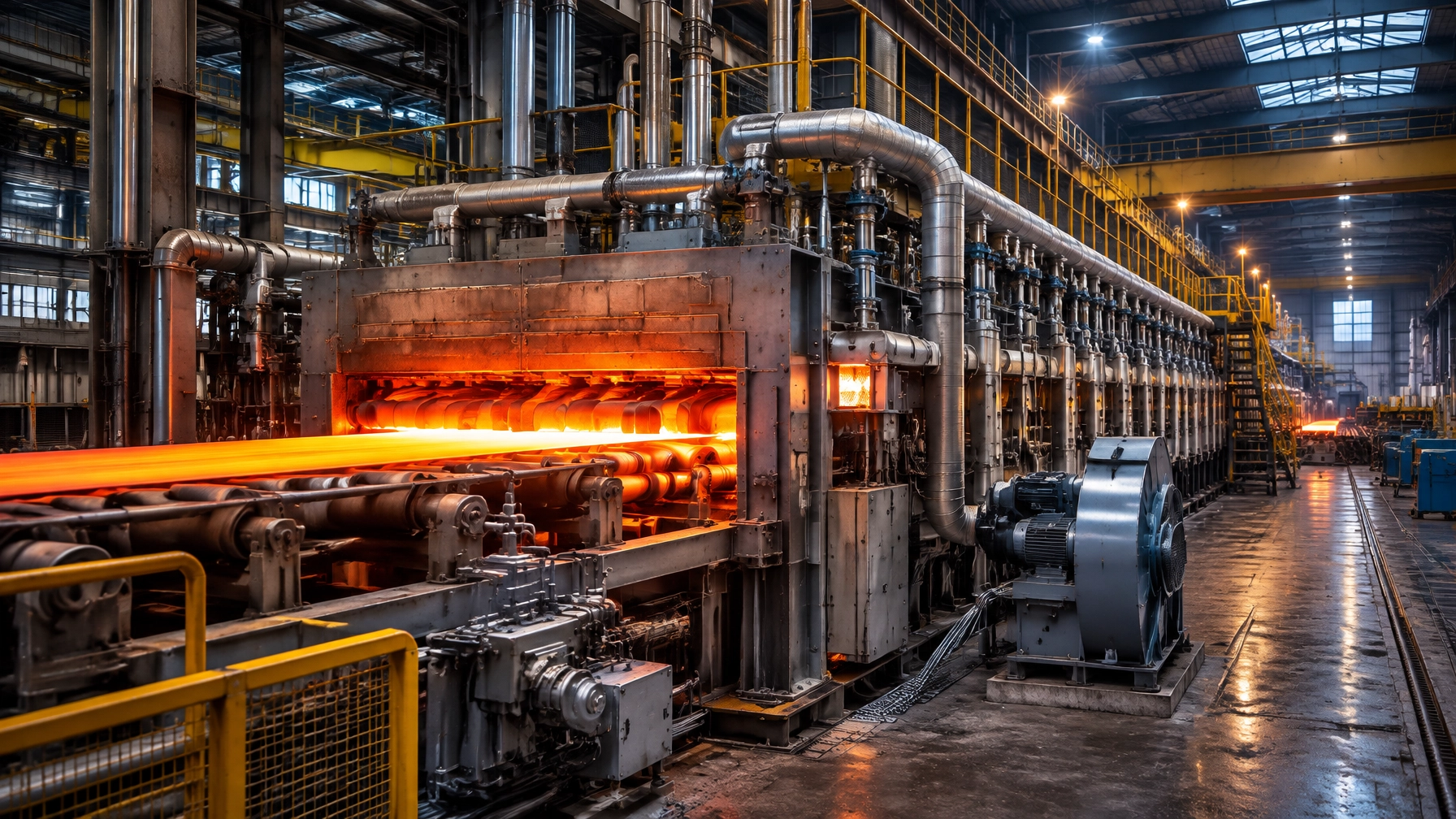
The hot dip galvanizing plant is an interconnected heat system: zone balance, load, firing pattern and bath demand all matter.
Indicative galvanizing furnace combustion benchmarks
| Measure | Indicative reference | Caveats |
|---|---|---|
| Excess air / flue O₂ | About 10–15% excess air is commonly cited; ~2–3% flue O₂ is a tune target in some radiant-tube contexts. The lower-excess-air trade-off is maintaining complete combustion and controlling CO. | Indicative; actual values vary by plant, kettle size, load mix, line type, throughput and local regulation. |
| Radiant-tube zone optimization | ~5–6 vol% O₂ criteria; reported 6–9% fuel reduction and CO elimination in the cited study. | Indicative; confirm sample point, burner design and operating conditions. |
| Flue exit temperature | Keep above the bath operating temperature, typically around 450 °C / 840 °F; zinc melts at about 420 °C. | Indicative; actual bath setpoint and process conditions govern. |
| Practical thermal efficiency | 65–70% is a practical reference range for jobbing furnaces. | Indicative; calculation method and furnace duty affect results. |
| Annual gas use | ~250,000–300,000 m³/y at a 40,000–50,000 t/y jobbing plant. | Indicative; meter boundaries and standby practice matter. |
| Spark gap | 0.04–0.08 in (1–2 mm) reference window. | Indicative; verify the burner manufacturer’s specification. |
| Zinc consumption | 4.8–5.7% of steel weight in survey reporting; an indirect process indicator only. | Indicative; product mix and operating practices affect results. |
All benchmarks are drawn from published surveys, plant reports, regulatory texts and supplier references; actual values vary by plant, kettle size, load mix, line type, throughput, standby practice and local regulation.
Radiant tube reliability and pulse firing
W and double-P radiant tubes depend on correct burner adjustment and even heat distribution. In pulse-fired systems, on/off operation allows individual burner adjustment and supports simplified electrical zoning. It can also improve temperature uniformity when the system is properly commissioned and maintained [2, 3].
Tube life is influenced by creep at sustained high temperature, localized hot spots from flame impingement or poor tuning, and thermal cycling from frequent safety shut-offs. When a tube is removed from service or replaced, re-tune the remaining burners in that zone: the original settings no longer describe the changed flow and heat-transfer conditions [4].
Include these checks in planned maintenance:
- Confirm spark gap is within the burner’s specified range; 0.04–0.08 in (1–2 mm) is an indicative reference.
- Inspect flame rods or UV electrodes and clean burner orifices.
- Check tube condition for leaks, deformation and signs of local overheating.
- Recheck combustion after a tube change or significant burner repair.
For planned maintenance, review furnace spares and accessories such as radiant tubes, electrodes and flame rods as part of outage preparation.

Combustion-side troubleshooting discipline
Use symptoms to guide measurement, not as a substitute for it. Compare readings with a documented baseline at like-for-like firing rates before adjusting equipment.
Combustion-side symptom → what it is telling you → first corrective action
| Symptom | What it is telling you | First corrective action |
|---|---|---|
| Rising flue O₂ at constant firing rate | Excess-air creep from linkage wear or changed settings. | Inspect linkage and air-fuel settings; verify with flue-gas O₂ and CO readings. |
| Yellow tips or CO smell | Incomplete combustion, potentially from fouled burners or restricted air. | Inspect and clean burners and air paths; confirm combustion with an analyzer. |
| Uneven strip or part temperature | A zone may be dragging after a tube replacement without re-tuning. | Check tube and burner condition; re-tune and compare zone temperatures. |
| Bright tubes with hot spots | Possible flame impingement from excessive firing rate or burner misalignment. | Verify burner alignment and firing conditions against equipment limits. |
| Frequent flame-failure trips | Dirty UV electrode or drift beyond the indicative 0.04–0.08 in spark-gap window. | Inspect flame detection and ignition components; verify the manufacturer’s gap specification. |
| High gas per tonne versus baseline | As-found settings may be outdated, including no tune-up since commissioning. | Establish a fresh combustion and fuel baseline; inspect and tune systematically. |
2026 technology and market updates
Oxygen-Trim Control Reaches Galvanizing
The Sameeeksha Howrah cluster DPR describes air-fuel ratio control using a flue-gas oxygen sensor, while the Hasco Smart Firing case study describes individualized burner control based on furnace demand [7, 8]. Wedge Galvanizing reports 15% average gas savings and four-to-ten-month payback for its implementation; this is a supplier/customer case result, not a guaranteed outcome for other sites.
Regenerative and Flameless Oxidation Radiant Tubes
FLOX flameless oxidation supports low-NOx operation; supplier material describes targets often below 100 mg/Nm³. Regenerative burner systems recover exhaust heat to preheat combustion air. Double-P self-recuperative tube experience reports air preheat around 700 °C, within the indicative 600–700 °C range [3, 5, 6]. Suitability depends on line design, emissions limits and maintenance capability.
Waste-heat recovery also deserves a measured feasibility review. Indirect flue-gas-to-water recovery can supply useful heat to process tanks or other compatible loads. Design for controlled bypass and account for condensation, fouling and corrosion risk; do not pursue a lower stack temperature without checking the system’s limits [1].
Hybrid Electric-Gas Heating Enters Galvanizing
Published in October 2026, Kanthal’s SynErgie3 project combines electric resistance heating with regenerative flameless gas burners in a redesigned double-P tube. The reported demonstrator integrates 2 × 63 kW electric heaters with a 120 kW gas burner, supporting electric, fuel-fired or combined operation. It is a developing industrial demonstration, not a universal retrofit prescription [9].
What this means across your furnace fleet
Combustion discipline applies beyond the hot dip galvanizing plant. A steel rolling mill reheating furnace, heat treatment furnaces, an aluminum melting furnace, a melting furnace for steel and a metal recycling furnace all benefit from measured air-fuel control, planned inspection and performance tracking. These are distinct thermal processing equipment applications, but the operating principle is consistent: verify conditions, tune to the process and record the result.

Continental Furnaces supports customized heat treatment furnaces and melting furnaces and recycling projects. As an industrial furnace manufacturer, we see furnace spare parts stocking (such as radiant tubes, electrodes, flame rods and gas valves) as part of an enduring service partnership across industrial furnace systems and the wire and cable industry.
A four-phase roadmap to combustion discipline
- Phase 1: As-found combustion audit and flue-gas survey (30–60 days). Record gas use, O₂, CO, firing rate, flue temperature and zone temperatures at representative operating conditions.
- Phase 2: Instrument and verify (1–2 quarters). Add permanent O₂/CO sampling points where appropriate and maintain zone-by-zone tuning records.
- Phase 3: Mechanical renewal (3–6 months). Inspect or replace tubes as needed, refresh ignition and flame-detection components, and re-tune after every tube swap.
- Phase 4: Upgrade (6–18 months). Evaluate O₂ trim, pulse-firing retrofits, regenerative or FLOX tubes, and hybrid electric-gas pilots against measured operating needs.
Build an enduring partnership around uptime
Combustion performance is built through consistent measurement, practical maintenance and upgrades matched to the furnace and production plan. Continental Furnaces brings 35+ years of experience, customized engineering and responsive service to support thermal processing performance over the equipment lifecycle.
Request a consultation to assess your furnace fleet and identify the next step toward dependable operation and sustained competitive advantage.
References
- WesTech: Reducing gas usage in a galvanizing plant
- FLOX: Trends for radiant tube heated strip lines
- FLOX: Double-P radiant tube operating experience
- FLOX: Factors influencing radiant tube life
- FLOX: Flameless oxidation in gas-fired radiant tubes
- FLOX: WS regenerative burner for thyssenkrupp FBA10
- Sameeeksha: Howrah cluster air-fuel ratio control with oxygen sensor
- Wedge Galvanizing: Hasco Smart Firing case study
- Kanthal: SynErgie3 hybrid heating
- American Galvanizers Association: 2019 Process Survey
- Energy consumption and capacity utilization of galvanizing furnaces
- CIC Pittsburgh: Galvanizing furnace service and tune-up
- NUTEC Bickley: Galvanizing kettle combustion control
- WesTech: Extending kettle life, furnace-side factors