Continental Furnaces Industrial Insights : Morning Edition | August 2026
Steel manufacturers are entering 2026 under simultaneous pressure to reduce energy costs, comply with tighter emissions standards, protect production uptime, and modernize aging equipment without disrupting output. For every steel rolling mill, energy efficiency is no longer only an environmental objective. It is a direct driver of yield, profitability, regulatory compliance, and long-term competitiveness.
Global steel energy consumption has declined from approximately 50 GJ per tonne in the 1960s to 20.95 GJ per tonne in 2024, according to worldsteel. The next generation of savings will come from integrated process design rather than isolated equipment replacement.
The central question for plant managers is clear: How can the facility produce more saleable steel while using less energy per tonne?
The 2026 energy-efficiency agenda
Steel plants should focus on six connected priorities:
- Reducing reheating demand through hot charging and direct rolling
- Recovering waste heat from furnace exhaust
- Installing high-efficiency burners and combustion controls
- Preparing industrial furnace systems for hydrogen and electrification
- Applying AI, automation, and predictive maintenance
- Retrofitting older equipment to extend asset life and minimize downtime
These measures apply across reheating lines, continuous casting operations, heat-treatment departments, melting shops, and finishing plants.
1. Hot charging and direct rolling: the highest-value integration opportunity
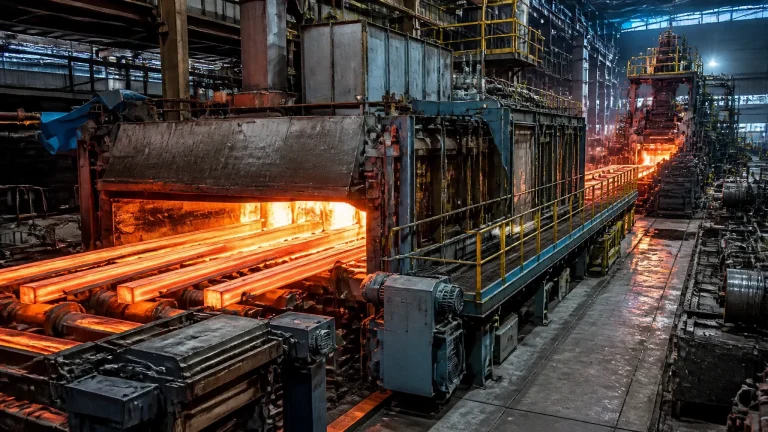
A modern steel rolling mill should avoid cooling material that will later require reheating. Hot charging transfers slabs, billets, or blooms from continuous casting to the reheating furnace while they remain at an elevated temperature, commonly between 600°C and 1,000°C, depending on the process route and transfer distance.
The reheating furnace then supplies only the additional energy required to reach the rolling temperature, typically around 1,100°C to 1,250°C, depending on steel grade and product specifications.
Measurable advantages include:
- 15–30% reduction in reheating fuel demand in suitable installations
- Approximately 0.3–1.0 GJ/t energy savings across the thermal route
- Lower scale formation and oxidation losses
- Improved material yield and reduced surface defects
- Lower furnace residence time and increased production flexibility
Direct rolling advances this approach by transferring continuously cast steel to the mill with minimal intermediate cooling. A tunnel furnace, equalization furnace, or induction unit may still be required to correct temperature variation, but the plant avoids reheating the entire product from ambient temperature.
As explained in Continental Furnaces’ guidance on hot charging and direct rolling, direct rolling is not simply a furnace upgrade. It is a production architecture that requires coordination between caster speed, steel grade sequencing, transfer logistics, mill availability, and temperature control.

2. Reheating furnace modernization and combustion optimization
Hot charging does not eliminate the need for flexible reheating capacity. Product changes, caster interruptions, variable order schedules, and quality requirements demand a furnace that can operate efficiently across multiple conditions.
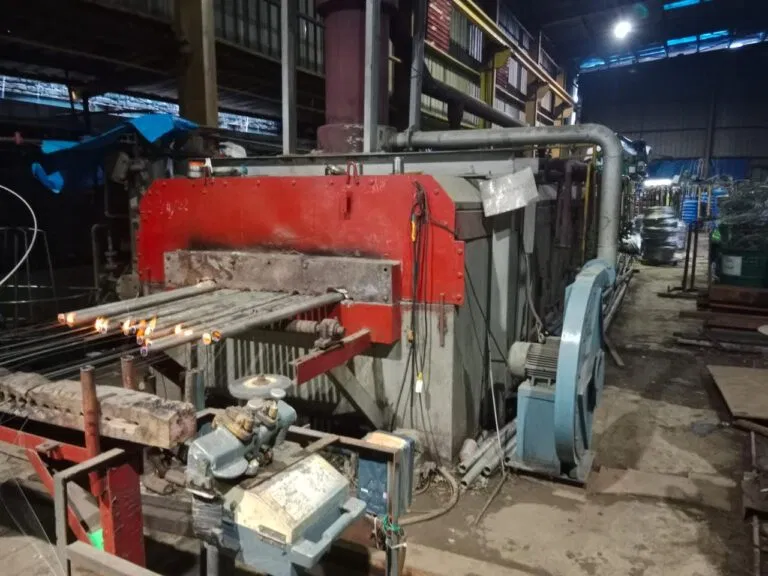
Modern thermal processing equipment should include:
- Automated air-to-fuel ratio control
- Oxygen and furnace-pressure monitoring
- High-performance refractory and insulation systems
- Low-infiltration doors and seals
- Walking-beam or optimized hearth design
- Automated billet and slab temperature measurement
- Recipe-based control for different steel grades
- Variable-speed drives for combustion-air fans
- Flue-gas monitoring and heat recovery
Older furnaces may lose 30–40% of input energy through exhaust gases, wall losses, radiation, skid systems, and uncontrolled air infiltration. In suitable applications, combustion optimization and heat recovery can reduce furnace fuel consumption by 15–30%.
Recuperative and regenerative burners typically deliver 10–20% fuel savings, with higher reductions possible where the existing system has poor burner balance, excessive air, damaged insulation, or uncontrolled furnace pressure.
The objective is not maximum flame temperature. The objective is uniform heat transfer at the lowest safe fuel input, while maintaining metallurgical quality and emissions performance.
3. Waste heat recovery becomes a core investment case
Flue gas leaving an industrial furnace contains valuable thermal energy. Depending on furnace design and operating conditions, exhaust gases may be several hundred degrees Celsius. Capturing this energy can significantly reduce fuel demand elsewhere in the plant.
Potential applications include:
- Preheating combustion air
- Preheating billets, slabs, or scrap
- Heating process water
- Supporting steam generation
- Supplying thermal energy to adjacent production areas
- Integrating with thermal storage systems
A proper feasibility study should measure:
- Exhaust temperature and flow
- Oxygen concentration
- Pressure drop
- Furnace operating hours
- Seasonal production patterns
- Available plant heat sinks
Projects that combine heat recovery, sealing, insulation, and combustion controls can achieve approximately 0.3–0.5 GJ/t savings in suitable installations. Indicative payback periods commonly range from 18 months to four years, depending on fuel prices, operating hours, and plant utilization.
4. Hydrogen-ready and electric furnace systems
Hydrogen-ready burners are moving from demonstration projects toward practical planning requirements. However, hydrogen readiness involves more than replacing a burner nozzle.
A future-ready furnace must address:
- Hydrogen blending from partial percentages to higher concentrations
- Higher flame speed and different ignition characteristics
- Gas-train sizing and pressure regulation
- Flame detection and safety interlocks
- Purge and ventilation logic
- NOx formation and mitigation
- Burner turndown and heat-flux distribution
Electrification is also gaining momentum where power availability, product mix, and operating economics support it. Electric radiant systems, induction units, and hybrid furnace configurations can reduce direct combustion emissions and provide highly responsive temperature control.
For steel producers, these technologies should be evaluated alongside the broader transition toward EAF production, scrap-based steelmaking, and hydrogen-based direct reduction. The International Energy Agency’s iron and steel outlook identifies energy efficiency, increased scrap use, electrification, hydrogen-based production, and carbon management as the principal decarbonization pathways.
5. Industry 4.0 turns furnace data into operating profit
A connected furnace measures energy and process performance continuously instead of relying on periodic manual readings. The most valuable data points include:
- GJ/t and kWh/t by product, grade, and shift
- Zone temperatures and discharge temperature
- Fuel flow and oxygen concentration
- Furnace pressure and burner status
- Fan vibration and motor current
- Refractory hot spots and door leakage
- Scale formation and material yield
- Unplanned stops and restart energy
Advanced control systems can link furnace setpoints with rolling schedules, product specifications, and production planning. Digital twins allow plant teams to model the effect of charging temperature, furnace residence time, burner settings, and mill delays before changing live production parameters.
AI-driven controls are increasingly being applied to optimize furnace temperature, fuel consumption, scrap mix, rolling schedules, and defect detection. Industry studies indicate that digital optimization programmes can reduce operating expenditure by approximately 8–15% in appropriate applications.

Conventional versus modern integrated thermal processing
| Performance metric | Conventional approach | Modern integrated approach |
|---|---|---|
| Typical charging temperature | 20–40°C | 600–1,000°C with hot charging |
| Reheating energy demand | 1.0–2.0 GJ/t | Significantly reduced through integration |
| Hot-rolling energy intensity | 1.8–2.5 GJ/t | Target range of 1.3–1.8 GJ/t |
| Fuel-saving potential | Baseline | Approximately 15–40% |
| Scale exposure | Higher | Lower through reduced residence time |
| Labour requirement | Higher manual intervention | Automated monitoring and handling |
| Downtime risk | Reactive maintenance | Predictive maintenance and critical spares |
| Retrofit payback | Not applicable | Approximately 1.5–4 years, site-dependent |
These figures are engineering benchmarks rather than universal guarantees. Actual performance depends on throughput, furnace condition, fuel price, operating hours, product mix, steel grade, and automation maturity.
A practical roadmap for plant managers
Phase 1: Assessment and planning : 0 to 4 weeks
Establish a verified baseline before approving capital expenditure.
Measure:
- Current GJ/t and kWh/t
- Charging, soaking, and discharge temperatures
- Furnace residence time
- Fuel and electricity consumption
- Exhaust temperature and oxygen level
- Scale loss and saleable yield
- Downtime and restart frequency
- Existing PLC, SCADA, and MES capabilities
Phase 2: Operational optimization : 1 to 3 months
Implement low-capital improvements first:
- Correct furnace recipes
- Eliminate unnecessary holding
- Balance burners
- Reduce excess air
- Repair doors, seals, and refractory hot spots
- Calibrate temperature and oxygen sensors
- Synchronize caster and rolling schedules
- Avoid operating the furnace below its efficient load range
Energy monitoring and controls can deliver payback in approximately 6–18 months when they identify avoidable operating losses.
Phase 3: Thermal retrofit : 3 to 12 months
Evaluate:
- Recuperative or regenerative burners
- Combustion-air fan variable-speed drives
- Refractory and insulation upgrades
- Automated temperature measurement
- Exhaust heat recovery
- Insulated transfer routes
- Hydrogen-ready gas trains
- Modern safety and control systems
A well-engineered burner and combustion-control retrofit may achieve 10–30% fuel reduction, with indicative payback of 1.5–3 years in suitable plants.
Phase 4: Full process integration : 12 to 36 months
For qualifying facilities, integrate:
- Continuous casting
- Hot transfer conveyors
- Covered or insulated transfer routes
- Automated production sequencing
- Equalization or tunnel heating
- Caster-to-mill MES coordination
- Digital temperature models
- Predictive maintenance platforms
This phase offers the greatest energy-intensity reduction but requires detailed engineering, robust contingency planning, and close coordination between operations, maintenance, quality, and procurement.

Retrofit strategy: protect uptime while improving efficiency
Retrofitting aging equipment is often more economical than replacing an entire line. The correct approach prioritizes components that affect energy performance, reliability, and safety simultaneously.
Critical furnace spare parts should include:
- Flame scanners and ignition electrodes
- Thermocouples and temperature sensors
- Burner nozzles and control valves
- PLC modules and safety relays
- Refractory components
- Door seals and bearings
- Fan and VFD components
- Hydraulic and pneumatic parts
A reliable spare-parts strategy prevents a small component failure from becoming a full production stoppage, emergency reheating cycle, or quality rejection.
The same lifecycle principles apply to heat treatment furnaces, a melting furnace for steel, an aluminum melting furnace, a metal recycling furnace, and specialized systems serving the wire and cable industry. They also support the thermal requirements of a hot dip galvanizing plant, pickling line, and integrated steel processing facility.
Continental Furnaces: an enduring engineering partnership
Energy efficiency is a plant-wide strategy, not a single equipment purchase. It requires thermal engineering, controls integration, production planning, maintenance discipline, and responsive lifecycle support.
Continental Furnaces combines 35+ years of expertise with energy-efficient technology, customized engineering, ISO-certified quality, and prompt service designed to keep downtime minimal. As an experienced industrial furnace manufacturer, we develop complete industrial furnace systems for steel, non-ferrous metals, recycling, automotive, construction, galvanizing, and other demanding industries.
Explore our guidance on metal recycling furnace projects and industrial aluminum melting furnace applications, or contact Continental Furnaces for a plant-specific assessment.
Conclusion: make lower energy intensity a competitive standard
The winning sequence for 2026 is decisive:
- Measure the baseline
- Maximize hot charging
- Optimize combustion
- Recover waste heat
- Prepare for hydrogen and electrification
- Connect furnace data with production planning
- Protect uptime with predictive maintenance and critical furnace spare parts
Plants that act now will reduce operating costs, strengthen emissions compliance, improve yield, and build resilience against volatile energy prices. Treat energy efficiency as a strategic operating standard and partner with an industrial furnace manufacturer capable of supporting the full lifecycle.
Consult Continental Furnaces to define your energy roadmap and secure sustained competitive advantage.