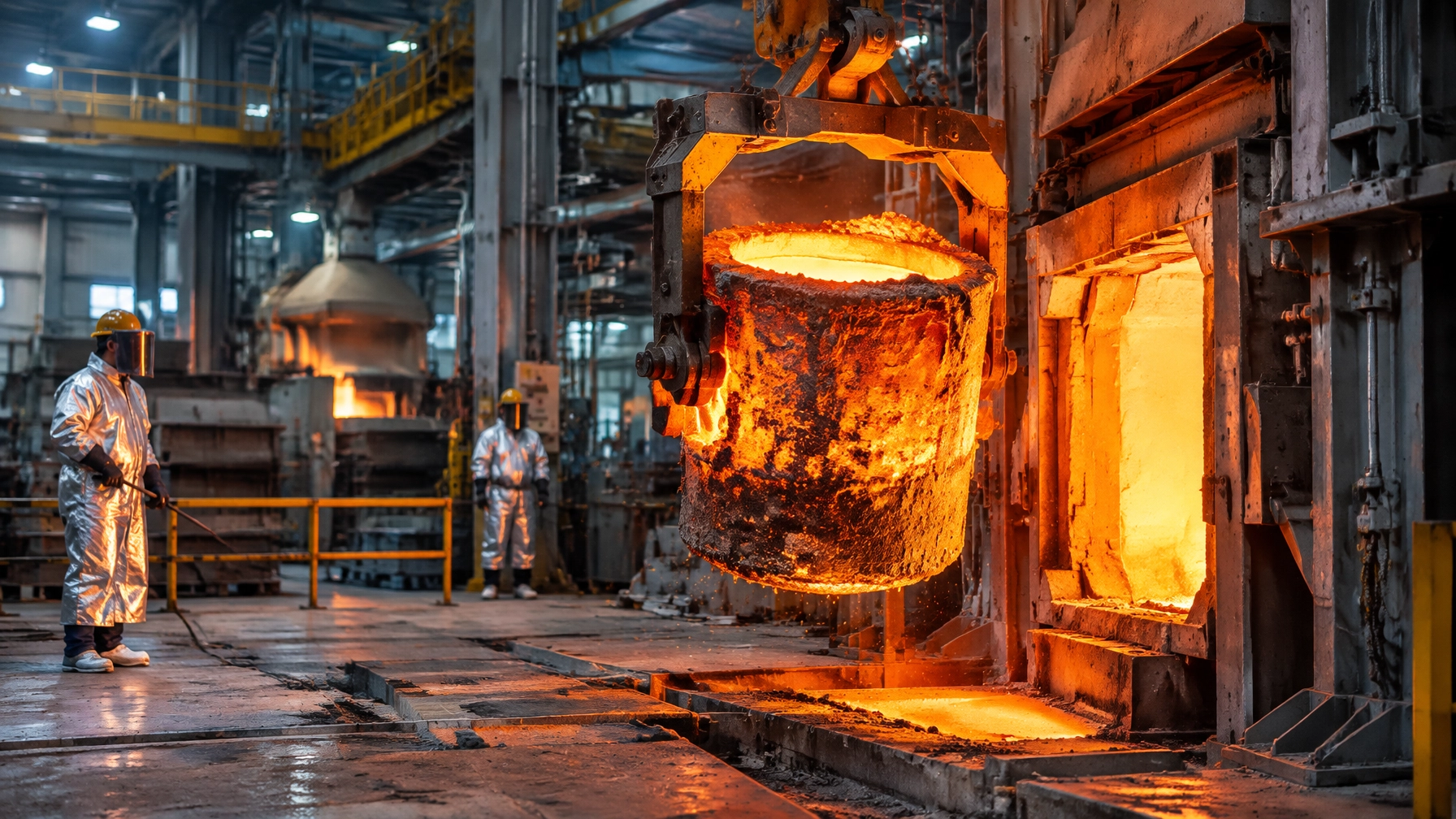
Crucible and pot furnaces remain workhorses of small- and medium-scale melting and holding worldwide, and for many plants an aluminum melting furnace of this type is the first vessel the metal touches and the last before it is poured. Their flexibility and modest initial investment make them valuable, but gas-fired crucible furnaces carry the lowest thermal efficiency of the common melting routes: 7–19%, compared with roughly 30–45% for reverberatory furnaces and 59–76% for coreless induction, according to U.S. Department of Energy metal-casting programme material.[6] In this operating context, the crucible is both the cheapest line item in the budget and a major uncontrolled multiplier on the most expensive ones: energy and metal loss. A crucible degraded through its campaign can nearly double energy use per kilogram melted. Disciplined selection, sintering, flux control, inspection and planned retirement move cost per tonne further than a burner adjustment alone.
All figures below are indicative benchmarks drawn from published foundry surveys, supplier technical papers, national energy programme reports, academic studies and regulatory texts. Actual values vary with alloy, crucible grade, furnace type, charge quality, throughput, tariff and local regulation.
The crucible is a consumable that sets your melt cost curve
Crucibles made from carbon-bearing compositions lose performance as the campaign advances. Carbon oxidation creates pores; protective glaze can be lost; and the wall gradually thins. Thinning may initially reduce the refractory mass that must be heated and shorten the heat-transfer path. But oxidation changes the wall structure and lowers its thermal conductivity. The apparent benefit of a thinner wall is therefore not a reliable indicator of a healthy crucible.
An EPD Congress 2003 degradation study reported that energy consumption rose by up to 100% per hour and 93% per kilogram melted as a campaign progressed. Heating time increased by as much as 80% compared with the campaign’s start.[1] These are not marginal shifts: they change melt cost, available production time and the point at which replacement becomes economical.
Geometry and capacity matter too. Modelling by Brian Pinto and Wenwu Shi in Foundry Practice 266 compared a 181 kg crucible at USD 8.02 per metric tonne with an 816 kg crucible at USD 3.23 per metric tonne. A 61% reduction in modelled energy cost per tonne, while melt rate rose from 0.91 to 2.32 kg per minute. Applying the material change alone to the small crucible produced only a 2.4% benefit.[2] The mass of refractory relative to the metal load is a key driver: capacity and throughput must be considered together.
Larger or thinner is not automatically safer. The same modelling work predicted maximum thermal stress of 15.8 MPa for a 1,055 mm outside-diameter crucible, versus 8.9 MPa for a 655 mm unit, approaching the strength of the refractory itself. A thermally efficient composition reduced predicted maximum stress from 15 MPa to 8.8 MPa. In another model, reducing wall thickness from 43 mm to 25 mm raised theoretical efficiency from 65.8% to 72.4%, with melt rate increasing from 1.25 to 1.44 kg per minute.[2] These are model results, not universal operating guarantees; engineering validation against the actual alloy and thermal cycle is essential.
TABLE 1. Indicative crucible and pot furnace melting benchmarks, 2026
| Parameter | Indicative value | Source basis |
|---|---|---|
| Gas-fired crucible furnace thermal efficiency | 7–19% | U.S. DOE metal casting programme[6] |
| Gas crucible energy demand; tower melting comparison | ~2,000–2,220 kWh/t; tower 540–900 kWh/t | 2018 TCO model and published industry comparisons[4][8] |
| Electric resistance and Indian cluster consumption | 400–550 kWh/t electric; Indian cluster 500–650 kWh/t; LPG-fired 150–220 m³/t | Cluster energy profile and 2026 comparison[9][10] |
| Melt loss: crucible/reverberatory versus induction | 3–5% versus 0.75–1.25% | DOE die-casting melting-efficiency study[5] |
| Total cost of ownership | Crucible €284.74/t; tower €93.94/t | Sustainability 2018 TCO model[4] |
| Crucible service life | 80–250 cycles or 2–6 months | Supplier technical guidance; actual life is application-dependent[3][11] |
| Modelled capacity and mass-to-metal ratio effect | 181 kg versus 816 kg capacity | Foundry Practice 266 modelling[2] |
These rows are not additive. They come from different plants, operating conditions, accounting boundaries and study methods; use them as screening benchmarks, then build a measured plant baseline.
Sintering and preheat, the first twenty-four hours decide the campaign
A new crucible must be handled and brought into service with care. Follow the supplier’s instructions for the specific grade and furnace. A practical staged preheat includes a hold at 150–200°C for 30–60 minutes to drive off moisture, a gradual rise through 400–500°C, then a controlled rise to operating temperature. Rushing this first heat risks thermal shock, cracking and an early end to the campaign.
On receipt, inspect for chips, cracks and abrasions. A light hammer ring test can help identify damage: a clear thud can indicate mishandling, while a bell-like ring is consistent with a sound crucible. It is a screening check, not a substitute for visual inspection. Never roll a crucible, nest one inside another or store it directly on concrete; its base can absorb moisture.[3]
Base size, base height and clearances need to follow the crucible and furnace specification. In a fuel-fired furnace, incorrect base height can place the flame against a local section of the wall, creating an overheated and oxidized patch. Insufficient clearance leaves no room for thermal expansion and can cause cracking. Keep the melt level as high as safely practical: modelling indicates that high fill levels reduce steep wall gradients and upper-wall superheat.[2] An unsintered first heat wastes fuel or electricity heating the crucible and can compromise the entire campaign before useful production begins.

Flux, dross and the chemistry that quietly consumes the wall
Flux is a process aid, not a routine substitute for controlled melting. Use the minimum effective amount and add it only after the bath is fully molten. When concentrated flux sits against a solid charge, it can attack the crucible surface during the melt.[3]
Dross and slag also carry a cost beyond the metal trapped inside them. Build-up has low thermal conductivity, so operators may raise furnace temperature to maintain melt rate. It absorbs flux and expands, pressing against the crucible. Remove it on a consistent schedule with scraping tools shaped to the crucible’s internal curve; a poorly matched tool gouges the wall.
Do not wedge ceramic fibre between the crucible and base, or against its top edge. This creates local conditions that promote oxidation and cracking. Long holding at minimum temperature also accelerates oxidation. In fuel-fired service, lid condition is a quality control issue: a UC Berkeley A356 study reported gas-melted test bars at only 80% of the mean tensile, yield and elongation of electrically melted bars. Dross, hydrogen porosity and oxide films were traced to combustion gas leaking past the compressible fibre lid gasket.[10]
For gas-fired crucible furnaces, recuperative combustion-air preheat is a significant efficiency lever: published guidance reports 25–38% fuel savings versus cold-air burners.[10] Electric resistance heating has no exhaust stream to recover in this way.

Retirement criteria, inspection and the cost of running to failure
Planned retirement protects both yield and schedule. Establish a crucible log and a repeatable inspection routine rather than waiting for visible failure.
- Measure wall thickness at fixed reference points and compare against the supplier’s minimum.
- Withdraw a crucible immediately if through-wall cracking is found.
- Use thermal imaging to identify abnormal hot spots around the shell.
- Treat staining or sweating as evidence of possible metal penetration.
- Ring-test at each cold start and investigate a changed sound.
- Record heats, alloy, peak temperature, flux use and holding hours for each unit.
A crucible kept two weeks beyond its economic knee can consume more in extra energy than the cost of replacement. Run-to-failure adds much greater exposure: metal loss, unplanned downtime and injury risk. Larger melting vessels may use acoustic emission or acousto-ultrasonic echo monitoring as part of a wider plant inspection programme; these practices inform decisions but do not replace visual checks and supplier limits.
TABLE 2. Crucible furnace symptom, root cause and first corrective action
| Symptom | Likely root cause | First action |
|---|---|---|
| Melt rate falling through the campaign | Glaze loss and wall oxidation | Log heats and pull forward replacement |
| Energy per tonne climbing with no process change | Crucible mass and conductivity degradation, plus dross layer | Scrape and re-baseline metering |
| Crucible cracking at the top edge | Ceramic fibre wedging or excessive clearance | Remove fibre and reset base and lid geometry |
| Early failure within a few heats | Inadequate sintering or moisture in the base | Redo staged preheat and check storage |
| Metal penetration stains on the shell | Flux attack or over-temperature hold | Cut flux, verify setpoint and retire |
| Dross ring growing faster than usual | Flux added with a solid charge or wet scrap | Change to post-melt flux addition and dry the charge |
Symptoms overlap with refractory and burner faults. Pair diagnosis with metering and process records rather than treating a single observation as proof of cause.
2026 technology and market updates
Thermally efficient crucible compositions reach field validation
Glazed, high-conductivity compositions are designed to transfer heat effectively and retain performance longer as the crucible ages. In the six-month, two-furnace Foundry Practice 266 field trial, a thermally efficient crucible used 605 kWh per tonne during casting against 764 kWh per tonne for the standard crucible, about 20% less. Holding energy fell 14%, from 30.4 to 26.0 MWh. The paper extrapolated savings of about 26 MWh and USD 2,500 per furnace per year at USD 0.08/kWh, and approximately 16,573 kg of CO₂ avoided.[2]
Newer glazed clay-graphite and silicon carbide-graphite products aim to maintain conductivity over more of the campaign.[12] This is a technology trend, not a vendor endorsement. Select by alloy set, flux practice, peak temperature, holding duty and measured thermal cycle, not by a catalogue efficiency claim alone.
Digital crucible tracking moves from spreadsheets to records that predict
Heat counts and lifecycle notes are the foundation of predictive replacement. RFID or other asset tags can identify individual vessels; linking crucible records to energy metering and production logs allows replacement to be planned against actual thermal exposure rather than calendar guesswork. The practical minimum for a plant without specialist software is simple: one tagged log and one energy meter per furnace.

Tariffs, CBAM and the price of a wasted kilowatt-hour
October 2026 day-ahead power averaged around €169.5/MWh in Germany and exceeded €230/MWh in Italy, increasing pressure on aluminium melting economics.[16] Industry reporting also put roughly 15% of Europe’s recycling furnace capacity idle in late 2025, citing scrap shortages and energy cost.[14]
The EU CBAM definitive regime began on 1 January 2026.[13] Under current classification guidance, aluminium castings declared under CN heading 7616 are within scope, while castings classified as machine or vehicle parts under Chapters 84, 85 and 87 are currently outside; verify the customs classification for each product and shipment. A proposed downstream scope expansion targeted at 2028 is not yet law. The commercial implication is clear: embedded energy in a cast component is a number buyers increasingly scrutinise, and crucible inefficiency flows directly into it.
Gas versus electric, revisited under 2026 tariffs
A 2026 techno-economic comparison found gas more cost-effective per unit melted under current tariffs for most plants it studied.[15] Typical melt rates are near 400 kg/hour for fuel-fired units versus 250 kg/hour for comparable electric resistance units; the electric route also requires roughly double the connected electrical load for equivalent output.[10]
The decision turns on peak melt rate, alloy criticality and the gas-to-electric tariff ratio. This is a selection framework, not a universal recommendation. Our engineering team sizes both routes against throughput and operating conditions.
What this means across your furnace fleet
Crucible and pot discipline applies well beyond a foundry melting bay:
- A steel rolling mill may use small batch alloy melts in guide and tool shops.
- Heat treatment furnaces may use ceramic and metallic retorts or salt pots for specific duties.
- Crucible melting cells can feed flux and alloy additions for a hot dip galvanizing plant; pickling plants support downstream surface preparation.
- Small crucible units and tilting pots support sweeps and small lots in a metal recycling furnace operation.
- The wire and cable industry may require alloying and solder or coating metal melts.
- A melting furnace for steel user may still run smaller induction or crucible units for specialty grades.
Our melting and recycling furnace range is part of an industrial furnace systems approach: the crucible is one node in a chain that includes charge preparation, transfer and holding. For aluminum melting furnace selection, match the crucible, furnace and duty together. We also supply heat treatment furnaces and retort or salt pot duties. As an industrial furnace manufacturer, we specify crucible, pot and hybrid melting routes alongside thermal processing equipment for these applications. Planned access to furnace spare parts including crucibles, bases, lids and elements is a practical way to support uptime.
A four-phase roadmap to crucible cost control
Phase 1: Baseline and audit, 30 to 60 days
- Install one energy meter per crucible furnace.
- Log heats, alloys, flux use and holding hours.
- Calculate energy and cost per tonne.
- Inspect each crucible and measure wall thickness at repeatable reference points.
Phase 2: Practice fixes, 1 to 2 quarters
- Standardise staged sintering and charge sequencing.
- Add flux only after the bath is molten.
- Use matched scraping tools and replace worn lid seals.
- Reinforce lid discipline during holding and production pauses.
Phase 3: Selection and specification, 3 to 6 months
- Match crucible grade and geometry to the alloy set and thermal cycle.
- Evaluate thermally efficient compositions against a measured baseline.
- Right-size capacity for actual throughput and establish planned retirement rules.
Phase 4: Systems and capital planning, 6 to 18 months
- Introduce digital crucible records linked to metering and production logs.
- Reassess fuel versus electric against the plant’s tariff structure.
- Plan capital options such as hybrid pre-melt and electric hold arrangements.
An enduring partnership in melt economy
A crucible is not a cheap consumable when its condition governs energy, metal yield and safe production. The enduring partnership starts with correct specification and sintering training, then continues through inspection, spares and planned replacement programmes.
We bring more than 35 years of expertise to thermal processing projects and work with customers to build measurable lifecycle value. Request a consultation and quote to review your crucible duty, cost per tonne and replacement strategy, and make the next improvement a strategic move toward sustained competitive advantage.
Technical references
- Degradation of crucible properties and impact on energy consumption during operation, EPD Congress 2003: abifa.org.br
- Pinto, B. and Shi, W., Thermally efficient crucible technology: fundamentals, modelling and applications for energy savings, Foundry Practice 266, Vesuvius/Foseco: vesuvius.com
- Getting the best out of your crucible: our top ten recommendations, Foseco: foseco.com
- Investment and management decisions in aluminium melting: a total cost of ownership model and practical applications, Sustainability 10(9), 2018: mdpi.com
- Task 2.1: Melting efficiency in die casting operations, US DOE / OSTI: osti.gov
- Advanced melting technologies: energy saving concepts and opportunities for the metal casting industry, US DOE ITP: energy.gov
- Choosing the right furnace for your operation, Modern Casting: moderncasting.com
- Reverberatory or shaft melting? Rethinking the production equation, Foundry Management & Technology: foundrymag.com
- Melting aluminium: oil, gas or kWh a tonne, Senseible: senseible.earth
- Gas-fired vs electric resistance crucible furnace: spec comparison, SpecForge: sourcebyspec.com
- Crucible selection guide, Luxel: luxel.com
- Introducing the Syncarb Z2 e2 crucible, Foseco: foseco.com
- CBAM definitive regime, European Commission, Directorate-General for Taxation and Customs Union: europa.eu
- Fifteen percent of Europe's recycling furnace capacity is idle, AlCircle interview with Dr Martin Iffert: alcircle.com
- StrikoWestofen to showcase energy-smart furnaces and next-gen dosing control at EUROGUSS 2026, Foundry-Planet: foundry-planet.com
- Power cost of EUR 600 versus EUR 1,800 per tonne: how electricity prices are reshaping Europe's aluminium industry, AlCircle: alcircle.com