Two furnaces can use the same refractory product and still deliver very different lining lives. The difference often begins before the first heat: installation method, water control, anchor engineering and workmanship determine whether the lining achieves the properties its datasheet promises.
For plant managers and project engineers, refractory execution is an operating decision. It affects relining time, yield, maintenance exposure and the reliability of the production schedule. The figures and rules of thumb below are published reference guidance, not universal requirements. Final decisions must follow the project specification, refractory supplier’s instructions and conditions in the furnace.
Choosing the installation method
Select the method for the zone, geometry, access, work volume, outage window and crew capability. Confirm that the product is designed for the method; application methods are not automatically interchangeable.
- Hand casting is simple and needs limited equipment, but commonly involves higher water content, which can reduce installed properties.
- Vibratory casting uses vibration to consolidate castable in forms. It can achieve lower water addition and optimize properties when vibration is controlled.
- Pump casting moves material quickly from mixer to forms and suits larger placements, but uncontrolled liquid addition at the pump can compromise the mix.
- Self-flow casting fills forms without a vibrator or pump and can reduce labour. The mix may cost more, may need robust forms, and can be sensitive to water content.
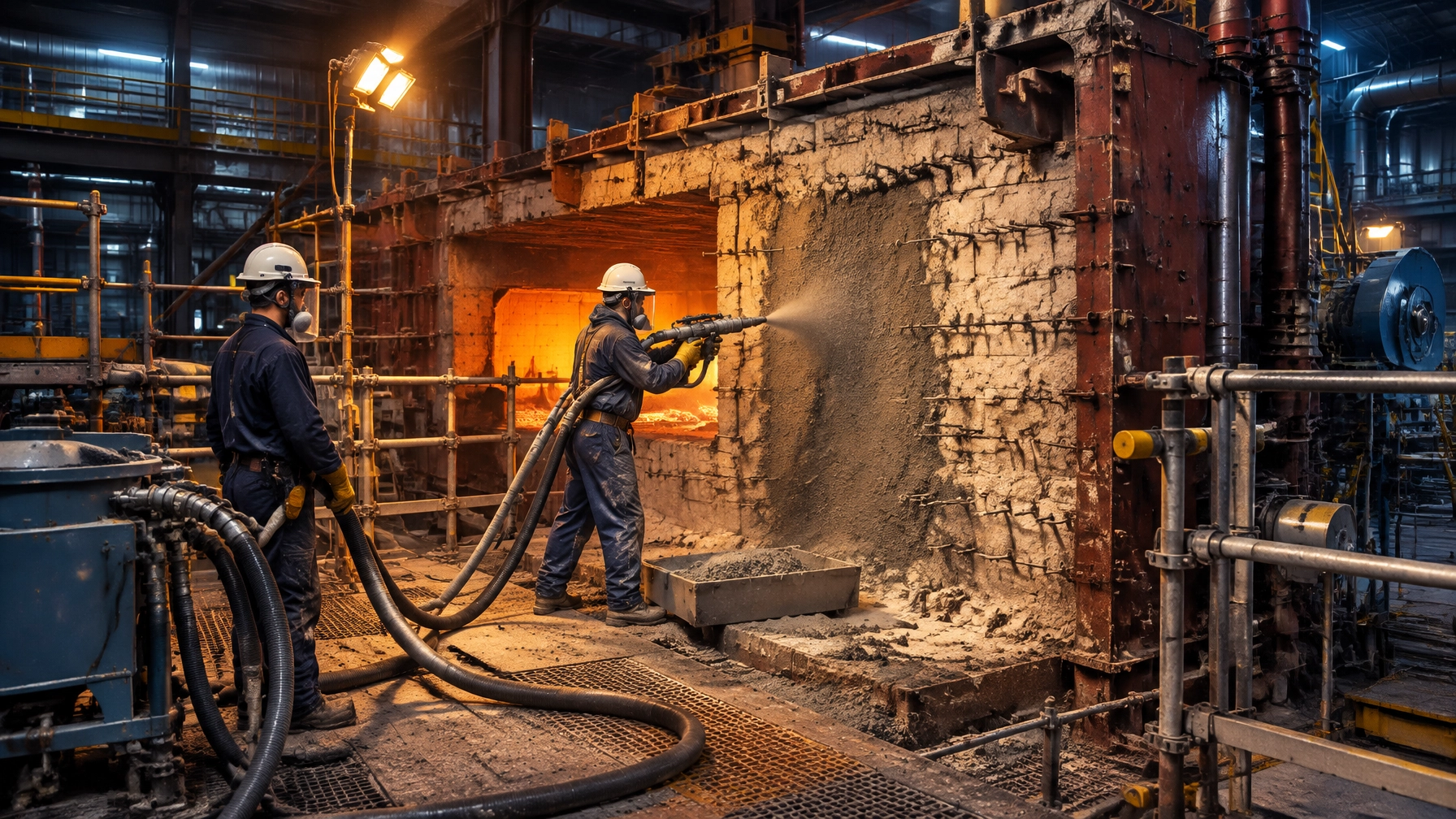
- Shotcrete is a wet application pumped through a hose and projected without conventional forms. Activator and compressed air are introduced at the nozzle.
- Gunning conveys dry mix pneumatically and adds liquid at the nozzle. It is quick to mobilize and useful for targeted repairs.
- Plastic refractory arrives in slabs and is rammed into place, often with an air hammer. It is labour-intensive, but can be useful for fast repairs and is generally less sensitive to dry-out than castable.
Vibratory casting discipline
Vibration is a controlled placement step, not a substitute for good mixing or sound formwork. Too little vibration can leave voids; too much can cause segregation and inconsistent properties.
- Measure the specified water addition and use clean water. Do not add liquid to improve flow without authorization.
- Use suitable vibration equipment and a planned sequence, paying particular attention to corners, penetrations and areas around anchors.
- Keep forms rigid and watertight. Seal joints against leakage and brace the structure for the load and vibration of placement.
- If work is interrupted, prepare the interface before resuming placement in accordance with the approved procedure.
Gunning vs shotcrete: a head-to-head
Both methods need a qualified crew. The critical difference is how the material and liquid are delivered, and how effectively the crew controls placement.
| Method | Process | Typical rebound | Density and porosity | Equipment | Best use | Key risk |
|---|---|---|---|---|---|---|
| Gunning | Dry mix conveyed by air; liquid added at the nozzle | Published ranges are about 5–15% | Can vary with nozzle water control and consolidation | Simpler, faster to mobilize | Small repairs, difficult access, rapid setup | Excess water, dust, higher rebound or weak consolidation |
| Shotcrete | Wet mix pumped through a hose; activator and air added at the nozzle | Published comparisons report about 4–5% | Typically denser and lower in porosity when correctly applied | Pump, hoses and coordinated operators | Larger areas and full relines | Poor pump or nozzle control, rebound management, equipment or access constraints |
These rebound figures are published comparison ranges, not guaranteed job results. Actual values depend on the mix, equipment, geometry and operator. Shotcrete rebound is not reusable; remove rebound rather than allowing it to become trapped in the lining. Gunning can be a practical choice for a small repair, while shotcrete can offer an advantage for a larger scope where lower rebound and consistent placement matter.
Anchor design: the hidden determinant
Anchors hold the lining against the shell or support system and prevent major movement that can lead to dislodgement. Literature estimates of structural failures linked to improper anchor design or installation vary widely, with published estimates ranging from 40% or less to more than 60%. These are estimates, not a universal failure statistic. [2]
Design must account for lining thickness, layers, installation method, furnace geometry and service environment. Common reference guidance includes:
- Anchor length of roughly 65–80% of lining thickness, with tips typically about 25–30 mm from the hot face.
- Spacing often in the range of 200–350 mm, but determined by design, experience and expected crack patterns, not a single universal formula.
- Shape and density matched to the lining, location and placement method. Too many anchors can obstruct flow and create poorly consolidated “shadow” zones around prongs.
- Allowance for movement between steel and refractory. Metal anchors expand about three times more than refractory, with a reference value of roughly 1.5 mm per metre per 100°C for metal. Wax or other approved parting agents can burn off at low temperature and create movement space.
Plastic caps at anchor tips are often used to provide expansion space and melt at around 150°C. However, published examinations found no consistent difference in refractory damage with or without caps, and caps can create localized carburization. Treat caps as a design choice, not an automatic improvement.
Stainless anchors held for extended periods between approximately 560–980°C can form sigma phase, most rapidly near 870°C. This reduces ductility and can make anchors vulnerable during cooling or impact. Corrosion risks above roughly 400°C can include carburization, oxidation, sulfidation, chlorination and nitridation. Anchor failure also occurs at interfaces between dense hot-face and insulating layers, where temperature and movement differ.
Environment drives anchor metallurgy
Published maximum-service-temperature figures vary for the same alloy and generally assume oxidizing conditions. Reference ranges include 304 stainless steel at about 760–900°C, 310 stainless at about 925–1150°C, and Inconel 601 at about 1095–1200°C. These are not design guarantees. Actual selection must account for local anchor temperature, atmosphere and corrosion exposure, not only the furnace set point.
For example, carburizing atmospheres can attack anchors in heat treatment furnaces. Zinc vapour and process chemicals near galvanizing lines, as well as chlorides or sulfur-bearing atmospheres, also demand careful materials review. Where temperatures or chemistry exceed the capability of metal anchors, evaluate ceramic anchors or another engineered support arrangement.
Formwork, joints and installation quality control
Formwork controls lining thickness, shape and consolidation. It must be rigid, sealed and designed for placement pressure and vibration. Joint design must accommodate refractory expansion and permanent dimensional change, avoiding restraint that can shear the lining or stress the shell. Verify anchor position and hot-face cover before closing forms.
Quality control should be specified before work begins. Use API Std 936, Refractory Installation Quality Control, as a reference framework alongside the project specification and supplier instructions. Practical controls include:
- Verify product identity, condition, storage and batch traceability before installation.
- Confirm that welders are certified as required by the project and inspect anchor locations and welding before refractory placement.
- Establish inspection points for mixing, measured water, vibration or nozzle application, thickness, joints and repairs.
- Keep records of materials, crews, equipment, installation conditions, defects and corrective work. Photograph defects and their repairs.
- Use an appropriate weld-verification test. Visual inspection alone cannot establish weld integrity.
- Compare shell thermography over time. Anchor bases can appear as hot spots, and rising temperatures may indicate hot-face wear or a developing risk to weld and shell integrity.
A consistent record turns the next outage into an evidence-led relining decision instead of a repeat of the last repair.
What the reheat sector’s reference examples show
A United Refractories paper describes a walking-beam reline in which one 60% alumina pump mix was pump-cast in the hearth and roof, then applied by shotcrete on the sidewalls and burner walls. Using one product across these areas simplified material supply and supported a shorter reline. The paper also describes a rotary-hearth wall relined with cement-free 60% alumina shotcrete, reporting quick installation, reduced labour versus pumping into forms, rapid dry-out and strong hot properties. These are published examples, not endorsements or guarantees for other furnaces. [1]
The same paper gives a vendor-specific rapid-firing example: for a single-component lining 225 mm or less, a typical schedule of up to 70 hours was reduced to approximately 24 hours using its Rapid Fire technology. Actual schedules depend on lining design and materials, and must be confirmed for the specific installation. [1]

Apply the discipline to each operation
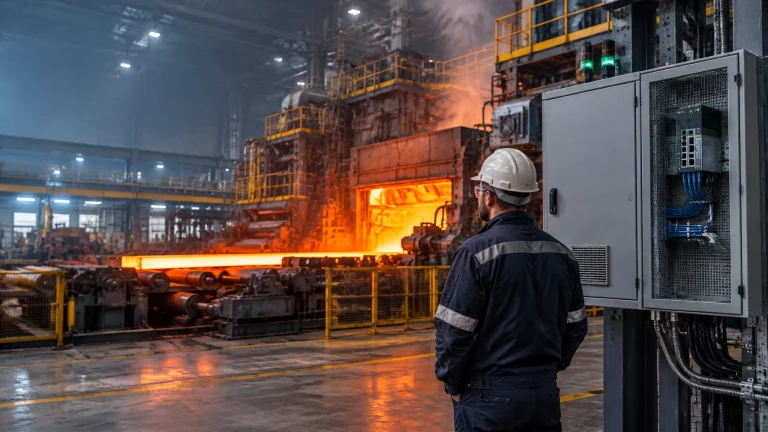
In a steel rolling mill, pusher-type reheat zones can expose linings to abrasion and thermal-profile variation, making placement quality around anchors and transitions important. A melting furnace for steel needs anchor metallurgy matched to both temperature and atmosphere. A roof repair on an aluminum melting furnace may favour a quickly mobilized method, provided water control and rebound removal are managed. Around a hot dip galvanizing plant, consider zinc vapour and other local exposures when selecting anchor alloys. Roof patches on a metal recycling furnace need a method suited to the repair area and access. In annealing lines for the wire and cable industry, consistent lining thickness and joint design help support repeatable thermal operation. Across every class of thermal processing equipment, the same execution discipline applies: the method, the anchors and the workmanship decide how much of the material's rated performance the furnace actually gets.

Keep the execution toolkit stocked
An outage plan is only as strong as the equipment and materials ready when the crew arrives. Align the site’s furnace spare parts and accessories with its chosen installation methods:
- Spare gunning nozzles and compatible hoses.
- Serviceable vibrators, mixers and placement tools.
- Anchor stock by approved alloy, shape and size.
- Reusable formwork components and sealing materials.
- Suitable weld-testing equipment and inspection records.
A well-planned inventory supports faster mobilization and reduces the risk of schedule delays from missing essentials. See Continental Furnaces’ Furnace Spares & Accessories and refractory solutions.

A five-phase relining roadmap
- Lining survey and failure forensics: Map wear, cracks, hot spots and prior repairs. Identify whether the failure was driven by installation, anchors, operation or a combination.
- Method and material selection: Match each zone’s material and application method to access, outage duration, conditions and crew capability. Design anchors into the plan.
- Pre-installation QC setup: Confirm forms, anchor drawings, weld checks, equipment, material condition, water controls and inspection points.
- Execution and daily QC: Record batch and placement details; inspect thickness, joints and defects; correct deviations before they are concealed.
- Dry-out, documentation and handover: Follow the approved schedule for the installed lining. Deliver inspection records, photographs, repair logs and recommendations for future maintenance.
This sequence links sustainability to practical control: fewer avoidable repairs, better use of materials and more predictable asset life.
Build the next campaign around execution
Refractory performance is an enduring partnership between plant teams, material specialists and the engineers responsible for the furnace. As an industrial furnace manufacturer, Continental Furnaces brings 35+ years of expertise, ISO-certified quality and customized engineering to industrial furnace systems and relining projects. Discuss your operating conditions and outage plan through our request for a quote. Make installation quality part of the design decision and take a strategic step toward sustained competitive advantage.
References
- Jim Caprio, Matt Ciarrocca and Brian Rhoads, United Refractories Co., “Technical Refractory Challenges to Consider in Steel Reheat Furnaces,” 27 August 2020. Source
- R. Engel, “Metal Anchors: An Abbreviated Review,” UNITECR 2022. Open-access paper
- F.S. Sperry, Refractory Installation and Maintenance. PDF
- API Std 936, Refractory Installation Quality Control: Inspection and Testing of Monolithic Refractory Linings, 2014, reaffirmed 2022.
- Rincecrete, “Gunning vs Shotcreting: Choosing the Right Refractory Method,” March 2025. Source