Spare-parts strategy is a production-continuity decision, not simply a purchasing exercise. A missing thermocouple, burner component or PLC module may stop a furnace, compromise product quality or extend a planned outage. At the same time, excessive stock ties up capital and increases the risk of deterioration and obsolescence.
For a steel rolling mill, heat treatment line or melting operation, the objective is the lowest defensible lifecycle cost while protecting safety, quality and uptime. That calls for a documented approach to criticality, stock levels, repair routes and equipment lifecycle risks.
Balance the cost of downtime against the cost of stock
The purchase price of a part is only one side of the decision. Compare the total cost of holding inventory with the expected impact of not having it when needed.
A practical assessment considers:
- Shortage exposure: expected downtime hours multiplied by the cost of lost production per hour.
- Additional consequences: scrap, rework, emergency freight, contractor call-outs, safety risk and compliance impact.
- Holding cost: capital, storage, insurance, inspection, shelf-life controls and obsolescence.
- Recovery time: supplier lead time, repair turnaround, commissioning and restart requirements.
For example, if a critical component could expose a plant to 10 hours of downtime at a site-estimated cost of $2,000 per hour, the direct production exposure is $20,000-before quality losses and emergency logistics. Those figures are illustrative; each plant should use its own costs and risk tolerance.
This logic reflects the asset-management principle of balancing performance, risk and cost across an asset’s life. See ISO 55000 asset-management guidance.
Classify parts by consequence, not purchase value alone
ABC analysis ranks parts by annual consumption value, but it can overlook infrequently used items that are essential to operation. A robust furnace spare-parts program overlays ABC with a criticality assessment informed by failure modes and effects analysis (FMECA).
For each item, record the equipment served, failure effect, installed quantity, lead time, repairability, substitutes and supplier status. Score consequences across:
- Safety and environmental exposure
- Furnace shutdown or reduced production
- Product quality and process compliance
- Time to diagnose, repair and restart
- Supplier lead time and availability of alternatives
- Obsolescence and interchangeability
A low-cost flame safeguard or temperature sensor may be critical if its failure stops safe operation. A higher-cost motor may need less onsite coverage if it is readily available and can be changed without stopping the furnace.

Set stocking rules by part class
The following are indicative planning benchmarks, not universal standards. Confirm quantities and service targets against failure history, lead-time reliability, plant exposure, storage conditions and the cost of downtime.
| Part class | Typical examples | Indicative stocking approach | Review focus |
|---|---|---|---|
| A: Critical | Safety valves, burner controls, PLC modules with no validated substitute, critical drives, long-lead radiant tubes | Hold an approved insurance spare, tested exchange unit or documented supplier-reserved stock. Protect planned shutdowns with a dedicated kit. | Confirm condition, compatibility, shelf life and obsolescence at least quarterly. |
| B: Important | Common thermocouples, actuators, selected refractory anchors, serviceable motors | Use min-max or reorder-point rules. Set safety stock according to demand and lead-time variability. | Review usage, supplier performance and stock levels monthly or quarterly. |
| C, Routine | Standard fittings and readily available consumables | Purchase to demand, pool across compatible assets or hold limited stock where economical. | Review for excess, duplicate SKUs and unnecessary replenishment. |
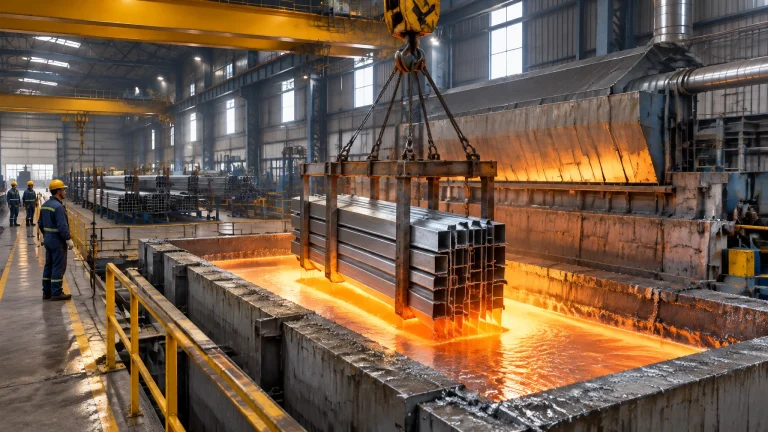
These classes should reflect function as well as cost. For example, rolls in a steel rolling mill may warrant high coverage if a damaged roll can stop a bottleneck stand. Burner valves and controls on a hot dip galvanizing plant may be critical where a failure affects safe furnace operation or temperature control.
Apply min-max and reorder-point logic
For a continuously reviewed item, a basic reorder point is:
Reorder point = average demand during supplier lead time + safety stock
Where demand and lead time are reasonably stable, safety stock can be calculated using demand variation and a selected service factor. As an indicative statistical reference, a factor of 1.65 corresponds to roughly 95% cycle service and 2.33 to roughly 99%, under the assumptions of the model. These are not guarantees of furnace availability.
For a slow-moving or one-off item, historical averages may be misleading. Review the failure consequence, repair options, lead time and planned outage schedule directly. Include stock already on order and parts allocated to work when calculating inventory position. The maximum level should cover the expected requirement through the review and replenishment period, plus justified safety stock.
Manage obsolescence and standardise the fleet
Legacy PLCs, HMIs, drives, flame safeguards and proprietary control cards can become high-risk spares even when they rarely fail. Maintain an obsolescence register that identifies lifecycle status, last-buy dates, available successors, software backups, retrofit work and the next suitable outage window.
Standardisation reduces the number of parts the plant must identify, store and maintain. Across compatible furnace systems, align specifications for sensors, actuators, drives and control platforms where engineering and safety reviews permit. Do not substitute components solely to reduce SKU count: confirm operating range, ratings, control logic, certifications and commissioning requirements.
For repairable modules, compare repair cost plus turnaround and repeat-failure risk with replacement cost, testing and commissioning. Keep a tested exchange unit where repair time exceeds the acceptable outage window. Record the repair outcome in the CMMS and use failure findings to update the criticality assessment.

Build spare-parts readiness into maintenance and digital systems
A digital parts catalogue should connect each part to the asset, approved manufacturer number, drawings, substitutes, supplier, lead time, storage conditions and repair history. This improves identification and purchasing accuracy, particularly across heat treatment furnaces, melting operations and the wire and cable industry.
For planned turnarounds, create job-specific kits in advance. Verify quantities, part condition and compatibility before the outage begins. On-site critical-spares kits should be clearly labelled and tied to a controlled inventory record, not held as informal, untracked stock.
2026-era predictive maintenance can improve readiness by combining condition signals with maintenance and purchasing plans. Useful inputs include vibration and motor current, burner alarms, thermocouple drift, operating hours, cycle counts and inspection findings. Use trends to forecast a replacement window, reserve a repair or buy, and align work with a planned outage. Predictive analytics should guide decisions; it does not replace safety procedures or engineering validation.
Vendor-managed inventory can also help where consumption is predictable and replenishment agreements are reliable. Define ownership, replenishment triggers, emergency response and responsibilities for obsolete stock in the contract.
Rapid manufacturing, including qualified 3D-printed parts, may provide an option for selected legacy components. Treat it as an engineering route, not an automatic substitute. Validate material, geometry, thermal exposure, pressure or load rating, traceability and any safety or compliance requirements before installation.
A four-phase roadmap for 2026
- Phase 1: Criticality audit. Map furnace assets and parts; identify safety, quality and bottleneck failure modes; validate lead times and estimate downtime exposure.
- Phase 2: Stocking policy design. Apply ABC and criticality classes; set min-max or reorder-point rules; document insurance spares, repair routes and planned-shutdown kits.
- Phase 3: Standardisation and obsolescence clean-up. Consolidate compatible specifications, remove duplicate or obsolete records, and schedule controls migrations before support disappears.
- Phase 4: Digital and predictive optimisation. Link the catalogue to CMMS/ERP, monitor stockouts and emergency purchases, and use condition data to plan replenishment and outage work.
Track critical-spare stockouts, emergency buys, inventory accuracy, obsolete stock value, repair turnaround and downtime attributable to unavailable parts. Normalise inventory comparisons against facility scale where useful; the SMRP reference on Replacement Asset Value (RAV) explains the measure. There is no single inventory benchmark that fits every plant: set targets from site risk, asset mix and lifecycle cost.
Make readiness part of the enduring partnership
A disciplined spares strategy supports more than the furnace itself. It protects yield, profitability, safety and production continuity across a steel rolling mill, aluminum melting furnace, melting furnace for steel or metal recycling furnace. It also strengthens the lifecycle performance of thermal processing equipment and complete industrial furnace systems.
Explore Continental Furnaces’ heat treatment furnaces or request a quote to discuss your equipment and spare-parts requirements. With 35+ years of expertise, ISO-certified quality and prompt service, Continental Furnaces works toward an enduring partnership, helping your operation build readiness and sustained competitive advantage.