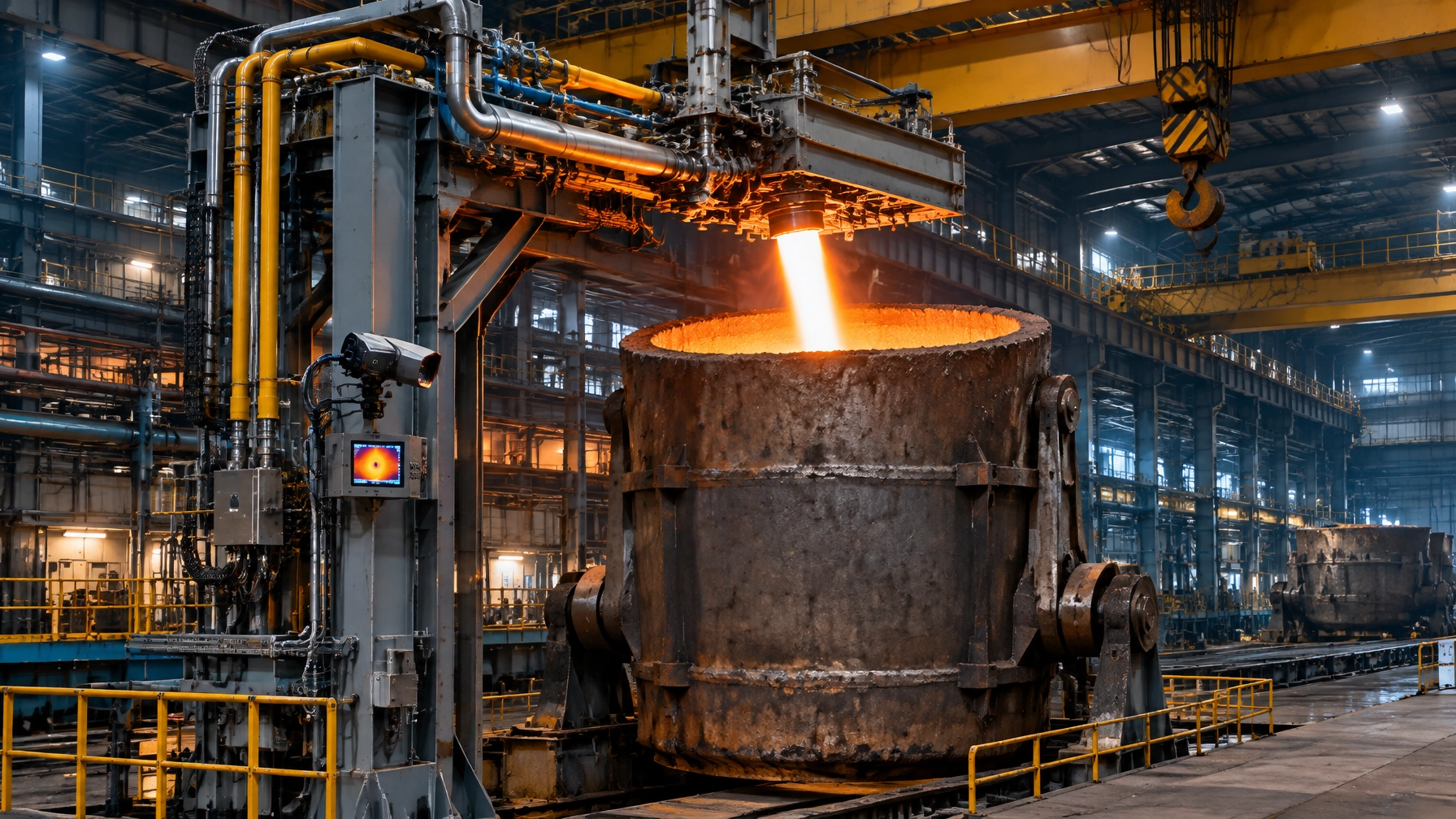
In continuous casting, temperature control does not begin at the caster. It starts with the refractory vessels that carry molten steel from the furnace. Poorly managed ladle and tundish heating drains energy, shortens refractory life and narrows the operating window for stable casting.
For steel plants and foundries, this is a consequential but often overlooked energy sink. In a continuous casting and steel rolling mill operation, heat lost during waiting, transport or inconsistent preheating must be recovered from the steel itself, or accepted as reduced superheat and greater process risk.
The solution is not simply to use a hotter burner. It is to align dryout, preheating, holding and casting schedules with the lining’s properties and the plant’s production rhythm.
Why ladle and tundish heat management matters
A cold or unevenly heated vessel absorbs heat from the steel when it is charged. That can contribute to temperature variation through the tundish and complicate superheat control at the mould. Conversely, excessive preheating wastes fuel and can expose refractory to unnecessary thermal load.
A heat-balance modelling study found that raising tundish refractory preheat by about 200°C can reduce the steel temperature drop in the tundish by approximately 10–15°C under typical operating conditions. That margin supports more stable casting conditions; it does not replace measurement and control of the actual steel temperature.

The same thermal discipline benefits upstream and downstream operations. Whether a site uses a melting furnace for steel, an induction furnace, or a metal recycling furnace, the transfer vessels connect melting performance to casting quality. At the other end, coordinating casting with rolling schedules helps prevent avoidable holding time and repeated reheating.
Dryout discipline: protect the lining before protecting the schedule
First dryout of a newly installed lining is not the same as routine preheating of an already dry ladle or tundish. A new lining contains moisture and must be heated according to its refractory supplier’s specified curve. Heating too quickly can create internal steam pressure, cracking or spalling; an aggressive ramp can also produce damaging thermal gradients.
For a specified lining and installation, an engineered ladle dryout curve may run 18–24 hours, reaching approximately 1,000–1,100°C to build heat accumulation and reduce thermal shock during service. This is not a universal recipe: lining chemistry, thickness, binder, curing conditions, permeability and thermocouple placement all affect the safe schedule. Follow the refractory supplier’s curve and confirm the actual lining temperatures.
A key operating checkpoint is to ensure a dry lining has reached about 700°C before turning the ladle horizontal, where that requirement applies to the lining and vessel design. Do not substitute elapsed time or burner setpoint for a measured lining condition. The RHI Magnesita study on tundish energy consumption illustrates why lining-specific schedules matter: reported drying times vary significantly with lining system.
For already dry vessels, routine preheat is a different task. A typical engineering starting point may be a 2–3 hour preheat, validated against the plant’s refractory, vessel size and casting target. Use measured hot-face and, where practicable, deeper lining temperatures to confirm readiness.
Burner options: compare the whole operating system
The choice between regenerative, oxy-fuel and electric preheating depends on fuel availability, oxygen cost, vessel mix, duty cycle, emissions requirements and control capability. The figures below are benchmarks, not guaranteed results for every installation. For oxy-fuel, an approximate 80% thermal-efficiency benchmark compares with roughly 40–60% for traditional open-flame air-fuel torches. Reported fuel savings of 40–70% and cycle reductions of 25% or more should be treated as project targets to verify at the plant boundary, including oxygen production and delivery.
| Technology | Typical strengths | Key considerations | Operating comparison |
|---|---|---|---|
| Traditional air-fuel torch | Familiar equipment; relatively straightforward fuel supply | Significant exhaust heat loss; flame distribution and operator practice affect consistency | Approx. 40–60% thermal-efficiency benchmark; baseline for site trials |
| Regenerative or recuperative air-fuel | Recovers exhaust heat to preheat combustion air; can reduce fuel use | Added equipment, maintenance and controls; outcome depends on duty cycle | A published tundish-heating review reports fuel reduction from recuperative systems; savings vary by installation |
| Oxy-fuel | High heat-transfer potential, faster heating and reduced exhaust-gas volume | Requires oxygen supply, safety systems and correct burner design; assess total energy and cost | Approx. 80% efficiency benchmark; site-specific fuel reductions can be substantial |
| Electric preheating | Precise controllability and no combustion products at the point of use | Electrical capacity, energy price, heater configuration and cycle time shape economics | Efficiency and payback depend on the full electrical supply and operating profile |
A 2026 full-scale study of flameless oxy-fuel tundish preheating reported more than 65% fuel savings in its installation. It is strong evidence that the technology can deliver major reductions, not a guarantee for every plant. Compare fuel and total energy at equivalent vessel condition, lining temperature, soak time and production interval. The Industrial Efficiency Technology & Measures review of efficient tundish heating provides further context on recovery options.

Operating practices that preserve heat and control
Burner performance alone cannot compensate for inconsistent handling. Plants can establish a shared operating standard across melt shop, ladle bay, caster and rolling mill:
- Use lids consistently. Cover ladles during transport and holding wherever the process and equipment permit. A tundish cover reduces standing heat loss and helps stabilize the thermal state.
- Define hold strategies. Establish temperature bands and escalation actions for planned waits, delays and standby. Avoid both unmonitored cooling and unnecessary full-power firing.
- Manage standby burners deliberately. Use defined low-fire or intermittent strategies appropriate to vessel design, with safe flame supervision and clear responsibility for status changes.
- Track the thermal path. Record steel temperature and vessel condition at the EAF or induction furnace, during transfer, at caster entry and across tundish operation.
- Monitor enthalpy, not just a single surface reading. Online thermal monitoring should interpret temperature in relation to vessel geometry, lining properties and operating history. A surface measurement alone may not represent stored heat throughout the refractory.
- Close the loop with production planning. Match vessel availability and preheat cycles to caster sequence and rolling mill schedules, reducing unnecessary idle time and repeated reheating.
These controls support inclusion flotation and stable flow by maintaining suitable casting conditions. They also help operators manage risks associated with low superheat and temperature variation. A thermal-management programme cannot promise to eliminate breakouts; it can help reduce avoidable process instability when integrated with mould, speed, steel chemistry and caster controls.
Phase-by-phase implementation roadmap
Phase 1: Assess the baseline. Record dryout and preheat curves, fuel or electricity use, oxygen consumption, vessel temperatures, hold times, lining repairs and casting delays.
Phase 2: Validate the refractory procedure. Align the dryout curve with the refractory supplier. Define thermocouple locations, ramp rates, holds, the 700°C turning checkpoint where applicable, and acceptance criteria.
Phase 3: Trial burner technology. Compare existing air-fuel heating with regenerative, oxy-fuel or electric alternatives on equivalent vessels and schedules. Include capital, maintenance, oxygen or electrical costs, staffing and safety requirements.
Phase 4: Standardize operations. Introduce lid discipline, standby rules, monitoring limits and clear handoffs between furnace, ladle bay, CCM and rolling mill teams.
Phase 5: Review lifecycle performance. Track fuel per heat, cycle duration, refractory life, temperature variation, unplanned delays and quality indicators. Update procedures as lining or production conditions change.
From vessel heating to plant-wide thermal efficiency
Ladle and tundish management is part of a wider thermal-processing strategy. The same attention to custom duty cycles and energy use informs projects involving heat treatment furnaces, an aluminum melting furnace, a hot dip galvanizing plant or other industrial furnace systems. For manufacturers serving steel, foundry, metal recycling and the wire and cable industry, the most valuable outcome is consistent process performance, not a burner specification in isolation.
Continental Furnaces brings more than 35 years of industrial furnace experience to customized thermal processing equipment, commissioning support and lifecycle service. The objective is an enduring partnership: equipment and operating practices designed around your production demands, with reliable furnace spare parts and responsive support to help minimize downtime.
Consult with Continental Furnaces to assess your ladle and tundish heating requirements, compare preheater options and build a measurable improvement roadmap for your plant. Request a project consultation or quote and make thermal control a source of sustained competitive advantage.