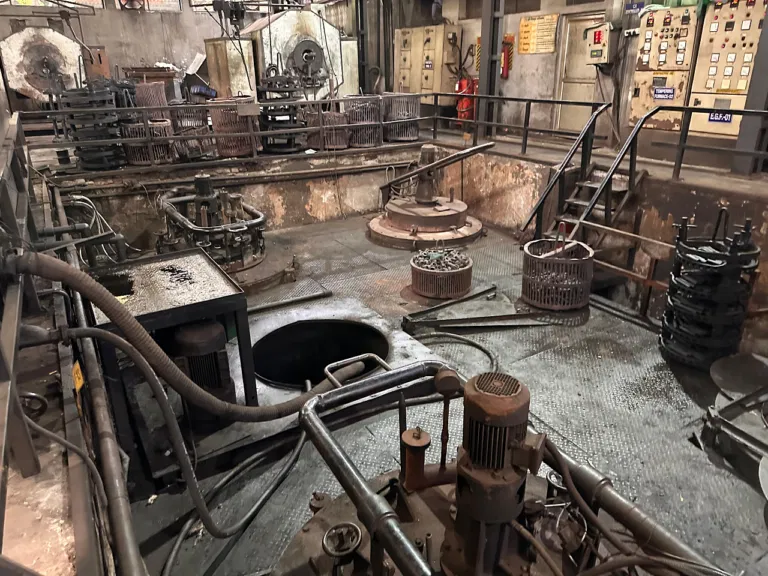
Executive summary: Treat the outage as a production project
A furnace shutdown is not simply a maintenance expense. It is a tightly scheduled production intervention whose quality affects throughput, fuel use, product yield and the next operating campaign. For plant heads and maintenance managers, the objective is to complete the right scope, with the right parts and people, within a controlled window, and return to stable, saleable production predictably.
That discipline matters across a steel rolling mill, heat treatment furnaces, melting operations and other industrial furnace systems. A planned outage also creates an opportunity to document equipment condition, verify controls and improve lifetime maintainability, without allowing unapproved scope growth to derail the restart date.
The cost of unplanned versus planned downtime
Start by calculating lost contribution, not simply lost sales:
Downtime exposure = constrained tonnes × contribution margin per tonne + restart fuel + scrap/rework + downstream disruption
For example, a line producing 150 tonnes per hour that is unavailable for six hours exposes 900 tonnes of production. The financial impact depends on the plant’s contribution margin, buffers, alternate capacity and customer commitments.
Outage duration varies with furnace design, lining condition, access, repair scope and curing requirements. Use the following as initial planning envelopes, not guaranteed or universal benchmarks:
- 3–5 days: inspection and defined minor repairs.
- 7–14 days: planned burner work and localized refractory repairs.
- 14–30+ days: major reline, extensive mechanical work or a complex campaign.
The critical distinction is not the number of outage days alone. It is whether inspection, procurement, prefabrication and work sequencing happen before production stops.
Phase 1: Plan at 12 months and 6 months
At 12 months: build and rank the scope
Create one integrated scope register across operations, maintenance, engineering, procurement and quality. Rank each task by consequence of failure, production impact, lead time and whether it can be completed while the furnace is operating.
Assess, as applicable:
- Refractory condition, anchors, shell hotspots and expansion joints.
- Burner assemblies, fuel trains, fans and recuperators.
- Thermocouples, control valves, cabling and temperature-recording systems.
- Doors, seals, charge/discharge mechanisms, quench systems and handling equipment.
- Interfaces with downstream lines, such as a hot dip galvanizing plant or wire and cable industry operation.
At 6 months: freeze the scope and fund it
Approve the outage window, work packs, contractor plan, budget and contingency. Define which findings justify additional work and who authorizes it. Document inspection criteria and acceptance tests before the outage begins.
For energy performance, compare like with like: fuel quality, charge temperature, throughput, product mix and operating temperature all affect results. ISO 13579-2 provides a method for measuring the energy balance and calculating efficiency for steel reheating furnaces.
Phase 2: Make parts readiness a gate, not a hope
A missing component can delay a shutdown far longer than its installation takes. Build the bill of materials against the approved scope, verify dimensions and specifications, and tag items to work packs.
Confirm stock or delivery dates for:
- Burner spares: tips, nozzles, pilots, igniters and flame-scanner components.
- Instrumentation: thermocouples, connectors, transmitters and calibrated test equipment.
- Refractory: approved grades, anchors, modules or prefabricated panels, plus installation consumables.
- Rotating and flow equipment: fan bearings, seals, belts, couplings and control valves.
- Auxiliary systems: quench components, pumps, handling parts and electrical/control spares.
Prioritize long-lead and single-point-of-failure items. For a melting furnace for steel or a metal recycling furnace, confirm that the selected materials and parts suit the operating atmosphere, temperature and charge conditions. Keep critical furnace spare parts labelled, protected and available at the worksite before shutdown authorization.

Phase 3: Execute to a joined-up critical path
The outage schedule should sequence cool-down, access, inspection, repair, installation, checks and commissioning, not just list trade activities. Assign a single owner to the integrated schedule and record progress by work pack.
Refractory work and dry-out
Refractory curing and dry-out are material- and geometry-specific. A 24–72-hour or longer controlled heat-up may be a useful early planning allowance for some repairs, but thick linings, moisture levels, castable chemistry and ambient conditions can extend it substantially. The approved supplier curve governs.
As an illustrative planning envelope, a repair may require staged holds in the 100–150°C range followed by controlled ramps and intermediate holds as specified for the installed lining. Do not apply a generic ramp rate to every furnace. Log lining temperatures, hold times and any deviations; obtain sign-off before advancing to the next stage.
Burners, mechanical and electrical work
Complete burner inspection, valve checks, fan and drive work, instrument replacement and electrical terminations against the approved drawings and test sheets. Include functional checks of burner safeguards and fuel-handling arrangements. ISO 13577-2 covers combustion and fuel-handling systems for industrial furnaces.
Bundle dependent work to avoid repeated access and handovers. A continuous heat-treatment line, steel reheating furnace and aluminum melting furnace will have different equipment interfaces and commissioning needs; a common schedule template should not become a one-size-fits-all work plan.

Phase 4: Restart, validate and release production
Restart is a commissioning phase, not the end of the shutdown. Follow site procedures and the approved equipment-specific sequence. Record each hold point and authorize the next step only after the responsible team accepts the results.
- Verify completion records, outstanding defects and instrument checks.
- Confirm the refractory dry-out record and permitted heat-up curve.
- Conduct burner and control-system functional tests, then establish stable low-fire operation before increasing load as approved.
- Ramp and soak in accordance with the furnace design, refractory specification and process recipe.
- Validate furnace temperature, uniformity and process conditions before loading production material.
- Confirm first-heat or first-batch quality, then release the line through a documented operations and quality sign-off.
Set temperature targets for the actual process. As broad context only, steel reheating commonly involves discharge temperatures around 1,100–1,250°C, while steel melting and aluminum melting operate at very different process temperatures. These are not restart setpoints; the product grade, furnace design and approved process recipe determine the correct values. For automotive component applications, see Continental Furnaces’ industrial furnaces for automotive heat treatment.
2026 planning tools that can shorten the outage
Technology delivers value when it removes work or uncertainty from the critical path:
- Prefabricated refractory panels and modules can reduce on-site fitting where the furnace geometry and design permit.
- Digital twins and 3D models can help scope access, estimate quantities and identify clashes before shutdown.
- Remote diagnostics can support troubleshooting and parts identification before specialist teams travel.
- Pre-tested burner assemblies and instruments reduce installation and fault-finding time.
- Recuperator, burner or burner-management upgrades can be evaluated during the outage, with commissioning and acceptance tests included in the plan.
Treat these as project options, not automatic savings. Any retrofit must have a defined scope, compatibility review and commissioning plan.
Traditional reactive shutdown vs. planned turnaround
The figures below are illustrative planning ranges and targets for site validation, not guaranteed industry averages. Compare only similar furnace types and work scopes.
| Measure | Reactive approach | Planned, data-led approach |
|---|---|---|
| Major multi-discipline outage | Often 14–30+ days when scope and parts emerge late | 7–21 days may be achievable for a defined scope; major relines can take longer |
| Reheat-furnace fuel use at stable operation | Establish site baseline; poorly performing units may exceed 1.7 GJ/t | Indicative planning range 1.2–1.6 GJ/t; normalize conditions before comparison |
| Labour requirement | More standby, overtime and repeat access | Crew hours planned by work pack; track against an agreed baseline |
| Reheat and rework | Often discovered after restart | First-heat checks and quality gates reduce avoidable instability |
| First-pass yield | Establish baseline by product and furnace | Set a site-specific improvement target; verify through production records |
| Schedule adherence | Late scope changes and missing parts drive overruns | Freeze scope, stage long-lead items and track critical-path completion |
For any fuel or productivity project, calculate payback using measured site data. A 6–18-month payback may be a reasonable screening target for a tightly scoped improvement with verified savings, but the result depends on utilization, energy prices, capital cost and realized uptime. Do not combine overlapping energy-saving estimates.
Audit every outage with a KPI dashboard
Review results at restart, then again after stable operation, typically within 30 days. Track:
- Total outage hours and schedule adherence.
- Planned versus emergent work and hours by work pack.
- Critical-path delay and parts-related waiting time.
- Dry-out curve compliance and commissioning rework.
- Time from first fire to first saleable product.
- Startup fuel per restart and stable specific energy consumption (GJ/t).
- First-pass yield, scrap, reheat and quality holds.
- Defects and forced stoppages within 30 and 90 days.
- Total outage cost per tonne of planned production.
Build the next turnaround as an enduring partnership
An effective outage protects more than the shutdown date. It safeguards yield, energy performance and customer delivery while strengthening the next operating campaign. As a leading industrial furnace manufacturer with 35+ years of experience, Continental Furnaces brings customized thermal processing equipment, ISO-certified quality and prompt service to furnace planning and lifecycle support.
Share your furnace type, operating conditions, planned window and maintenance priorities with our team. Start a practical turnaround discussion through Continental Furnaces or request a quote, and make the next shutdown a deliberate investment in sustained competitive advantage.