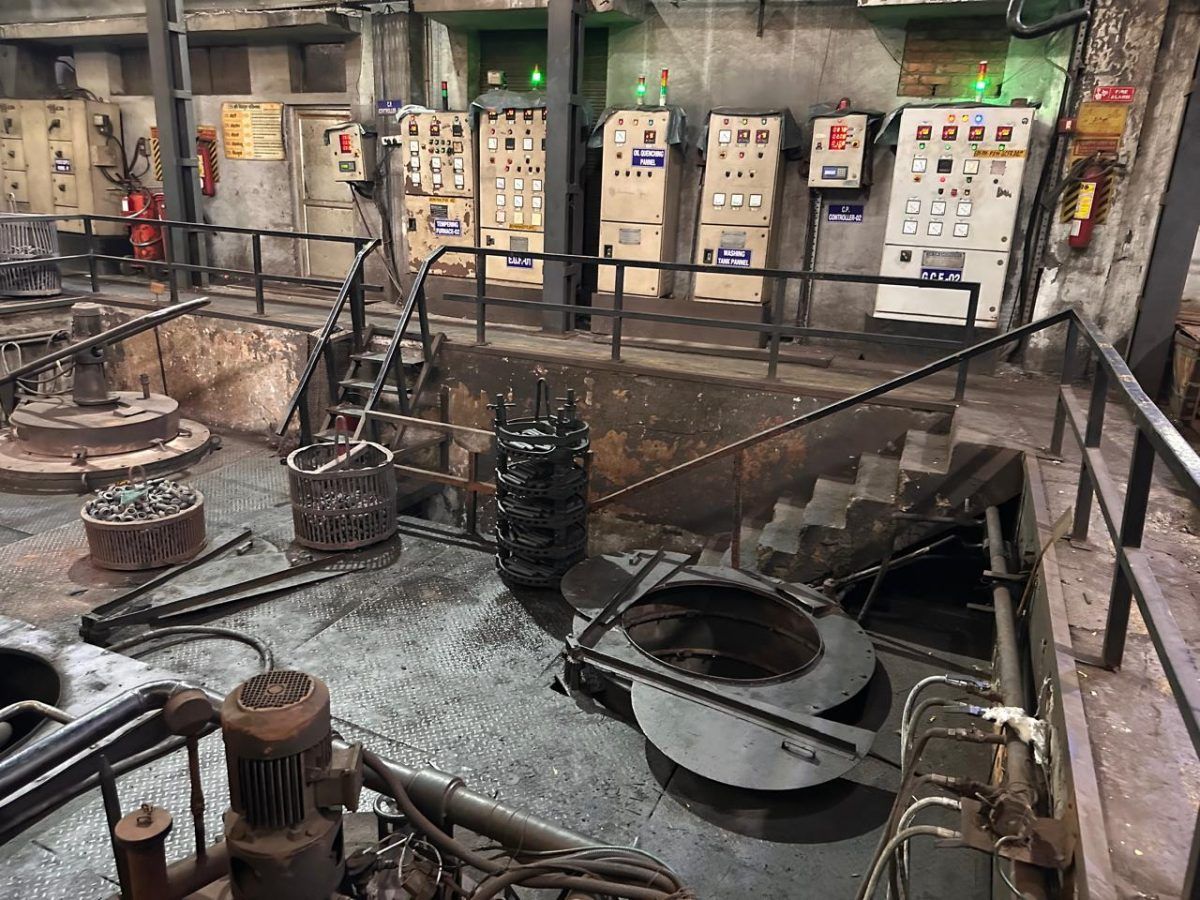
All numerical figures below are indicative benchmarks from published surveys, plant reports, regulatory texts and supplier references. They vary by plant, feed, alloy, line type, throughput and local regulation. Confirm process windows and acceptance criteria against the current controlled specification and the part drawing.
Atmosphere discipline determines nitriding performance
Gas nitriding and ferritic nitrocarburizing (FNC) are low-distortion thermochemical treatments conducted below the steel transformation range. Their performance depends on more than temperature and time: ammonia supply purity, dissociator reliability, gas distribution and nitriding-potential control determine the layer structure.
A 50–120-hour cycle exposed to drifting atmosphere conditions can jeopardize an entire load of gears, crankshafts or H13 dies. Treat the ammonia dissociator, retort and instrumentation as a process asset with a documented maintenance program. This is particularly important because the dissociator can be overlooked even while other gas-generation equipment receives scheduled attention.
Process windows and layer outcomes
Gas nitriding commonly runs at 495–565 °C for 10–80 hours, producing typical case depths of 0.20–0.65 mm. Its diffusion zone supports fatigue and wear performance, while the compound layer, often called the white layer, typically measures approximately 3–20 µm. Published ranges can extend to 5–25 µm depending on process and material. Bodycote’s overview describes the process and its applications.

Indicative thermochemical windows for nitriding-family processes
| Process | Operating window | Atmosphere | Layer outcome | Typical duty |
|---|---|---|---|---|
| Two-stage gas nitriding | 495–565 °C; ~10–80 h | NH3; stage-one dissociation ~15–30%, stage two ~65–85%, or Kn control | Diffusion zone; compound layer controlled to specification | Fatigue and wear parts |
| FNC | 540–590 °C; ~1–6 h | NH3 plus carbon-bearing gas | Epsilon-rich compound layer | Corrosion and wear |
| Post-oxidation after FNC | Roughly 500–600 °C | Steam or oxidizing step | Magnetite seal; ~450–600 h salt-spray class | Black corrosion-resistant finish |
These are process-family benchmarks, not substitute specifications. Typical surface hardness is approximately 550–650 HV for 4140-class steel and 1,000–1,200 HV for H13 tool steel. Common applications include crankshafts, camshafts, gears, spindles, ball screws, extrusion screws, die-casting dies, wire-drawing dies and capstans.
Dissociator reliability and Kn control
An ammonia dissociator cracks anhydrous NH3 over a nickel catalyst at approximately 850–950 °C, producing a nominal 75% H2 / 25% N2 mixture. Residual ammonia in unpolished cracked gas can be approximately 20–500 ppm. Molecular-sieve purification can reduce it to 1–3 ppm and lower dew point from around −30 °C to as low as −80 °C, though many industrial systems specify −40 to −60 °C. Indicative energy demand is 0.5–0.9 kWh per m³ of cracked gas.
A small unit may produce about 5 m³/h at approximately 4 kW; larger plants are sized to their production demand. Include these checks in the asset plan:
- Inspect the catalyst annually and review replacement at approximately 3–5 years, subject to condition and operating hours.
- Check gas purity weekly and calibrate analysers quarterly as an indicative cadence.
- Keep ammonia supply dry. Moisture can contribute to etching, staining or corrosion.
- Maintain sample lines, filters and drip legs so moisture does not corrupt measurements.
- Review heating elements, retort condition, catalyst retention grids and maintenance access.
Nitriding potential is Kn = pNH3 / pH2^(3/2). Two-stage practice commonly uses higher Kn in stage one to build the diffusion zone and lower potential in stage two to manage compound-layer growth. AMS 2759/10-style setpoints are often cited as 4–15 for stage one. Stage-two ranges depend on the white-layer requirement: approximately 0.2–0.8 for none, 0.4–2.6 for up to 0.0005 in (about 13 µm), and 1.2–5.5 for up to 0.001 in (about 25 µm). Verify exact class limits and the applicable revision before production. Super Systems’ process-control paper explains the role of hydrogen measurement and potential-based control.
Constant-flow nitriding is open-loop: it does not automatically compensate for changing load surface area, retort loading or dissociation drift. Closed-loop Kn control uses continuous hydrogen measurement, commonly through thermal-conductivity or H2 analysers, to adjust ammonia dosing. The result is more repeatable white-layer structure, more controlled gas use and lower emissions. For equipment planning, see Continental Furnaces’ heat treatment furnaces page.
Retort hygiene, white-layer discipline and FNC
Retort deposits and contaminated fixtures can catalyze ammonia dissociation before the gas reaches the workload, skewing dissociation readings. Clean the retort and internal furniture regularly, and shot-blast or glass-bead-blast load supports. Avoid plain-carbon or low-alloy steel racks inside the retort: they can absorb nitrogen and disrupt process consistency. If dissociation readings fall, inspect flow lines for internal oxidation or restriction as well as reviewing catalyst condition.
Parts must be free of coolants and machining residues before loading. Contamination can cause staining and soft spots. Where drawings do not require a compound layer, prevent its growth through potential control or remove it with light lapping or buffing. Avoid grinding the finished case, which can remove the beneficial hardened surface.
FNC adds a carbon-bearing gas, such as endothermic gas providing CO or a CO2-based recipe. Higher carbon in the compound layer supports epsilon-phase formation and can improve wear and corrosion behavior. Post-oxidation aims to form dense magnetite, Fe3O4, that fills layer porosity and creates the characteristic black finish. The chemistry must favor magnetite; other iron oxides provide inferior protection. Salt-spray results around 450–600 hours are indicative and depend on process control and test conditions.
AMS 2759/10 and AMS 2759/12 provide process context for potential-controlled nitriding and FNC. CQI-9-style temperature-uniformity expectations around ±8 °C (±14 °F) are commonly cited practice, not a universal specification.
Atmosphere symptom → what it is telling you → first corrective action
| Symptom | What it is telling you | First corrective action |
|---|---|---|
| Dissociation degree falling or drifting | Retort deposits, fixture contamination or catalyst aging | Clean retort and furniture; review catalyst hours |
| Staining or etching | Moist ammonia supply | Dry or purify supply; check dew point |
| Inconsistent white layer load-to-load | Open-loop constant flow | Move to Kn control with H2 analyser |
| Soft spots in hardness pattern | Dirty surfaces or flow maldistribution | Reinforce cleaning and review fixturing |
| Brittle, cracked compound layer | Stage-two Kn too high | Lower stage-two Kn to the white-layer specification |
| Ammonia odour or high exhaust slip | Excess dosing or exhaust treatment issue | Review dosing and post-combustion or scrubber health |

2026 technology and market updates
Closed-Loop Kn Control Becomes the Default
Digital controls increasingly measure hydrogen continuously and calculate or adjust nitriding potential automatically. A fixed analyser can calculate Kn, ammonia percentage and dissociation values from hydrogen readings. SSi’s nitriding analyser provides an example; Nitrex’s NITREG brochure describes potential-controlled processing. The value is measurable in repeatability, white-layer control and process records.
Low-Flow Nitriding and Ammonia Discipline
SECO/WARWICK’s ZeroFlow approach uses real-time hydrogen measurement and periodic ammonia dosing in a tightly controlled retort. Published supplier references cite ammonia savings of up to roughly 10 times versus continuous-flow practice in suitable operating conditions; performance must be confirmed against a plant baseline. A small exhaust utilization burner supports treatment of process gas. The 2026 conference programme also lists an internal ammonia dissociator concept, IAD/EnerSever, and the SimNit process simulator, intended to bring dissociation, retort control and cycle development closer together. See the ZeroFlow technical paper and 2026 conference listing.
Ammonia as a Hydrogen Carrier Meets the Shop Floor
On-site ammonia cracking is being assessed as a hydrogen supply route, with techno-economic estimates around $3–5 per kg of hydrogen at current ammonia prices. These estimates are indicative; electrochemical cracking remains at lower technology readiness. Heat treaters already operating a cracker have transferable expertise in dry supply, catalyst monitoring and gas purity. See the ammonia-cracker reference and the cited review of ammonia decomposition.
What this means across your furnace fleet
The same atmosphere discipline protects roll-neck and guide hardware in a steel rolling mill, and dies and capstans used in the wire and cable industry. Tooling and die blocks in an aluminum melting furnace or metal recycling furnace operation, a melting furnace for steel shop, and hardware associated with a hot dip galvanizing plant all depend on dependable thermal processing and maintenance practices. An experienced industrial furnace manufacturer can align industrial furnace systems, instrumentation and furnace spare parts planning across these production areas. For related plant capabilities, see Continental Furnaces’ furnace spares and accessories gallery.
Four-phase roadmap for process stability
- Phase 1: As-found atmosphere audit (30–60 days). Log dissociation and dew-point records, verify ammonia dryness, inspect retort deposits and fixture materials, and baseline Kn data.
- Phase 2: Instrumentation and measurement discipline (1–2 quarters). Add or calibrate H2/Kn instrumentation, maintain sample lines, institute weekly purity checks and quarterly analyser calibration, and track catalyst hours.
- Phase 3: Operating and cleaning discipline (3–6 months). Set retort and furniture cleaning intervals, establish pre-load cleaning standards, review white-layer requirements with customers, and set min-max stock for dissociator and retort consumables.
- Phase 4: Potential-controlled and low-flow upgrade (6–18 months). Evaluate closed-loop Kn or low-flow dosing, improve exhaust post-combustion, and use trend data to plan catalyst replacement.
Build an enduring partnership around uptime
Continental Furnaces brings 35+ years of thermal processing equipment expertise to customized solutions, lifecycle support and responsive service. Build an enduring partnership focused on process stability, reduced downtime and sustained competitive advantage. Request a consultation and quote.
Technical references
- Super Systems, “Gas Nitriding” technical bulletin T4601-1
- Super Systems, “A Practical Approach to Controlling Gas Nitriding and Ferritic Nitrocarburizing”
- ASM International, “One Minute Mentor: Process Control in Nitriding Systems”
- Nitrex, “NITREG potential-controlled nitriding” brochure
- Bodycote, gas nitriding process overview
- Gear Solutions, “Nitriding of Steels”
- SECO/WARWICK, “Gas nitriding technology ZeroFlow” paper
- SECO/WARWICK ZeroFlow nitriding furnaces
- SubsTech, “Ammonia cracker” technical reference
- Mahler-Börsig ammonia crackers
- Alpha Detroit, “Troubleshooting Nitriding Process Problems – Part 1”
- The Monty Heat Treat News, “A Guide to Troubleshooting the Nitriding Process”
- SSi Europe fixed H2/O2 analyser for nitriding and FNC
- AHT, “When to Use Nitrocarburizing / Nitriding”