Why Predictive Maintenance Is Essential in 2026
For a modern manufacturing plant, furnace availability is directly linked to throughput, yield and profitability. A failure in a reheat furnace, steel rolling mill, aluminum melting furnace or hot dip galvanizing plant can stop an entire production chain, not only the thermal unit.
Traditional maintenance models remain insufficient:
- Reactive maintenance waits for failure and accepts maximum disruption.
- Preventive maintenance replaces components at fixed intervals, regardless of actual condition.
- Predictive maintenance uses live data to identify degradation, forecast failure and schedule intervention during a controlled operating window.
The 2026 objective is not simply to collect more data. It is to convert furnace data into early warnings, maintenance decisions and measurable uptime improvement.
Industry research indicates that mature AI-enabled maintenance programs can target 25–30% lower maintenance costs and 35–45% lower unplanned downtime, although actual results depend on asset criticality, sensor quality, operating discipline and historical failure data. These figures should be treated as implementation benchmarks, not automatic guarantees.
The Sensor Strategy: Monitor Failure Mechanisms, Not Just Temperature
A successful condition-monitoring program begins with failure-mode analysis. Installing sensors without defining the failure mechanism creates dashboards, not reliability.
1. Thermal and process sensors
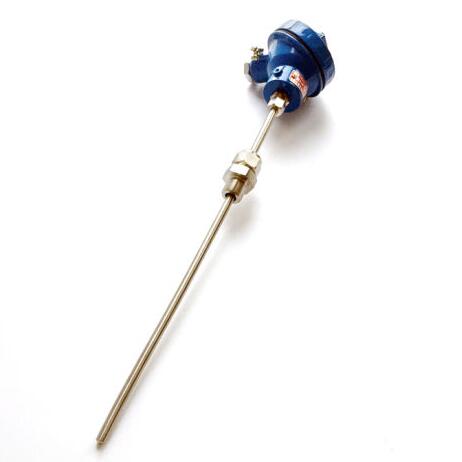
Thermal signals remain the foundation of monitoring for heat treatment furnaces and other industrial furnace systems.
Recommended measurements include:
- Furnace-zone temperature and temperature uniformity
- Exhaust-gas temperature
- Furnace pressure and draft
- Fuel flow and combustion-air flow
- Oxygen concentration in flue gas
- Tube-metal or casing temperature where applicable
- Bath or pot temperature in galvanizing operations
- Melt temperature and holding-temperature stability
- Cycle time, loading pattern and production rate
A steady rise in exhaust temperature, for example, may indicate heat-transfer deterioration, air leakage or burner performance loss. A widening temperature difference between zones may indicate sensor drift, burner imbalance, insulation deterioration or process loading changes.
Thermal cameras add another layer of visibility. Periodic infrared surveys can identify abnormal casing temperatures and localized hot zones that are not visible through standard control-room readings.
2. Vibration and mechanical-condition sensors
Many furnace failures originate in connected mechanical equipment rather than the chamber itself. Critical monitoring points include:
- Combustion-air blowers
- Exhaust fans
- Recirculation fans
- Charging and extraction mechanisms
- Furnace doors and lifting systems
- Rolling-mill drives
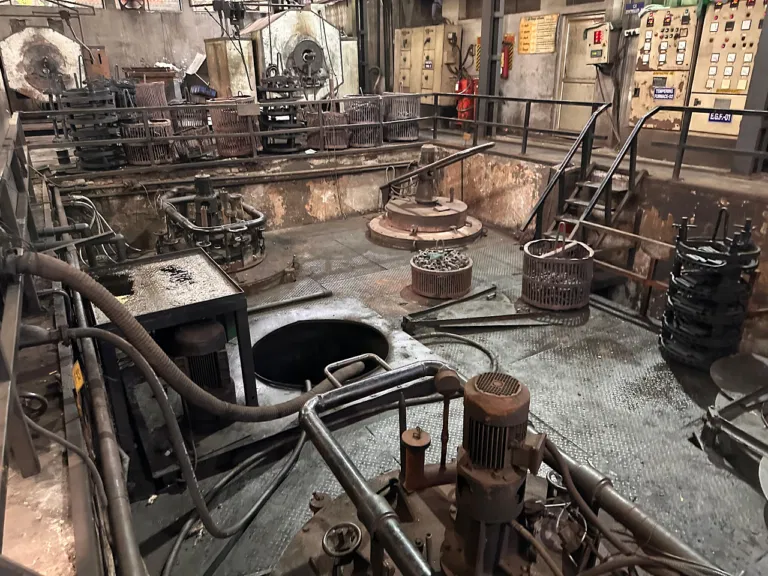
- Pumps, gearboxes and hydraulic power units
- Wire and cable industry line drives
Accelerometers can detect imbalance, misalignment, looseness and bearing degradation. For high-speed rotating equipment, high-frequency vibration data can identify early-stage defects well before audible noise or excessive temperature develops.
3. Electrical and acoustic monitoring
Motor-current signature analysis can reveal changes in motor loading, rotor condition, insulation health and mechanical resistance. Acoustic and ultrasonic sensors are valuable for identifying:
- Compressed-air leaks
- Gas-valve abnormalities
- Bearing damage
- Mechanical friction
- Structural cracking
- Abnormal combustion noise
The most reliable programs combine thermal, vibration, electrical and process data rather than depending on one signal.

Failure Prediction Across Furnace and Mill Assets
Predictive maintenance models should be trained around specific failure modes and operating conditions. A generic alarm threshold is less effective than a model that understands production load, furnace recipe, ambient conditions and historical interventions.
| Asset or subsystem | Primary sensors | Typical leading indicators | Maintenance decision |
|---|---|---|---|
| Heat treatment furnace | Zone temperature, pressure, fuel flow, IR imaging | Increasing thermal deviation, unstable pressure, abnormal casing temperature | Inspect combustion, instrumentation and insulation |
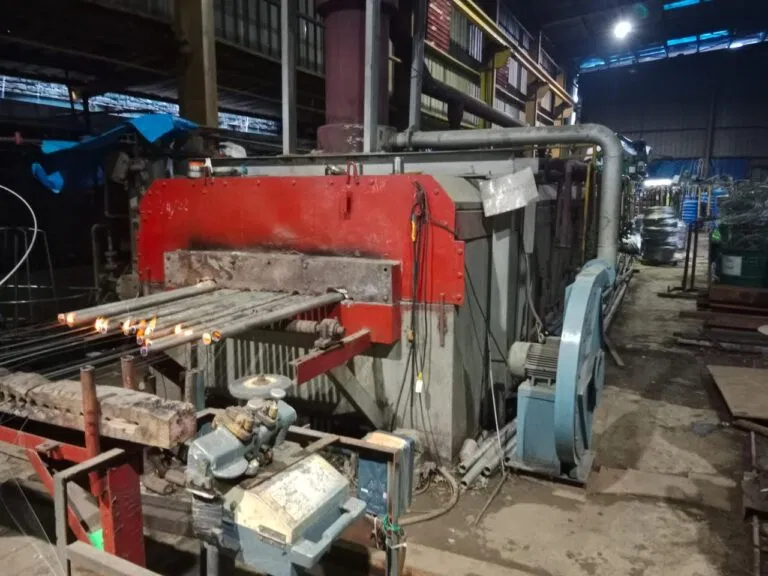
| Steel rolling mill reheat furnace | Zone temperatures, exhaust temperature, fan vibration | Temperature non-uniformity, fan vibration trend, draft instability | Plan inspection during the next production window |
| Aluminum melting furnace | Melt temperature, burner data, exhaust temperature, motor current | Longer melt cycle, unstable temperature recovery, rising drive load | Inspect burner, charging system, fan and electrical components |
| Hot dip galvanizing plant | Pot temperature, atmosphere data, fan vibration, strip temperature | Bath instability, fan imbalance, strip-temperature drift | Investigate heating, atmosphere, drive or circulation systems |
| Metal recycling furnace | Charge-cycle data, temperature, electrical load, vibration | Longer cycle time, abnormal load response, thermal instability | Check charging, burner, blower and material-handling equipment |
| Furnace doors and lifting systems | Position, motor current, vibration, cycle time | Increased opening time, current spikes, positional error | Service drive, guide, chain, limit switch or actuator |
For selected furnace components, models may identify degradation 2–4 weeks before a critical event when sufficient historical data and high-quality thermal signals are available. For rotating assets, remaining-useful-life estimates may extend to 30–90 days, depending on component type and failure history.
These estimates must always be validated by qualified engineers. AI should support engineering judgment, not bypass safety procedures.
Digital Twins: From Alarm Generation to Maintenance Simulation
A digital twin is a virtual representation of a physical furnace, production line or asset. It combines equipment geometry, design parameters, process data, inspection history and live sensor readings.
For an industrial furnace manufacturer, the most valuable digital-twin applications include:
- Simulating temperature distribution across furnace zones
- Tracking the relationship between load pattern and thermal response
- Comparing normal and abnormal combustion signatures
- Modeling fan, drive and extraction-system behavior
- Forecasting the effect of a developing fault on production
- Testing maintenance options before making a physical intervention
- Coordinating furnace maintenance with mill, galvanizing or casting schedules
A digital twin for a melting furnace for steel may combine charge weight, power or fuel demand, temperature recovery, cycle duration and equipment vibration. A twin for an aluminum melting furnace can monitor thermal response, charging behavior and holding stability. A galvanizing-line twin can connect furnace condition with strip temperature, line speed and downstream quality.
The business value is significant: maintenance teams can compare “run to next outage” against “intervene now” using production risk, safety exposure and expected repair cost.
2026 Technology Updates: Edge AI, Multimodal Data and Prescriptive Maintenance
The next development in Industry 4.0 is the movement from isolated dashboards to intelligent, plant-level decision support.
Edge AI
Edge computing processes data near the equipment rather than transmitting every high-frequency signal to a remote cloud. This enables:
- Faster anomaly detection
- Lower bandwidth requirements
- Continued operation during network interruptions
- Better protection of sensitive production data
- Millisecond-level response for selected non-safety control actions
Multimodal sensing
The strongest models fuse multiple data types:
- Temperature
- Vibration
- Pressure
- Flow
- Electrical current
- Acoustic emissions
- Operator inspection notes
- Maintenance work orders
- Production and quality records
This approach reduces false alarms. A temperature increase becomes more meaningful when accompanied by rising fuel flow, fan vibration or pressure instability.
Prescriptive maintenance
Predictive maintenance answers: “What is likely to fail, and when?”
Prescriptive maintenance adds: “What should we do, when should we do it, and what will be the operational impact?”
A prescriptive system may recommend:
- Reducing load within approved operating limits
- Inspecting a blower during the next shift change
- Reserving a specific furnace spare part
- Scheduling an intervention before a high-value production campaign
- Comparing repair cost against the risk of continued operation
IBM’s 2026 overview of AI in predictive maintenance describes this progression from fixed schedules to data-driven asset decisions.
A Practical Roadmap for Implementation
Phase 1: Assessment and planning
Identify the 10–15 assets where failure creates the highest operational and financial risk.
Document:
- Failure modes
- Existing sensors
- Historical breakdowns
- Production losses
- Safety and compliance implications
- Availability of OEM manuals and inspection records
Phase 2: Baseline and instrumentation
Establish normal operating signatures across different loads and recipes. Install sensors only where they improve a defined maintenance decision.
Prioritize:
- Furnace temperature and pressure
- Flue-gas and combustion parameters
- Fan and motor vibration
- Drive current
- Critical door, charging and extraction movements
- Thermal imaging inspection points
Phase 3: Analytics and CMMS integration
Connect condition-monitoring alerts with the maintenance management system. An alert should create an actionable workflow containing:
- Asset identification
- Probable failure mode
- Confidence level
- Recommended inspection
- Required furnace spare parts
- Safe intervention window
- Escalation responsibility
Phase 4: Digital twin deployment
Begin with one high-value furnace or production line. Calibrate the model against real operating data, inspection results and maintenance outcomes. Expand only after the first deployment demonstrates reliable decision value.
Phase 5: Governance and continuous improvement
Align the program with recognized frameworks such as ISO 17359 condition-monitoring guidance, asset-management principles and applicable functional-safety requirements.
Predictive alerts must never override independent safety interlocks, burner-management systems or emergency shutdown logic.

The Commercial Case for Condition Monitoring
| Maintenance approach | Typical decision basis | Labour requirement | Downtime exposure | Inventory strategy |
|---|---|---|---|---|
| Reactive | Failure has occurred | Emergency response | Very high | Expedited purchasing |
| Preventive | Calendar or running hours | Regular planned labour | Moderate | Broad safety stock |
| Predictive | Measured condition and risk | Targeted intervention | Low when mature | Condition-based stocking |
| Prescriptive | Predicted failure plus production impact | Optimized cross-functional planning | Lowest practical exposure | Risk-ranked inventory |
For a plant operating an aluminum melting furnace, metal recycling furnace or galvanizing line, the return is not limited to avoided repair cost. It includes:
- Higher equipment availability
- Better production scheduling
- Fewer emergency callouts
- Improved maintenance labour productivity
- Lower risk of collateral damage
- More disciplined spare-parts planning
- Stronger regulatory and safety records
Continental Furnaces supports customers with heat treatment furnaces, furnace spares and accessories, customized thermal processing equipment and lifecycle service. With more than 35 years of industrial experience, our engineering approach connects furnace design, condition monitoring and long-term maintainability.
Conclusion: Convert Furnace Data into Sustained Competitive Advantage
Predictive maintenance is now an essential capability for steel rolling mills, heat treatment operations, aluminum foundries, recycling facilities, galvanizing plants and the wire and cable industry. The winning strategy combines correct sensor placement, failure-mode engineering, AI analytics, digital twins and fast technical response.
Do not begin with a generic software dashboard. Begin with your critical assets, known failure mechanisms and measurable uptime targets.
Consult Continental Furnaces to assess your industrial furnace systems, define a 2026 condition-monitoring roadmap and build an enduring partnership focused on reliability, profitability and sustained competitive advantage.