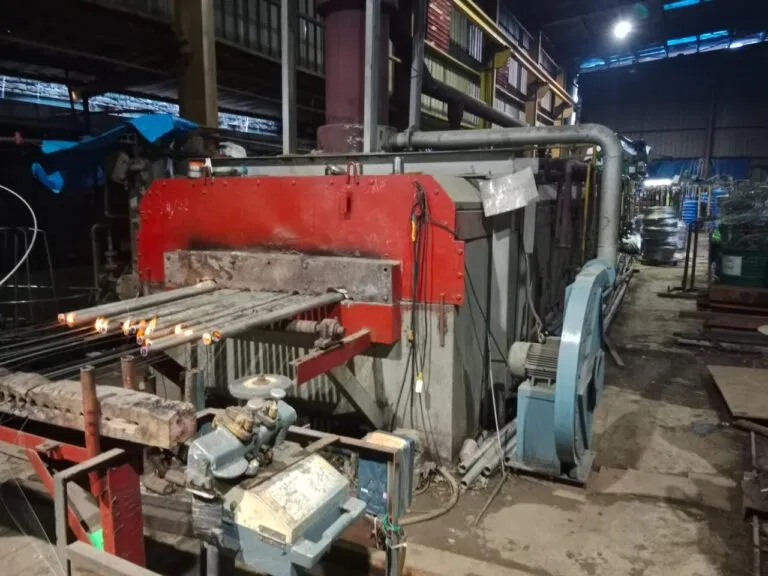
Refractory linings are engineered components, not interchangeable consumables. Their performance affects heat loss, product quality, maintenance frequency, worker safety and the cost of unplanned downtime. For a steel rolling mill, heat treatment line or melting operation, the right choice depends on what each zone experiences: temperature, cycling, abrasion, atmosphere and chemical contact.
In this 2026 edition, we outline a practical way to select lining materials, control dryout and manage repairs across the furnace lifecycle. The values below are screening benchmarks, not universal design specifications; final selection must be confirmed against the refractory supplier’s data, installation method and actual operating conditions.
Match the lining to the zone, not just the furnace
A furnace rarely has one uniform refractory duty. The roof, hearth, doors, burner blocks, skid areas and metal-contact zones can fail for different reasons. Before specifying a material, document:
- Continuous and peak hot-face temperature, plus start-stop frequency.
- Atmosphere, dust, scale, slag, flux or molten-metal contact.
- Abrasion, impact, load, vibration and gas flow.
- Required shell temperature, insulation thickness and available space.
- Installation access, curing requirements and repair method.
The table compares common options. Conductivity figures are indicative and must be checked at the same test temperature and method before comparing supplier offers. Maximum or classification temperature is not necessarily a recommended continuous operating temperature.
| Lining option and common zones | Indicative service-temperature range | Indicative thermal conductivity | Cycle-life fit | Relative installed cost |
|---|---|---|---|---|
| Dense high-alumina castable or brick: hearths, burner blocks, skid supports, impact zones | Product grades commonly rated up to about 1,750°C | About 1.2–2.0 W/m·K at 400°C for representative dense castables | Strong working face where abrasion or mechanical loading dominates; inspect for cracking and chemical attack | $$–$$$ |
| Insulating castable: backup layer and lower-load zones | Representative products up to about 1,400°C | About 0.3–0.6 W/m·K | Useful as insulation; protect from impact and direct metal contact | $$ |
| Insulating firebrick (IFB): backup lining and rigid hot-face areas | A common K-23 grade is rated to about 1,260°C | About 0.14 W/m·K | Rigid, but thermal mass and cycling response differ from fibre | $$–$$$ |
| Ceramic-fibre blanket or module: walls and roofs with limited erosion | Common grades about 1,260–1,400°C | Approximately 0.08–0.10 W/m·K for representative products | Low thermal mass suits cycling; check shrinkage, joints, anchoring and dust/chemical exposure | $$–$$$ |
| Dense, low-porosity non-wetting castable: aluminum bath-contact and charging zones | Select to the process and metal/flux chemistry; temperature rating alone is insufficient | Working layer varies; insulation behind it is often below 0.5 W/m·K | Designed around penetration, wetting, erosion and thermal shock risks | $$–$$$$ |
These properties vary by formulation, density, thickness and test state. Request the actual datasheet, including conductivity at relevant mean temperatures, permanent linear change, strength, permeability and chemical compatibility. Standards such as ASTM’s refractory standards and ISO 10635 for ceramic-fibre products help establish a consistent test basis.
Apply the choices to operating conditions

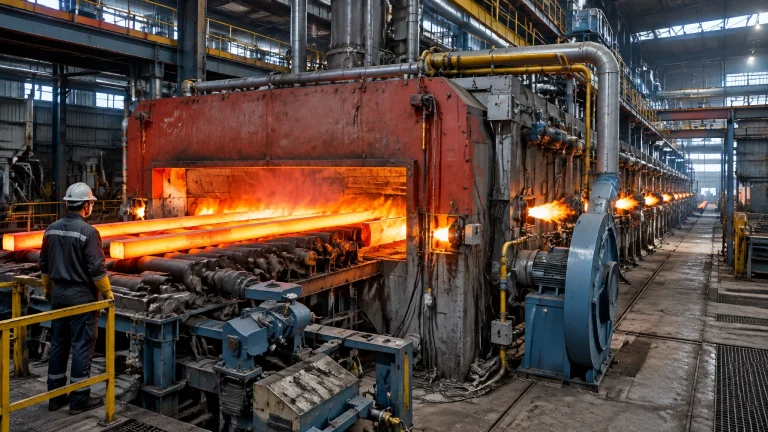
A steel reheating furnace typically needs a composite lining, not a single material throughout. Dense refractory suits burner blocks, skid supports, hearths and areas exposed to scale, abrasion or impact. Lower-conductivity insulation can reduce heat loss behind the working face and in less erosive roof or wall zones.
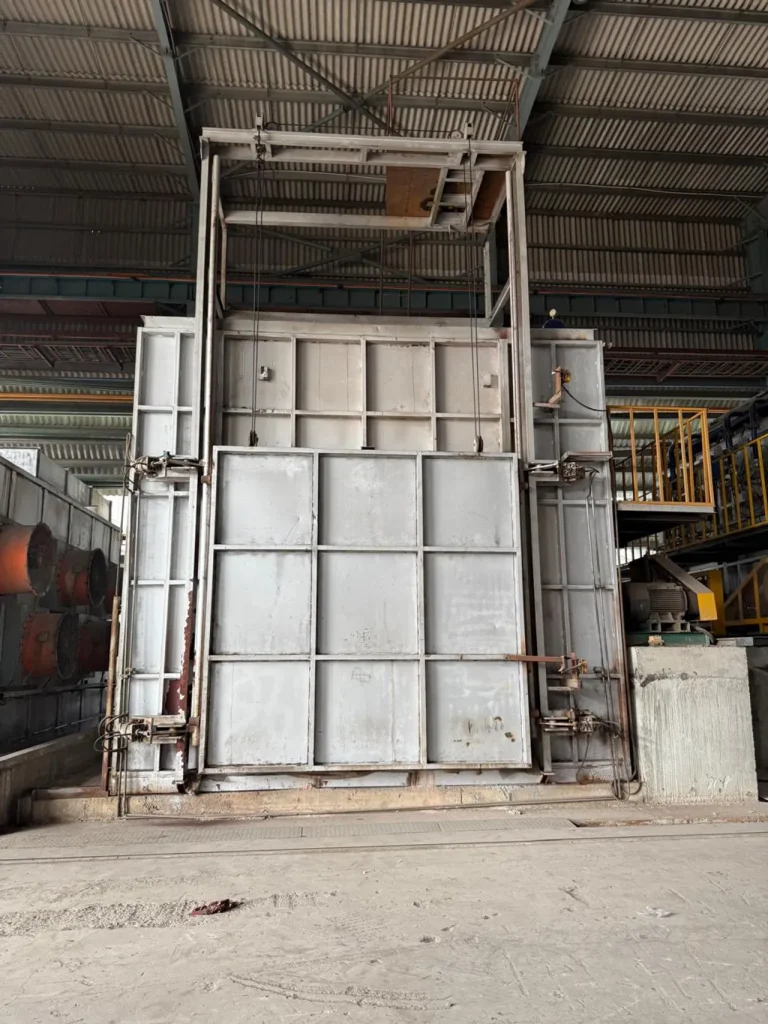
In heat treatment furnaces, ceramic-fibre modules can be appropriate for walls and roofs where rapid cycling and low thermal mass matter. Use IFB or insulating castable where rigidity or abrasion resistance is required, and dense refractory on loaded hearths, rails and door thresholds. Continental Furnaces’ heat treatment furnace solutions are engineered for application-specific thermal processing requirements.
For an aluminum melting furnace, specify the bath-contact working lining separately from the charging ramp, door sill and burner area. The bath-contact lining must address aluminum wetting and penetration, flux or oxide attack, and thermal shock. A compatible dense working face with an insulating backup is often more suitable than choosing a material solely for its nominal temperature rating. For steel melting, the refractory system must likewise be matched to the furnace type, steelmaking practice and slag chemistry.

Campaign-life economics: evaluate cost per service year
Lowest-first-cost purchasing can shift expense into repairs, energy loss and production interruptions. Compare options using total installed and operating cost:
Lifecycle cost = materials + installation + dryout + energy loss + inspections and repairs + production impact.
A simple example illustrates why campaign life matters: a lining installed for $100,000 and lasting four years has a basic installed cost of $25,000 per service year. A $125,000 lining lasting six years is about $20,800 per service year: before accounting for energy, repair or downtime differences. These figures are illustrative only; use site costs and verified campaign records to calculate payback.
Campaign life depends on duty, chemistry, cycling, lining design and operating practice. As broad references, overall furnace-lining life is often discussed in the range of 4–15 years, while one cited aluminum-furnace model uses four years for a melting furnace and 15 years for a holding furnace. Steel reheating references also report burner-block life improving from about one year to more than three years, while some skid insulation may need intermediate repair after roughly 2–2.5 years. Treat these as context, not warranties or design promises. Technical work on reheating-furnace refractories highlights the importance of thermal cycling, insulation and localized wear.
Dryout discipline protects the lining
Castables contain water that must be removed in a controlled way. Rapid heating can build steam pressure and cause explosive spalling. The refractory manufacturer’s written curing and dryout schedule always takes precedence over a generic program.
A conservative reference sequence for a dense castable may include curing for at least 24 hours, then controlled heating at approximately 10–25°C per hour toward 100°C, followed by a 4–6-hour hold. Further gradual ramps and holds around 200°C and 300°C, then 600°C, may be specified to manage water release and bond development. Thick sections, particularly those over 150–200 mm, may require slower ramps or longer holds.
Use calibrated thermocouples, controlled ventilation and a documented temperature log. Fibre linings generally have less moisture-related spalling risk, but binders, anchors and joints still require adherence to the supplier’s startup instructions.
Hot repairs and predictive management
Hot repair can restore localized lining damage and help avoid a full replacement, but it is not a substitute for diagnosing the failure mechanism. A qualified refractory specialist should confirm the material, substrate condition, access and safe work limits before patching or gunning. The repair must bond to sound refractory and remain compatible with the surrounding lining; hot work must follow the equipment and material supplier’s procedures.
Build a condition history around repeatable observations:
- Map shell temperatures with thermography and fixed sensors where appropriate.
- Record cracks, hot spots, distortion, penetration and remaining lining thickness.
- Track repairs by furnace zone, material batch and operating hours.
- Set action limits for shell temperature and minimum acceptable lining thickness.
- Use inspection trends to distinguish isolated repair needs from systemic design or installation issues.
In 2026, three developments merit evaluation: lower-embodied-carbon refractory formulations, advanced monolithics and improved ceramic-fibre modules, alongside better integration of sensor data into predictive maintenance. Sustainability gains must be verified against service life, repair frequency and energy performance, not assumed from a product label. Circular-economy plans should also account for sorting and contamination before refractory waste is considered for reuse.
A four-phase refractory lifecycle roadmap
- Audit and assessment: Map furnace zones, operating cycles, known failures, shell temperatures and repair history.
- Selection and engineering: Specify each layer by thermal, mechanical and chemical duty. Validate compatibility, thickness, anchors and heat-loss requirements.
- Installation, dryout and commissioning: Inspect installation quality, document cure and dryout, and establish baseline operating temperatures.
- Lifecycle optimisation: Review inspections and repair trends, update campaign-life economics, and plan targeted interventions using condition data.
Continental Furnaces brings more than 35 years of experience in industrial furnace systems and customized thermal processing equipment. The right refractory strategy is an enduring partnership across engineering, commissioning, service and lifecycle improvement. Consult our team about your furnace duty and lining objectives, or submit a project through our request-for-a-quote page. A zone-by-zone review is a practical first step toward sustained competitive advantage.