Morning Edition | 22 October 2026
For high-carbon steels, spring grades and wire rod, decarburization is a surface-quality issue with direct consequences for fatigue performance, yield and downstream processing cost. A component can meet its bulk chemistry target and still fail to deliver reliable service if its surface loses carbon during reheating, rolling or heat treatment.
The control strategy is not a single furnace setting. It is a coordinated discipline across steel temperature, time at temperature, atmosphere chemistry, dew point, sealing and verification, from bloom reheating in a steel rolling mill to patenting or bright annealing in the wire and cable industry.
Why the surface-carbon balance matters
Decarburization occurs when carbon at the steel surface reacts with oxidizing species in the furnace atmosphere. The principal drivers are:
- Temperature and exposure time: longer exposure at elevated temperature gives surface reactions more opportunity to remove carbon.
- Oxidizing species: oxygen, water vapour and carbon dioxide can contribute to carbon loss.
- Atmosphere potential: the balance of gases determines whether the environment protects or depletes surface carbon.
Moisture deserves particular attention. Water vapour can act as a soft oxidizer, enabling continuing carbon loss without the obvious warning of a heavy protective scale. A clean-looking surface, therefore, is not proof of a carbon-protective atmosphere.
The relevant carbon potential is governed by the H₂/H₂O and CO/CO₂ ratios. Dew point is a useful indicator of moisture in the atmosphere, but it is not a complete measure of carbon potential. A target dew point must be established in context: against the steel grade, process temperature, gas composition and operating conditions, not copied as a universal setpoint.
Temperature sensitivity is equally important. Research on 55SiCr spring steel reports no decarburization below 700°C under low-oxygen conditions, with partial decarburization observed above that range in the studied conditions. This is not a universal safe-temperature threshold: it demonstrates why atmosphere and exposure must be evaluated together, particularly as steel enters high-temperature transformation ranges.
From specification limits to fatigue risk
A commonly used industry practice is to limit decarburization depth to about 2% of total thickness. Product-specific standards may impose more detailed limits. For ASTM A228 music/spring wire, the cited requirements specify a maximum affected depth of 2% of wire diameter or 0.15 mm, whichever is less, and average partial decarburization no greater than 1.5%. Verify the applicable standard edition, product scope and customer specification when establishing acceptance criteria.
For fatigue-critical applications, a specification limit should not automatically be treated as a process target. The Spring Research Association reported that a decarburization depth of 0.13 mm could reduce fatigue strength by about 25% in its investigated spring-steel case. Tire-cord wire producers may target near-zero decarburization; in some cases, 0.05–0.10 mm is accepted. The correct limit depends on grade, wire size, end use and qualification results.
Decarburization depth can be assessed using micrographic examination or hardness distribution under ISO 3887. For spring wire, appropriate transverse-section examination and measurement should be tied to the applicable product requirement. Sampling after key process stages helps determine where carbon loss occurs rather than merely detecting it at final inspection.

Compare mitigation approaches before changing the process
| Mitigation approach | Where it adds value | Main consideration |
|---|---|---|
| Atmosphere and dew-point control | Reduces exposure to wet or oxidizing gas; supports carbon-potential discipline | Dew point must be interpreted with gas ratios, temperature and grade, not used alone |
| Temperature-time reduction, including hot charging | Limits cumulative exposure; lower reheating temperature and shorter heating time can reduce decarb opportunity | Confirm the required core temperature, uniformity and rolling schedule |
| Protective coatings | Can provide a surface barrier in compatible processes | Assess coating compatibility, application consistency and removal or downstream effects |
| Mechanical removal allowances | Scarfing, grinding or shot blasting can remove affected material | Adds material loss, labour, handling and cost; does not prevent the original furnace issue |
| Closed-loop sensing | Detects atmosphere changes and supports timely correction | Sensor placement, calibration, maintenance and alarm response determine usefulness |
No single measure replaces process control. Coatings and mechanical removal may be appropriate for specific products, but prevention generally protects yield more effectively than removing a problem after reheating.
Practical control points for rolling and wire operations
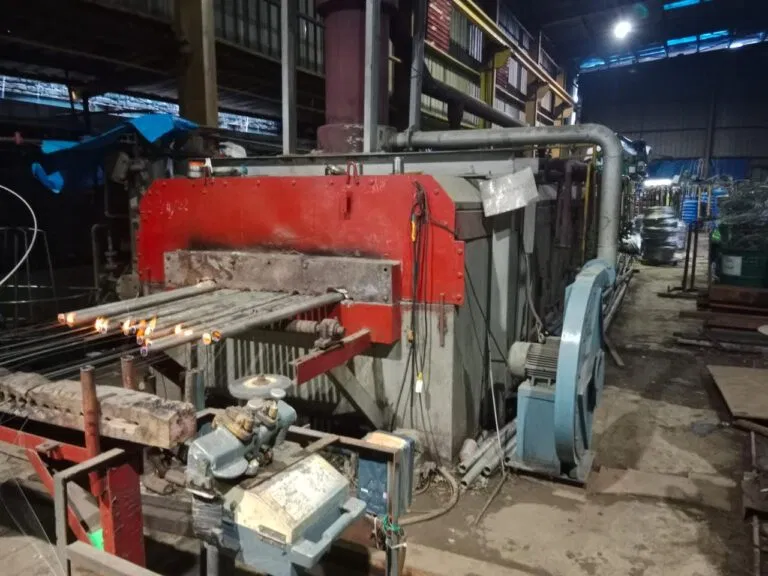
For high-carbon blooms, one industrial reheat practice illustrates the potential of temperature-time optimisation: reducing a reheating temperature from 1050°C to 970°C, alongside shorter heating times. This is a case example, not a universal recipe. Any change must preserve the required rolling temperature, throughput and product properties.
A practical plan for a steel rolling mill or wire-rod line should examine:
- Charging strategy: assess hot charging where production logistics and temperature uniformity permit.
- Furnace type and material movement: walking-beam furnaces are often preferred for special bar quality (SBQ) applications because controlled movement can support consistent heating.
- Bloom surface condition: scarfing can remove surface defects before reheating; it should complement, not substitute for, atmosphere discipline.
- Pressure and sealing: a weak, low-oxygen micro-positive-pressure atmosphere helps limit air ingress when appropriately engineered for the furnace.
- Exposure profile: review ramp, soak and discharge conditions to reduce unnecessary time at elevated temperature.

Closed-loop control: measure the furnace that is actually running
Setpoints describe intended conditions; sensors reveal operating conditions. Leaks, lubricant decomposition and air ingress can cause the actual furnace atmosphere to deviate from the input gas specification. Closed-loop control using oxygen or dew-point sensing helps operators identify these deviations and respond before they become recurring product defects.
A robust monitoring approach considers:
- Oxygen and dew point at representative locations, including the hot zone and furnace exit where suitable.
- Gas composition and the H₂/H₂O and CO/CO₂ relationships relevant to carbon potential.
- Furnace pressure, flow and trends during starts, stops, loading changes and maintenance events.
- Regular sensor checks, calibration and defined alarm-response actions.
This is where Industry 4.0 has direct operational value: trend data can connect atmosphere excursions to lot history, inspection results and maintenance events, improving root-cause analysis and process repeatability.
A phased implementation roadmap
Phase 1: Establish the baseline
Map grade, product size, furnace zones, temperature profile, residence time, charging practice and current decarb results. Identify the stages with the greatest exposure.
Phase 2: Set acceptance and sampling rules
Align the internal target with the customer specification and relevant standard. Use transverse samples and a consistent method to distinguish complete and partial decarburization.
Phase 3: Stabilise the process
Inspect seals and doors, review pressure control, and assess sensor location and reliability. Trial temperature-time changes and atmosphere adjustments under controlled production conditions.
Phase 4: Validate and sustain
Compare metallography or hardness profiles with fatigue or downstream performance where applicable. Document approved recipes, alarm limits and response procedures; use the resulting data to refine operating windows.

Business impact: quality protection is cost control
Surface-carbon control affects more than metallurgical compliance:
- Yield: reduced decarb can lower the need for scarfing, grinding or shot blasting and limit material removal.
- Fatigue life: protecting the surface carbon profile helps preserve performance in springs and other cyclically loaded products.
- Grinding cost: mechanical correction adds labour, handling and production time.
- Energy: unnecessary high-temperature exposure consumes energy without adding value to the product.
- Rejections: reliable atmosphere control reduces the risk of lots failing surface or performance requirements.
The business case is strongest when inspection results, furnace trends, rework and rejection costs are reviewed together. That turns decarburization from a recurring quality complaint into a measurable process-improvement opportunity.
The same discipline across thermal operations
Atmosphere management has useful parallels across thermal processing, though the chemistry differs by process. In a melting furnace for steel, slag and furnace atmosphere management help limit unwanted interaction with the melt. In an aluminum melting furnace or metal recycling furnace, attention to oxidation, contamination and operating conditions also protects metal recovery and process stability. These are analogies, not interchangeable control recipes: each process needs measurements and limits suited to its materials and reactions.
Reliable burners, seals, sensors and other furnace spare parts support consistent operation across these systems. Planned maintenance and prompt service reduce the risk that a small equipment fault becomes a prolonged production interruption.
For operations reviewing heat treatment furnaces or wider industrial furnace systems, Continental Furnaces brings more than 35 years of experience in customized thermal processing solutions. Our work spans steel and non-ferrous processing, as well as equipment such as a hot dip galvanizing plant; the engineering priorities remain consistent: process fit, energy efficiency, dependable performance and lifecycle support.
Decarburization control is an enduring process discipline, not a one-time setpoint adjustment. Review your furnace atmosphere, temperature-time profile and verification plan with Continental Furnaces. Explore our heat treatment furnace solutions or request a consultation and quote to build a practical improvement roadmap for your line and protect sustained competitive advantage.