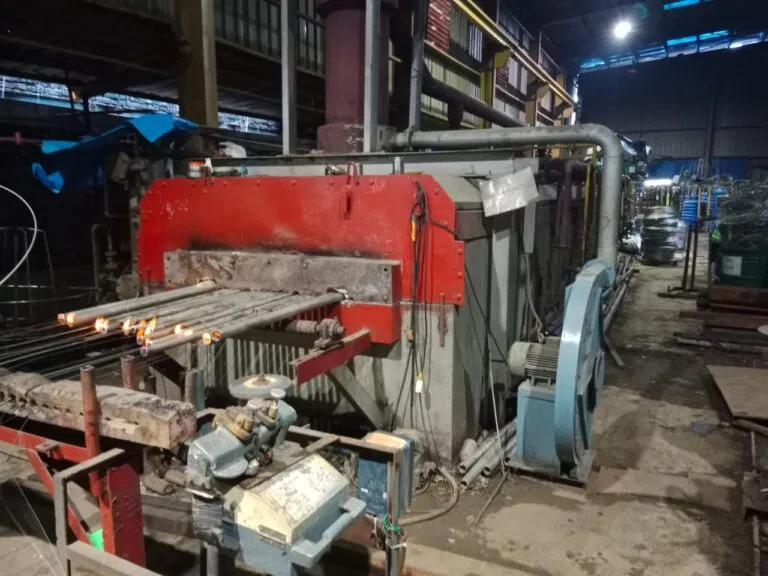
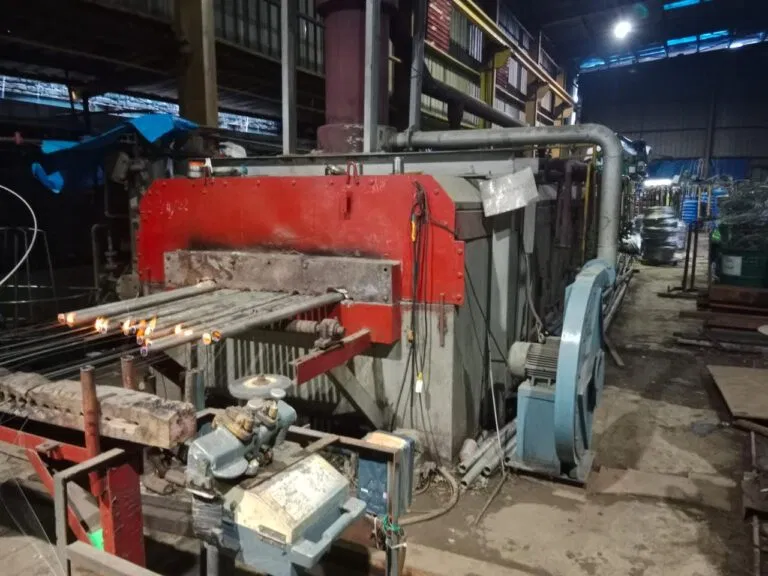
In a steel rolling mill, mill scale is more than a housekeeping issue. It represents metal lost before rolling, added work at descaling, and a potential source of surface defects. Oxidation also releases heat inside the furnace, but that energy credit is small compared with the value of the steel sacrificed.
Effective scale management balances atmosphere, temperature and time, not simply burner output. For plant teams, this is a practical route to better yield, fuel efficiency and product consistency.
Why scale management matters
Steel reheat-furnace oxidation losses are commonly reported in a broad range of 0.4% to 3% of charge weight, depending on furnace conditions, grade, billet or slab geometry, and measurement practice. DOE research commonly describes approximately 1–2% as a typical range; 3% should be treated as a high-loss condition, while 0.4% is an ambitious operational benchmark, not a universal guarantee.
Scale formation accelerates as steel temperature rises, particularly above approximately 1,050°C, and increases with the duration of exposure to oxidizing furnace gases. Oxygen, carbon dioxide and water vapour participate in oxidation at the hot surface.
The reaction is exothermic. Reported scale-formation heat can contribute roughly 2–3% of total furnace heat input. This is a limited heat credit, not a net economic benefit. Metal yield loss, descaling, scale handling, potential roll wear and surface-defect risk typically outweigh the heat released.
For additional context, see the U.S. Department of Energy’s scale-free steel reheating research.

What drives scale formation?
Several operating conditions combine to determine the scale burden:
- Excess air and residual oxygen: More oxygen available at the steel surface generally increases oxidation. Research reports scale-loss reductions of up to 35% under specific conditions when excess air or free oxygen is reduced. This is not a universal setpoint; combustion completeness and safe CO levels remain essential.
- Temperature and hot spots: Higher surface temperatures accelerate oxidation. Uneven heating can create local scale growth even when average furnace temperature appears acceptable.
- Residence time: Longer soaking and production delays give oxidation more time to proceed. Time spent waiting at temperature is costly exposure.
- Furnace leakage and air ingress: Openings, seals and charging or discharge practices can introduce oxygen into hot zones.
- Steel chemistry and surface condition: High-carbon and spring steels need particular attention. Oxidation can also cause surface decarburization, affecting properties and downstream quality. An important concern for wire rod and the wire and cable industry.
- Scale removal and measurement: Scale collected, discharged or removed by descaling should be measured consistently. Comparing different methods can produce misleading performance claims.
For melting operations, the same principle applies, protect recoverable metal from oxidation, but losses may appear as oxide-bearing slag or dross rather than reheat-furnace scale. A melting furnace for steel, an aluminum melting furnace and a metal recycling furnace each require process-specific controls.
Comparing practical mitigation approaches
| Approach | Main mechanism | Operational value | Key considerations |
|---|---|---|---|
| Atmosphere and air/fuel control | Reduces excess air and free oxygen at the steel surface | Studies report up to 35% lower scale loss in specific operating cases | Tune by zone; maintain complete combustion, safe CO levels and stable operation |
| Residence-time reduction | Limits duration of hot exposure | Avoids unnecessary oxidation and can support throughput | Coordinate furnace scheduling, material tracking and rolling-line availability |
| Hot or direct charging | Uses hotter incoming stock and skips part of the heating cycle | Can reduce fuel demand and time at temperature | Benefits depend on upstream conditions, logistics and charge-temperature consistency |
| Oxy-fuel or induction heating | Changes heat-transfer and oxidation conditions; induction heats the workpiece directly | Can support faster, more controlled heating and lower scale in suitable applications | Requires site-specific capital, capacity and integration assessment |
| Anti-scale coatings | Creates a barrier between steel and oxidizing gases | May help protect selected grades or components | Validate coating compatibility, application quality and downstream removal requirements |
These options are complementary. A furnace can reduce residence time while improving air/fuel control, for example. In one DOE scale-free-heating development, reported slab scale was approximately 0.05–0.07%, compared with 0.57–0.63% in the conventional comparison mode. Such results demonstrate technical potential under specified test conditions; they are not guaranteed outcomes for every mill.

A phased implementation roadmap
Phase 1: Establish a reliable baseline
Track scale loss against charged steel weight over representative shifts and grades. Record:
- Furnace zone temperatures and steel discharge temperature
- Free oxygen or excess-air indicators, where instrumentation permits
- Residence time, delays and production rate
- Scale collected and descaling frequency
- Fuel use per tonne of good product
- Surface defects, rework and roll wear observations
Use consistent weighing and sampling procedures. Separate reheat-furnace scale data from melting-furnace slag or dross accounting.
Phase 2: Identify the dominant loss mechanism
Map the relationship between scale and operating conditions. Review high-temperature zones, soak duration, air/fuel settings, furnace openings and production interruptions. For high-carbon and spring-steel grades, add checks for decarburization and surface quality to the assessment.
Phase 3: Apply operational improvements first
Prioritize controlled air/fuel adjustment, avoiding unnecessary soaking, and better alignment between furnace discharge and rolling demand. Reducing excess air can cut scale, but excessive reduction risks incomplete combustion and unsafe CO. Make changes incrementally, with qualified combustion oversight and defined operating limits.
Phase 4: Evaluate equipment and process upgrades
If baseline data shows persistent losses, assess hot charging, improved combustion management, suitable low-scale heating concepts or anti-scale coatings. Compare expected yield and fuel benefits against capital costs, maintenance needs and production integration. A thermal processing equipment upgrade should be evaluated against the actual product mix and operating schedule.
Phase 5: Sustain and verify
Set operating targets by grade and product, review performance routinely, and maintain critical sensors, burners, seals and controls. Reliable furnace spare parts and prompt service help prevent small component issues from becoming prolonged high-oxidation operation.
Translate scale reduction into business impact
The commercial case is broader than the weight of scale recovered. Lower oxidation can improve:
- Yield: More charged steel remains available for saleable output.
- Fuel efficiency: Shorter exposure and better control can reduce energy consumed per tonne of good product; verify the result against actual throughput and fuel data.
- Surface quality: Less scale and decarburization risk support cleaner downstream processing and fewer defect-related interventions.
- Operating cost: Reduced descaling and scale handling can lower maintenance and material-management demands.
- Sustainability: Better metal utilization supports circular-economy objectives by reducing replacement production and waste.
The oxidation heat contribution, approximately 2–3% of furnace heat input, should be included in a technically complete energy balance, but never treated as justification for accepting avoidable yield loss.
Continental Furnaces brings 35+ years of thermal-processing experience to customized industrial furnace systems and lifecycle support. Our heat treatment furnaces are engineered for precision and application-specific process requirements. The same disciplined approach to controls, equipment reliability and service is relevant across steel and non-ferrous operations, including rolling mills and hot dip galvanizing plant lines.
For mill-scale management, the next step is a data-led review of your charge, temperatures, residence times and current scale accounting. Request a quote or consultation with Continental Furnaces to identify practical opportunities for improved yield, dependable operation and sustained competitive advantage.