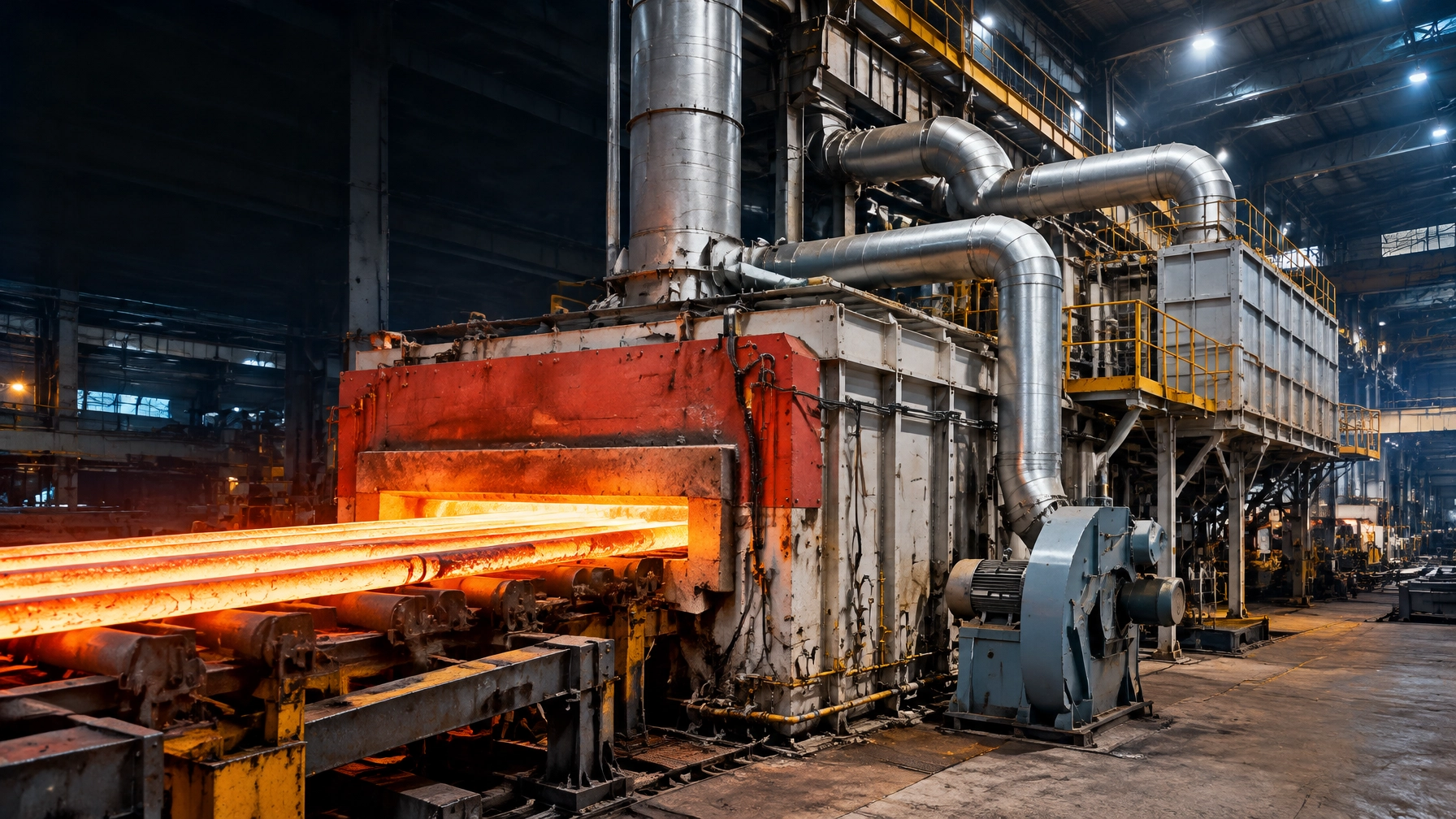
For plant heads, operations directors and energy managers, waste heat recovery is a direct opportunity to improve fuel productivity without compromising throughput or product quality. In a fuel-fired furnace, high-temperature exhaust carries energy that could instead preheat combustion air, charge material or supply useful steam.
The economics depend on the furnace and the operating pattern, not simply the temperature at the stack. A credible investment case connects measured exhaust conditions to fuel consumed per tonne, production stability, maintenance requirements and the value of energy recovered.
Why stack losses deserve attention
Flue-gas losses are typically the largest single energy loss in fuel-fired furnaces. In steel reheat furnaces, they can represent 30–76% of fuel input, depending on exhaust temperature and excess air. Recovery is generally worth investigating when exhaust temperatures exceed about 538°C (1,000°F).
That is a screening point, not a guarantee of savings. The recoverable energy depends on factors such as:
- Exhaust temperature, flow and oxygen content
- Fuel type and heating value
- Furnace production rate and operating hours
- Air leakage, furnace pressure and openings
- Material entry temperature and required discharge temperature
- Fouling, corrosion and allowable pressure drop
A lower stack temperature alone is not proof of improved performance. The key business measure is fuel per tonne at equivalent production and product quality.
Four recovery pathways, and what they do
1. Recuperators: continuous heat exchange
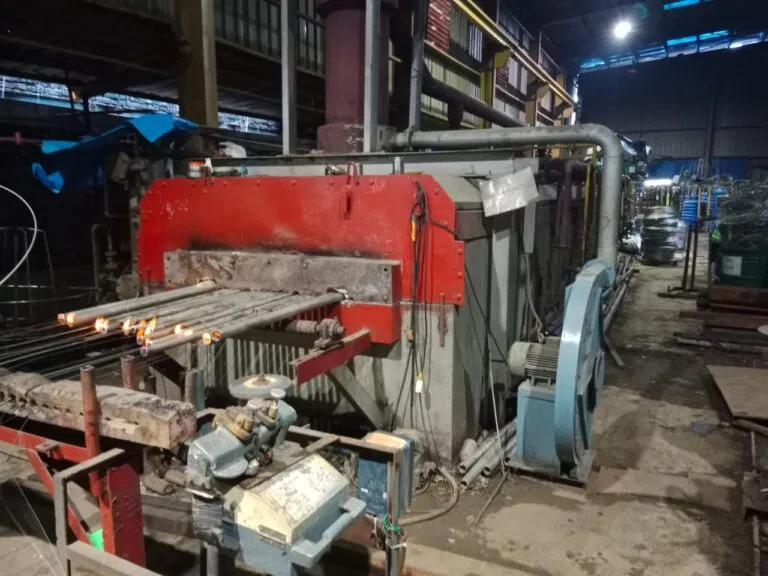
A recuperator transfers heat from exhaust gas to incoming combustion air through a heat-exchange surface. It offers a practical retrofit path for many fuel-fired furnaces, including a steel rolling mill reheat furnace. Typical reported fuel savings are 10–30%, though actual performance depends on the baseline condition and system design.
High-temperature recuperators can raise combustion-air temperature substantially. A North Star Steel assessment estimated about 10% lower energy consumption when combustion air was raised from 600°F to 900°F. This is a useful illustration of the value of incremental improvement, not a universal guarantee.

2. Regenerative burners: alternating heat storage
Regenerative systems alternate exhaust and combustion-air flow through heat-storage media, usually in paired burners. The media absorb heat during exhaust and release it to incoming air during the next firing period. Typical heat-recovery efficiency is around 60–85%, with reported fuel savings of 10–40% or more in suitable applications. Combustion air may be preheated to 800–1,000°C or higher.
Higher recovery comes with added system complexity: switching valves, controls, burner pairing, maintenance planning and emissions management. Regenerative burners make strongest sense when the required air preheat, furnace duty and operating hours justify that complexity.
3. Waste heat boilers: useful steam or hot water
A waste heat boiler captures stack energy to produce steam or hot water for plant services. It does not necessarily reduce the furnace’s fuel use directly; its value is the fuel or purchased energy it displaces elsewhere on site. This option can suit plants with steady heat demand and a compatible exhaust stream.
4. Direct charge preheating: recover heat into material
Where furnace layout and process flow permit, off-gases can preheat incoming billets, slabs or other charge. Direct charging or charge preheating can deliver 15–20% savings in applicable cases. It integrates recovery into the production route, so material handling, scale formation, temperature uniformity and space must be addressed in the engineering review.

Technology comparison for project screening
| Option | Typical fuel savings / recovery benchmark | Capital and operating complexity | Best-fit application |
|---|---|---|---|
| Recuperator | 10–30% fuel savings | Moderate; exchanger, ducting and pressure-drop considerations | Retrofit where exhaust heat and combustion-air demand are well matched |
| Regenerative burners | 60–85% heat-recovery efficiency; 10–40%+ fuel savings | High; burner pairs, switching valves, controls and maintenance | High-temperature duty and high operating hours where hotter air is valuable |
| Waste heat boiler | Site-specific; savings accrue by displacing other steam or hot-water generation | Moderate to high; boiler, water treatment and integration | Plants with consistent heat supply and steady thermal demand |
| Direct charge preheating | 15–20% savings in suitable arrangements | High integration with material handling and production flow | Processes able to preheat charge using available furnace off-gases |
These figures are industry benchmarks for initial comparison, not guaranteed project outcomes. A DOE industrial waste heat recovery review discusses recovery options and their application. For steel furnaces, the North Star Steel assessment provides an example of evaluating combustion-air preheat alongside other energy measures.
Stack-loss economics: make the case with measured data
Fuel savings scale with combustion-air preheat temperature: each additional 100°C of preheat can meaningfully reduce specific fuel use. But the saving depends on the furnace heat balance, air-fuel conditions, production and the efficiency of the recovery system.
Build the investment case around a stable baseline and the plant’s actual economics:
- Measure fuel consumption and production over representative operating periods. Record fuel per tonne, throughput, product mix and operating hours.
- Log exhaust and combustion conditions: stack temperature, oxygen, carbon monoxide where applicable, combustion-air temperature and furnace pressure.
- Check product and process constraints: material entry and discharge temperatures, scale loss, temperature uniformity and quality requirements.
- Model recovered energy and parasitic loads. Include fan power, added pressure drop, maintenance, emissions controls and expected downtime.
- Calculate payback using site-specific costs. Fuel price, capital cost, financing, service access and utilization can shift the result significantly.
For context, the U.S. Department of Energy’s Process Heating Assessment and Survey Tool (PHAST) supports assessment of energy use and process-heating opportunities. A plant audit should likewise separate heat-exchanger gains from other improvements, so savings are not incorrectly attributed to one device.
Phase-by-phase implementation roadmap
Phase 1: Assessment and planning
Establish the baseline at steady production. Confirm exhaust conditions, fuel use per tonne, load profile and available installation space. Identify any process or environmental limits before selecting a recovery route.
Phase 2: Engineering and option selection
Compare recuperation, regeneration, steam generation and charge preheating against the same operating data. Check materials, fouling risk, corrosion, pressure drop, combustion-air distribution and access for inspection. A new or upgraded heat treatment furnace should be evaluated as part of the complete thermal processing equipment design, not as an isolated exchanger choice.
Phase 3: Installation and performance verification
Plan tie-ins around production requirements and define acceptance criteria in advance. Verify fuel per tonne, output, product quality, stack conditions and system availability under comparable operating conditions.
Phase 4: Ongoing optimization
Track performance through an Industry 4.0 approach: trend key measurements, compare them with the verified baseline, and investigate drift. Include inspection of heat-transfer surfaces, seals, valves, burners and related furnace spare parts in the maintenance plan.
Build recovery into a wider efficiency strategy
Waste heat recovery supports sustainability and the Circular Economy by putting energy already generated to productive use. It can also improve profitability and energy resilience. For a metal recycling furnace, aluminum melting furnace or melting furnace for steel, the right solution will depend on exhaust conditions and the value of displaced fuel or steam. Similar analysis can benefit heat treatment furnaces, the wire and cable industry, and a hot dip galvanizing plant.
The best project is not automatically the one with the highest recovery percentage. It is the one that delivers a dependable reduction in energy cost while preserving output, product quality, regulatory compliance and maintainability. Continental Furnaces brings more than 35 years of expertise as an industrial furnace manufacturer, with customized industrial furnace systems and lifecycle support focused on dependable operations.
Start a project discussion with Continental Furnaces through our request-for-a-quote page. Share your furnace type, fuel, production rate, stack temperature and operating hours. A structured review is the first step toward a practical recovery roadmap and sustained competitive advantage.