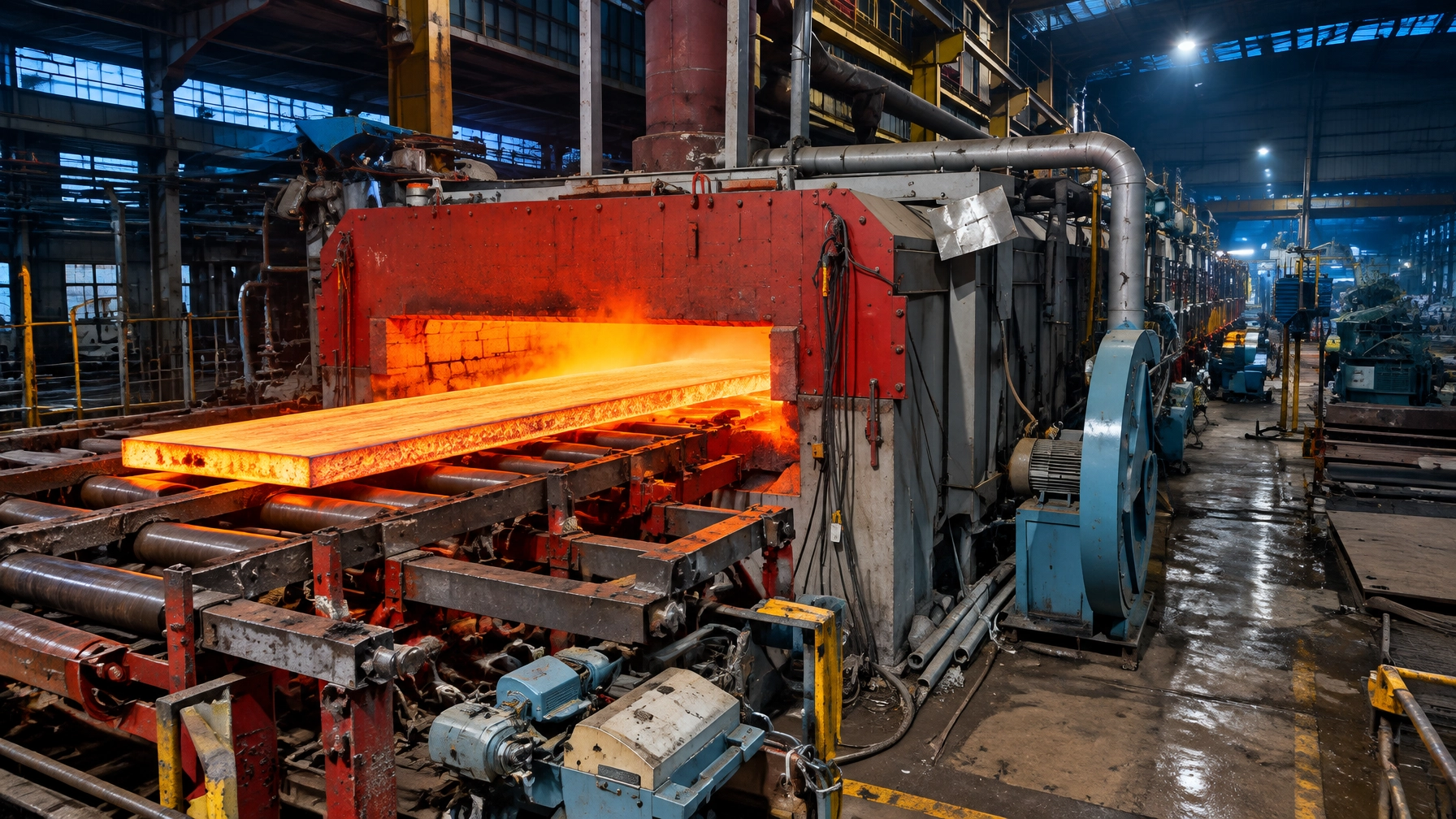
A furnace has always had three outputs that matter to a plant manager: tonnage, temperature and loss. Since 1 January 2026, there is a fourth: the embedded carbon of the product, and it is subject to verification. Furnace decisions now influence a number that travels with the goods, alongside yield and quality.
This is distinct from our 15 November emissions-monitoring post. That article addressed proving that a stack stays within a permit limit. This one addresses product-level carbon accounting for trade: a different number, a different rulebook and a different customer. It does not revisit the earlier series topics on combustion fans, refractory installation, OT security or alarm management.
The framework below summarises published Commission guidance and legal texts current as of November 2026. It is a reference framework, not a substitute for checking the legal texts and the specific arrangements between each operator, exporter and EU importer.
What changed on 1 January 2026
The EU CBAM definitive regime began on 1 January 2026, following the transitional reporting phase from 2023 to 2025. The financial obligation sits with the EU importer, or its indirect customs representative, and can be passed back through the supply chain. That is why verified product data must travel with the steel or aluminium.
An importer exceeding 50 tonnes net mass of CBAM goods per calendar year must hold authorised CBAM declarant status. The threshold is one cumulative mass threshold across all CBAM CN codes, aggregated per importer and calendar year. It does not apply to hydrogen or electricity.
Authorised declarants buy certificates from their national competent authority, declare embedded emissions annually and surrender the corresponding certificates. The certificate price follows the EU ETS auction price, using a quarterly average in 2026 and a weekly average from 2027. A carbon price already paid in the country of production may be deducted when proven. CBAM phases in progressively, reaching full effect in 2034.
Verification is central to using actual emissions data. Key instruments include Implementing Regulations (EU) 2025/2547 (the Methodology Act), 2025/2621 (default values), 2025/2546 (verification principles), Delegated Regulation (EU) 2025/2551 (accreditation and verification requirements), and Implementing Regulation (EU) 2025/2620 (free-allocation adjustment).
The calendar is the project plan
The sequence is already underway:
- First CBAM verifiers are expected to receive accreditation around September 2026, and accredited verifiers can register in the CBAM Registry from then.
- Verification of 2026 emissions starts in the second half of 2026, with documentation review and site visits.
- Accredited verifiers can issue the first reports in January 2027. Operators can share available reports with declarants from that month.
- Declarants can purchase certificates from February 2027 and must finalise the 2026 declaration by 30 September 2027.
The practical consequence is immediate: an exporting site needs to be verifier-ready before it can be paid for its data. The first verification window is now, not next year.
Operators prepare a monitoring plan, an operator’s emissions report and its summary. A declarant-specific addendum is also required where electricity emissions are calculated from actual data. The monitoring plan and emissions report must be submitted in English, and supporting monitoring and reporting records retained for at least 6 years.
Where the boundary falls, and why it falls on your furnace
For iron and steel, the aggregated goods categories include sintered ore (CN 2601 12 00); pig iron (7201 and some of 7205); ferro-manganese, ferro-chromium and ferro-nickel (7202 1, 7202 4, 7202 6); DRI (7203); crude steel (7206, 7207, 7218, 7224); and iron or steel products (7205, 7208 to 7217, 7219 to 7223, 7225 to 7229, 7301 to 7311, 7318 and 7326). Ferrous waste and scrap (7204) and other ferro-alloys, such as ferro-silicon, are out of scope.
The iron or steel products boundary includes direct CO2 from fuel combustion and flue-gas treatment during re-heating, re-melting, casting, hot and cold rolling, forging, annealing, coating, galvanizing, wire drawing and pickling. It excludes plating, cutting, welding and finishing, as well as purchase and maintenance of infrastructure and equipment. Rolling, pickling, annealing, coating and galvanizing are inside the boundary. That is why reheat, annealing and galvanizing furnaces, and pickling lines, directly shape the declared emissions of a rolled product. For heat-treatment operations, see Continental Furnaces’ heat treatment furnace solutions.
Primary hot rolling and rough forging of crude steel into semi-finished forms belong to the crude-steel process; other rolling and forging steps belong to iron or steel products. Relevant precursors include pig iron, DRI, ferro-alloys, crude steel and iron or steel products. Purchased scrap is not a precursor and is treated as having zero embedded emissions; post-consumer scrap used alone is also assumed to have zero embedded emissions.
For iron and steel goods listed in Annex II, only direct emissions count, except that sintered ore carries indirect electricity emissions into complex goods that use it. Direct emissions also include measurable heat consumed inside the boundary, regardless of where it was produced, and emissions from flue-gas-cleaning materials such as carbonates.
Aluminium has a different boundary. Unwrought aluminium, whether primary electrolytic or secondary from melting and recycling, is a simple good: alumina, anodes and scrap are not precursors, so their upstream emissions remain outside. Aluminium products are complex goods and carry the embedded emissions of their unwrought-aluminium precursor, tracked separately for primary and secondary aluminium where known. Forming, extrusion, casting, rolling, forging, drawing, annealing and surface preparation or treatment are included; cutting, welding and finishing are excluded. Aluminium waste and scrap (CN 7602) is out of scope, and non-precursor alloying elements are excluded from the good’s mass and embedded emissions. For a secondary melter, grid intensity drops out of the CBAM number; fuel, process carbon and metal yield drive it. The aluminium melting and holding furnace is therefore a yield-control asset as well as a thermal one.
The mass ratio is a yield number wearing a carbon suit
For a complex good, the calculation includes the precursor’s specific embedded emissions multiplied by mi, the tonnes of precursor consumed per tonne of good produced, plus the installation’s own specific emissions. If metal is lost and scrap or waste leaves with zero embedded emissions, mi rises above 1. Yield loss therefore increases the declared figure per tonne of saleable product.
The Commission’s worked example illustrates the effect: 1,227,000 tonnes of stainless slabs consumed to make 1,133,000 tonnes of product gives mi = 1.083. A precursor at 1.337 t CO2/t contributes 1.448 t CO2 per tonne of product. These are Commission guidance figures, not Continental Furnaces benchmarks.
In a rolling mill or wire line, reheat-furnace scale, crop and trim, oxidation at an annealing or galvanizing entry, drag-out, over-pickling and melting-furnace dross all become declared carbon as well as metal cost. Scale loss is now a yield argument and a CBAM argument. Decarburization removes carbon from the metal, while fuel emissions used to provide the heat remain in the accounting.

The numerator lives in the burner train
Specific fuel consumption per tonne, excess oxygen, air infiltration, door and seal losses, holding and idling hours, burner turndown at low load, and the fuel’s carbon content all feed directly into specific direct emissions. There is no averaging mechanism that makes poor operating discipline disappear.
Fuel selection is both an emissions and a data decision. A switch changes the emission factor and net calorific value (NCV), and may change whether partial oxidation produces CO. CO must be counted at its molar equivalent of CO2. The plant must be able to prove what fuel it burned, not merely that it burned fuel. Process carbonates, carbon carriers and electrodes also need defensible quantities and carbon data.
What the furnace team owns in a declared number
| Parameter | Where it is generated | How it usually goes wrong | Engineering lever | Who signs it off |
|---|---|---|---|---|
| Fuel quantity, NCV and emission factor | Fuel supply and furnace train | Conversion or supplier data mismatch | Metering and documented fuel specifications | Operations and reporting lead |
| Combustion CO2 and CO | Burner and flue gas | Poor combustion or unsupported factors | Stable operation and verified input data | Furnace and emissions teams |
| Carbonate and flue-gas-cleaning CO2 | Process inputs and treatment | Untracked material consumption | Weighing, inventory and procedure | Process and reporting teams |
| Electrodes and carbon carriers | Melting and EAF operations | Consumption allocated to wrong output | Charge and consumption reconciliation | Melt shop and reporting lead |
| Good tonnes and yield ratio | Production and weighing points | Scrap, dross or scale omitted | Mass-balance discipline | Production and quality |
| Metering and data availability | Instruments and historian | Gaps, drift or missing records | Maintenance, spares and data review | Instrumentation and site management |
Mass balance, and why the fuel meter becomes the invoice
Where the mass-balance method is used, carbon entering and leaving is balanced for each source stream using both material quantity and carbon content. The conversion is 3.664 tonnes CO2 per tonne of carbon. Carbon leaving in product, slag and waste is entered as a negative output. A reliable mass balance therefore depends on defensible carbon-content data, not quantity records alone.
Biomass is treated as fossil unless RED II sustainability and greenhouse-gas-saving criteria are demonstrated, for example through a recognised voluntary certification scheme. Process-input biomass, such as charcoal used as a reductant or in electrodes, can be zero-rated without the RED II test. ISO 13833 (radiocarbon sampling for the biogenic fraction) and ISO 18466 (balance method) are named routes for separating biogenic from fossil CO2 in a stack.
What the verifier will actually ask for
A monitoring plan needs to explain the method, the data trail and any uncertainty choices, supported by written procedures. Commission guidance gives these orientation thresholds:
- For the largest source streams, above 500,000 t CO2 per year, uncertainty over the reporting period should be 1.5% or better.
- For the smallest streams, below 10,000 t CO2 per year, uncertainty below 7.5% is acceptable.
- For continuous measurement of sources above 100,000 t fossil CO2e, 2.5% uncertainty is recommended.
Continuous measurement requires both concentration and volumetric flow at the measurement point, averaged hourly or over a shorter reference period. At high CO2 concentration, CO2 may be derived by difference from other measured components. The relevant standards reference set includes ISO 20181:2023, ISO 16911-2, ISO 14164, and ISO 14385 parts 1 and 2.
When fewer than 80% of the maximum possible data points for a parameter are available in an hour, the substitute is the representative-period arithmetic mean plus twice its standard deviation. That substitution is why instrument reliability is a cost item. Measurement-based emissions must also be corroborated by calculation for the same sources; buying a monitoring system does not remove the need to retain fuel records.
A claim that a more accurate method would incur unreasonable cost must be justified in the monitoring plan and assessed against EUR 80 per tonne of CO2e and an accumulated annual cost limit of EUR 4,000.

Default values are a 30% penalty by 2028
Where actual data are not used, default values receive a mark-up of 10% in 2026, 20% in 2027 and 30% from 2028 onwards. The fertiliser-sector mark-up is 1%. The Commission’s guidance concludes that actual values will in most cases be more advantageous than defaults, for precursors as well as final goods. That makes measurement investment a commercial priority, not paperwork overhead.
Actual precursor data are usable only when supported by a verification report issued by a verifier whose accreditation was valid at the time and covers the relevant sector and reporting period. Otherwise, defaults apply. Track precursor data by supplier installation and production year; calculate specific embedded emissions as weighted averages across suppliers and production years for the same precursor type. Narrower attribution requires sufficient evidence. Defaults are year-dependent, and the reporting period is normally the calendar year of import unless the actual production year is evidenced.
The bubble, and when you cannot use it
An installation producing two or more eligible goods from sintered ore, pig iron, ferro-alloys, DRI, crude steel and iron or steel products may define one joint production process, or “bubble”, if no precursor produced at the installation is sold separately. If crude slabs are sold alongside finished bar, the bubble is unavailable and each process must be measured separately.
The Commission’s blast-furnace/basic-oxygen worked example gives 1.539 t CO2 of direct specific embedded emissions per tonne of steel product, plus 0.028 t CO2 of indirect emissions carried through sintered ore. Its free-allocation example for 10,000 tonnes of rails in 2027 gives 15,670 t CO2 embedded, an 11,980 t CO2 free-allocation adjustment and a residual obligation of 3,690 certificates. The specific embedded free allocation is deducted from declared embedded emissions, so the certificate count is the gap, not the whole carbon content.
What moves the number fastest in the next two quarters
As an engineering judgement, rank the work this way:
- Yield and scale first. Reconcile input mass to saleable product, quantify scale, crop, trim, oxidation and dross, then target the largest repeatable losses.
- Fuel and combustion next. Establish fuel consumption per good tonne, check NCV and carbon-factor documentation, and review excess oxygen, infiltration, holding time and low-load operation.
- Metering and documentation in parallel. Close data gaps, define ownership of source records, and prepare the English-language monitoring plan and emissions report before the verifier’s review.
Where this lands across furnace applications
A steel rolling mill can connect scale and crop losses to its product carbon figure, while heat treatment furnaces bring fuel use inside the product boundary. A secondary aluminum melting furnace faces a yield-led calculation; a melting furnace for steel must account for fuel and carbon inputs. An industrial furnace manufacturer can help customers design for measurable, efficient operation, and industrial furnace systems can be specified with the required data trail in view. The wire and cable industry must consider drawing, annealing and pickling losses; a hot dip galvanizing plant has in-boundary process stages; a metal recycling furnace must tightly reconcile charge to good metal. Across thermal processing equipment, the commercial case increasingly rests on both production performance and credible emissions data.
Keep the evidence chain instrumented, not just the furnace
The evidence chain depends on reliable instruments and maintainable components. Review the availability and service condition of calibrated fuel flow meters and orifice plates; fuel-train pressure and temperature transmitters; flue-gas oxygen and CO analysers; load cells and weighbridge spares; thermocouple and pyrometer spares; sampling probes and filters for fuel and flue-gas sampling; data loggers and historian storage; and calibration gases and regulators. Damper linkages and actuator positioners also matter: mechanical failure can silently distort operating conditions or the data used to represent them.
A planned furnace spare parts strategy helps protect both uptime and the integrity of records.
A five-phase readiness roadmap
- Scope and CN-code mapping: align the product and export list with the commercial team.
- Boundary and precursor map: identify production boundaries, purchased inputs and any precursors sold separately.
- Metering and data quality: upgrade measurement and records to meet the relevant uncertainty bands.
- Monitoring plan and procedures: draft them with the verifier’s checklist in hand.
- Verification dry run and yield programme: test the evidence chain and tie loss-reduction projects to the carbon number.
Build the number into the enduring partnership
CBAM makes furnace efficiency, good-metal yield and verifiable records part of the same operational conversation. Continental Furnaces brings 35+ years of expertise, ISO-certified quality, customized solutions and prompt service to thermal-processing projects. Engage us to review the furnace and data requirements as one engineering programme, and take a practical step toward sustained competitive advantage. Request a quote or consultation.
References
- European Commission, CBAM definitive regime.
- European Commission, Verification of CBAM emissions, including accreditation and verification timeline.
- European Commission, Guidance Document No. 3: CBAM methods for the calculation of emissions embedded in goods, 14 August 2026.
- European Commission, Guidance Document No. 5d: Sector-specific guidance on iron and steel, 14 August 2026.
- European Commission, Guidance Document No. 5e: Sector-specific guidance on aluminium, 14 August 2026.
- European Commission, Implementing Regulation (EU) 2025/2547, calculation methods and monitoring requirements.
- European Commission, Implementing Regulations (EU) 2025/2621, 2025/2546 and 2025/2620, and Delegated Regulation (EU) 2025/2551.
- Regulation (EU) 2023/956, as amended by Regulation (EU) 2025/2083.