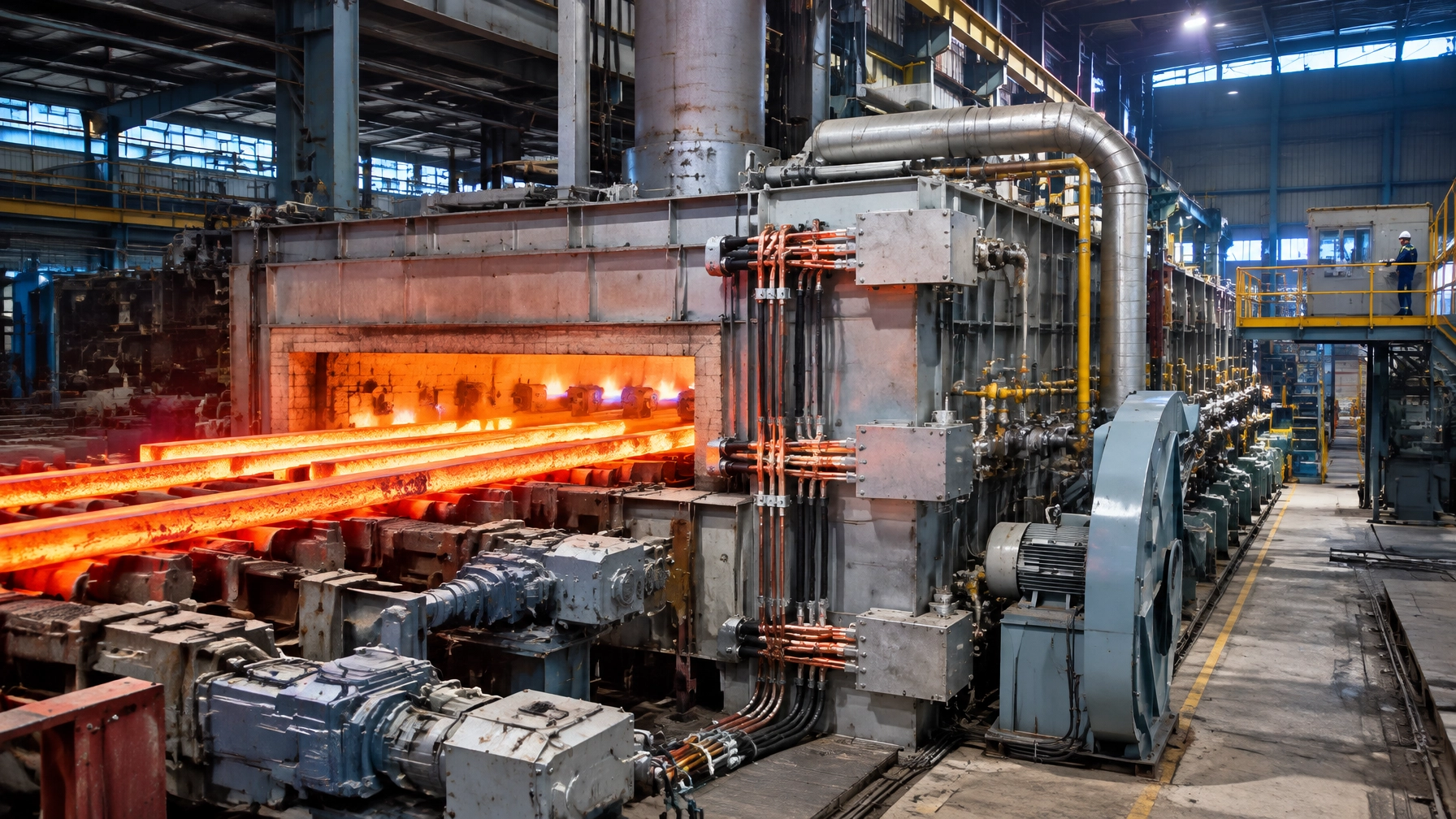
Electrifying industrial heat is no longer just a technology question. Resistance heating, induction, electric boilers and electric arc furnaces are commercially proven. In many locations, the harder question is whether the site can secure enough reliable power, and deliver it at the rate the process requires.
That distinction matters to plant heads, energy managers and project engineers planning upgrades to a steel rolling mill, heat-treatment line, foundry or aluminum operation. The sound 2026 strategy is not to electrify every furnace at once. It is to identify suitable duties, test grid and process constraints, and phase electrical heat in where it improves efficiency, product quality or energy security.
Electrification’s opportunity, and its engineering limit
Electricity accounts for less than 12% of steel-sector energy consumption, while almost 70% of that energy supplies process heat above 1,000°C, according to IEEFA’s October 2026 steel-value-chain analysis. The opportunity is substantial, but high-temperature processes are not interchangeable loads.
In rolling, reheating furnaces account for 15–20% of total iron and steel industry energy use and about 70% of rolling-process energy consumption. Billets, blooms and slabs are typically heated to 1,250–1,300°C. Cold-charge reheating commonly requires 1.4–1.8 GJ per tonne; hot charging can bring that down to 0.61 GJ/t, while poor operating cases exceed 3 GJ/t.
The first efficiency question is therefore broader than “gas or electricity?” It includes charging practice, throughput, furnace condition, waste heat and the usable power available on site. Typical gas-fired reheating furnaces operate at about 60% thermal efficiency. One industrial example supplied 1.55 GJ/t, of which about 0.8 GJ/t transferred to the steel; the balance was lost through waste gas, furnace losses and water cooling.

Match the technology to the duty
Electric heat can improve efficiency and process control, but the application determines the right choice. Resistance heating can deliver up to about 90% thermal efficiency in heat-treatment furnaces. Electric melting furnaces typically reach 50–75%. For aluminium, reported gas-fired crucible melting can be as low as 7–20% efficiency; reported energy use is approximately 400–650 kWh/t for electric resistance melting, versus 1,600–4,800 kWh/t for gas crucible furnaces.
Those figures describe reported ranges, not a guaranteed result for a specific plant. Furnace design, charge, operating practice and measurement boundary all matter.
A critical constraint is power density. Fuel burners can achieve more than 300 kW/m², while electric elements such as MoSi₂ typically peak near 160 kW/m². An electric furnace with the same hearth area therefore cannot automatically supply the same heat input as a gas-fired unit. This limits straightforward replacement in high-throughput reheating and large melting duties. MoSi₂ elements can operate at about 1,700°C and above, depending on grade and atmosphere; element temperature, however, does not remove the need to size the furnace around the process heat load.
| Option and representative duty | Thermal performance or energy use | Energy-cost reference | Capex and lead-time considerations | Emissions and process implications |
|---|---|---|---|---|
| Gas-fired reheating furnace | About 60% thermal efficiency | About USD 31/t billet reheating in the cited scenario | Established fuel-side configuration; connection to gas supply remains relevant | Combustion products and flue losses; fuel-supply exposure |
| Induction billet reheating | The cited study assumes 75% total efficiency | About USD 41/t in the cited scenario; cost parity with gas at electricity near USD 54/MWh | Electrical conversion and grid capacity require site assessment; connection queues can defer projects | No combustion in the heating zone; grid emissions depend on electricity supply |
| Hydrogen-fired reheating | The cited comparison assumes 50% furnace efficiency | About USD 76/t in the cited scenario | Hydrogen burner systems can cost 4–8 times gas burner systems; hydrogen supply infrastructure is also required | Avoids fossil fuel at the point of use when green hydrogen is used; conversion losses are higher than direct electric heat |
| Electric resistance heat treatment | Up to about 90% thermal efficiency | Not directly comparable to the reheating cost figures above | Power supply, controls and element replacement logistics must be planned | No combustion products in the work chamber; suited to atmosphere-sensitive work |
| Electric resistance aluminium melting | Reported 400–650 kWh/t | No like-for-like cost figure stated here | Electrical supply and melt schedule determine feasibility | Avoids burner products in the work chamber |
The reheating cost comparison is a published, scenario-specific levelised-cost estimate, not a universal tariff forecast. Its assumptions include gas at USD 10/GJ, green hydrogen at USD 6/kg, firmed renewables at USD 90/MWh and a carbon price of USD 85/tCO₂. At USD 130/tCO₂, gas and induction become broadly comparable in that analysis. Higher electricity prices than the cited parity point generally keep electric reheating’s running cost above gas in many markets today.

Grid connection is part of furnace design
A connected furnace is not useful if the connection cannot reliably support its duty. Frost & Sullivan’s October 2026 assessment identifies grid interconnection as a binding constraint: multi-year connection queues across India, Southeast Asia and some US jurisdictions are deferring industrial projects.
Before selecting an electric furnace system, evaluate:
- Transformer capacity and available connection power, including other major site loads and their operating schedules.
- Connection timing and certainty, not only the capacity requested.
- Load flexibility and demand response: can holding or soaking be shifted, or can a thermal buffer reduce peak demand?
- Power quality, especially power factor and harmonics for induction equipment.
- Continuity of operation: specify an emergency or standby heat source so a grid event does not leave metal immobilised in a furnace.
Grid capacity can also determine project sequence. A plant may be able to electrify a small batch furnace now while a high-load rolling-mill project waits for reinforcement or approval. That is a practical staging decision, not a failure of the technology.
Where hybrid heating works in practice
Hybrid architecture gives a plant a way to electrify useful heat without asking the grid to carry the entire peak load from day one. In a reheating furnace, gas burners can remain responsible for high-rate heating and melting, while electric elements or induction provide holding, soaking, low-rate periods or heat in atmosphere-critical zones. A walking-beam furnace can also use electric boost in the soaking zone, retaining burners for faster upstream heating.
A hybrid may therefore protect throughput while improving control over a selected part of the process. European research work such as the SUPERHEAT project at RWTH Aachen is developing partial electrification for steel reheating, combining electric superheating modules with a burner system and investigating operation with natural gas, hydrogen blends and green hydrogen. These are development programmes, not results to assume for every retrofit, but they demonstrate the practical case for staged integration.
Electricity-to-heat efficiency is also why hydrogen should be assessed as a distinct pathway, not treated as a direct substitute for electric heating. Overall electricity-to-heat efficiency through electrolysis, compression, storage and combustion is about 55%, compared with direct electric heating. A cited study found switching a scrap-based Italian EAF facility from gas heat to hydrogen raised thermal-energy cost by about 230%. Hydrogen may have an important role in industrial decarbonisation, but for process heat, direct electrification should be evaluated first where technically and economically suitable.
A duty-based readiness framework
Strong candidates for full electrification now, subject to grid and process review:
- Small-batch heat treatment and tempering.
- Bright annealing and other atmosphere-sensitive processes.
- Holding furnaces and holding periods.
- Low-tonnage melting.
- Preheating zones where a lower or controllable heat input suits the process.
Electric heat brings benefits beyond fuel substitution: no combustion products in the work chamber, tighter temperature control and faster response, no furnace flue losses, and lower maintenance demand on burners and associated refractories. These characteristics can support surface quality and reduce oxidation or decarburisation from combustion gases, which matters in precision work and throughout the wire and cable industry.
Duties more likely to remain hybrid or gas-fired for now:
- High-throughput reheat above 100 t/h.
- Large melting duties with demanding peak power requirements.
- Sites with weak grid connections or uncertain connection dates.
Induction is already used for billet heating; SMS group’s Elotherm system replaced gas-fired reheating at Feralpi’s rebar mill. Kanthal and Swerim’s ELROS project has tested combined induction and resistance reheating for billets and slabs. These examples establish technology pathways, not a guarantee that every mill has matching grid, throughput or product conditions.

A phased electric-heat roadmap
Phase 1: Assessment and planning. Establish the furnace’s energy and production baseline: fuel use, charging temperature, throughput, heating profile, product quality and downtime. Compare cold- and hot-charge performance, and map available electrical capacity and connection requirements. Include site power quality and connection timing in the feasibility study.
Phase 2: Select the first duty. Prioritise the process zone or furnace where electric heat can meet product requirements without compromising production. Compare full electrification with hybrid operation, and assess electricity cost against the published scenario benchmarks, not against assumed savings or payback periods.
Phase 3: Engineer for staged conversion. Design controls, power equipment, heating elements or induction equipment, furnace zones and standby heat together. A new gas-fired furnace should be designed for future electric boost from the outset; bolting it on later can create avoidable integration and outage risks. This approach limits the risk of premature retrofit and stranded assets while preserving options as grid access changes.
Phase 4: Commission, monitor and refine. Track energy per tonne, temperature uniformity, throughput, yield, surface condition and maintenance events. Use operating data to decide whether to expand the electric share, retain the hybrid balance or adjust the operating schedule.
Plan spares and lifecycle support early
Electrification changes the maintenance plan as well as the energy source. A robust furnace spare parts strategy should address:
- Element inspection, life tracking and replacement logistics.
- Critical thyristor and power-module spares.
- Refractory condition and repair planning.
- Control-system components and pyrometry calibration.
- Standby heat and response procedures for grid interruptions.
These requirements apply across heat-treatment furnaces, a metal recycling furnace, a melting furnace for steel, and thermal lines supporting a hot dip galvanizing plant. For aluminium operations, a site assessment of an aluminum melting furnace must include both the furnace duty and the electrical supply needed for it. In India, where almost 90% of metallurgical coal demand is imported and steel capacity ambitions reach 604 Mtpa by 2047, partial electrification also has a clear energy-security dimension.

Make readiness a lifecycle decision
Electrification can improve yield, process control and energy resilience, but profitability depends on the whole system: furnace duty, connection capacity, electricity pricing, production flexibility, maintenance and backup heat. An industrial furnace manufacturer should help assess the operating case as well as the equipment, whether the solution is a retrofit, hybrid arrangement or new industrial furnace system.
Continental Furnaces brings 35+ years of expertise in customized thermal processing equipment, backed by ISO-certified quality and prompt service to help keep downtime minimal. Explore our heat treatment furnaces or request a quote to discuss your furnace duty, grid constraints and phased electrification options. Begin with an engineering consultation and build an enduring partnership for sustained competitive advantage.