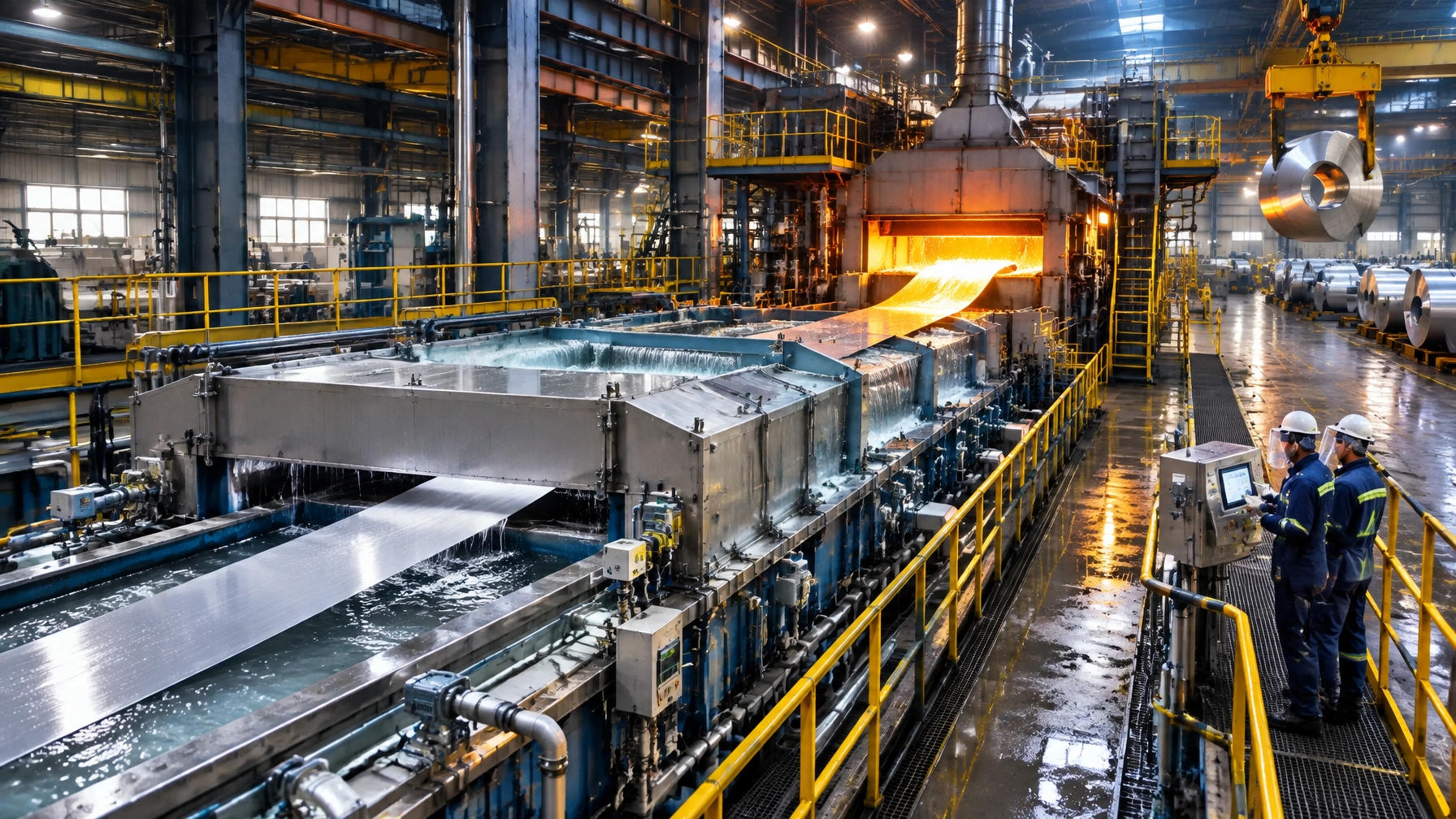
For steel rolling mills, the front end of the finishing line now determines far more than appearance. Pickling quality influences galvanizing adhesion, coating uniformity, downstream yield, effluent load and customer acceptance.
In 2026, operators face simultaneous pressure to reduce energy intensity, acid consumption, water use, waste-treatment cost and surface-quality rejects. Carbon accounting, tighter discharge requirements and demand for thinner high-strength grades are making conventional, manually controlled lines commercially unsustainable.
The winning strategy is an integrated process: controlled pickling, efficient rinsing, acid regeneration, heat recovery, online instrumentation and dependable service support.
Why the pickling-to-galvanizing interface matters in 2026
A continuous line must remove scale without attacking the steel substrate, then deliver a chemically clean, dry and thermally stable strip to the galvanizing section.
The major operating pressures are clear:
- Energy costs across acid heating, drying, ventilation and galvanizing.
- Increasing acid and iron loading in process baths.
- Freshwater consumption and chloride-rich effluent.
- Surface stains, residual scale and coating defects.
- Production losses caused by unplanned line stoppages.
- Thinner high-strength grades with narrower process windows.
- Customer requirements for digital traceability and verified sustainability.
The latest steel-industry energy guidance reinforces the importance of process integration, electrification, scrap utilization and energy efficiency. For a steel rolling mill, these priorities begin before the strip reaches the zinc pot.
Pickling line fundamentals: control the chemistry, speed and heat
Pickling removes mill scale, oxides and surface contamination using acid chemistry. Carbon-steel lines commonly use hydrochloric acid, while other grades and applications may require sulfuric or mixed-acid systems.
Actual setpoints depend on grade, strip thickness, scale morphology and line design. However, typical engineering planning ranges for hydrochloric-acid pickling include:
- Acid concentration: approximately 10–18% HCl by weight.
- Bath temperature: approximately 70–90°C.
- Continuous line speed: commonly 60–200 m/min, depending on strip condition and line configuration.
- Rinse arrangement: typically three to five counter-current stages.
- Dry-off temperature: commonly 80–150°C, depending on strip speed and moisture load.
These figures are design references, not universal operating prescriptions. The correct process window must be established through trials and measured surface-quality results.
The cost of under-pickling
Under-pickling leaves residual scale or oxide on the strip. The consequences include:
- Poor zinc adhesion.
- Bare spots and coating discontinuities.
- Increased customer rejection.
- Additional rework or downgraded product.
- Surface defects that become visible only after galvanizing.
The cost of over-pickling
Over-pickling is equally damaging. Excessive acid exposure can increase:
- Base-metal loss and dimensional variation.
- Hydrogen absorption risk.
- Acid consumption and iron loading.
- Fume-generation and neutralization costs.
- Surface roughness and coating inconsistency.
The objective is not maximum acid strength. It is minimum chemical input that delivers complete, repeatable scale removal.

Energy and resource efficiency: engineer the entire line
Recover heat from acid tanks and rinse water
Acid tanks operate at elevated temperatures, while rinse water is continuously heated by the strip and process circulation. Heat exchangers can transfer this energy to:
- Incoming rinse water.
- Fresh acid make-up.
- Cleaning solutions.
- Dry-off air.
- Flux or pre-treatment systems.
- Plant hot-water circuits.
A properly designed heat balance should measure tank temperature, flow rate, exhaust temperature, operating hours and available heat sinks before equipment selection. Heat recovery is most effective when the demand profile is continuous and stable.
Use counter-current rinsing
Counter-current rinsing moves the cleanest water toward the final rinse stage and progressively more contaminated water toward the earlier stages. This arrangement reduces freshwater demand while maintaining surface cleanliness.
A modern rinse system should monitor:
- Conductivity.
- pH.
- Chloride concentration.
- Flow and pressure.
- Drag-out between tanks.
- Spray-nozzle condition.
- Overflow and recovery rates.
Reducing rinse flow by 30–60% is achievable in suitable installations when counter-current design, drag-out control and conductivity-based replenishment are implemented together. The exact saving depends on strip width, line speed and contamination load.
Regenerate acid instead of treating it as waste
Closed-loop acid regeneration is becoming a central element of the circular economy. In hydrochloric-acid systems, regeneration can recover usable acid while separating iron as an iron-oxide by-product.
Benefits include:
- Lower fresh-acid consumption.
- Reduced chloride discharge.
- Lower neutralization chemical demand.
- More stable bath chemistry.
- Reduced sludge generation.
- Potential recovery value from iron oxide.
Spent acid should be characterized by acid strength, iron concentration, contaminants and volume. Suitable streams can be routed to a thermal regeneration unit, while other iron-bearing residues may support metal-recovery routes linked to a metal recycling furnace or other by-product recovery system. A melting furnace for steel is not a universal substitute for acid regeneration, but integrated plants can evaluate whether recovered metal-bearing materials have a viable secondary-use pathway.
Instrumentation converts chemistry into measurable performance
Process control instrumentation should include:
- Online free-acid and iron-load measurement.
- Bath temperature sensors at multiple points.
- Strip-speed and tension feedback.
- Conductivity meters in rinse stages.
- Flow and level transmitters.
- Fume-extraction pressure monitoring.
- Moisture detection before galvanizing.
- PLC/SCADA integration with production records.
The critical performance indicators are acid consumption per tonne, water consumption per tonne, energy per tonne, reject rate, coating adhesion and line availability.
The 2026 steel manufacturing trends shaping finishing lines
Thinner high-strength grades
Advanced high-strength steels demand tighter control of strip tension, flatness, acid exposure and drying. Small deviations can create edge defects, residual scale or galvanizing non-uniformity.
Hot-rolled pickled-and-oiled substitution
More customers are using hot-rolled pickled-and-oiled products in applications that previously required additional processing. This increases the commercial value of consistent pickling and places greater emphasis on clean, traceable surface quality.
Near-net-shape and green steel supply chains
Near-net-shape production reduces material and reheating demand. Green steel supply chains add another requirement: suppliers must demonstrate not only product conformity but also reduced energy, water and carbon intensity.
Digital traceability
Surface-quality data is becoming part of the product record. Modern lines can associate each coil with:
- Acid concentration history.
- Bath temperatures.
- Rinse conductivity.
- Line speed.
- Galvanizing temperature.
- Coating thickness.
- Inspection results.
- Deviations and corrective actions.
Tighter effluent regulation
Effluent systems must address chlorides, iron, suspended solids, acidity and other site-specific contaminants. Closed-loop water management, segregation of waste streams and online monitoring are now essential elements of regulatory compliance.
Traditional batch pickling versus modern continuous processing
The following planning benchmarks illustrate the commercial difference. Actual values depend on steel grade, throughput, acid system and plant layout.
| Metric | Traditional batch pickling | Modern continuous pickling with regeneration and heat recovery |
|---|---|---|
| Specific energy | 120–220 kWh/t | 60–120 kWh/t |
| Fresh-acid consumption | 25–50 kg/t | 10–25 kg/t |
| Labour requirement | Higher manual handling | 30–50% lower direct handling labour |
| Water consumption | 1.5–3.0 m³/t | 0.5–1.5 m³/t |
| Footprint | Larger coil staging area | 20–40% lower process footprint |
| Surface consistency | Batch-to-batch variation | Continuous recipe-based control |
| Payback for modernization | Not applicable | Approximately 2–5 years, site-dependent |
These figures should be validated through a site audit and total-cost-of-ownership model before investment approval.
A phased roadmap for 2026 modernization
Phase 1: Assessment and baseline
Complete a 2–4 week operating study covering:
- Acid and iron concentration.
- Strip speed and throughput.
- Tank temperatures.
- Rinse-water flow and conductivity.
- Dry-off energy.
- Galvanizing-bath stability.
- Energy consumption per tonne.
- Rejects, rework and downtime.
- Effluent volume and treatment cost.
Phase 2: Heat recovery and rinse optimization
Prioritize lower-capital improvements:
- Install heat exchangers where heat sinks are available.
- Implement counter-current rinsing.
- Reduce drag-out between tanks.
- Repair insulation and tank covers.
- Add conductivity-based rinse control.
- Balance fume extraction and ventilation.
- Optimize dry-off air temperature and flow.
Phase 3: Regeneration and closed-loop by-product handling
Evaluate:
- Hydrochloric-acid regeneration.
- Iron-oxide recovery and sale.
- Segregated waste-acid storage.
- Closed-loop rinse-water treatment.
- Metal-bearing residue recovery.
- Integration with recycling or melting operations.
This phase delivers the largest reduction in acid waste and treatment exposure.
Phase 4: Digital process control and predictive maintenance
Connect pickling, galvanizing and downstream coating data through PLC, SCADA and maintenance systems. Apply predictive analytics to:
- Pumps and circulation systems.
- Heat exchangers.
- Burner and furnace components.
- Fume-extraction fans.
- Roll bearings and drives.
- Sensors, valves and dosing systems.

Service continuity across pickling, galvanizing and thermal systems
Energy efficiency only creates value when the line remains available. A failed pump, valve, sensor, burner, heating element or control module can stop a high-throughput operation within minutes.
Continental Furnaces supports lifecycle reliability through customized furnace spare parts, maintenance planning and prompt replacement services. The same service philosophy applies to pickling lines, hot dip galvanizing plants, heat treatment furnaces, melting systems and other industrial furnace systems.
As an experienced industrial furnace manufacturer, Continental Furnaces brings more than 35 years of expertise, ISO-certified quality, customized engineering and responsive service support. Its wider portfolio includes thermal processing equipment, melting and recycling projects, an aluminum melting furnace, steel-processing systems and solutions for the wire and cable industry.

Conclusion: make surface quality an energy strategy
The 2026 agenda is decisive:
- Control acid chemistry rather than overusing acid.
- Recover heat from tanks, rinse water and exhaust.
- Reduce water through counter-current rinsing.
- Regenerate acid and recover iron-bearing by-products.
- Digitize surface-quality traceability.
- Prepare for high-strength grades and tighter effluent requirements.
- Protect uptime with critical spares and planned service.
Continental Furnaces approaches every modernization project as an enduring engineering partnership, combining equipment design, process integration and lifecycle support.
Consult Continental Furnaces to assess your pickling-to-galvanizing line and define a practical roadmap toward lower operating cost, stronger regulatory compliance and sustained competitive advantage.