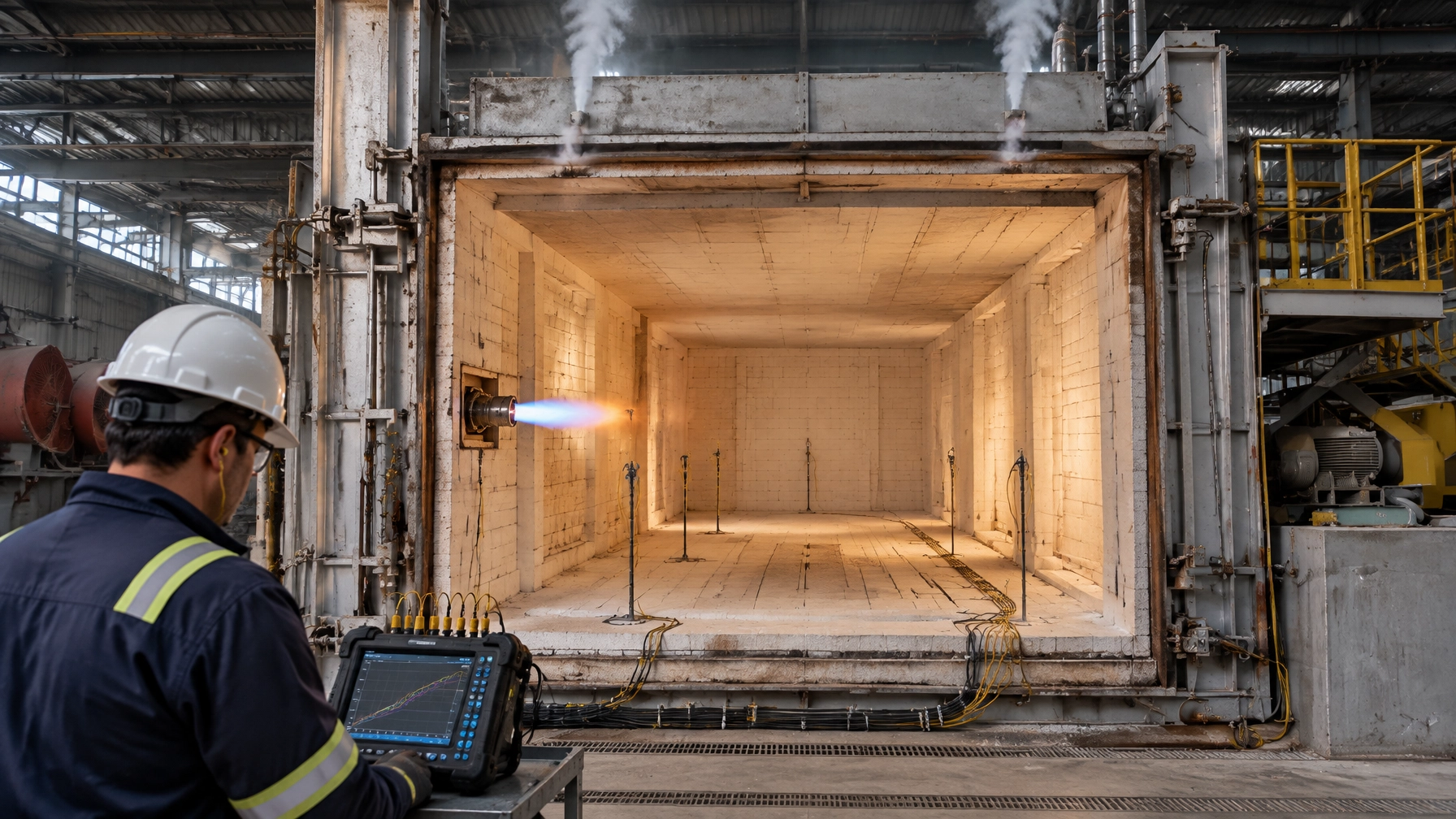
Why the first heat matters
A new furnace lining, or a local repair, faces its greatest risk during the first controlled heat-up. A rushed bake-out can turn retained moisture into damaging steam pressure, crack or spall refractory, and delay the return to production. That is why commissioning and post-repair dry-out deserve the same discipline as the operating process in a steel rolling mill, foundry or recycling plant.
The principles apply across heat treatment furnaces, melting operations and other industrial furnace systems. The goal is not simply to reach operating temperature: it is to remove moisture at a controlled rate while protecting the lining and furnace structure.
Important: All temperatures, rates, durations and field figures below are published reference values, not guarantees for any specific installation. The installed refractory manufacturer’s current, product-specific data sheet takes precedence. Complex or multi-component linings and installations thicker than the schedule permits require case-by-case engineering.
The physics you are managing
Refractory retains two kinds of water after installation:
- Free, physical water occupies pores and typically boils off at 212°F (100°C).
- Chemically combined water is held in cement-hydrate phases and is released in stages as the lining heats.
HarbisonWalker International (HWI) identifies critical cement-phase dehydration temperatures of 440°F (227°C), 530°F (277°C) and 1,020°F (549°C). Jenkins, Piper and Proctor identify a broader 400–600°F critical chemical-water release band. These are published reference points; actual release behavior depends on the material and installation.
Water expands roughly 1,600 times in volume when it becomes steam, according to HWI. If steam cannot escape through the refractory quickly enough, internal pressure can exceed the lining’s strength. Hotwork-USA reports incidents typically occurring around 800°F; damage is often found 2–4 inches below the hot face, rather than at the furnace shell.
Permeability, the ease with which moisture can escape, is central. In conventional castables, roughly 25% of mixing water is chemically combined on average; about 75% remains as free placement water. Published Brimstone figures place water content around 4–8% by weight for dense conventional castables, 15–20% and sometimes 20–40% for insulating castables, and 40% or more for ultra-light materials. Lower-density products generally have higher permeability; dense, low-cement castables are less forgiving of rapid heat-up.

Designing the curve: schedule logic, not guesswork
A ramp-and-hold curve heats to a set point, holds for a defined period, then continues. Published schedules commonly use ramps around 25–75°F per hour, with holds often calculated by lining thickness. A continuous-ramp approach instead distributes the heating more evenly: a Brimstone example converts a 25°F/hour ramp-and-hold into a 12.5°F/hour continuous ramp of the same total duration, reducing peak internal steam pressure at intermediate points. These methods are not interchangeable prescriptions; the material supplier’s schedule governs.
| Dry-out approach | Temperature control and uniformity | Indicative spalling risk | Best fit |
|---|---|---|---|
| Main process burner | May have inadequate turndown or uneven heat distribution | Elevated if output is difficult to control or flame impinges | Only when its control range and heat pattern are verified for dry-out |
| Ad-hoc torch or process heat | Often localised; multi-point control may be absent | Elevated where hot spots and gradients develop | Not a substitute for an engineered curve |
| In-house ramp-and-hold with portable burner | Can be controlled with suitable instrumentation and air circulation | Depends on curve, burner placement, venting and operator discipline | Straightforward work with an approved schedule and qualified team |
| Professional high-velocity convective dry-out | Designed to distribute heat and manage circulation | Can reduce non-uniform heating when properly engineered | Large, complex or high-consequence linings |
Comparison is indicative, not a performance guarantee. Equipment, lining geometry and site conditions determine results. Hotwork reports that high-velocity excess-air burners, described in its field literature as having approximately 100:1 turndown and nozzle discharge near 450 ft/s, can provide uniform convective heating. In one cited glass-industry comparison, high-velocity systems reduced some heat-up durations substantially versus lance heating. Those project examples should not be treated as a promise for another furnace.
Published schedules illustrate why the material and thickness must be confirmed:
- Resco suggests, for certain single-component linings up to 9 inches, a 24-hour cure, heating to 300°F, and a hold of 1½ hours per inch (maximum 8 hours), followed by controlled ramps. For linings over 9 inches, its example uses 50°F/hour ramps and staged holds at 300°F, 600°F and 1,000°F.
- Plibrico Schedule B specifies a 24-hour moist cure, then 50°F/hour to 1,000°F, 100°F/hour to operating temperature, and an operating hold of 1 hour per inch of total lining thickness. It also calls for multiple hot-face measurements and avoiding gradients over 50°F.
- The SBS Refractory Service practice sheet describes staged curves lasting two to five days, depending on material and thickness: slow heating to 110°C, a hold until steaming ceases, further holds at 350°C and 600°C, and slower heating through the 350–600°C critical window.
HWI’s cited standard schedules apply to single-component linings up to 9 inches; thicker and multi-component linings need specific review. Hotwork has reported three supplier curves from 95 to 350 hours for chemically similar products in one aluminum melting furnace project. This variation reinforces the rule: obtain the exact curve for the actual product and total lining build-up.
Curing conditions also matter. HWI identifies 70–90°F as an ideal curing range for its guidance; curing below 70°F can reduce strength and permeability and extend curing time. Brimstone notes that cold-curing can form gel phases that retain more chemically combined water, requiring slower ramps and additional holds.
Execution discipline on bake-out day
- Instrument the lining: Use multiple thermocouples at or near the hot face. Plibrico specifies placement within ½ inch of the surface. Refratechnik guidance calls for thermocouples protruding at least 100 mm into the chamber, away from burner shadow and direct flame; follow the applicable project instructions.
- Provide moisture paths: Verify wicking, forms removal, unclogged vents and weep holes. Refratechnik reports that 10-mm holes in the outer steel shell, at a minimum of 5 per m², have proved successful in its kiln guidance; confirm applicability with the lining and vessel designer.
- Prevent saturated air and hot spots: Maintain fresh-air circulation and exhaust. Avoid flame impingement or radiant spot heating, which can drive moisture toward cooler areas.
- Recognise pressure steaming: Light visible wisps can be normal and show moisture is escaping. Hotwork’s working test for pressure steaming is inability to hold a hand 4 inches from the stream for 10 seconds. If pressure steaming occurs, hold temperature until it subsides before resuming the approved curve.
- Agree interruption rules beforehand: Resco recommends restarting its schedule after heat or power loss, while Plibrico advises stabilising at the current temperature and resuming from the corresponding point. The responsible supplier and project team must define the rule before firing.
- Record the evidence: Log the curve, thermocouple locations, readings, holds, interruptions and deviations in commissioning sign-off records.
Hotwork reports roughly 400 dry-out projects annually and an average of 2–3 explosive spalling incidents, or less than 0.75% of projects, in its field experience. Its papers identify recurring contributors such as off-target mix water, missing or poorly dispersed polypropylene burnout fibres, unsuitable curing, weather exposure and prolonged hot storage. These figures describe Hotwork’s reported experience, not a universal industry rate.

After the bake-out: protect the lining in service
After initial dry-out, subsequent starts and stops are governed largely by thermal-expansion stress rather than steam removal. THORPE guidance recommends not exceeding 100–125°F/hour for subsequent start-ups and shutdowns, as a published reference range for protecting the brick-to-shell “interference fit.” Heating the lining too rapidly can stress brick before the shell warms; rapid cooling can spall the hot face and loosen brick rings.
A partial repair still needs an approved curve. New castable does not dry faster simply because the repaired area is smaller. For recurring work, establish a curve library by furnace, refractory product, lining thickness and repair type.
A five-phase dry-out roadmap
- Pre-installation planning: Obtain the product data sheet and curve; confirm mix-water targets, curing conditions, weather protection, weep holes and vent paths.
- Curve tailoring: Align the refractory manufacturer, installer and heating contractor on thickness, geometry, burner access and any one-sided heating or zone lag.
- Instrumentation and records: Define thermocouple points, data logging, responsibilities and sign-off criteria before the furnace is heated.
- Controlled bake-out: Govern each hold point. Pause for pressure steaming, investigate unexpected gradients and document deviations.
- Institutionalise learning: Keep curve records, repair histories, interruption decisions and post-dry-out start-up procedures available to maintenance and operations teams.
Support the bake-out before you need it
Keep the essentials available: thermocouples and data loggers, suitable dry-out burner packages, vent components, specified polypropylene burnout fibre, approved anchor systems and ceramic-fibre protection where needed to prevent flame impingement. Reliable furnace spare parts availability and prompt technical support reduce avoidable delays, but spares do not replace a material-specific schedule or qualified commissioning.
Whether planning a melting furnace for steel, a metal recycling furnace, equipment for the wire and cable industry, or a hot dip galvanizing plant, dry-out engineering is part of the wider thermal processing equipment lifecycle. Continental Furnaces is an industrial furnace manufacturer with 35+ years of expertise, ISO-certified quality, customized solutions and super prompt service. Explore our heat treatment furnaces and melting furnaces and recycling projects.
Make the next bake-out a planned step toward sustained reliability. Request a consultation or quote and discuss an enduring support plan with Continental Furnaces.
References
- HarbisonWalker International, “Curing and Dryout of Refractories”.
- Jenkins, Piper and Proctor, “Important Considerations for Refractory Dryouts, Startups & Shutdowns”, Brimstone Sulfur Symposium paper.
- Cobane, “Explosive Spalling of Low Cement Castable Refractories”, Hotwork-USA.
- Resco Products, Suggested Heating Procedures for Conventional Castables.
- Plibrico, Heat-Up Schedule B.
- SBS Refractory Service, “Running heat-up curves correctly”.
- Refratechnik Steel, “Notes on heating up monolithic refractory products”.
- Hotwork-USA, “Steaming Generated During Refractory Dryouts”.
- Jenkins, Piper and Proctor, Brimstone paper, cited above, for start-up and shutdown guidance.