Morning Edition | Continental Furnaces Industrial Insights
Energy efficiency has become a decisive operating metric for steel producers, foundries, recyclers, and manufacturers across the wire and cable industry. Fuel volatility, tighter environmental requirements, material-yield expectations, and pressure to document carbon performance are transforming thermal processing from a utility function into a strategic business priority.
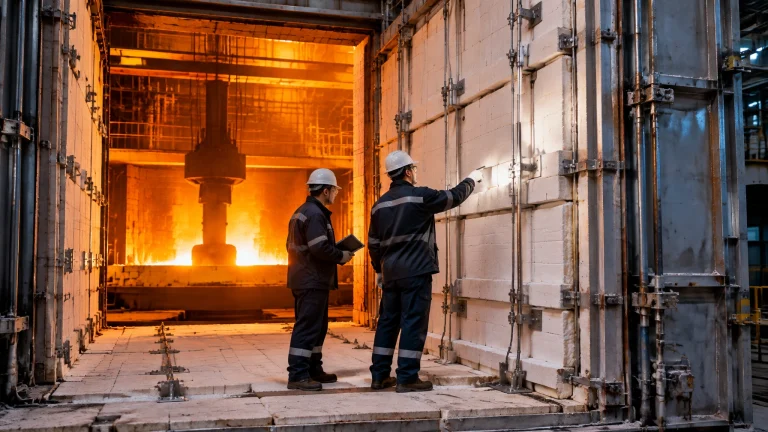
For a modern steel rolling mill, the reheating furnace can represent approximately 60–65% of total rolling-mill energy consumption. Across the industry, hot-rolling energy performance varies significantly: world-class operations may approach 2.0–2.4 GJ per tonne of rolled steel, while less-optimized facilities can consume materially more.
The competitive edge is clear: a well-engineered furnace reduces fuel consumption, improves metallurgical consistency, protects yield, and supports regulatory compliance simultaneously.
The New Energy Benchmark for Rolling Mills
A modern thermal processing strategy must address the complete energy chain: from billet charging to rolling, heat treatment, maintenance, and recovery of waste heat.
Key performance benchmarks include:
- Billet reheating capacity: 10–120 TPH, depending on mill configuration and product mix.
- Operating temperature range: approximately 700–1320°C, with billet discharge temperatures commonly specified around 1200–1250°C for hot rolling.
- Best-practice billet heating: approximately 200 Mcal/t, or about 0.84 GJ/t, for the heating step in highly optimized operations.
- Potential recuperative fuel savings: commonly 15–30%, depending on furnace load, exhaust temperature, combustion control, and baseline performance.
- Hot-charging opportunity: typically 25–40% lower specific heat consumption compared with cold charging, when plant layout and caster-to-mill logistics permit.
- Temperature uniformity: a properly controlled system can target billet temperature variation within approximately ±10°C, supporting stable deformation and product quality.
These figures are performance benchmarks, not universal guarantees. Actual results depend on billet dimensions, steel grade, fuel, throughput, furnace design, operating schedule, and the boundary used for energy measurement.

Five Engineering Levers That Deliver Energy Efficiency
1. Recuperators and High-Efficiency Combustion
A recuperator transfers heat from outgoing flue gas to incoming combustion air. This simple thermodynamic principle produces a substantial reduction in fuel demand because the burner receives preheated air rather than ambient air.
The most effective systems combine:
- Recuperative or regenerative burners
- Automatic air-to-fuel ratio control
- Oxygen and furnace-pressure monitoring
- Low-NOx combustion technology
- Variable-speed drives for combustion fans
- Properly balanced multi-zone firing
The U.S. Department of Energy identifies combustion-air preheating as a major industrial furnace efficiency measure, with typical savings of 15–30% in suitable high-temperature applications.
However, heat recovery must be correctly matched to the furnace. An unsuitable recuperator can create maintenance problems, excessive pressure drop, corrosion, or unstable burner operation. Thermal design, flue-gas analysis, and lifecycle serviceability must be considered together.
2. Furnace Insulation and Reduced Heat Loss
Radiation, conduction, open doors, charging gaps, skid losses, and air infiltration steadily erode furnace efficiency. Modern industrial furnace systems therefore use:
- High-performance refractory linings
- Ceramic fibre modules and insulating castables
- Sealed inspection doors and access points
- Water-cooled skid systems designed for low thermal loss
- Optimized furnace openings and curtains
- Reduced shell temperatures through improved insulation thickness
Reducing heat loss also improves temperature stability. That directly supports lower scale formation, shorter residence times, and more predictable rolling conditions.
3. Hot Charging and Mill-Wide Integration
Hot charging is among the most valuable energy-efficiency strategies available to integrated steel operations. Instead of allowing billets to cool before reheating, the production line transfers their retained thermal energy directly into the reheating process.
Charging billets at approximately 450–550°C can substantially reduce furnace fuel demand. At higher charging temperatures, the energy requirement falls further. In advanced caster-to-mill configurations, hot charging and direct rolling can become a foundational element of a low-carbon steel strategy.
This requires more than a new furnace. It requires integration of:
- Continuous casting schedules
- Billet handling and transfer systems
- Furnace charging logic
- Rolling-mill demand signals
- Production planning and buffer management
- Real-time temperature measurement
4. Advanced Controls and Industry 4.0
The next generation of thermal processing equipment is not defined only by refractory design or burner technology. It is also defined by the quality of its data.
A digitally enabled furnace can monitor:
- Zone temperature and billet temperature
- Fuel consumption per tonne
- Oxygen levels and furnace pressure
- Burner performance
- Flue-gas temperature
- Throughput and residence time
- Door-opening frequency
- Mechanical-system condition
- Alarm history and downtime events
Model-based control can adjust firing rates according to billet grade, size, production speed, and rolling demand. This reduces over-heating and avoids the common practice of operating every zone at an unnecessarily high set point.
For decision-makers, the benefit is measurable: lower specific fuel consumption, improved yield, fewer cobbles, and more reliable production planning.
5. Preventive Maintenance and Furnace Spare Parts
Energy efficiency declines when burners become unbalanced, refractory joints deteriorate, seals leak, or sensors drift. Maintenance is therefore an energy-management activity: not merely a repair function.
A reliable spare-parts programme should cover:
- Burner assemblies and ignition components
- Thermocouples and pyrometers
- Recuperator elements
- Refractory modules and castables
- Water-cooled skid components
- Hydraulic and pneumatic actuators
- Control valves and instrumentation
- Fans, dampers, and drive components
Strategic availability of furnace spare parts reduces unplanned shutdowns and protects the furnace’s original efficiency. This is particularly important in a rolling mill, where a furnace stoppage can interrupt the entire production chain.
Modern Technology Compared with Legacy Operation
| Performance area | Legacy furnace operation | Modern energy-efficient approach |
|---|---|---|
| Combustion air | Ambient air with high excess air | Recuperative or regenerative preheating |
| Furnace control | Manual set points and limited measurement | Automated zone, oxygen, pressure, and throughput control |
| Charging | Cold billets after extended storage | Hot charging or direct-transfer integration |
| Insulation | Conventional refractory with high shell loss | Engineered refractory and ceramic-fibre systems |
| Maintenance | Reactive replacement after failure | Condition-based maintenance and planned spares |
| Energy visibility | Monthly fuel accounting | Real-time GJ/t and production analytics |
| Typical improvement potential | High fuel and scale losses | 15–40% lower energy demand, depending on baseline |
| Business outcome | Higher operating cost and variable quality | Better yield, uptime, compliance, and profitability |
Beyond Steel: Efficient Melting and Circular Manufacturing
Energy efficiency also defines the economics of recycling and non-ferrous production. Continental Furnaces designs solutions for an aluminum melting furnace, aluminum recycling lines, and rotary melting furnace for non-ferrous applications.
A well-designed metal recycling furnace must optimize:
- Scrap preparation and charging density
- Melt-loss control
- Burner arrangement and flame coverage
- Door-opening cycles
- Exhaust heat recovery
- Dross management
- Temperature and chemistry control

For ferrous applications, a melting furnace for steel must combine high heat-transfer intensity with robust refractory protection, safe tapping, and dependable material handling. Efficient melting reduces energy per tonne while improving melt consistency and increasing the value recovered from scrap.
This is the practical foundation of the Circular Economy: recover material, minimize melt loss, reduce primary-resource demand, and use waste heat wherever technically and economically viable.
A Practical Roadmap for Furnace Modernization
Phase 1: Assessment and Planning
Establish a defensible baseline before specifying equipment:
- Measure fuel and electricity consumption per tonne.
- Record flue-gas temperature, oxygen, and excess air.
- Map billet or charge temperature at entry and exit.
- Quantify scale, dross, rejects, and downtime.
- Review furnace age, refractory condition, and burner health.
- Identify applicable emissions and energy regulations.
Phase 2: Quick-Win Optimization
Implement low-capital improvements first:
- Correct air-to-fuel ratios.
- Seal doors and unused openings.
- Repair damaged refractory.
- Calibrate sensors and flow meters.
- Optimize production scheduling and furnace loading.
- Reduce unnecessary holding and idling time.
Phase 3: Technology Upgrade
Evaluate the right combination of:
- Recuperator or regenerative burner system
- Multi-zone automated control
- Walking-beam or continuous furnace configuration
- Hot-charging integration
- Improved refractory lining
- Waste-heat recovery for charge preheating
- Predictive maintenance and remote diagnostics
Phase 4: Lifecycle Partnership
The project does not end at commissioning. Sustainable performance requires:
- Operator training
- Performance audits
- Scheduled burner and refractory inspections
- Critical spare-parts planning
- Control-system upgrades
- Emergency technical support
- Documented energy and production reviews
Continental Furnaces: Engineering for Sustained Advantage
Since 1987, Continental Furnaces has supported industrial customers from its engineering base in Faridabad, India. As an experienced industrial furnace manufacturer, the company develops customized solutions for rolling mills, foundries, recycling plants, heat treatment operations, galvanizing lines, and the wire and cable industry.
Our portfolio includes:
- Billet reheating furnaces from 10–120 TPH
- Heat treatment furnaces operating across demanding temperature ranges
- Aluminum melting and recycling furnaces
- Rotary furnaces for non-ferrous metals
- Melting furnaces and recycling projects
- Hot dip galvanizing plants
- Pickling plants
- Furnace spares and accessories
Continental Furnaces is ISO 9001:2015 and ISO 14001:2015 certified, aligning engineered quality with environmental responsibility. Our approach combines customized design, energy-efficient technology, reliable commissioning, and prompt after-sales support to minimize downtime throughout the equipment lifecycle.
Explore our billet reheating furnace solutions, melting and recycling projects, and hot dip galvanizing plant capabilities.
The next step is an energy baseline and technical assessment of your operation. Consult Continental Furnaces to convert thermal efficiency into measurable yield, lower operating cost, and sustained competitive advantage.