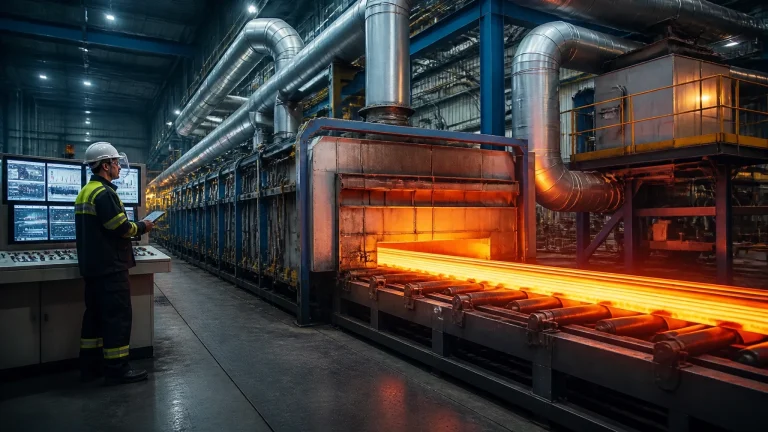
In the high-stakes environment of a modern steel rolling mill, the difference between a high-yield operation and a marginal one often comes down to just a few millimeters of oxide. Scale loss: the oxidation of metal surfaces during heating: typically accounts for a mass loss of 0.7% to 1.5% in standard reheating operations. For a mill producing 500,000 tons annually, a reduction of just 0.5% in scale loss translates to an additional 2,500 tons of finished product salvaged directly from the furnace floor.
As a leading industrial furnace manufacturer with over 35 years of engineering expertise, Continental Furnaces views thermal processing not merely as a heating step, but as a critical lever for profitability. Optimizing your thermal processing equipment requires a holistic approach that merges metallurgical science with advanced mechanical engineering.
Below is our professional roadmap for steel mill operators looking to achieve a quantum leap in yield and energy efficiency.
Step 1: Atmospheric Control and Oxygen Stabilization
The primary driver of scale formation is the presence of excess oxygen in the furnace atmosphere at high temperatures. In traditional industrial furnace systems, air infiltration through doors, gaps, and poorly sealed roof joints creates an oxidative environment that accelerates scale growth.
To mitigate this, mills must move toward precision atmospheric management:
- Maintain Low Excess Air: Utilize flue gas analyzers and O₂ sensors to maintain excess air at the lowest possible levels: ideally between 1% and 2%: while ensuring complete combustion.
- Pressure Management: Implement automated furnace pressure controls to prevent "stinger" flames or cold air ingress. Maintaining a slightly positive pressure ensures that the atmosphere remains stable.
- Advanced Sealing: Regular inspection of furnace seals is essential. Even minor leaks can lead to localized "cold spots" that force burners to over-fire, further increasing oxidation rates.
Step 2: Precision Burner Tuning and Combustion Optimization
Optimizing your combustion system is perhaps the most direct way to reduce specific energy consumption (GJ/t). Modern melting furnaces for steel and reheating units rely on high-velocity burners that provide superior heat transfer through convection.

Strategic Action Items:
- Staged Combustion: Adopt staged-air or staged-fuel burners to create a more uniform temperature profile. This prevents "hot spots" which are notorious for causing rapid, heavy scaling.
- PID Control Integration: Replace antiquated manual or simple on/off controls with advanced Proportional-Integral-Derivative (PID) controllers. This ensures that the furnace hits target temperatures with minimal overshoot, staying within a ±10°C window.
- Burner Maintenance: Regularly calibrate your burners. A misaligned burner can impinge directly on the steel surface, causing catastrophic local scale loss and decarburization.
Explore our range of high-performance furnace spare parts to ensure your combustion system stays at peak efficiency.
Step 3: Advanced Refractory and Insulation Management
Thermal efficiency is the bedrock of sustainability in the wire and cable industry and general steel manufacturing. Heat that escapes through the furnace shell is not just wasted energy; it represents a failure in thermal stability that forces the system to work harder, increasing the time steel spends at oxidizing temperatures.
The Continental Standard for Insulation:
We recommend a transition to high-density, multi-layer refractory linings. Modern ceramic fiber modules and high-alumina bricks offer superior thermal resistance compared to traditional firebricks. By reducing shell temperatures, you stabilize the internal environment, allowing for a more predictable time-temperature profile.
KPI Focus: High-efficiency refractories can reduce shell heat loss by up to 15-20%, directly impacting the ROI of your thermal processing equipment.
Step 4: Digital Optimization and Predictive Maintenance
The transition to Industry 4.0 is no longer optional for competitive steel mills. Integrating sensors and AI-driven data management allows for real-time monitoring of furnace health and performance.

Implementation Phase: Digital Transformation
- Predictive Maintenance: Shift from calendar-based maintenance to meter-based maintenance. By tracking variables like shell temperature and burner firing hours, you can replace furnace spare parts before a failure occurs, preventing unplanned downtime that leaves steel soaking in a hot furnace: the worst-case scenario for scale loss.
- Real-time Yield Tracking: Connect your discharge weighing systems to your furnace control software to correlate scale loss with specific heating cycles. This creates a feedback loop that allows for constant refinement of heating curves.
For more insights on avoiding common pitfalls, read our guide on 7 maintenance mistakes you're making with heat treatment furnaces.
Step 5: Modernization and Strategic Route Planning
Sometimes, the most effective way to reduce scale loss is to rethink the process route itself. For mills operating older equipment, a modernization project or a strategic shift to billet reheating furnaces with integrated pre-heating can yield massive returns.
The "Direct Rolling" Advantage:
Whenever possible, maximize hot charging: the process of loading cast products into the reheating furnace while they are still at elevated temperatures. This drastically reduces the residence time required to reach rolling temperature, cutting the window for oxidation by 30% to 50%.
Technical Comparison: Modern vs. Traditional Furnace Systems
| Feature | Traditional Furnaces (Pre-2010) | Modern Continental Systems | Impact on Profitability |
|---|---|---|---|
| Scale Loss (%) | 1.2% – 2.0% | < 0.6% | Quantum leap in yield |
| Specific Fuel Consumption | ~1.8 GJ/ton | ~1.3 GJ/ton | 25% Reduction in OpEx |
| Temperature Control | ±25°C | ±5°C | Improved metallurgical quality |
| Automation Level | Manual/Basic PLC | Full SCADA / AI Ready | Lower labor costs, higher safety |
| Maintenance Cycle | Reactive | Predictive / Meter-based | 18-25% lower maintenance costs |
The Strategic Roadmap to Thermal Excellence
Implementing these changes requires a phased approach to ensure zero disruption to your production schedule.
- Phase 1: Assessment (Month 1-2): Baseline your current scale loss and energy metrics. Install O₂ sensors and temperature loggers to identify "hidden" inefficiencies.
- Phase 2: Operational Tuning (Month 3-6): Calibrate burners, seal leaks, and optimize your PID loops. Train operators on the critical link between atmosphere and scale.
- Phase 3: Capital Modernization (Month 6-18): Upgrade to high-efficiency bogie hearth furnaces or specialized aluminum melting furnaces for non-ferrous projects.
- Phase 4: Full Integration (Month 18+): Implement AI-driven scheduling to minimize idle times and maximize hot-charge rates.

Toward a Sustained Competitive Advantage
At Continental Furnaces, we believe that every furnace we build is an enduring partnership. Whether you are looking for a complete hot dip galvanizing plant or simply need high-quality spares for your existing metal recycling furnace, our mission is to deliver the highest level of thermal precision.
Reducing scale loss is not just a technical challenge; it is a strategic move toward global competitiveness. By following this 5-step guide, steel mills can ensure they are not just "burning fuel," but creating value with every thermal cycle.
Ready to optimize your thermal processing operations?
Contact our engineering consultants today for a comprehensive site audit and a customized efficiency roadmap. Let’s build the future of thermal processing together.