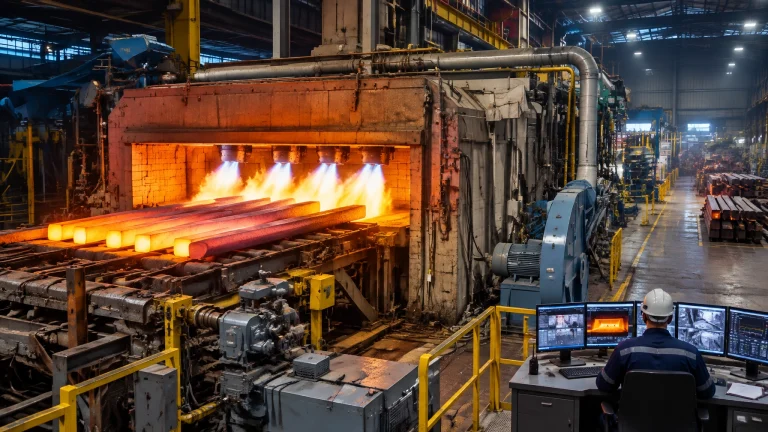
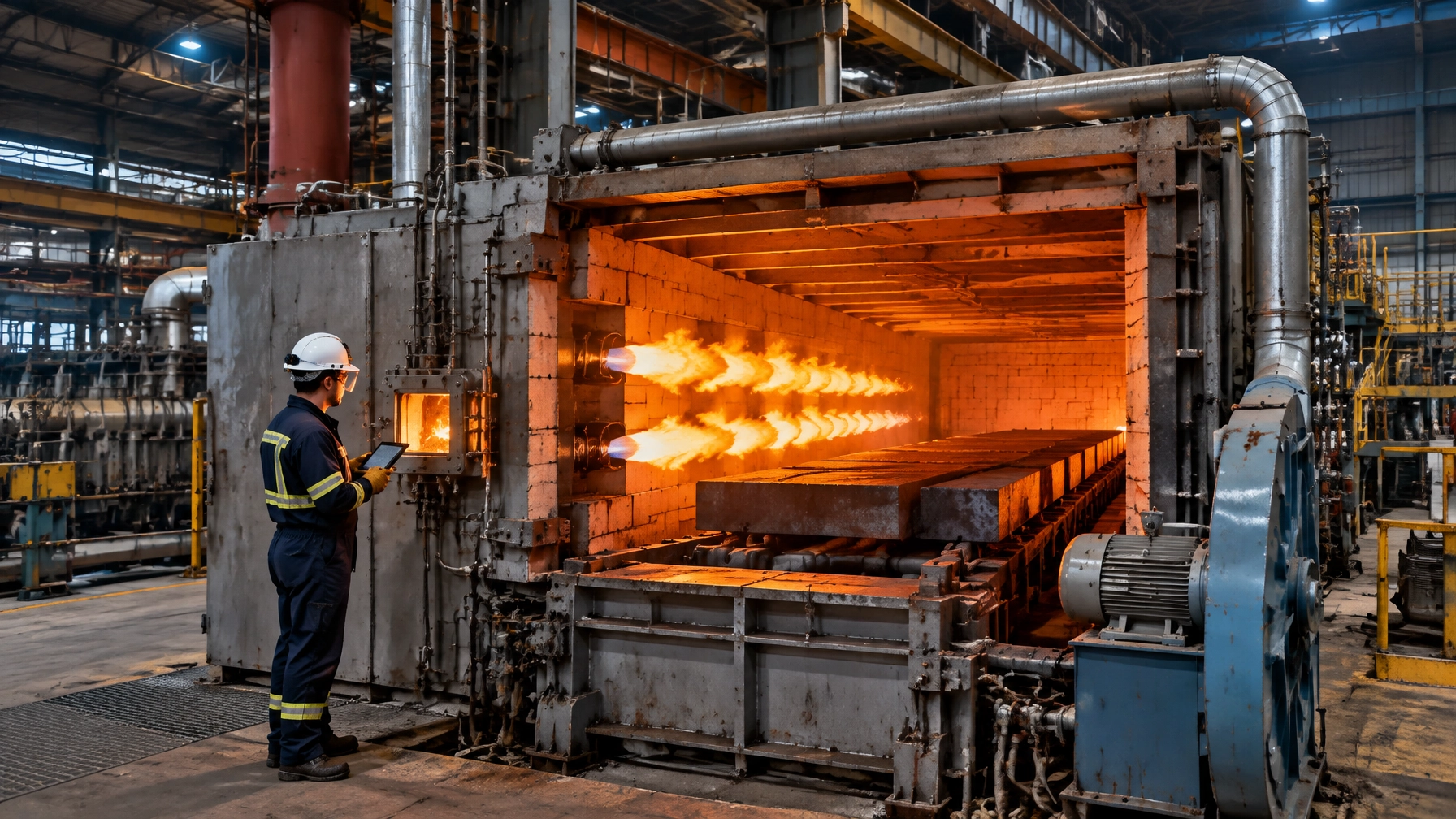
Every plant operator has heard it: an intermittent low-frequency hum or rumble that appears only at certain firing rates. In industrial furnaces and boilers, this sound can arise from feedback between unsteady heat release and acoustic modes of the furnace chamber. When combustion and pressure oscillations reinforce one another, the result can compromise structural integrity, raise emissions and reduce thermal efficiency.
This is a coupling problem with established physics and a tractable diagnostic workflow, not simply an annoying noise to work around. Figures in this article are indicative benchmarks drawn from published studies, utility plant reports, supplier references and regulatory texts. They vary by furnace geometry, burner type, fuel, throughput, load profile and local regulation, and are not turnkey guarantees. Any operating changes or instrumentation work must be assessed against the site’s safety systems and procedures.
Why Furnaces Rumble: The Thermoacoustic Feedback Loop
The physics in one paragraph
Furnace heat-release fluctuations can couple with cavity resonances, including Helmholtz-type and longitudinal modes. When a flame responds to pressure or velocity oscillations at a phase that reinforces them, the feedback loop amplifies. In swirl burners, a precessing vortex core is a recognised low-frequency driver; flash-back or partial flame lift can also trigger or intensify coupling. A study of oscillations in a large swirl burner/furnace combination describes the challenge of diagnosing this interaction in a practical system (University of Cyprus study, 2024).
What instability costs
The impact depends on the equipment and operating history; it should be established through measured baselines rather than assumed from sound level alone.
- Efficiency and emissions: Oscillating combustion can reduce thermal efficiency and increase emissions. The Babcock & Wilcox review explains how vibration can affect industrial furnace and boiler performance (technical paper).
- Mechanical fatigue: Repeated vibration can accelerate fatigue in burner manifolds, tube supports, refractory, and casing.
- Flame-safeguard trips: A moving or fluctuating flame may contribute to nuisance trips if scanner signals become unstable. Review flame-safeguard application and scanner guidance in the Fireye multi-burner controls document.
- Unplanned inspection costs: Repeated events can prompt additional checks of casing, supports, refractory and burner hardware, disrupting planned maintenance.
DOE and Oak Ridge National Laboratory characterization work discusses rumble sources and the difficulty of separating combustion-driven oscillation from other vibration mechanisms (source-identification study; rumble characteristics). In one reported industrial boiler case, a dominant oscillation near 10 Hz was observed; that is a case-specific finding, not a universal rumble frequency.
The counter-intuitive upside, driven oscillating combustion
Natural instability is a defect. Deliberately driven, controlled oscillation is a process tool. A U.S. DOE Industrial Technologies Program steel report describes oscillating combustion that creates alternating fuel-rich and fuel-lean zones. The project report cites efficiency improvement of up to approximately 5% and NOx reductions ranging from 28% to 55%, with a broader benefit summary reporting reductions up to 75% in some applications (DOE ITP Steel report).
These are project results, not guaranteed outcomes for every furnace. The distinction is control: engineered pulsation has defined frequency, amplitude, phase management and validation; uncontrolled thermoacoustic rumble does not.
A Diagnostic Ladder: From Ear to Instrumentation
Treat combustion dynamics as a measurable plant discipline: instrument, characterise, re-tune and monitor.
- Operational symptoms. Record audible rumble bands, pulsing stack behaviour, scanner nuisance trips, operator reports tied to specific turndown points, and vibration noticed at sight-glasses or manifold bolts. Log firing rate, fuel, zone, load changes and trip events.
- Acoustic instrumentation. Use dynamic pressure transducers and microphone probes. For hot zones, waveguides can bring the measurement point away from the harshest conditions. Pressure connections should be flush-mounted, without protruding tips that disturb the flow. Select ATEX-certified intrinsically safe equipment where the area classification requires it. Capture relevant frequency bands and use short-time Fourier transform (STFT) or spectral analysis to distinguish burner-instability bands from structural vibration. See DLR work on acoustic pressure measurement in high-temperature environments and Polifke/TUM microphone measurement notes.
- Optical and flame sensing. Trend UV/IR scanner DC intensity alongside flicker-frequency channels. Optoelectronic sensors are also under development for flash-burner flame monitoring (2025 Sensors paper). For scanner setup, choose modulation frequency and gain to maximise flame-on/flame-off discrimination, and view the primary combustion zone with adjacent burners at high fire. Consult the relevant Fireye CU-95 and SC-108 guidance.
- Advanced methods. Spectral proper orthogonal decomposition (SPOD) can separate coherent heat-release oscillations from background noise and mechanical vibration in industrial combustors (2025 JAECs study). Bayesian inference of thermoacoustic properties and flame transfer functions offers another route where optical access is restricted (JASA 2026 paper).

TABLE 1: Diagnostic instrumentation ladder compared
| Diagnostic level | What it detects | Indicative cost/effort | Indicative resolution | Best use |
|---|---|---|---|---|
| Operator symptoms and log review | Operating point, event pattern, audible change and trip correlation | Low; staff time and disciplined records | Event- and shift-level | First screening and baseline |
| Portable acoustic survey (dynamic pressure/waveguide microphones) | Dominant pressure frequencies, amplitude and event timing | Medium; temporary instrumentation and analysis | Frequency-resolved, survey period | Localising rumble bands and comparing load points |
| Fixed flame-scanner analytics (DC intensity + flicker frequency) | Flame presence, intensity variation and flicker behaviour | Medium; scanner compatibility and configuration | Continuous, per scanner | Burner-level trend and trip investigation |
| Fixed pressure-tap monitoring at burner and cavity points | Pressure oscillation amplitude, frequency and correlation across locations | Medium-high; installation, wiring and data integration | Continuous, time-synchronised | Persistent or recurring instability |
| Research-grade (SPOD, Bayesian flame transfer function inference, AI voiceprint) | Coherent modes, inferred flame response or classified acoustic states | High; specialist data, modelling and validation | High analytical detail; system-dependent | Targeted pilots and complex root-cause studies |
Figures are indicative effort categories based on supplier guidance and published studies, not quotations. Instrument selection, installation and safety requirements must be confirmed for the site.
Flame Dynamics Monitoring Goes AI

Computer vision on thermal video
A 2025 hybrid computer-vision system for steel reheating furnace flame monitoring reported end-to-end anomaly-detection F1 scores of approximately 97.7% in the front zone, 80.6% in the middle zone and 83.1% in the back zone (Scientific Reports study, DOI). These are results from one system and one industrial data set. Performance varies with image contrast, occlusion and camera placement; the study itself notes the need for validation across additional furnaces.
Acoustic voiceprint classification
A 2025 CNN-based acoustic voiceprint study reported approximately 93.49% accuracy for classifying combustion states including flameout, flashback and thermoacoustic oscillation (MDPI Sensors paper). Treat this as a single-study result, not a universal accuracy guarantee or a substitute for burner safety controls.
Intelligent control for load-ramping
A wavelet-LSTM-PPO framework has been studied for mitigating furnace pressure fluctuations during rapid load ramping (Frontiers in Energy Research, 2025). The application is relevant to a steel rolling mill, where furnace load can move with mill schedules. Practical deployment still requires plant-specific validation and clear limits on automated control authority.
Radiative-field diagnostics
RGB digital-camera methods can characterise radiative fields through flame intensity, uniformity and temporal variability (Chalmers 2026 publication). A separate 2026 Energies study explores diffusion-model anomaly diagnosis for slab reheating furnaces (paper). These approaches belong on an implementation roadmap as pilots, not procurement mandates. Evaluate vendor claims against in-plant data, operating conditions and operator acceptance.
Re-Tuning the Furnace: Practical Instability Fixes
Combustion-side levers
- Map equivalence-ratio windows and identify stable operating regions away from coupling.
- Restore excess-air discipline. Air infiltration and pressure-control discipline help keep flue paths stable, so combustion changes should be assessed alongside leakage and draft conditions.
- Test staggered burner firing angles or sequencing where the burner design permits.
- Evaluate fuel-injection modifications if evidence points to a driving mechanism. An ASME case study describes eliminating thermoacoustic vibration in a gas-fired package boiler using fuel-injection modification and cold-air system stabilisation (ASME Journal of Pressure Vessel Technology, 2009).
- Consider Helmholtz resonators, quarter-wave tubes or perforated liners only after frequency data identifies the target band. A damping device tuned to the wrong frequency adds hardware without solving the cause.
Control-side levers
- Create turndown maps with documented no-go bands. Avoid known unstable firing rates or cross them promptly under an approved operating procedure.
- Review cross-lighting sequences for interactions between burners.
- Re-tune scanner modulation frequency and gain to improve discrimination and reduce nuisance trips without weakening flame-safety requirements.
- Define commissioning-era acceptance criteria. A practical acceptance-test list includes:
- Turndown and light-off checks across the operating map.
- Per-burner stability margins at each defined load point.
- Scanner discrimination ratio.
- NOx and CO measurements across the load range.
- Vibration survey at nominated casing points.
Hardware and spare-parts readiness
After instability events, inspect flame scanners, UV tubes, igniters, pilot assemblies, dynamic pressure taps, waveguides and refractory anchors as appropriate. Standardising scanner and burner-control components as furnace spare parts across a fleet can simplify maintenance and reduce restoration time. Post-event refractory checks belong with the wider shell condition-monitoring discipline; see Continental Furnaces’ heat treatment furnaces for context on precision-engineered thermal processing equipment.
TABLE 2: Instability symptom → likely cause → first-line response
| Symptom | Likely mechanism | First-line response | Escalate to |
|---|---|---|---|
| Rumble at mid-turndown only | Coupling at a particular firing-rate window | Log load point; compare pressure and flame trends; apply approved no-go band | Combustion engineer and acoustic survey |
| Scanner nuisance trips at high fire | Flame movement, poor view, saturation or unsuitable scanner setting | Check sighting, DC signal, flicker channel, gain and modulation | Flame-safeguard specialist |
| Pulsing stack with CO spikes | Unsteady combustion, air/fuel imbalance or draft variation | Verify combustion readings, air supply and draft stability | Combustion and process-control team |
| New rumble after fuel or burner change | Changed flame response, fuel properties or system impedance | Compare before/after firing maps and fuel data | Burner supplier and acoustic diagnostic team |
| Vibration after refractory repair | Changed chamber geometry or acoustic boundary condition | Inspect repair and compare operating point with baseline | Refractory and furnace engineering team |
| Broadband noise after air-heater retrofit | Flow disturbance, leakage or changed duct/fan interaction | Inspect air path, dampers, seals and fan operating data | Mechanical, draft and combustion specialists |
A Four-Phase Roadmap to a Quieter, More Stable Furnace
Phase 1: Symptom and baseline audit (30–60 days)
Create a rumble log by firing rate, scanner-trip log, fuel and NOx baseline for each furnace, vibration walk-down and CCTV/flame visual survey. Record production conditions alongside every event so that maintenance and operations teams can compare like with like.
Phase 2: Characterisation (1–3 quarters)
Conduct a portable acoustic survey and map spectral bands against furnace modes and operating points. Test scanner discrimination and build an equivalence-ratio map for each burner zone. Agree how measurements will be synchronised and reviewed before the team starts changing settings.
Phase 3: Fix and pilot (3–12 months)
Apply burner re-tuning and firing-map changes under controlled commissioning; re-parameterise scanners; and install damping hardware only when frequency data supports it. Pilot AI flame monitoring on one furnace with pre-defined acceptance criteria for detection, false alarms and operator workflow.
Phase 4: Institutionalise (12–36 months)
Trend flicker-frequency and pressure signatures as leading indicators. Schedule annual re-tuning and assign owners to KPIs such as trips per quarter, defined dB bands, NOx in mg/Nm³ and fuel per tonne. Include acoustic acceptance criteria in every new burner or industrial furnace systems purchase specification.
2026 Technology and Market Updates
Research-grade diagnostics reach plant floors
The recent SPOD work (2025 JAECs), Bayesian thermoacoustic inference (JASA 2026), radiative-field camera diagnostics (Chalmers 2026) and voiceprint CNN research (2025) broaden the available toolkit. Their value is strongest when applied to a defined plant question, such as locating a coherent oscillation or separating combustion signatures from mechanical noise.
AI flame monitoring validated on reheat furnaces
The 2025 Scientific Reports hybrid system and 2026 Energies diffusion-model study show momentum in AI-based reheat-furnace monitoring. Both remain single-study results pending multi-site replication. A practical plant decision should weigh sensor placement, image quality, maintenance burden and performance under changing production conditions.
Intelligent control for flexible operation
The wavelet-LSTM-PPO load-ramping framework points toward more responsive pressure management. Interest will rise as fuel supply and energy tariffs become more variable. However, intelligent control must work within validated combustion limits and established flame-safety interlocks.
Why this matters now
Hydrogen-blend trials will change flame speed and stability margins. Establishing acoustic and flame-dynamics baselines in 2026 therefore supports pre-hydrogen readiness, complementing wider decarbonisation planning. Increasing operator attention to energy use and emissions also keeps scanner analytics and diagnostic monitoring on the investment list.
What This Means Across Your Furnace Fleet
A steel rolling mill reheat furnace combines many burners with fast load changes, making it a strong candidate for coordinated pressure and flame monitoring. In heat treatment furnaces, including bright annealing lines in the wire and cable industry, radiant-tube stability and scanner discipline protect consistent processing. A hot dip galvanizing plant may have long steady burns in preheat zones, where low-frequency vibration can be felt in the shell. An aluminum melting furnace or a melting furnace for steel may use regenerative burners with intentional pulse-combustion characteristics that must be distinguished from uncontrolled rumble. A metal recycling furnace may face variable fuel quality from mixed gas streams, while pickling plants sit within downstream lines where stable upstream heating supports production continuity.
Across these applications, an industrial furnace manufacturer conversation should include documented stability margins, scanner discrimination data and acoustic acceptance criteria in commissioning packages. Specify the evidence needed for the full operating envelope, not just a successful light-off at one load.
Make Combustion Stability a Measured Plant Discipline
Continental Furnaces brings 35+ years of expertise, ISO-certified quality, customized energy-efficient thermal processing equipment and super prompt service to an enduring customer partnership. A combustion-stability review can include a scanner discrimination audit, acoustic survey, firing-map re-tune and spare-parts standardisation for flame-safety hardware.
Treat the review as a strategic step toward sustained competitive advantage: request a quote to discuss a diagnostic and improvement plan for your furnace fleet.