Morning Edition | Continental Furnaces (India) | 31 October 2026
The nitrogen tax: paying to heat what the process does not need
In a conventional air-fired furnace, most of the combustion air is nitrogen. It does not participate in combustion, but it absorbs heat and leaves through the stack as hot flue gas. That is the nitrogen tax: fuel consumed to heat gas that does not heat the product.
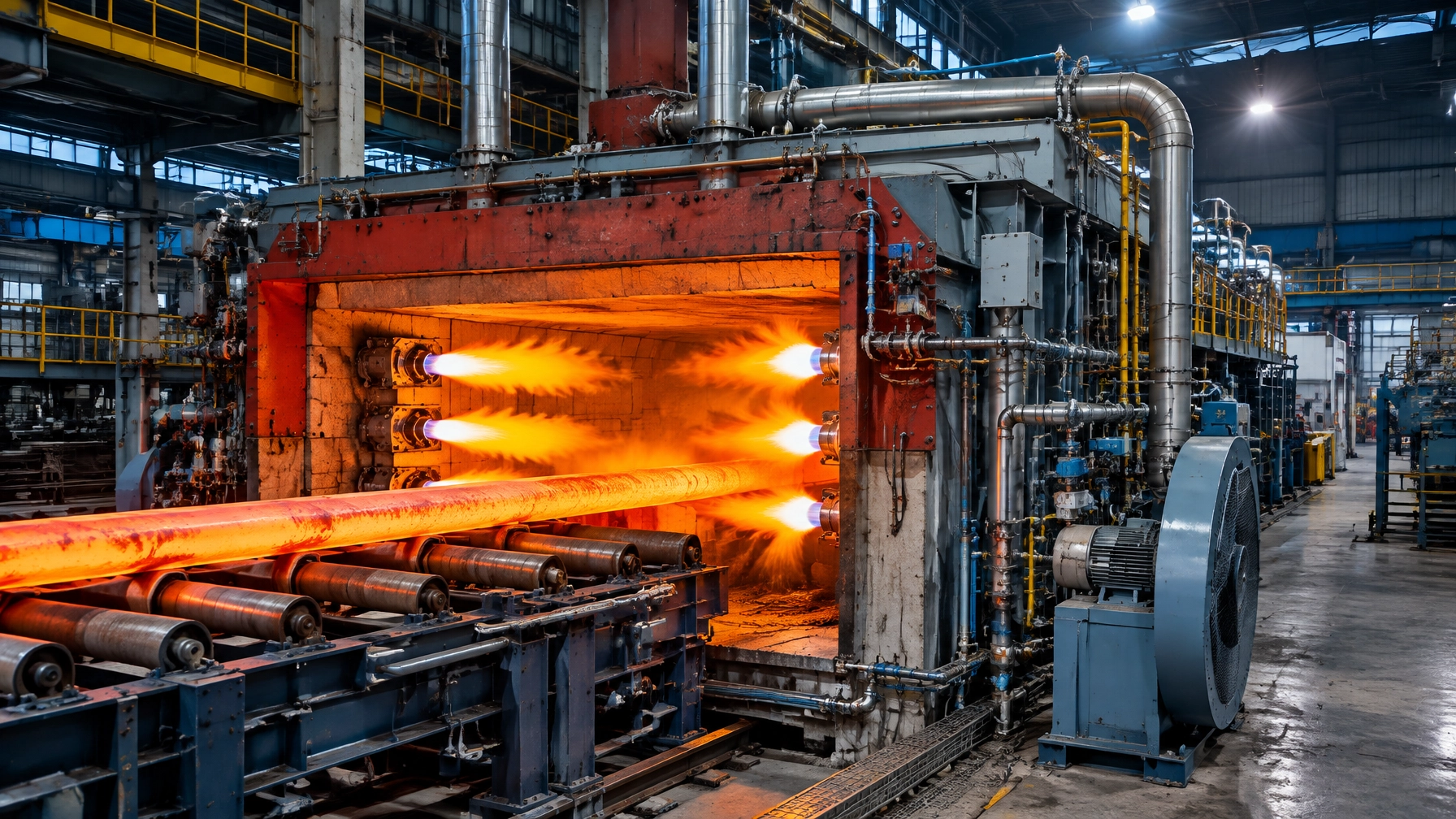
Oxy-fuel combustion directly addresses this loss by replacing some or nearly all combustion air with oxygen. In 2026, energy and emissions pressures, and more options for oxygen supply in India, make the retrofit worth reassessing. But lower fuel use alone does not establish a sound business case. Oxygen costs, operating hours, throughput value, refractory condition and emissions performance all matter.
Why oxy-fuel changes available heat
Air contains approximately 21% oxygen and 79% nitrogen. Enriching combustion air reduces the nitrogen ballast; full oxy-fuel combustion removes most of it. With less nitrogen to heat, less energy leaves in the exhaust. Published reheat-furnace references report flue-gas volume reductions of approximately 70–80% for oxy-fuel systems, with the precise result depending on the conversion and operating conditions.[1]
The higher the furnace temperature, the more energy the nitrogen would otherwise carry out of the stack. This is why the available-heat benefit can become especially significant in high-temperature processes such as steel reheating. Oxygen enrichment can also raise flame temperature and heat-transfer rates. Those same changes require careful control of heat distribution and refractory exposure.
The U.S. Department of Energy advises estimating enrichment savings from measured flue-gas temperature and oxygen concentration, not from a generic percentage.[3]
What published case studies indicate
These figures are published case results, not guarantees. Furnace design, fuel, operating practice, retrofit scope and measurement methods differ.
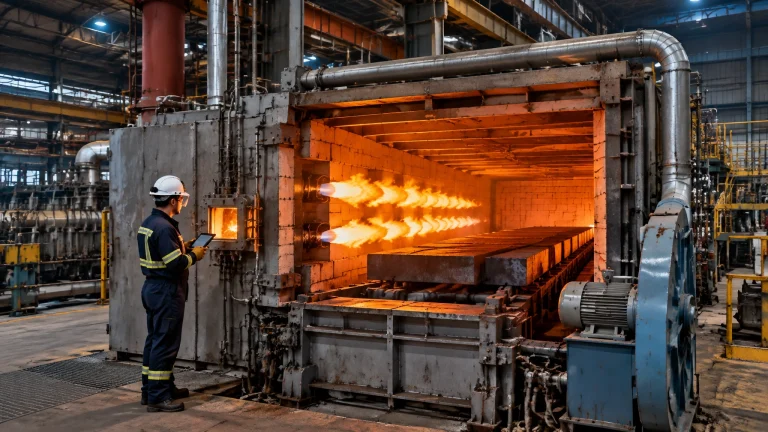
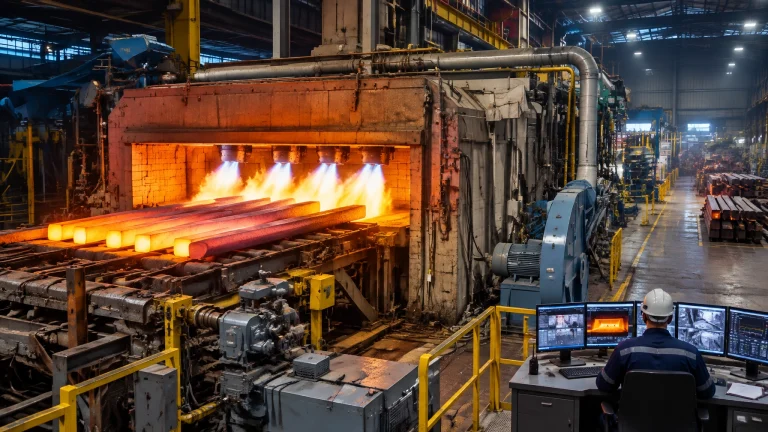
- Steel reheat: Linde REBOX references and a 2020 METAL conference paper describe flameless oxy-fuel installations (including cases at Ascometal, Ovako and Outokumpu) with reported ranges of 25–60% fuel savings, 25–50% productivity gains and often 40–90% or greater NOx reductions. The conference paper reports results of up to 60% fuel savings and 50% higher throughput across installations; those are upper-end results, not a forecast for every steel rolling mill.[1]
- Aluminum melting: A DOE-supported oxygen-enhanced combustion project at a secondary aluminum plant reported about 30% higher furnace productivity and 40% lower specific fuel consumption than air-fuel operation, using an oxidizer containing 35–50% oxygen. Some burner designs can also reduce bath-surface disturbance and dross formation; the effect depends on flame shape, bath conditions and furnace practice.[2][6]
- Galvanizing and annealing: Direct Flame Impingement (DFI) oxy-fuel heats strip directly and can remove surface residues, supporting coating adhesion. At ThyssenKrupp Steel’s Finnentrop line, a published case reported capacity increasing from 82 to 105 tonnes per hour, approximately 28%, alongside lower gas use and removal of a 25-metre pre-cleaning section. Results depend on strip, residue load and line configuration.[5]

These findings may be relevant to an aluminum melting furnace or metal recycling furnace where both melt rate and energy per unit of output affect profitability. For applications including a melting furnace for steel, project-specific burner and refractory assessment is essential.
The oxygen invoice: calculating net economics
The core calculation is not “fuel saved”; it is fuel, compliance and production value gained minus oxygen and retrofit costs.
Oxygen may be supplied as delivered liquid oxygen or generated on site using VPSA (vacuum pressure swing adsorption). VPSA is often considered for moderate or larger, sustained demand. Its economics depend on plant size, oxygen purity and pressure, utilization, capital and maintenance. Electricity is a major contributor to on-site oxygen cost; published oxygen economics literature places power at roughly one-third to two-thirds of total oxygen cost in some contexts.[4] This range is not a current Indian tariff or a supplier quote.
Utilization is decisive: a furnace running only a few hours per day may not justify a dedicated oxygen plant. Delivered oxygen, or a lower-demand enrichment retrofit, may be more suitable. Compare supply options using site-specific quotations and include backup arrangements.
Before capital commitment, complete a heat-balance audit and establish fuel per tonne, production rate, exhaust temperature, oxygen and CO measurements, and relevant NOx data. DOE’s MEASUR Oxygen Enrichment Calculator estimates fuel use from available heat; its relationship is FC_enriched = FC_base × AH_std/AH_enriched.[3] Use it as a screening tool, then verify the assumptions with furnace data.
Choosing the retrofit level
| Option | What changes | Fuel benefit | Capex / oxygen demand | Best fit | Principal risk |
|---|---|---|---|---|---|
| Combustion tune-up | Burner condition, air-fuel ratio, leaks and measurement | Site-specific; establish baseline | Low / none | First step for any furnace | Mistaking maintenance gains for retrofit performance |
| Air enrichment (lacing) | Oxygen added to combustion air, often up to about 27–30% O₂ | Partial; depends strongly on flue temperature and enrichment | Low to moderate / low | Existing burners; modest capital | Hot spots, emissions shift and oxygen handling |
| Oxy-fuel boosters / hybrid zones | Oxy-fuel in selected zones; air-fuel retained elsewhere | Partial to substantial; case-dependent | Moderate / moderate | Targeted preheat or soak-zone bottlenecks | Uneven heat distribution and integration complexity |
| Full flameless oxy-fuel | Furnace and burners converted for distributed oxy-fuel combustion | Published steel cases range up to 60%; not guaranteed | High / high | High utilization, major fuel or capacity opportunity | Oxygen cost, refractory loading and retrofit scope |
For enrichment, oxygen lacing supplements existing air-fuel burners and can be a lower-capital first step. Hybrid systems add oxy-fuel boosters in selected zones while retaining air-fuel elsewhere. Full flameless conversion offers the largest potential reduction in nitrogen-related exhaust loss, but requires burner and furnace modifications plus a robust oxygen-supply plan.

Risks and safeguards
- Refractory and flame impact: Higher flame temperature and radiation flux can increase refractory heat load. Map burner aim and heat flux; assess refractory condition and use suitable higher-duty materials where required.
- NOx behaviour: Conventional oxy-fuel can create high local temperatures and thermal NOx. Flameless or dilute oxy-fuel designs spread combustion and lower peak temperatures, but NOx must be measured under actual operating conditions.
- Oxygen safety: Oxygen systems require oxygen-compatible materials, oil- and grease-free handling, dedicated piping practices, trained personnel and formal operating procedures. Apply applicable oxygen-service and furnace-safety standards, including NFPA-type frameworks.
- Modification and controls: Review burner blocks, gas trains, flow measurement, flame detection, interlocks and control logic. Commissioning should verify combustion, furnace pressure, temperature uniformity and emissions.
A phased retrofit roadmap
- Audit and baseline: Measure fuel per tonne, throughput, flue-gas temperature, oxygen/CO and NOx; document furnace and refractory condition.
- Assess supply: Compare delivered liquid oxygen with VPSA sizing using actual demand, pressure, purity, utilization and backup requirements.
- Pilot one change: Test enrichment or a single-zone booster with instrumented, comparable production runs.
- Verify economics: Reconcile fuel and oxygen use with throughput, emissions, maintenance and product quality before scaling.
- Monitor permanently: Trend oxygen and CO trim, fuel per tonne, NOx and refractory condition after commissioning.
Furnace spare parts and lifecycle support
A retrofit also changes the maintenance profile of industrial furnace systems, and the spares list grows with it. Plan for oxy-fuel burner bodies and nozzles, duty-rated flame detectors or UV scanners, oxygen control valves and flow meters, oxygen analyzers, flashback or flame arrestors where specified, spare igniters, refractory anchors and higher-duty castables near burner zones.
For a steel rolling mill, foundry, hot dip galvanizing plant or operation in the wire and cable industry, a planned furnace spare parts inventory and prompt service help minimize downtime. Continental Furnaces supplies customized thermal processing equipment, including heat treatment furnaces and melting furnaces and recycling projects.
As an industrial furnace manufacturer with 35+ years of expertise, Continental Furnaces combines customized engineering, ISO-certified quality and prompt service. Discuss your furnace data and oxygen-supply options with our team to evaluate the right retrofit scope and build an enduring partnership for sustained competitive advantage. Request a consultation or quote.
References
- Linde REBOX reference cases (Ascometal, Ovako 48 pit furnaces and Outokumpu); J. von Scheele and V. Zilka, “Successful Use of Flameless Oxyfuel in Steel Reheating,” METAL 2020, doi:10.37904/metal.2020.3460.
- U.S. DOE Industrial Technologies Program, High-Efficiency, High-Capacity, Low-NOx Aluminum Melting Using Oxygen-Enhanced Combustion; Air Products project report, OSTI 765375.
- U.S. DOE, Process Heating Tip Sheet #3: Oxygen-Enriched Combustion; ORNL, MEASUR O₂ Enrichment Calculator.
- ACEEE, Recent Trends in Oxy-Fuel, Air-Fuel, and Hybrid Combustion Technologies; Hisashi Kobayashi, oxy-fuel oxygen-production and economics overview.
- H. Eichelkraut et al., “DFI oxyfuel solution boost galvanizing capacity at ThyssenKrupp Steel,” Metallurgical Research & Technology (2007), DOI 10.1051/metal:2007206.
- Messer, Bermco Aluminum: Custom Oxy-Fuel Combustion Case Study.