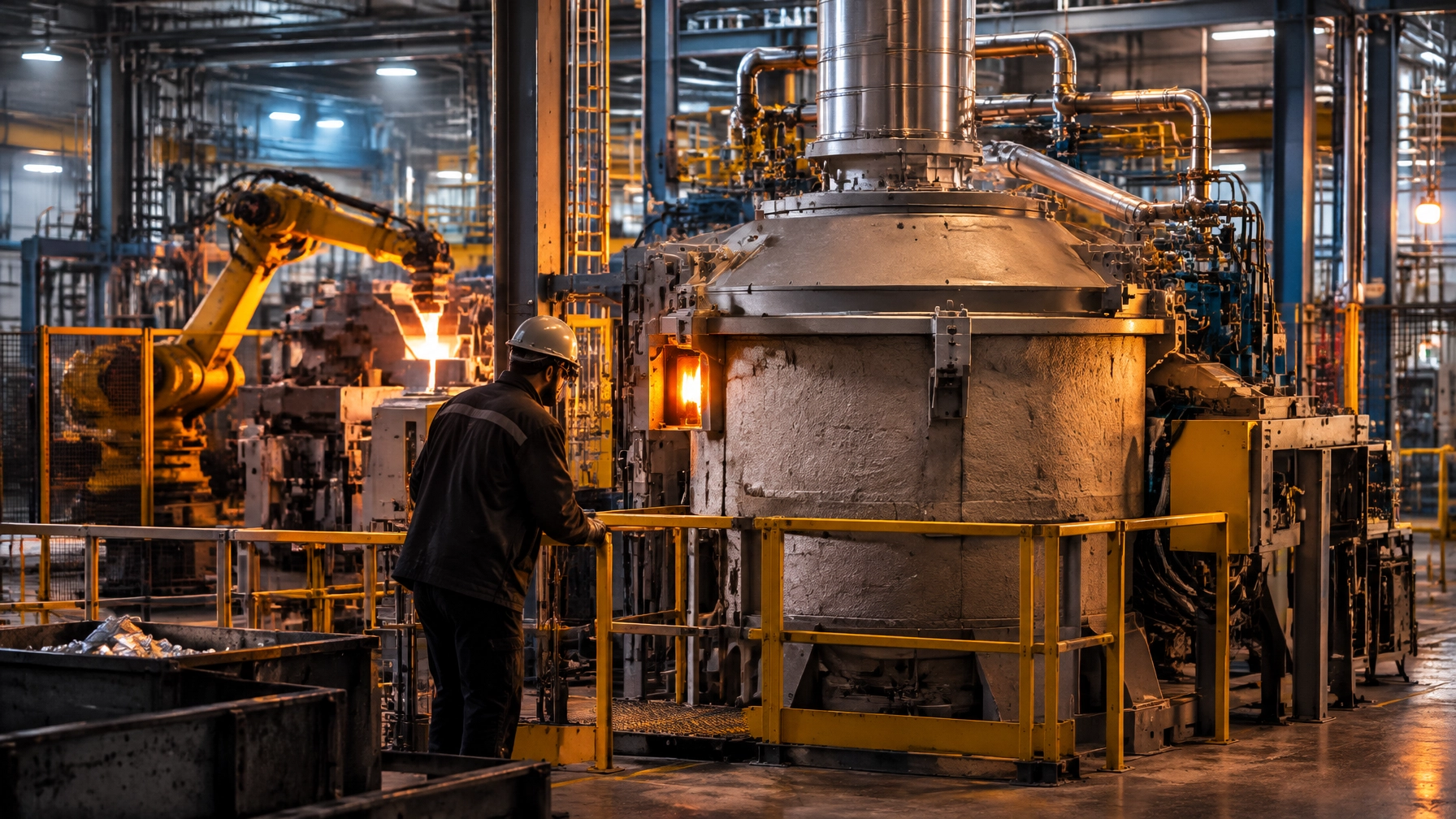
Die casters invest heavily in the casting machine and the die, but the melt waiting beside the machine can determine both scrap rate and energy bill. The holding furnace is a thermal control point, not a bucket. Open it unnecessarily and energy escapes; expose molten aluminum to humid air and hydrogen pickup becomes a quality risk; lose temperature in transfer and the melter must compensate. The benchmarks below are indicative figures drawn from published surveys, plant reports, regulatory texts and supplier references. Actual results vary by plant, alloy, furnace type, throughput and local practice. A disciplined approach to thermal processing equipment connects melt quality to production performance.
Why the Holding Furnace Is a Control Point
Holding furnaces typically maintain aluminum at approximately 680–740 °C while it awaits the next shot. DOE metal-casting studies report that melting and holding together can consume 50–77% of a die-casting plant’s total energy; holding alone can account for roughly 22%.[1][2] In DOE tests, an uncovered surface of about three square feet lost 5–8 kWh per hour at 1,100–1,400 °F. Uncovered furnaces used 155–182% more energy than covered furnaces in those tests.[1]
A 2025 IEEE ACDSA study reported about 38.2% lower energy consumption when a sealed lid was combined with high-performance insulation.[3] From an exergy perspective, heat escaping by radiation and convection from a melt held at temperature delivers no useful production work; it is simply lost from the process.[4]
The main leakage points are:
- Lids left open between pours or during idle periods
- Degraded insulation, refractory joints or lid seals
- Holding capacity larger than production needs
- Excessive superheat used to mask transfer losses
- Charge and refill schedules that create avoidable idle holding
Lid, Insulation and Design Choices That Cut the Bill
What the benchmarks say
DOE’s covered-versus-uncovered tests show how much the lid matters: uncovered operation used 155–182% more energy under the reported test conditions.[1] The separate 2025 study’s approximately 38.2% reduction combined a sealed lid and high-performance insulation, rather than attributing the result to either upgrade alone.[3]
For electric units, zoned heating elements with PID control help maintain temperature homogeneity across the bath.[10] Refractory and insulation design must balance thermal resistance with durability under molten-aluminum contact and operating conditions.[11]
Dosing furnaces: the enclosed advantage
A fully enclosed dosing furnace limits exposed-surface radiation and convection, supports temperature uniformity and reduces contact between the melt and plant air. Air-pressure dosing is one established design class for repeatable shot delivery.[12][13] Enclosure is not a substitute for proper atmosphere and melt-quality controls, but it reduces unnecessary exposure during delivery.

Holding and dosing furnace design approaches compared
| Design approach | Heat-loss character | Typical reported energy effect | Melt-quality implications | Best fit |
|---|---|---|---|---|
| Open/uncovered crucible | High radiation and convection from exposed surface | DOE tests found 155–182% higher use than covered operation | More exposure to plant atmosphere; larger temperature swings | Frequent-access legacy cells |
| Covered crucible, standard insulation | Reduced surface losses; wall losses remain | Lower use than uncovered in DOE tests | Less air exposure while closed | Retrofit where access remains necessary |
| Covered, high-performance insulation and sealed lid | Lower surface and wall losses | IEEE 2025 study reported about 38.2% reduction for combined upgrade | Better temperature retention; reduced exposure while sealed | Energy-focused upgrades |
| Zoned electric with PID | Controlled heat input by zone | Depends on baseline and operating profile | Supports temperature homogeneity | Electric holding and precise control |
| Fully enclosed dosing furnace | Minimal exposed-surface radiation and convection | Design-specific; no universal percentage | Limits plant-air exposure; repeatable dosing | High-volume, quality-critical cells |
Benchmarks are indicative, based on published studies and supplier references. Results vary by alloy, furnace type, throughput, installation and operating practice.
Hydrogen Reabsorption: The Invisible Clock
Water vapor is a significant hydrogen source for molten aluminum. It reacts at the melt surface to form alumina and hydrogen; one study estimated that about 51% of the reaction hydrogen can enter the melt.[5] Absorption risk is influenced by humidity, temperature and oxide-film characteristics. Research on Al-Mg melts examines uptake under humid atmospheres, and magnesium-containing alloys can be especially sensitive because their oxide films are more permeable.[6][7]
Operational discipline matters:
- Keep lids closed during idle and holding periods; use appropriate covering fluxes where relevant.[24]
- Monitor furnace atmosphere and investigate moisture ingress or abnormal burner conditions.
- After extended holds, verify melt condition and degas as needed rather than assuming an earlier treatment remains effective.
- Standardize rotary degassing. Argon is often preferred for cleanliness-critical melts; nitrogen selection should account for evidence that treatment conditions can introduce oxide bifilms that act as porosity nucleation sites.[8][9]
The Reduced Pressure Test (RPT) remains a common plant check: a sample solidifies under vacuum, often around 80–100 mbar, and its density index helps assess gas-related porosity potential. It is not a direct, definitive hydrogen measurement, and results depend on consistent sampling, vacuum, mold temperature and procedure.

Transfer Heat Loss: The Hidden Second Furnace
Every step (central melter to launder, holding furnace to ladle or dosing system, then shot sleeve) can cost degrees. A supplier reference reports about 1–3 °C per metre for covered, insulated ceramic launders in steady flow, compared with approximately 8–15 °C per metre uncovered or uninsulated.[14] A consultant reference puts covered, insulated ladle losses at roughly 2–3 °F per minute, with uninsulated losses more than double; it recommends preheating transfer ladles to around 800 °F.[15]
Design the system to melt centrally, hold locally, and transfer by the shortest covered, preheated route.[16] Avoid over-superheating at the melter to cover transfer losses: it adds thermal load, increases exposure to gas pickup and accelerates refractory wear.
Melt-Quality Measurement and Traceability
Pair chemistry with cleanliness and gas measurements:
- Spark OES for composition, with a repeatable sampling and spectrometry workflow.[17]
- RPT density index for gas-related porosity potential; use a bifilm index or suitable cleanliness method for oxide-related assessment.
- Inline ultrasonic inclusion detection: Fraunhofer IZFP described AloX in 2026 as a system for rapid, continuous detection of non-metallic inclusions in aluminum melts.[19] An April 2026 review consolidates molten-aluminum quality evaluation approaches.[18]
Digital platforms can connect chemistry, RPT results, degassing logs and furnace parameters by shift.[20] IIoT and AI use cases include monitoring furnace fill against consumption, predicting refill timing, optimizing parameters and reducing scrap; published examples include foundry process research and a Lenaal uptime case.[21][22] Model-based control has also been studied for die-casting energy efficiency.[23]
Holding and Dosing Furnace Failure Modes → What It Looks Like → First-Line Response
| Failure mode | What it looks like on the floor | First-line response | Escalate to |
|---|---|---|---|
| Lids left open during idle periods | High energy use; visible heat plume | Reinforce close-after-access procedure; check seals | Operations and maintenance |
| Porosity spikes in humid seasons | More porosity or RPT index drift | Trend humidity, RPT and lid-open time; verify degassing | Metallurgy and furnace engineering |
| Shot-to-shot temperature drift | Casting temperature varies by cycle | Check sensors, PID zones and refill timing | Controls and instrumentation |
| Excessive melter superheat | High tap temperature despite transfer losses | Measure temperature at each transfer stage | Process engineering |
| Degassing ineffective despite correct treatment | RPT remains out of target | Verify rotor condition, gas flow, depth and test method | Melt-quality specialist |
| Refill events cause temperature dips | Scrap clusters after furnace refill | Review refill quantity, timing and recovery capacity | Production and furnace engineering |
These are indicative diagnostic patterns, not universal fault signatures; validate against alloy, equipment and plant procedures.
A Four-Phase Roadmap for Holding & Dosing Discipline
- Phase 1: Baseline audit (30–60 days). Record kWh per kg poured by shift and machine, lid-open time, RPT density index, transfer temperature drops and melter superheat.
- Phase 2: Instrumentation and sealing (1–2 quarters). Check lid interlocks, insulation and refractory; verify thermocouples and protection tubes; cover launders, formalize ladle preheating and build awareness of atmosphere dew point.
- Phase 3: Pilot and optimise (3–6 months). Upgrade one furnace with sealed lid and insulation, compare before-and-after kWh per kg, standardize degassing, including argon for critical alloys, and log melt quality by shift.
- Phase 4: Scale and institutionalise (6–18 months). Roll improvements across cells, assign KPI owners, link requalification to refractory and element maintenance, and specify holding/dosing requirements in every new industrial furnace systems purchase.
Treat critical furnace spare parts (heating elements, thermocouples and protection tubes, lid seals, dosing pumps and launder covers) as availability items, not commodities.
2026 Technology and Market Updates
Inline melt-quality sensing is becoming real-time
Fraunhofer’s 2026 AloX announcement describes ultrasonic inclusion detection for use in aluminum melts, while the April 2026 review brings together evaluation methods.[18][19] These developments support a shift from occasional sampling toward more timely process feedback.
AI and IIoT reach the dosing furnace
Fill-level versus consumption monitoring, refill prediction and process optimization can connect furnace behavior to production outcomes. Foundry research and the Lenaal case illustrate current directions; model-based energy control adds a route to optimize furnace settings.[21][22][23]
Real-time spectrometry on the melt line
A 2025 workflow article discusses using real-time spectrometry data to improve chemistry testing and quality control.[17] The value comes from linking reliable composition data to the relevant melt batch and process record.
Why holding discipline matters more as energy prices swing
Holding is a continuous thermal load. Sealed lids, sound insulation and controlled setpoints reduce avoidable consumption regardless of tariff movements, without relying on speculative energy-price assumptions.
What This Means Across Your Furnace Fleet
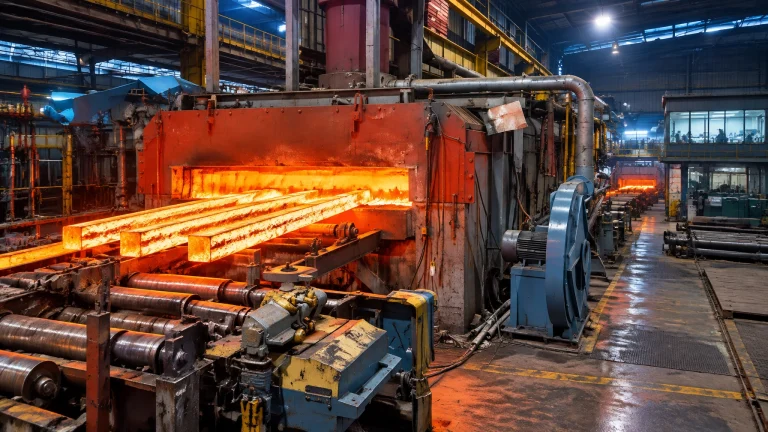
The same “hold without waste” logic applies in a steel rolling mill reheating between passes. Heat treatment furnaces and bright-annealing lines in the wire and cable industry depend on temperature uniformity and atmosphere discipline. A hot dip galvanizing plant relies on equally consistent temperature management. A metal recycling furnace or melting furnace for steel benefits from charge scheduling and transfer-loss control.
Aluminum melting furnace and remelt operations remain the primary focus. Continental Furnaces, an industrial furnace manufacturer, designs melting and holding thermal processing equipment as an integrated system rather than isolated boxes. Explore our melting furnaces and recycling projects and heat treatment furnaces or view a hot dip galvanizing plant.
Start an Enduring Partnership with Continental Furnaces
With 35+ years of expertise, ISO-certified quality, customized solutions and prompt service, Continental Furnaces helps plants make holding and dosing performance measurable and maintainable. Request a holding/dosing furnace thermal audit and melt-quality readiness review: the first step toward an enduring partnership and sustained competitive advantage. Request a quote.
Technical References
- DOE/OSTI Task 2.1: Melting Efficiency in Die Casting Operations
- ITP Metal Casting: Energy Consumption of Die Casting Operations
- IEEE ACDSA 2025 lid and insulation study, DOI 10.1109/acdsa65407.2025.11166598
- Energy Conversion & Management: Exergy analysis of an aluminum holding furnace
- Springer: Furnace Atmosphere and Dissolved Hydrogen in Aluminium
- Montanuniversität Leoben: Al-Mg hydrogen absorption from humid atmospheres
- 2025 chapter: Dynamics of Hydrogen in Aluminium, DOI 10.1007/978-3-031-80676-6_142
- International Journal of Metalcasting: Rotary degassing study, DOI 10.1007/s40962-020-00428-z
- MDPI Metals: High-shear melt conditioning and degassing overview
- Kanthal: Aluminum holding furnaces with electric heating
- SBS: Aluminum holding furnace refractory and insulation
- SINC Thermal: Holding chamber design for aluminum melt quality
- DASEON: Aluminum alloy air-pressure dosing furnace
- Ceramic launder temperature-drop supplier reference
- David W. White: Transfer system problems in aluminum melting
- Dynamo: Die-casting foundry melting and holding applications
- Foundry Management & Technology: Real-time spectrometry workflow
- April 2026 review of molten aluminum quality, DOI 10.1007/s41230-026-5115-4
- Fraunhofer IZFP: AloX ultrasonic inclusion detection
- Intelomelt foundry intelligence platform
- AFC 2025 IIoT/AI foundry paper
- Lenaal Monitizer AI uptime case
- Energy journal: IoT model-based die-casting energy efficiency
- AdTech: Covering and refining flux for aluminum holding furnaces