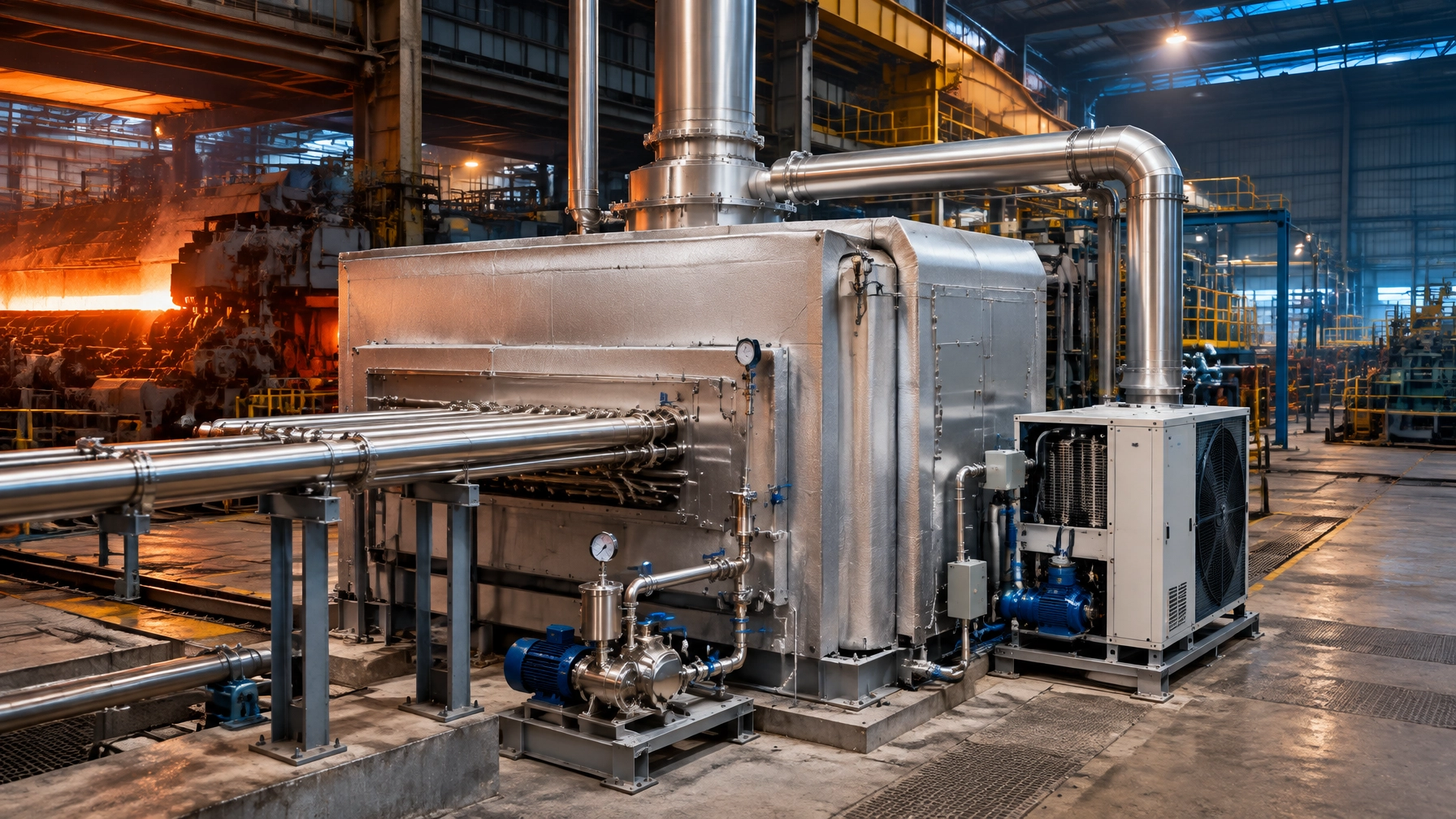
The last recoverable tier of furnace waste heat is cold, wet and heavy, and often remains unused after higher-temperature recovery has been addressed. This 2026 opportunity is not another look at hot exhaust recovery. It is about the low-temperature energy left in flue gas, cooling water and plant effluent, and the economics of matching that heat to a useful destination.
Published furnace heat-balance references place stack loss at 15–45% of total fuel input, depending on the process and its level of recovery. That is a broad reference range, not a forecast for a particular line. The viable next step depends on what remains in the exhaust or water circuits, how consistently it is available, and, above all, whether the facility has a suitable heat sink.
Where the remaining heat actually sits
Low-grade heat can be distributed across several streams, each with different operating conditions:
- Stack exit gas: After other recovery stages, residual sensible heat remains. For natural-gas combustion, the flue gas also carries substantial water vapour, and the latent heat released if that vapour condenses.
- Skid and rider cooling water: In walking-beam reheat furnaces, published studies report water-cooled skid/rider losses of 6–17% of total fuel input. Pusher-furnace configurations can have less exposed cooling area. Insulation can reduce the heat entering the cooling circuit; recovery can make use of some heat that remains.
- Quench and effluent streams: Wash water, rinse baths and process effluent may leave with steady, low-temperature heat that suits water preheating or a heat-pump source.
- Compressed-air systems: Compressor aftercoolers and warm receiver-tank surfaces may offer a separate, local source worth measuring.
In a steel rolling mill, these sources can operate on different schedules from production demand. Similar questions arise around heat treatment furnaces and melting and recycling operations. The first task is to measure temperatures, flow and operating hours, not to select equipment from a catalogue.

Condensing economizers: the latent-heat dividend
Natural-gas combustion products contain roughly 10–15% water vapour by weight. Their water-vapour dew point is approximately 57°C (135°F). Heat can be recovered sensibly above the dew point; capturing a substantial share of latent heat requires cooling the gas below it, typically to around 55°C or lower.
A condensing economizer transfers heat from flue gas to a water stream, recovering both sensible heat and, below the dew point, latent heat. DOE references report that a condensing economizer can improve overall boiler or steam-system thermal efficiency by up to 10%. They also cite approximately 3–4 percentage points of additional latent recovery for each 10 K of cooling below the dew point. These are published reference ranges, not guaranteed results for furnace exhaust or any specific installation.[1]
The economics hinge on the receiving water stream. Boiler makeup water, feedwater or another continuous low-temperature demand can give recovered heat a direct use. The condensate itself may also be valuable: where water availability is a concern, recovering and treating flue-gas condensate can offset some fresh-water demand.
Corrosion is the governing design constraint. Condensate absorbs CO₂ and may contain trace acids or contaminants from the fuel and process. Heat-exchanger materials must be selected for the actual gas and condensate chemistry; stainless steel or suitable aluminium alloys may be appropriate depending on conditions. Drainage, inspection access, treatment and condensate disposal or reuse all belong in the design basis.
Direct-contact quench condensation
A direct-contact condenser brings flue gas into contact with recirculating spray water. Gas cooling and condensation occur directly at the gas–liquid interface; a mist eliminator limits droplet carryover, and the water loop carries recovered heat to a sink or heat exchanger.
This arrangement can provide effective contact and avoid some surface-fouling limitations, but it makes water-chemistry management essential. Spray nozzles, recirculation equipment, condensate handling and downstream systems must be designed for the gas composition. It is not a universal substitute for an indirect economizer.

Low-grade sinks and heat-pump upgrading
Low-temperature heat has low exergy: it contains energy, but limited capacity to perform useful work without a temperature lift. That makes destination more important than the recovery technology. A heat pump can raise low-grade heat to a more useful process temperature, but it adds electricity consumption and complexity.
Commercial industrial heat pumps are reported across COP 2–5, upgrading sources around 18–100°C to process heat around 90–180°C. One documented case lifted 75°C heat to 120°C at COP about 8.2; steam generation at 170°C from low-grade sources has been reported at COP around 2. These are examples from specific systems, not a performance promise. COP falls as temperature lift grows, and actual performance depends on operating conditions and integration.[6]
Match the sink before choosing the equipment
Use this decision sequence:
- Is there a real, recurring heat demand below 60°C? If yes, test direct recovery first.
- Can the source heat that demand at the available temperature? If so, a heat exchanger or condenser may avoid heat-pump compressor power.
- Is there a persistent demand at a higher temperature? Evaluate a heat pump using measured source and sink profiles, including the required temperature lift.
- Do source and demand coincide over operating hours? Account for downtime, seasonal changes, storage and backup requirements.
- Is there a water-reuse opportunity? Include condensate quality and treatment needs in the business case.
Candidate sinks include make-up water preheating, cleaning or rinse baths, boiler feedwater, space or auxiliary heating, and a heat-pump evaporator source. If there is no dependable sink, recovery economics can collapse even when technically feasible.
Comparative options
| Option | What it recovers | Typical benefit range and caveats | Relative capex | Best fit | Principal risk |
|---|---|---|---|---|---|
| Condensing economizer | Sensible and latent heat from flue gas | DOE reports up to 10% boiler/steam-system efficiency lift; site and sink dependent | Moderate | Suitable flue gas and continuous water demand | Acidic condensate corrosion |
| Direct-contact condenser | Heat and condensate through gas–water contact | Deep cooling and water recovery potential; performance depends on gas, spray and water chemistry | Moderate | A compatible gas stream and managed water loop | Contamination, carryover and water treatment |
| Skid-water recovery and insulation | Heat in cooling water; insulation reduces heat entering the circuit | Published skid/rider losses of 6–17% of fuel input indicate a potential loss pool, not recoverable savings | Low to moderate | Reheat furnace with measurable cooling-water heat and a nearby sink | Insulation limits, water-loop constraints |
| Heat-pump upgrade | Low-temperature liquid or recovered heat upgraded to process heat | Reported industrial COP commonly 2–5; falls with greater temperature lift | High | Stable source and sustained higher-temperature demand | Power use, refrigerant and compressor maintenance |

Risks and engineering safeguards
- Acid-dew-point corrosion: Assess fuel and process contaminants, condensate chemistry, materials, and cold-end temperatures before specifying equipment.
- Back-pressure and draft impact: Confirm allowable pressure drop and assess the effect on the existing stack and draft-control arrangement.
- Condensate treatment: Provide for collection, pH adjustment, filtration or other treatment as required; direct-contact designs also need recirculating-water controls.
- Freeze protection: Protect exposed piping, drains and standby equipment where site conditions make freezing possible.
- Controls integration: Interlock recovery equipment with furnace operation, water flow, sink demand and bypass conditions; define a safe operating state for trips and maintenance.
Five-phase implementation roadmap
- Thermal audit and sink inventory: Measure gas and water temperatures, flow rates, chemistry and operating hours; map continuous and intermittent heat demands.
- Exergy match and shortlist: Prioritize direct-use sinks below 60°C. Shortlist condensation, skid-water measures or heat-pump upgrading only where source and demand profiles align.
- Pilot on one line: Select a representative furnace, install appropriate metering, and prove operating stability before scaling across lines.
- Measure and verify: Compare fuel or utility use against production-normalized baselines. Record recovered heat, pump or compressor electricity, water recovered, downtime and maintenance.
- Institutionalize with M&V: Establish operating limits, inspection routines and a measurement-and-verification plan that keeps savings visible over the equipment lifecycle.
Design the recovery system for serviceability
Low-temperature recovery depends on components that remain reliable in wet, corrosive and sometimes fouling service. A planned inventory of furnace spare parts can reduce downtime and protect the project’s availability assumptions. Depending on the system, critical spares may include condensing-module tube bundles, corrosion-resistant spray nozzles, condensate pumps and pH-trim dosing components, stack dampers and induced-draft spares, drain and trap assemblies, and heat-pump compressor or refrigerant-service kits.
For a melting furnace for steel, an aluminum melting furnace, a metal recycling furnace or other thermal processing equipment, the recovery package must suit the actual duty and site conditions. The same principle applies across industrial furnace systems, a hot dip galvanizing plant and the wire and cable industry: integrate for measured source and sink conditions, with access to maintenance support. An experienced industrial furnace manufacturer can help align system design, operating needs and lifecycle service rather than treating recovery as a standalone skid.
A practical next step
Low-grade heat recovery can strengthen efficiency, water stewardship and profitability, but only when a real sink, sound materials selection and reliable measurement support the case. Continental Furnaces brings 35+ years of expertise, ISO-certified quality, customized solutions and prompt service to thermal-processing projects. Start a technical discussion about the sources and sinks at your site through Request a consultation or quote and build an enduring partnership for sustained competitive advantage.
References
- U.S. DOE, Steam Tip Sheet #26A: Consider Installing a Condensing Economizer
- U.S. DOE, Waste Heat Reduction and Recovery for Improving Furnace Efficiency, Productivity, and Emissions Performance (ITP-35876)
- ORNL, Waste Heat Recovery for Process Heating Equipment: Assessment Methodology
- Energies, Study of Flue-Gas Dew Point
- Walking-Beam Furnace Energy and Exergy Study
- IEA Heat Pump Technologies, Industrial Heat-Pump Case Study: Paper-Pulp Drying in France
- Almatis/voestalpine, Reduction of Heat Losses on the Skid Pipe System of a Pusher-Type Furnace