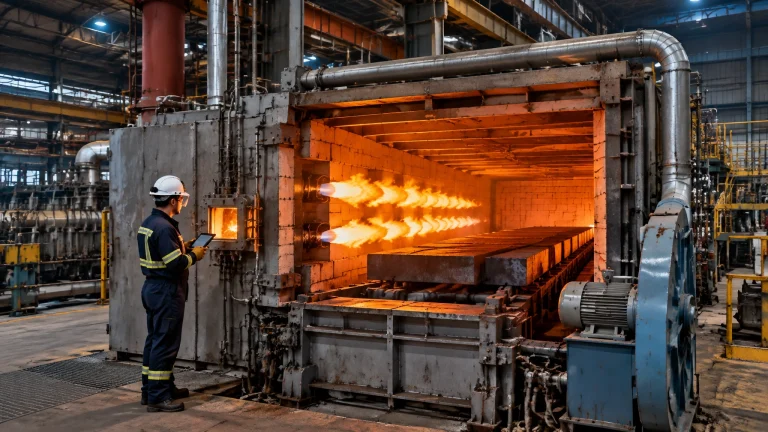
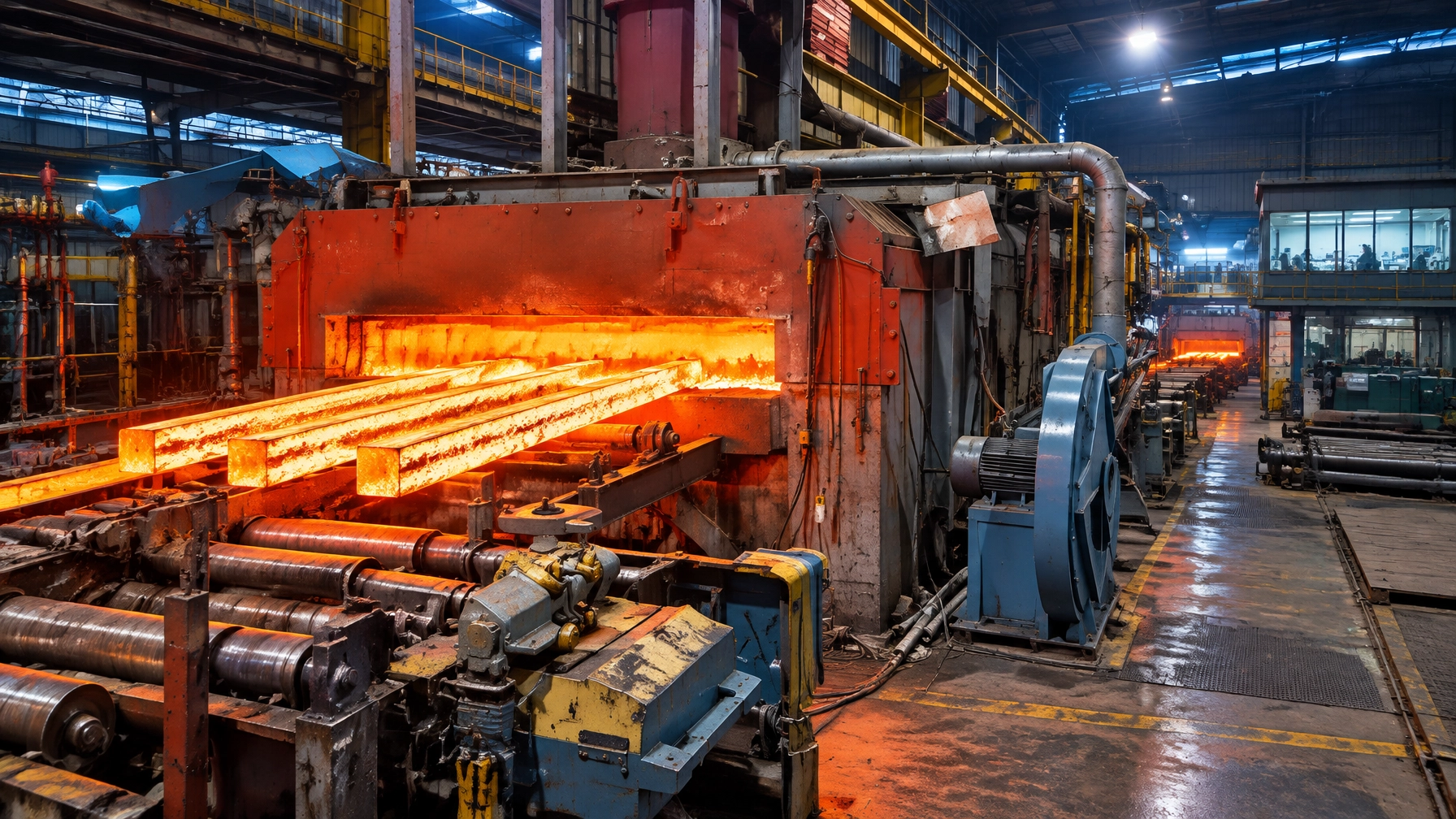
A reheat furnace managed by operator experience often runs on familiar habits: dial in a setpoint, keep it high through a delay, then adjust when the discharge temperature moves. A furnace supported by a Level-2 (L2) process model takes a different approach. It tracks each piece virtually, predicts its temperature and calculates zone setpoints against the expected mill pace.
L2 models now range from classic zone-method thermal models to physics-informed neural networks. Published results commonly point to fuel savings of a few percent, with additional potential from improved temperature consistency and yield. All figures in this article are indicative benchmarks drawn from published papers, supplier references and plant reports. Actual results vary with plant, furnace type, product mix, line pace, instrumentation quality and operating discipline.
What a Level-2 Model Actually Does Above Your PLC
The Level 1 PLC runs the fast local loops, including zone temperature control. L2 sits above it, combining process data with a model of the material in the furnace to calculate and supervise targets. It complements, rather than replaces, the PLC.

Tenova’s Sethlans L2 system provides a useful reference architecture for reheating furnaces. Its functions include online thermal modelling and predictive control for walking-beam, pusher and roller-hearth furnaces, including:
- Virtual charge tracking and thermal modelling for slabs, billets and other products.
- Predictive temperature setpoint calculation and furnace pace-rate modelling.
- Automatic management of mill and furnace stillstands and delays.
- Adaptive feedback from mill pyrometers, thermal balance and production reporting.
- Virtualised, high-availability architecture connected with Level 1 and plant systems.
A 2016 AM/NS Calvert upgrade paper reports that updated algorithms and process models reduced discharge-temperature variability and energy consumption [2].
Why manual control leaves money on the table
Production delays are a common source of avoidable heat input. If zone setpoints stay high “just in case” while the mill is stopped, fuel continues to be consumed and scale continues to form. An L2 pace model can reduce firing during stillstands, then calculate a controlled recovery ramp as production resumes. Reviews of furnace digitisation identify mathematical models and control optimisation as important elements of efficient, lower-emission operation [3].
The Economics: Fuel, Scale and the Price of Overheating
Fuel benchmarks
A zone-method thermal model with self-adapting predictive control reported approximately 6% fuel savings in a simulation-plus-plant study [4]. A neural-network setpoint-optimisation retrofit estimated 5–12% fuel reduction, while noting that maintenance, material mix and operator intervention make it difficult to isolate one definitive figure [5]. Supplier and case literature generally clusters around 2–6%.
Savings depend on the baseline and measurement method. Plants should normalize fuel per tonne for grade, thickness, throughput and operating state before comparing model-on and model-off periods.
Scale loss
Scale formation depends on surface temperature, residence time and furnace atmosphere. Indicative reported scale loss ranges from roughly 0.5–2.5% of charge weight; modern walking-beam practice may hold around 0.6%, depending on conditions [6]. Published oxidation work reports roughly 50% more oxidation when oxygen rises from 0.3% to 3% above 1200 °C [7].
That creates a double payment: excess heat costs fuel, while oxidation reduces saleable yield. At 1% yield loss, a plant forfeits raw-material value equal to 1% of the metallic cost per tonne of throughput, plus the fuel already invested in steel that never ships [8]. These are indicative ranges, not universal plant guarantees.
Deployment Evidence: What Plants Actually Report

Continuous annealing and strip quality
Tata Steel India and IIT Bombay applied supervisory model predictive control (MPC) to continuous annealing lines. The system solves finite-horizon optimal-control problems every minute. The published case reports a consistent 8% reduction in specific fuel consumption per tonne; across current and commissioning installations, it reports annual savings of about US$2.5 million and roughly 10,000 tonnes of CO₂ avoided [9].
In another application, the share of strip within a ±5 °C band rose from about 30% to 50% [10]. A separate multi-mode MPC billet case reported on-spec strip length increasing from roughly 75% to 98% [11, 12]. These are individual case findings, not cross-plant expectations.
Predictive control on a galvanizing line
KG Steel’s No. 3 continuous galvanizing line annealing furnace at Dangjin uses AI-based predictive control with industrial AI firm INEEJI. In an October 2026 report, KG Steel said AI usage was around 60%, with a target above 80%. It reported LNG consumption down about 400,000 Nm³ per year, annual savings of roughly 400 million won to date, and expected savings near 700 million won after exceeding the usage target. A system upgrade cut reported computation time from about 28 seconds to 2 seconds [13].
Reheat furnace supplier cases
A vendor-reported advanced process-control case on European reheat furnaces found fuel reductions of 2–6%, including a baseline-certified decrease of 2.88%. The same supplier reports one installation with discharge-temperature uniformity improving from about ±25 °C to ±8 °C, specific energy consumption down 16.6%, and payback near 1.8 years [14]. These are vendor case findings, not guarantees.
Model-based Control Approaches Compared
| Approach | What it controls | Typical reported results (indicative) | Data and instrumentation needed | Best fit |
|---|---|---|---|---|
| Classic zone-method L2 thermal model | Piece tracking, furnace pace and zone setpoints | About 6% fuel savings in simulation-plus-plant studies [4] | Reliable charge tracking and pyrometers | Stable product mix on reheat furnaces |
| Model predictive control (MPC) | Zone setpoints ahead of transitions; delay management | 8% specific fuel reduction at Tata Steel; ±5 °C share 30% to 50% in one case [9, 10] | Reliable mill data and model identification | Lines with pace changes and grade mixes |
| Neural-network setpoint optimisation | Data-driven zone targets | 5–12% estimated fuel reduction in one published retrofit [5] | Historian data and a sound maintenance baseline | Furnaces with long, clean operating histories |
| Physics-informed digital twin, PINN/G-PINN | Predicted temperature fields | MAE about 2.75 °C for one walking-beam furnace roof-zone model [16] | Thermocouple and pyrometer data streams | Plants exploring fuel flexibility, including hydrogen |
| AI scheduling across parallel furnaces | Charge assignment, timing and energy-optimal order | Tracking error below 0.98% in a 2026 study [19] | L2 and plant MES data | Mills operating two or more reheat furnaces |
Comparisons summarize individual studies and cases. Results are indicative and depend on model boundaries, data quality and plant conditions.
Where the Models Are Heading: 2025–2026 Research
- Physics-informed models: A 2025 G-PINN study predicts billet temperature fields for hot-strip rolling [15]. An August 2026 study of a 2250 mm walking-beam furnace reports G-PINN MAE of about 2.75 °C in Heating Zone II, supporting energy-efficient operation and refractory safety without online retraining [16].
- Hybrid fuel and temperature models: A March 2026 study combines a CNN, least-squares support vector machines and a genetic algorithm to predict and optimise reheat-furnace fuel consumption [17]. A hybrid mechanistic and data-driven finishing-entry-temperature model reports best MAPE of 1.73% [18].
- Digital twins for scheduling: A February 2026 study of parallel walking-beam furnaces uses a three-stage virtual-entity model to track slab positions and logistics with relative error below 0.98%, then applies adaptive large-neighbourhood tabu search to scheduling [19].
- Hydrogen-ready twins: The EU TWINGHY project (2023–2027) combines high-fidelity thermal FEM models, physics-informed neural networks and reduced-order models to explore hydrogen fuel mixes. Mid-2026 updates describe progress from development toward industrial deployment, including physically based modelling at SSAB [20, 21].
These are research and pilot findings, not procurement guarantees. A 2025 machine-learning prediction study for slab reheat furnaces adds to the emerging evidence base [22].
A Four-Phase Roadmap for L2 and AI Setpoint Control
- Phase 1: Baseline and data audit (30–60 days). Establish fuel per tonne by grade and shift, discharge-temperature deviation, scale loss and override rate. Check pyrometer and thermocouple health and historian data quality.
- Phase 2: Model-readiness assessment (1–2 quarters). Verify charge tracking, sensor coverage and stillstand detection. Define cybersecurity and data governance, vendor scope and acceptance criteria.
- Phase 3: Pilot one furnace (3–9 months). Start in shadow mode, then move to closed loop against agreed tests for fuel per tonne, discharge deviation, override rate and scale loss. Document manual-intervention rules and model-versus-manual results.
- Phase 4: Scale and institutionalise (9–24 months). Extend to other furnaces and scheduling optimisation where relevant. Assign KPI owners, define model revalidation triggers tied to maintenance, and specify L2 interfaces in new industrial furnace systems purchases.
2026 Technology and Market Updates
Research-grade accuracy reaches plant-floor discussions
G-PINN furnace and billet studies and 2025 machine-learning work illustrate faster, more accurate temperature prediction. Validate performance against operating data before using research metrics as acceptance guarantees [15, 16, 22].
MPC strengthens its role on annealing lines
The Tata Steel case, reported strip-band gains and 2026 work on time-varying state-space MPC for continuous annealing lines point toward supervisory optimisation as a practical production discipline [9, 10].
AI usage rate becomes a KPI
KG Steel’s reported move from about 60% AI usage toward a target above 80%, alongside a computation-time reduction from 28 to 2 seconds, highlights an operational measure beyond model accuracy: how often the system can be used effectively on the live line [13].
Hydrogen-ready digital twins
TWINGHY’s work connects digital twins with future fuel flexibility. Plants planning fuel-flexibility trials should baseline L2 models now. A model that cannot represent hydrogen flame behaviour will require adaptation and revalidation before it can guide those trials [20, 21].
What This Means Across Your Furnace Fleet
Reheat furnaces in a steel rolling mill are the clearest starting point: pace control, delay handling and scale economics all matter. Similar principles apply to heat treatment furnaces and bright annealing lines serving the wire and cable industry, where atmosphere accuracy and uniformity bands are critical.
An aluminum melting furnace can also benefit from model-based monitoring, although published machine-learning energy reductions should be treated as single-study findings. The preheat and annealing sections of a hot dip galvanizing plant can gain from disciplined grade-change targets. A melting furnace for steel or metal recycling furnace can share historian and model infrastructure with rolling operations. Downstream pickling plants are part of the wider quality chain.
When evaluating an industrial furnace manufacturer, ask for the L2 model description, virtual-sensor validation data and revalidation triggers in commissioning documents. Specify furnace spare parts for the instrumentation on which the model depends, including pyrometers, thermocouples, tracking sensors and scanners. This is how thermal processing equipment delivers lifecycle value, not merely initial performance.
Continental Furnaces brings 35+ years of expertise, ISO-certified quality, customized thermal processing equipment and prompt service. Request a consultation to review L2 readiness, instrumentation and model revalidation as an enduring partnership and a strategic step toward sustained competitive advantage.
References
- Tenova Sethlans Level 2 System for Reheating Industrial Furnaces
- AM/NS Calvert L2 performance-improvement paper, DOI 10.33313/377/258
- Digitization and greening of industrial reheating furnaces, Applied Thermal Engineering
- Zone-method based reheating furnace model and control study
- Neural-network setpoint optimisation, Neundorfer AISTech 2019
- McGill walking-beam scale study
- 2025 oxidation-kinetics study
- Steelonthenet: Understanding steel mill yield losses
- Tata Steel continuous annealing MPC, INFORMS Journal on Applied Analytics
- Strip temperature-band application, DOI 10.33313/377/256
- Multi-mode MPC billet paper
- MDPI Sensors, 23(8), 3966
- KG Steel AI predictive control update, Herald Corp, October 2026
- Tigo Steel industrial project case
- 2025 G-PINN billet temperature-field study, China Metallurgy
- 2026 G-PINN walking-beam furnace digital twin study
- 2026 CNN-LSSVM fuel optimisation study, Applied Thermal Engineering
- Hybrid physics-informed finishing-entry-temperature model
- 2026 parallel-furnace digital twin scheduling study, IEEE TII
- TWINGHY: end of second project period and industrial deployment
- TWINGHY: physically based furnace modelling at SSAB
- 2025 machine-learning performance study for slab reheat furnaces
Reported percentages are case-specific and vary with plant conditions, feed, alloy, line type, throughput, instrumentation and local operating practice.