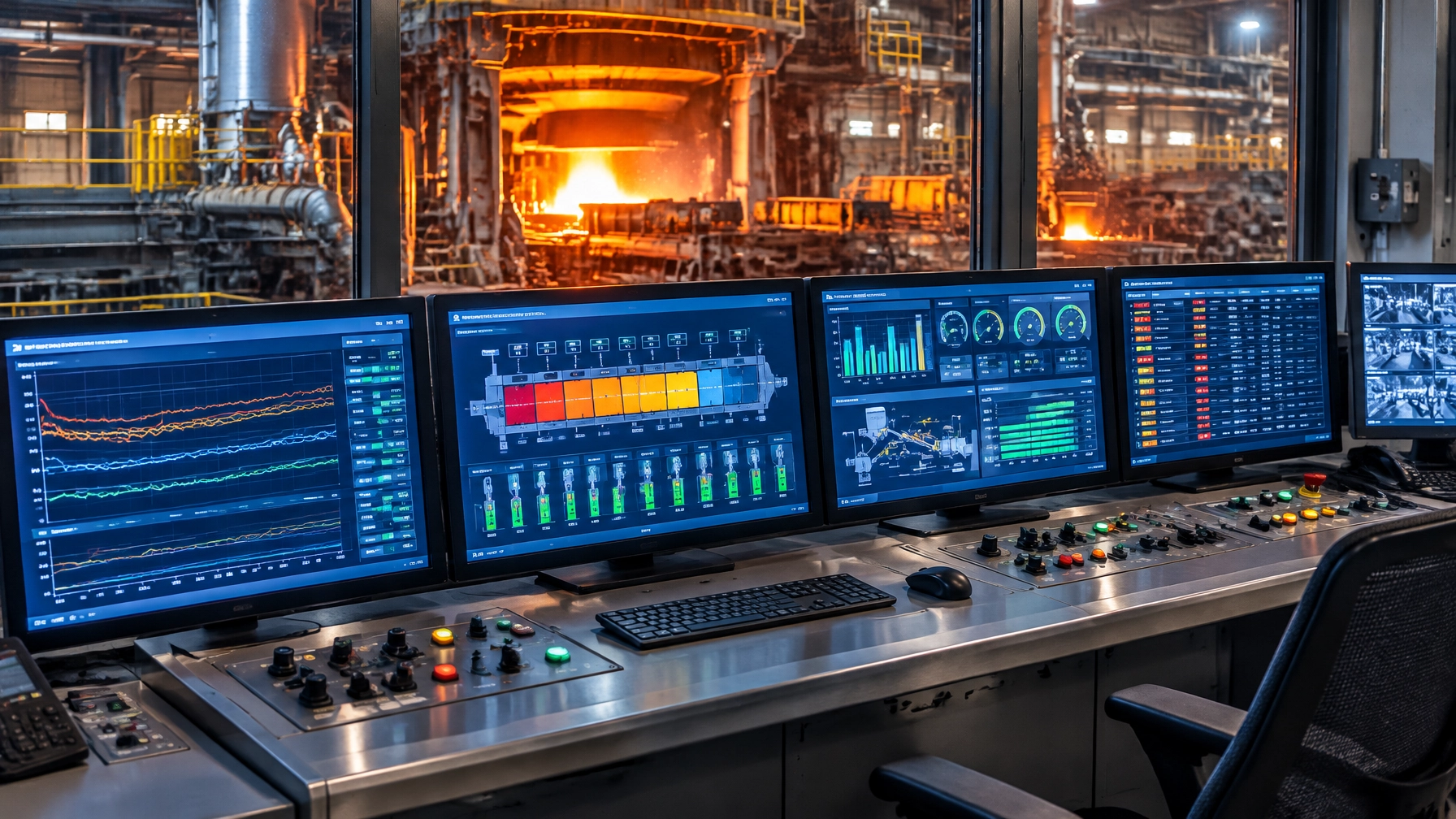
Furnace controls are easy to overlook when production is running. Yet an obsolete PLC, undocumented code or unsupported HMI can turn a minor fault into an extended shutdown, and leave operators without reliable information on energy use, temperature performance or downtime causes. In 2026, automation modernization is a practical way to reduce that exposure and build a stronger basis for process decisions.
For a steel rolling mill, heat treatment line or melting operation, the goal is not simply to install new screens. It is to create a secure, maintainable control system that preserves dependable furnace operation while making useful data available to the people who need it.
Why aging control platforms are a hidden operational risk
Legacy systems can remain in service for years after their original supplier support has ended. Their condition may be difficult to judge from the operator station alone.
Common warning signs include:
- PLCs, I/O cards, HMIs or communication modules that are obsolete or difficult to source.
- Control code without current backups, version records or clear documentation.
- Limited alarm history and fault messages that do not identify the likely cause.
- Plant data trapped in individual machines, with no consistent view of production or energy.
- Remote-access connections or engineering workstations that have not been reviewed for security.
The impact reaches beyond maintenance. When process values cannot be reconstructed after an event, teams have less evidence to distinguish an instrument fault from a real operating deviation. Control-system resilience is therefore a production, quality and business-continuity concern.
What a modern furnace control architecture looks like
A useful architecture separates deterministic control from supervisory monitoring and business reporting:
- Machine level: PLCs and, where required by the risk assessment, safety-related controllers manage sequences, interlocks, burners, drives, material handling and temperature loops.
- Supervisory level: SCADA/HMI gives operators a consistent view of furnace zones, setpoints, alarms, trends and operating states.
- Data level: A historian stores time-stamped process values and events, while an industrial edge gateway can buffer data and normalize plant protocols.
- Business level: Governed interfaces connect selected production and energy information to MES or ERP systems.

For an existing line, modernization need not mean replacing every field device. The design can retain serviceable instruments and drives while replacing unsupported controllers or adding a supervisory layer. The essential requirement is a documented boundary between control, monitoring and external data access.
When planning upgrades to heat treatment furnaces, define the recipe, alarm, traceability and reporting needs alongside the hardware specification. This avoids building an attractive dashboard that cannot answer production’s real questions.
Control upgrades that support repeatable operation
A PLC retrofit should preserve proven furnace sequences and safety functions while making the logic easier to support. That calls for code review, tested backups, clear I/O documentation and a defined commissioning plan, not just a controller swap.
Temperature, combustion and adaptive control
Modernization can provide a platform for improved control strategies, including:
- Air–fuel ratio control using appropriate measurements and limits, with interlocks retained in the established control system.
- Model-based reheating that uses product identity, dimensions, charging conditions and mill demand to inform target profiles.
- Adaptive soak control that adjusts timing against measured process response while respecting validated material and equipment constraints.
An optimizer should initially operate in advisory mode. Any move toward automatic setpoint changes requires tested limits, authorization, a safe fallback and clear PLC authority. A published steel reheating-furnace study reported 94.7% prediction accuracy for a particular energy-consumption model; this is evidence of a research result, not a guaranteed plant outcome. See the Scientific Reports study.
Turn furnace data into operating decisions
A historian and analytics layer are valuable only when tags are time-aligned and connected to production context. Useful inputs can include zone temperatures, fuel and electrical consumption, furnace state, charging and discharge events, material grade, tonnage, alarm events and downtime reason.
Dashboards can then report:
- Specific energy consumption: kWh/t or GJ/t, with fuel and electricity shown consistently.
- OEE: availability × performance × quality, using agreed production and downtime definitions.
- Temperature deviations, charge-to-discharge time, throughput and relevant quality measures.
- Alarm frequency, response time and recurring equipment fault patterns.
- Thermal-camera observations, where integration is suitable and calibrated to the task.

A thermal camera can add valuable surface-temperature information, but its readings must be interpreted with emissivity, viewing conditions and product tracking in mind. Likewise, OEE should not be calculated from PLC run status alone: reconcile furnace events with charging, rolling, production and quality records.
As an indicative project target, plants may specify historian availability above 99% and define appropriate sampling and event capture during design. The required rate depends on the signal, process dynamics and diagnostic purpose. Numerical benchmarks in this article are indicative and vary by furnace type, age, instrumentation and duty cycle.
Compare the upgrade paths
| Criterion | Relay / analog controls | 1990s–2000s PLC + HMI | Modern integrated SCADA / edge architecture |
|---|---|---|---|
| Downtime exposure | High where troubleshooting depends on manual checks and scarce components | Moderate; improves if spares and code support remain available | Lower potential with diagnostics, backups and planned phased migration |
| Energy visibility | Local instruments or manual records | Basic trends may be available | Contextualized kWh/t or GJ/t dashboards and historical analysis |
| Fault diagnosis | Limited; often component-by-component | Alarm and PLC diagnostics, depending on design | Searchable alarms, trends, event context and maintenance alerts |
| Upgrade path | Panel redesign and extensive engineering may be required | Controller/HMI refresh or supervisory layer can be staged | Modular expansion through documented interfaces and governed data access |
| Indicative cost band | Low initial cost, potentially high lifecycle risk | Moderate retrofit scope | Higher initial project scope; investment depends on line count, integration and cybersecurity needs |
Cost bands are relative planning categories, not quotations. Actual project costs depend on controller and I/O replacement, software licensing, instrumentation, panel condition, engineering effort, outage constraints and commissioning scope.
OT cybersecurity belongs in the retrofit scope
Connecting previously isolated controls to plant networks changes the risk profile. Segmentation should separate control zones from business networks, and remote access should be named-user, time-limited, approved and logged. Avoid direct cloud-to-PLC access; maintain offline backups and test recovery procedures.
The ISA/IEC 62443 series provides a framework for securing industrial automation and control systems throughout their lifecycle. The NIST Cybersecurity Framework offers broader guidance for managing organizational cybersecurity risk. Apply these with a plant-specific risk assessment, not as a substitute for one.
A four-phase retrofit roadmap
Phase 1: Assessment and audit
Inventory PLCs, HMIs, drives, instruments, network paths, software versions and available backups. Review operating risks, cybersecurity exposure and production dependencies. Agree on baseline KPIs and the data needed to calculate them.
Phase 2: Design and vendor selection
Develop the control architecture, I/O plan, alarm philosophy, historian requirements and integration boundaries. Confirm how safety functions will be validated, how legacy devices will communicate and what support and documentation will be delivered.
Phase 3: Phased implementation with hot cutover
Build and factory-test new panels and code before site installation. Where feasible, use parallel running, staged migration or one-section-at-a-time cutover while production continues. Schedule the final changeover for a planned outage; verify interlocks, sequences, alarms, recipes, backups and operator readiness before release.

Phase 4: Optimization and data exploitation
Validate historian records against meters and production totals. Refine dashboards, identify recurring downtime causes and introduce advisory analytics. Once results and safeguards are proven, assess whether a constrained setpoint optimizer is appropriate.
2026 priorities: edge computing, AI and open integration
Edge computing can process or buffer furnace data close to the equipment, helping maintain continuity when a network connection is interrupted. AI-assisted setpoint optimization can help identify operating opportunities, but it must remain within defined process, quality and safety limits. Cloud historians can support fleet-level analysis when data governance and cybersecurity controls are in place.
Vendor-neutral and open-source SCADA options may also fit some projects. Selection should weigh lifecycle support, protocol compatibility, security maintenance, engineering capability and total cost, not licensing alone.
Continental Furnaces brings 35+ years of thermal-processing experience to equipment and modernization conversations. Whether the requirement concerns a steel rolling mill, melting operation or heat treatment line, a well-engineered retrofit can make system health and operating performance more visible without treating production continuity as an afterthought.
Discuss your requirements with Continental Furnaces through our request-for-a-quote page. Begin a focused assessment and build an enduring partnership for reliable controls, lifecycle support and sustained competitive advantage.