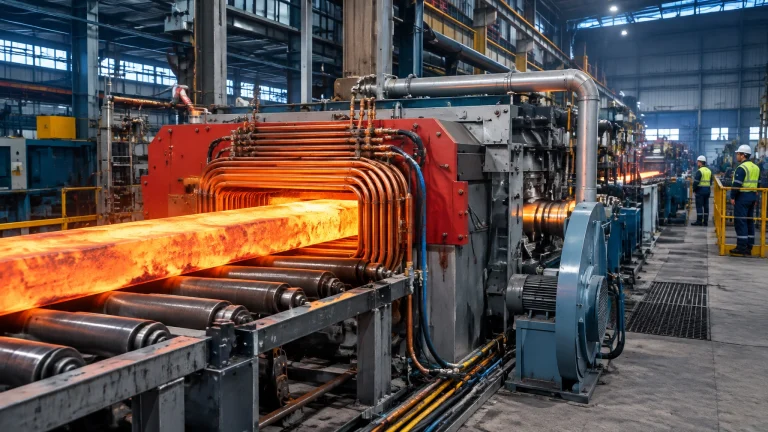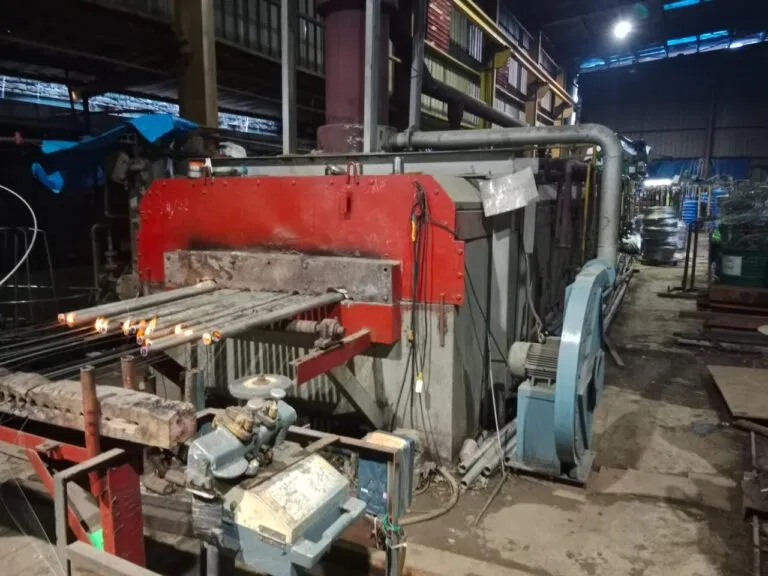
A reheat furnace is not just a source of heat: it is a production constraint, a fuel-cost driver and a determinant of rolling consistency. For a steel rolling mill, the choice between pusher-type and walking beam design affects billet handling, temperature uniformity, scale formation, maintenance and the ability to respond to product changes.
Neither design is universally superior. The right choice depends on throughput, product mix, quality targets, site layout and the cost of downtime. This guide compares the two designs and sets out a practical framework for evaluating them in 2026.
How the two furnace designs move steel
Pusher-type furnace
In a pusher furnace, billets, blooms or slabs are charged end-to-end. A hydraulic or mechanical pusher advances the line through the furnace, and each new charge moves the material toward discharge. This is a straightforward arrangement with relatively simple handling and a long track record in rolling mills.
Its main operational constraint is that the stock is linked in a sequence. A jam, distorted billet or interruption can create a pile-up risk. Product changes and selective discharge can also be more complicated: material in the furnace must generally progress through the line in order.

Walking beam furnace
A walking beam furnace supports the steel on stationary and moving beams. The moving beams lift and advance the product in controlled steps before setting it down again. This lets the furnace handle pieces individually and can reduce prolonged contact with the same support points.
The design supports flexible charging and discharge patterns, and can help improve heating around the product. Walking-beam furnaces are often selected where consistent temperature, low skid-related marking and product-mix agility matter. However, the mechanism is more complex, and the investment and maintenance requirements are typically higher. Water-cooled beam systems also make skid insulation and cooling-water management critical.
Pusher vs walking beam: practical comparison
| Selection factor | Pusher-type | Walking beam |
|---|---|---|
| Typical capital cost | Lower; simpler material-handling arrangement | Higher; more complex beam mechanism and controls |
| Product movement | Continuous end-to-end pushing; stock moves as a sequence | Individual stepping and placement of products |
| Skid marks and cold spots | More persistent contact can contribute to skid marks and local temperature differences | Reduced repeat contact can improve uniformity; performance depends on beam and insulation design |
| Pile-up risk | Higher exposure to stock jams and sequencing disruptions | Lower dependence on pushing a continuous line; still requires reliable beam and control systems |
| Furnace emptying | Less flexible; stock generally needs to progress through the furnace | Individual handling allows greater flexibility to clear or sequence the furnace |
| Product flexibility | Strong fit for steady, repetitive production | Better suited to frequent changes in size, grade or rolling schedule |
| Maintenance profile | Mechanically simpler; pusher, guides, seals and refractory need attention | More moving components, drives, hydraulics and water-cooled systems to maintain |
| Typical application fit | Cost-sensitive, stable long-product production | Higher-throughput or quality-sensitive production with varied product mix |
The comparison is a starting point, not a substitute for a performance specification. Supplier guarantees should reflect the actual steel grade, charge temperature, discharge temperature, throughput and fuel basis.
Energy, skid losses and scale: the economics beneath the design
A useful planning benchmark for conventional reheating is 1.5–2.0 GJ per tonne. This is not a universal target: performance varies with charge temperature, furnace size, production rate, fuel, heat recovery, and how auxiliaries are counted. Published references include more ambitious walking-beam examples around 1.0–1.3 GJ/t under favourable operating conditions. Compare bids on the same measurement basis, not on headline burner efficiency alone. TERI’s review of energy-efficiency technologies provides context for best-available performance benchmarks.
Water-cooled skid and support systems remove heat from the furnace. Depending on furnace configuration and operating conditions, skid cooling can account for roughly 6–15% of total energy input. Insulation upgrades have been reported to reduce skid-related losses by 40–60% in specific installations. These figures describe potential reductions in skid losses, not a guaranteed reduction of 40–60% in total furnace fuel use. Project results depend on insulation design, condition, installation and service life. Case studies from Almatis at ArcelorMittal Bremen and Voestalpine Linz illustrate the value of evaluating skid insulation as an engineered system.

Specify skid insulation by more than initial heat-loss performance. Ask suppliers to state thermal performance at operating temperature, resistance to abrasion and scale, expected campaign life, inspection requirements and water-side heat-loss measurement method. A walking beam may offer handling and uniformity advantages, but its water-cooled area and insulation quality must be considered in the energy balance.
Scale loss matters just as much. Longer exposure at temperature can increase oxidation and reduce saleable yield. Walking-beam references report scale-loss targets around 0.5–0.6% in particular installations; these are useful procurement benchmarks, not automatic results of choosing a furnace type. Steel chemistry, time-temperature profile, furnace pressure and descaling practices all influence actual loss. Include a defined test method and operating conditions in any guarantee.
Match the furnace to your product mix
- Billets for long-product mills: A pusher furnace can be a strong economic fit when production is steady, sizes are repetitive and the mill prioritizes a lower initial investment. Walking beam becomes more attractive as grade changes, size variation, skid-mark limits or tight temperature requirements increase.
- Blooms: Larger sections demand careful control of core heating and residence time. Evaluate the heating profile and discharge-temperature variation at the actual bloom dimensions and throughput, not just nominal furnace capacity.
- Slabs for plate or strip: Product value, surface quality and temperature uniformity carry substantial weight. A walking beam’s flexible handling can be beneficial, but the final decision should include slab thickness, charging temperature, scale-loss target and downstream rolling requirements.
- Mixed schedules: If the mill frequently changes grades and dimensions, the cost of lost flexibility can outweigh the walking beam’s higher capital cost. If the schedule is stable, simpler pusher operation may provide better lifecycle economics.
This selection logic is specific to reheating. It complements, but does not replace, the design requirements for other thermal processing equipment, such as heat treatment furnaces. A plant’s wider equipment strategy may also include an aluminum melting furnace, a melting furnace for steel, a metal recycling furnace or a hot dip galvanizing plant; each has distinct process and energy requirements.
Buyer’s roadmap: four phases to a defensible decision
Phase 1: Establish the operating case
Document annual throughput, product dimensions and grades, charge-temperature range, discharge targets, shift pattern, fuel data and expected future mix. Record current bottlenecks, downtime causes and surface-quality losses.
Phase 2: Compare lifecycle performance
Request a like-for-like comparison covering:
- Net fuel consumption in GJ/t, with fuel heating-value basis stated
- Maximum skid-cooling loss and insulation specification
- Discharge-temperature uniformity and scale-loss guarantee
- Usable throughput, availability assumptions and auxiliary power
- Capital cost, maintenance labour, expected spare-parts inventory and downtime exposure
Calculate payback using site-specific fuel price, annual tonnes and yield value. Do not accept a generic ROI period without the assumptions behind it.
Phase 3: Validate integration and maintainability
Review charging and discharge interfaces, layout, foundations, utilities, automation, safety systems and installation access. For pusher designs, focus on the pusher drive, guides, seals and jam-recovery plan. For walking beam, inspect beam drives, hydraulic or mechanical components, cooling circuits, insulation condition and access for maintenance.
For either design, agree on critical furnace spare parts, lead times and local service arrangements before commissioning. Reliability depends on planned maintenance and prompt support, not only the original equipment specification.

Phase 4: Commission against the guarantees
Conduct performance testing using agreed production conditions. Verify fuel consumption, discharge temperature, scale loss, throughput and cooling-water heat loss. Retain baseline data for ongoing monitoring and continuous improvement.
Make the decision on lifecycle value
A pusher furnace is often the pragmatic choice for a cost-conscious mill with a stable schedule and straightforward product requirements. A walking beam can be the stronger investment where product flexibility, handling, surface quality and temperature consistency protect yield and profitability. Its performance, however, depends on disciplined skid-loss engineering and a realistic maintenance plan.
Continental Furnaces brings 35+ years of industrial furnace experience and an engineering-led approach to thermal processing solutions. As an industrial furnace manufacturer, we believe equipment selection should begin with your operating data and remain an enduring partnership through commissioning, maintenance and lifecycle support. For a project assessment, share your production and fuel parameters through our request-for-a-quote page. A well-defined comparison today is a strategic step toward sustained competitive advantage.