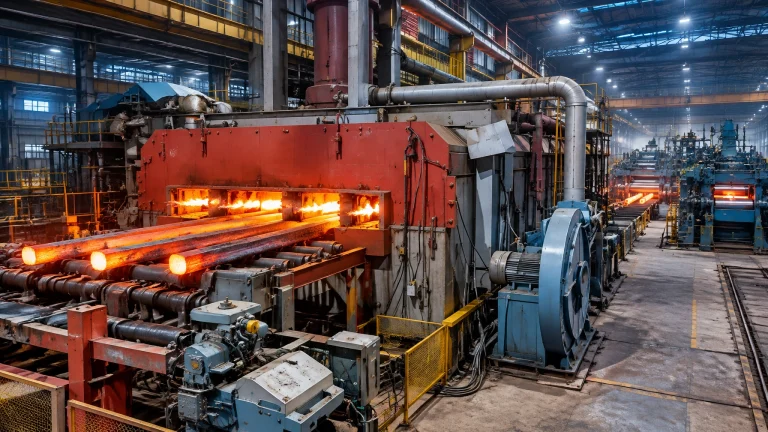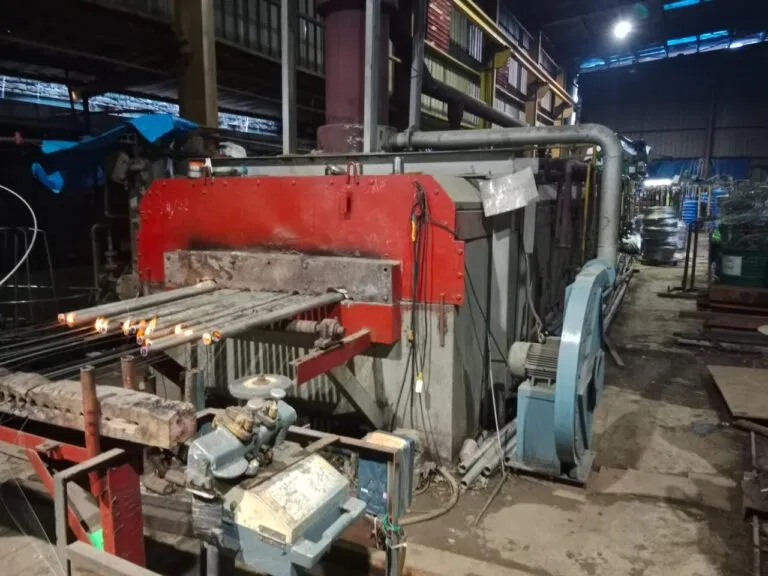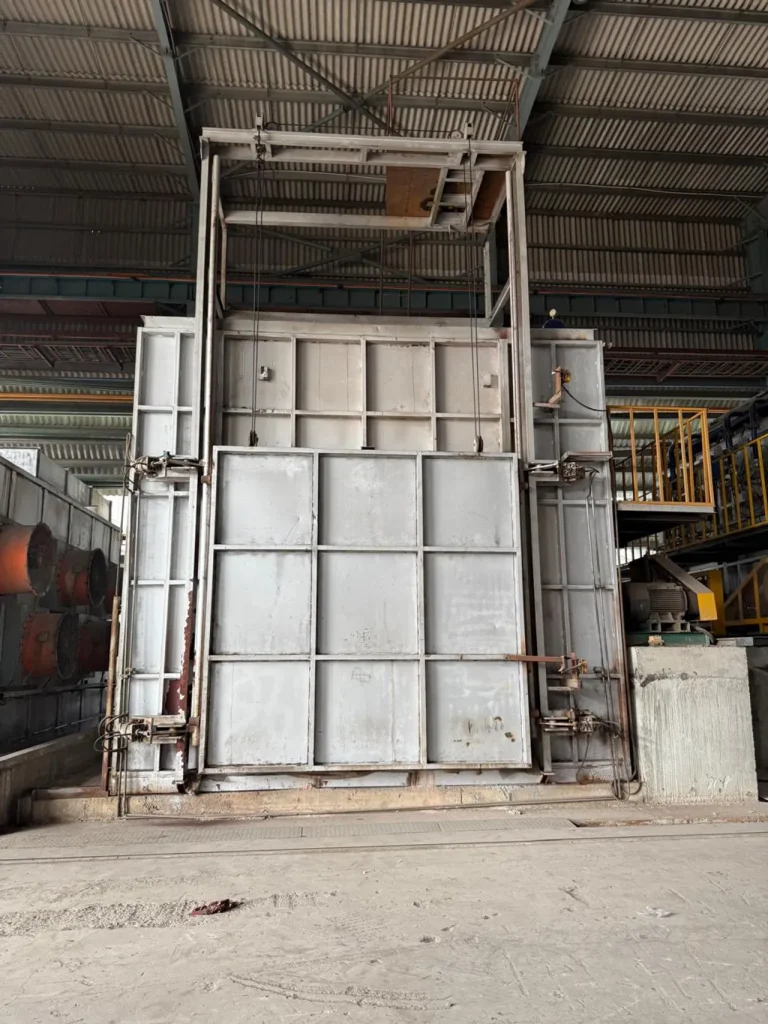
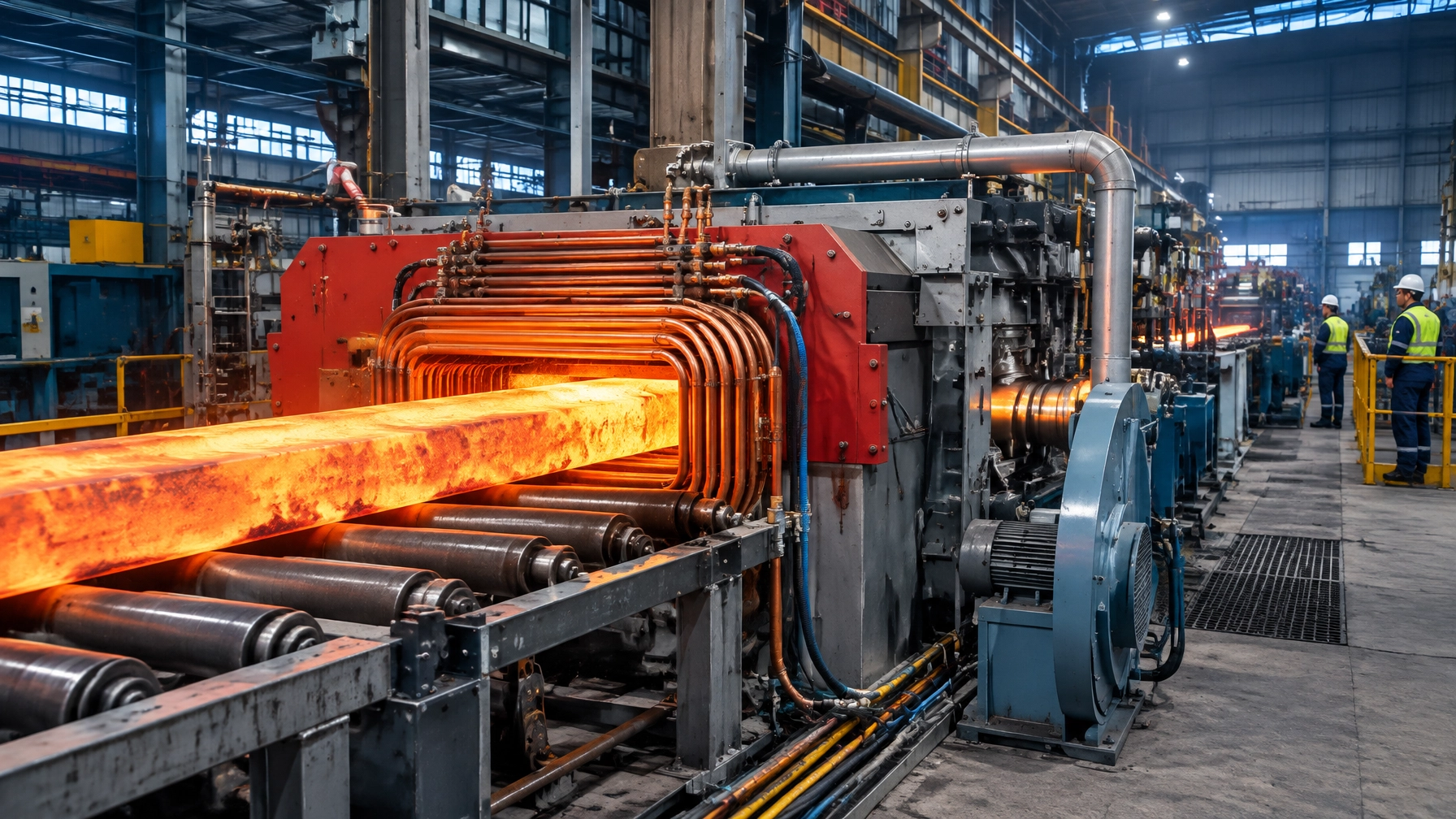
Induction heating is increasingly valuable in steel rolling mills not as a blanket replacement for every reheat furnace, but as a precise way to add heat where and when the process needs it. For billet, bloom and bar lines, an inline induction heater can raise or equalise temperature immediately before rolling: reducing unnecessary reheating, limiting scale formation and helping maintain a stable rolling schedule.
The strongest 2026 business case is often a hybrid line: a gas-fired furnace provides bulk heating, and induction supplies the final temperature correction. The right solution depends on billet entry temperature, throughput, grade mix, electricity and fuel costs, and the capacity of the existing line.
Where induction fits in a rolling process
An induction system creates heat within a conductive workpiece using an alternating electromagnetic field. In a steel rolling mill, induction units can be installed:
- After a continuous casting machine (CCM), to recover heat lost during transfer.
- Before a continuous casting and rolling (CCR) or rolling line’s first stand, to make a final temperature adjustment.
- Downstream of a conventional reheat furnace, to equalise temperature or accommodate grade changes.
- In forging operations, where rapid, repeatable billet or bar heating supports the next forming step.
Final rolling temperatures are grade- and process-dependent; many hot-working schedules operate in the approximate 1,050–1,250°C range. The system should be engineered to the mill’s specified discharge temperature and allowable temperature variation, not to a generic setpoint. Pyrometer feedback, billet tracking and coordinated power control help match heating to line speed and product recipe.

Induction, gas reheat and hybrid lines: compare the duty
Published energy figures are not directly interchangeable. A gas-furnace figure is commonly reported as fuel input, while an induction figure is electricity input; hot-charge and cold-charge conditions also differ. Compare total cost and energy per saleable tonne using the same billet-entry temperature, product mix and operating schedule.
| Operating factor | Conventional gas reheat | Inline induction | Hybrid gas + induction |
|---|---|---|---|
| Indicative energy benchmark | About 1.4–1.8 GJ/t fuel input for cold-charge reheating in cited analyses | Around 350–500 kWh/t electricity in a reported study; hot-charge duties may be substantially lower | Furnace supplies bulk heat; induction adds only the required final temperature rise |
| Scale and yield | Oxidation continues during furnace residence; one published industrial comparison reported about 3% scale loss | Short heating time can limit additional oxidation; the same example reported about 0.5% | Can reduce time at high temperature while retaining furnace flexibility |
| Response to change | Slower response; the furnace heats a broader inventory of material | Fast, local power adjustment to suit billet and line conditions | Flexible bulk heating with rapid final correction |
| Footprint and line fit | Typically requires a longer furnace and material-handling route | Compact heating section, but requires power equipment, coil cooling and electrical infrastructure | Adds an induction section to an existing or new furnace line |
| Best-fit conditions | Cold billets, variable or intermittent demand, or limited electrical capacity | High utilisation, suitable electrical supply and a short, continuous transfer route | Existing furnace assets, hot billets and a need for better final-temperature control |
These values are indicative benchmarks, not guaranteed plant results. The 3% versus 0.5% scale-loss figures are from a specific published comparison, not universal performance guarantees. Evaluate the 2026 techno-economic analysis alongside measured site data. For hot-charge applications, the long-products process overview also explains why retaining billet sensible heat changes the economics.
The most useful financial metric is cost per saleable tonne, including energy, scale loss, peak electrical demand, maintenance, yield, downtime and any carbon costs. A melting furnace for steel serves a different process duty; induction reheating should be assessed specifically against the mill’s billet-conditioning and rolling requirements.
Power electronics, frequency and temperature uniformity
Modern solid-state power supplies convert incoming power to the frequency and output required by the heating coil. Modular designs allow heating zones to be controlled separately, while sensors and automation can adjust power as billet temperature, section size or line speed changes. These capabilities support Industry 4.0 when connected to production recipes, trend records and plant-level controls.
Frequency selection is an engineering decision, not a rule of thumb. It depends on billet cross-section, steel grade, required heating rate, coil gap and the desired depth of heat penetration. As a starting point for feasibility studies, larger sections may be assessed around 500–1,000 Hz, while smaller sections and faster surface response may be assessed within 1–6 kHz. These are study ranges, not universal settings: validate the choice through coupled electromagnetic and thermal modelling, followed by production trials. The InductoForge billet-heater brochure provides an example of modular billet-heating equipment; Thermopedia’s induction-heating reference outlines the underlying principles.
Temperature uniformity depends on the whole line, not the coil alone. Include billet spacing, centring, transfer time, scale condition, coil design, pyrometer position and control response in the commissioning plan. Specify temperature acceptance limits by grade and rolling schedule, then verify them at representative operating rates.
Coil lifecycle management: plan for availability
Induction removes combustion at the point of heating, but it does not remove maintenance. The coil is a critical production component, and its cooling and insulation condition directly affects reliability.

Build preventive checks around:
- Cooling: Trend flow, pressure, conductivity and inlet/outlet water temperatures. Investigate alarms and changes promptly.
- Coils and protection: Inspect copper tubing, connections, insulation and refractory or ceramic wear protection for damage, erosion or cracking.
- Power equipment: Check cooling performance, electrical insulation, capacitor condition and abnormal temperature or harmonic trends.
- Process signals: Review pyrometer readings, billet tracking and power history for recurring hot or cold sections.
- Spares and response: Keep critical coil components and appropriate furnace spare parts available, with a documented isolation, replacement and restart procedure.
Plan coil inspection intervals around actual operating hours and condition data. Monitor repairs, coil changes and stoppages as part of the line’s maintenance record.
A four-phase adoption roadmap
Phase 1: Assessment and planning
Record current fuel and electricity use, throughput, billet entry temperatures, grade mix, scale loss, stoppages and transfer distances. Compare a gas baseline, a hybrid option and a full induction case using the same production assumptions.
Phase 2: Engineering and integration
Confirm available electrical capacity, cooling water, foundation and footprint constraints, roller-table geometry, safety interlocks and bypass arrangements. Define temperature tolerances and interfaces with CCM, CCR and rolling-mill controls.
Phase 3: Trial and commissioning
Test representative grades and billet sizes across expected line speeds. Validate power settings, temperature uniformity, scale results, control response and production transitions before finalising operating recipes.
Phase 4: Optimisation and lifecycle support
Track energy per saleable tonne, yield, availability and maintenance events. Review the data with operations and maintenance teams, update recipes and spares plans, and refine performance targets as production requirements change.

For plants evaluating a hybrid route, a conventional furnace can remain central to the process while induction provides targeted final heating. Explore Continental Furnaces’ heat treatment furnace solutions as part of a broader thermal-processing discussion. With 35+ years of industrial furnace experience, Continental Furnaces works with customers on application-specific thermal processing equipment and plant requirements.
Build a business case around your line
Induction heating is most compelling when the line runs continuously, hot billets retain useful heat, scale losses matter, and electrical infrastructure can support the required duty. Gas or hybrid heating can remain preferable when billets arrive cold, utilisation is inconsistent or electrical supply is constrained.
The next step is a site-specific assessment, not a generic equipment comparison. Share your billet dimensions, grades, entry and target temperatures, throughput, operating hours and existing furnace data with our team. Request a quote and consultation to evaluate the options as an enduring partnership focused on lifecycle value and sustained competitive advantage.
All numerical ranges in this article are indicative benchmarks drawn from the linked technical references. Actual energy use, scale loss, temperature uniformity, footprint and payback vary with duty, billet condition, process design, utility costs and operating practice.