Water is an invisible utility on the galvanizing line, but never an insignificant one. Each litre leaving the site can carry dissolved zinc, acid, iron or flux salts. Water is therefore simultaneously a production input, an environmental permit obligation and a cost line. A well-designed closed loop (combining countercurrent rinsing, compatible process reuse and targeted treatment) can reduce freshwater demand and turn a compliance liability into recovered process water and valuable metal-bearing sludge.
Benchmark caveat: All numerical figures in this article are indicative benchmarks drawn from published surveys, plant reports, regulatory texts and supplier references. Results vary with plant design, line type, workpiece mix, throughput, feed chemistry and local regulation. Regulatory figures are examples, not a substitute for confirming the applicable permit and jurisdictional requirements.
Quench control is a quality decision
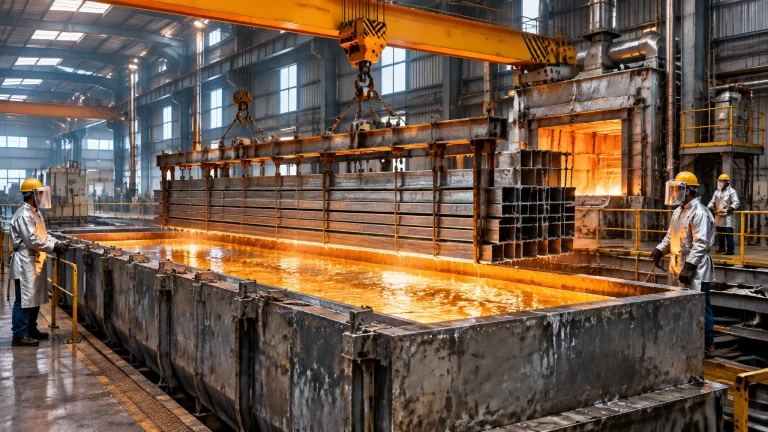
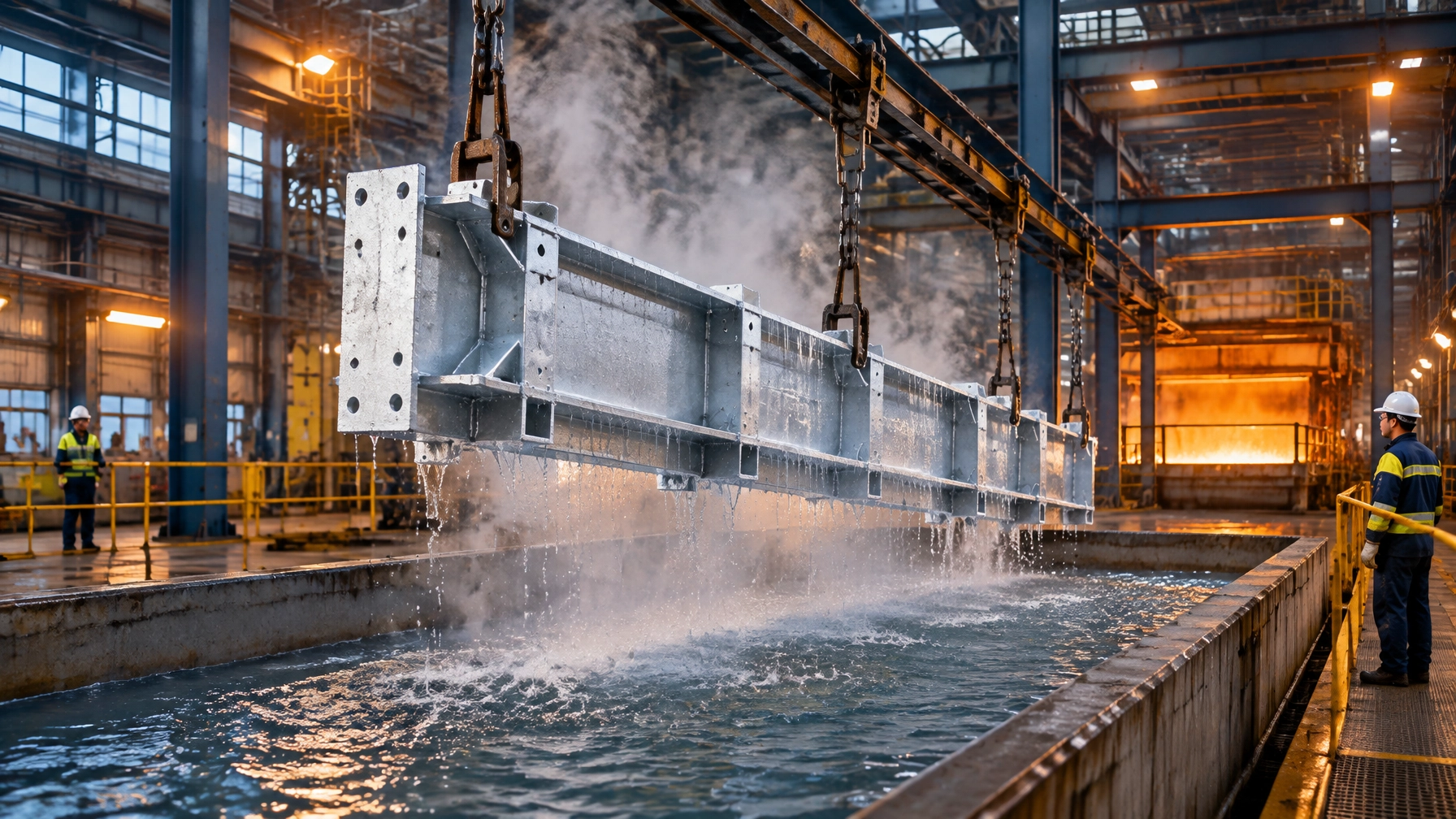
Steel typically leaves the zinc bath at 445–465 °C. Cooling is not simply the last step before handling: it influences coating appearance, surface protection and the integrity of the workpiece. The Galvanizers Association of Australia’s quenching advisory and hot dip galvanizing process guide describe quenching as a common way to cool articles for safer handling and, where suitable additives are used, provide temporary surface passivation that can help limit wet storage stain.
- Water quenching cools quickly and can limit continued zinc–iron reaction, which is important for some reactive steels and coating conditions.
- Air cooling is often preferred for welded fabrications where rapid cooling could contribute to microcracking, as well as for distortion-sensitive assemblies or specific finish requirements.
- Water misting offers an intermediate cooling approach where full immersion is not the right choice.
The correct choice depends on the article, its steel chemistry, welds and end-use specification. Quench discipline means monitoring bath temperature and inhibitor concentration, controlling zinc-particle and flux drag-in, maintaining the bath and regularly skimming or removing zinc fines. Keep the quench loop separate from acid and rinse streams unless a treatment and reuse plan specifically allows the combination.
Map the line’s water before sizing treatment
A galvanizing line can generate distinct wastewater streams: alkaline, oil-bearing degreasing rinses; pickling rinses containing hydrochloric acid, iron and zinc; flux rinses carrying zinc ammonium chloride; quench overflow or drag-out; and scrubber blowdown. Combining them prematurely increases treatment complexity and can discard reuse opportunities.
Countercurrent cascade rinsing, water flowing opposite to work travel, uses cleaner water at the final rinse and progressively more contaminated water upstream. Metal-finishing literature describes potential freshwater reductions of over 90% versus single-tank practice. A rule-of-thumb is roughly 8–22 litres of fresh water per litre of dragged-out solution, depending on cascade count and rinse-quality criteria. UK galvanising sector guidance IPPC SG5 recommends two rinse tanks to reduce waste and extend bath life, and identifies rinse water as a potential make-up source for pickling baths or their evaporative losses. A 2022 IWA Water Science & Technology paper examines preventive reuse and recycling approaches for HDG wastewater.

Table 1: Water streams across a hot dip galvanizing plant
| Stream | Typical contaminants | Recommended handling | Best-practice destination |
|---|---|---|---|
| Degreasing rinse | Alkalinity, oils, surfactants | Segregate; control oil and conductivity | Reuse in compatible upstream cleaning or treat |
| Pickling rinse | Hydrochloric acid, iron, zinc | Cascade; monitor pH, conductivity and metals | Compatible pickling make-up, or precipitation |
| Flux rinse | Zinc ammonium chloride, salts, iron | Keep separate where practical; characterize before reuse | Treatment and suitable reuse, subject to chemistry |
| Quench overflow/drag-out | Zinc fines, inhibitor, suspended solids | Recirculate, skim/filter fines and control purge | Dedicated closed loop; treat controlled blowdown |
| Fume-scrubber water | Dissolved metals, salts, suspended solids | Segregate and measure blowdown quality | Scrubber-loop reuse or treatment |
Operating practices that deliver results:
- Minimise drag-out with adequate drain time, drip bars and effective jig orientation.
- Run rinses countercurrent, with water flowing opposite to work travel.
- Keep incompatible streams segregated before treatment.
- Monitor rinse pH and conductivity against site-defined action limits.
- Maintain quench inhibitors, skim zinc fines and control purge.
- Never use quench or rinse tanks as uncontrolled dump points.
- Meter water by stream and log flows to establish a reliable water balance.
Effluent compliance and treatment choices
In the United States, 40 CFR Part 420, Subpart L covers hot coating, including hot-dip zinc coating. For strip, sheet and miscellaneous products, an illustrative BPT zinc limit is 0.00150 kg/kkg as a daily maximum and 0.000500 kg/kkg as a 30-day average; pH is 6.0–9.0. Applicability depends on the product subcategory and permit.
By contrast, 40 CFR Part 465, Subpart B addresses coil coating of galvanized basis material, not hot-dip galvanizing itself. Its BAT zinc values are area-based: 1.20 mg/m² daily maximum and 0.51 mg/m² monthly average, with pH requirements in the relevant provisions. Mass-based and area-based limits are not directly comparable. Confirm the exact subcategory, discharge route, jurisdiction and permit. The Irish EPA BAT guidance for non-ferrous metals and galvanising provides further context on segregation, monitoring and treatment.
A common treatment train uses hydroxide precipitation: adjust pH toward the zinc minimum-solubility region, add lime or caustic, flocculate with an appropriate polymer, clarify and dewater the sludge. A 2025 Gauteng galvanisation-effluent case study evaluated lime and anionic polyacrylamide treatment. Depending on salinity and reuse targets, polishing may use ultrafiltration and reverse osmosis, electrodialysis or EDR, electro-ceramic desalination, or thermal evaporation. RO reject remains a concentrate; thermal systems such as multi-effect evaporation or mechanical vapour recompression can process the final concentrate where ZLD is required or justified.
Table 2: Treatment and recovery options compared
| Option | Indicative recovery band or effect | Main strengths | Main limitations | Indicative best fit |
|---|---|---|---|---|
| Chemical precipitation only | Metals removed; little water recovered for reuse | Established, comparatively straightforward metals control | Sludge generation; dissolved salts remain | Discharge treatment |
| Precipitation + UF/RO | Over 90% recovery is claimed in some membrane cases | Reusable permeate; smaller concentrate stream | Feed quality, scaling, fouling and reject management | Reuse where salts and metals need polishing |
| Electrodialysis/EDR | Site-specific; transfers ions into concentrate | Can target dissolved salts and recover water | Requires suitable chemistry and system design | Selected rinse streams; electrolytic-line applications |
| Thermal evaporation/MVR | Concentrate reduced; distillate recovered | Processes concentrated reject for ZLD | Energy demand, scaling and solids handling | Final concentrate management |
| Countercurrent cascade + bath make-up reuse | Potentially over 90% less freshwater than single-tank practice | Prevents waste and reduces treatment load | Layout, drag-out and process-quality constraints | First-line water efficiency investment |
Recovery percentages are supplier and case-study claims; actual performance varies strongly with feed chemistry. ZLD economics should be evaluated against freshwater purchase, discharge fees, treatment chemicals, sludge disposal, energy, maintenance and permit risk, not recovery percentage alone.

Four-phase roadmap for a closed-loop line
- Phase 1: Audit, Map streams, install per-stream meters, sample effluent against permit limits and review quench condition.
- Phase 2: Redesign, Convert suitable rinses to countercurrent cascades; add piping for compatible pickling make-up reuse; improve drip and drain practices; define quench temperature and inhibitor controls.
- Phase 3: Treat & close the loop, Optimise precipitation, assess membrane or evaporative polishing for concentrate, and establish sludge handling and zinc-value recovery routes for hydroxide cake.
- Phase 4: Verify, Assign owners and escalation triggers to KPIs: litres of fresh water per tonne galvanized, zinc concentration in final discharge, percentage of water recycled and treatment cost per cubic metre.
2026 technology and market updates
Water scarcity and permit tightening are making water an increasingly permitted and priced input. Recent developments illustrate the commercial shift:
- A Membrion metal-finishing ZLD case study, published in March 2026, reports over 90% recovery in its specific project configuration using electro-ceramic desalination ahead of thermal evaporation.
- VSEP’s galvanizing wastewater resource was updated in March 2026 and describes supplier-claimed high-recovery membrane systems. Validate claims through representative feed testing.
- A September 2026 MDPI Water review discusses pollutant speciation, metal fate and closed-loop strategies for electroplating wastewater: useful context, though not a substitute for HDG-specific testing.
- An August 2026 industry note on scrubber-water reuse considers converting scrubber blowdown into a managed water source.
- Hindustan Zinc was reported to have recycled approximately 23 billion litres in FY2025–26, with a 49% recycling rate (India CSR report).
- The UK’s formal draft BAT Conclusions for ferrous metals processing and batch galvanizing includes tighter expectations for water efficiency and emissions to water. It is a draft, not a final requirement.
Integrate water management across the plant
The same closed-loop logic applies to pickling plant water and acid circuits and to quench control around heat treatment furnaces. It also informs cooling circuits for metal recycling furnace solutions and continuous coating operations in the wire and cable industry. Across a steel rolling mill, an aluminum melting furnace or a melting furnace for steel, coordinated water and energy planning helps manage utility demand plant-wide.
As an industrial furnace manufacturer with more than 35 years of expertise, Continental Furnaces delivers thermal processing equipment and industrial furnace systems, including galvanizing plant auxiliaries and furnace spare parts support. Explore our hot dip galvanizing plant technology as part of a wider lifecycle plan.
For a water-balance review or a plant-specific equipment discussion, request a quote. Build an enduring partnership with Continental Furnaces and turn water control into a practical step toward sustained competitive advantage.