Continental Furnaces Industrial Insights | 26 October 2026
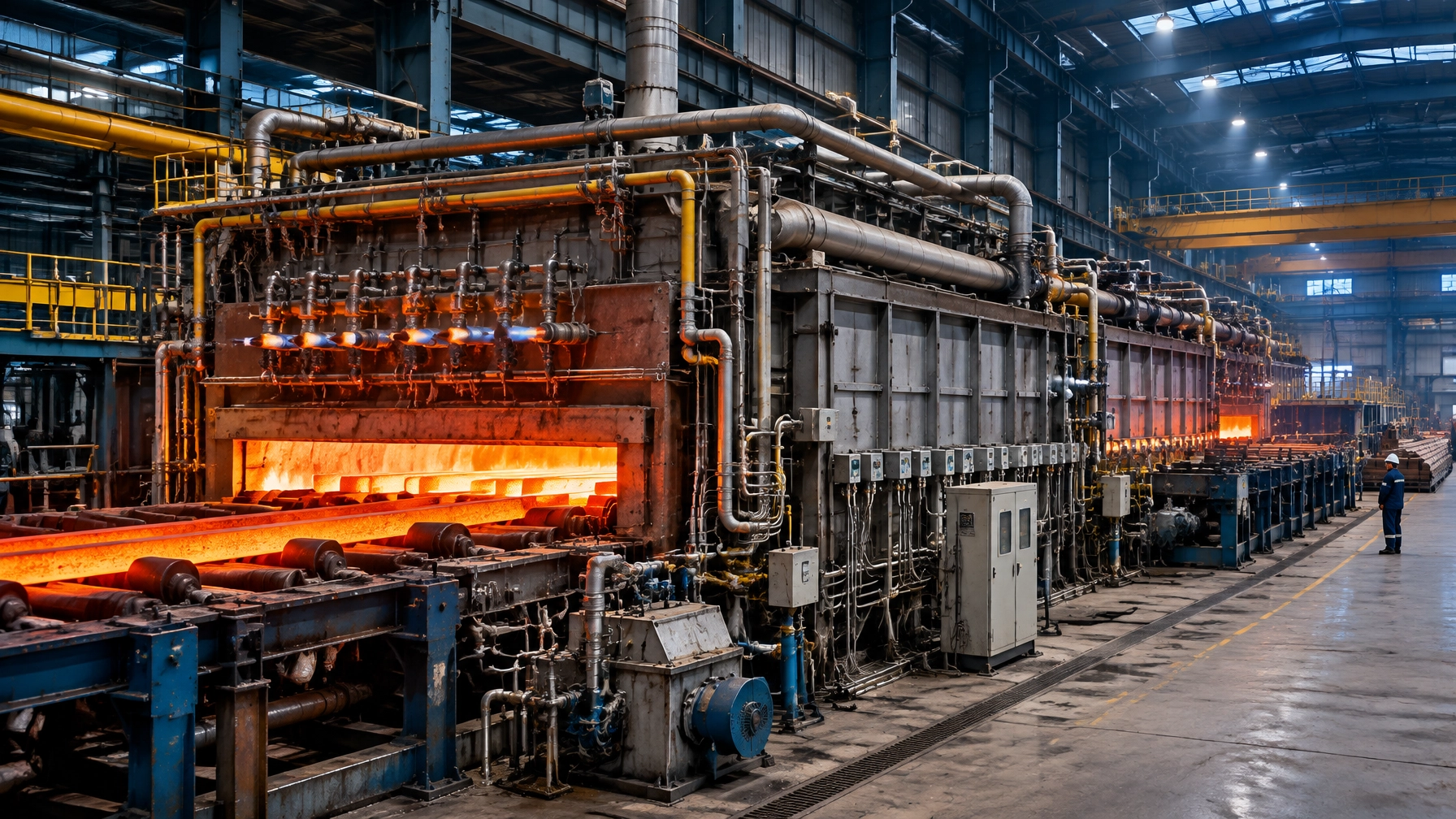
A furnace can look stable on its zone-temperature screens and still burn 20% more fuel per tonne than its own operating capability. In many poorly measured operations, a 3–20% avoidable fuel gap is a useful diagnostic range, not a universal benchmark or a guaranteed saving. The gap persists when meters are not validated, energy use is viewed only in monthly totals, or the comparison ignores charge temperature, product mix and mill delays.
The stakes are substantial: a 2025 review reports that reheating furnaces account for roughly 67% of energy use in continuous casting and rolling lines, while the steel industry uses about 8% of global energy.[4] The first step toward savings is therefore not necessarily a new burner or a new furnace. It is a trustworthy baseline that connects energy input to tonnes processed, product quality and operating conditions.
What a furnace energy monitoring system should measure
The master KPI is specific energy consumption (SEC): fuel or energy consumed per tonne of acceptable product, typically expressed as GJ/t or kWh/t. A practical system should capture:
- Fuel flow by zone, and, where useful, by burner group, with meter validation and fuel heating value recorded.
- Combustion conditions: air–fuel ratio, flue-gas oxygen (O₂) and carbon monoxide (CO).
- Zone and hearth temperatures, including regular checks that thermocouples are correctly located and calibrated.
- Charge and discharge temperatures, measured with suitable pyrometers.
- Throughput and pacing: tonnes per hour, billet movement, residence time and interruptions.
- Furnace pressure at a representative location.
- Hot-charge ratio and delay time, distinguishing productive heating from holding, shutdown and restart operation.
A monthly gas reading can confirm a bill. It cannot show whether a particular zone is over-firing during a mill stoppage or whether specific energy rose because the incoming billets were colder. Higher-resolution data makes that distinction possible.
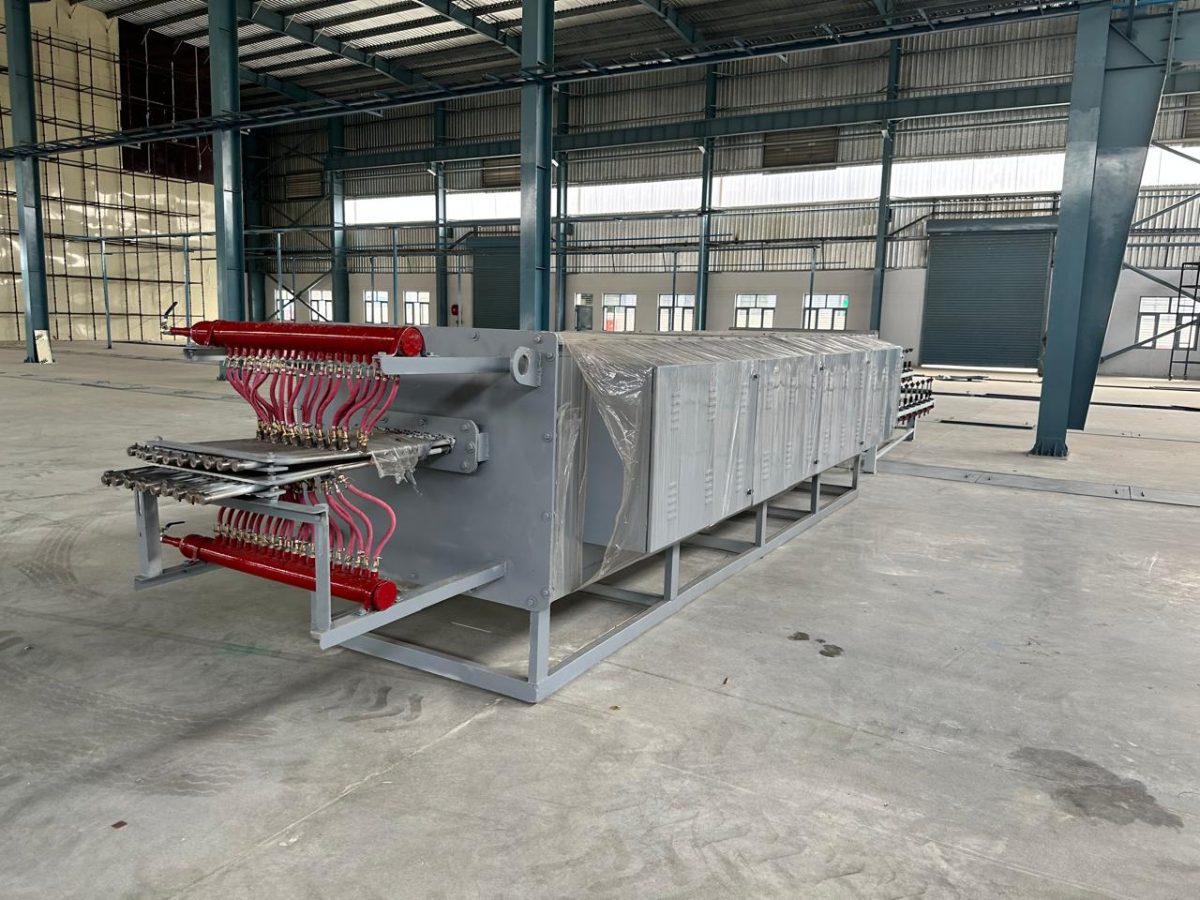
Instrumentation choices deserve engineering attention rather than catalogue selection. Fuel metering on a melting furnace for steel or a billet reheating furnace should match the gas pressure, temperature and turndown range actually experienced, and every installed analyser needs a documented calibration interval. When an industrial furnace manufacturer designs metering into a new furnace, sensor access, isolation valves and calibration fittings are included from the start; retrofitting them into an operating plant is slower and costs production windows, so the Phase 3 specification deserves the same rigour as any furnace spare parts purchase. Instrument selection also differs by furnace family: induction and aluminum melting furnace installations may concentrate on coil power, melt-cycle energy and holding-furnace kWh/t, while combustion-equipped industrial furnace systems rely more heavily on flue-gas analysis and zone metering.
Normalizing the baseline: why two shifts never compare
An ISO 50001-style energy performance indicator (EnPI) compares energy use with the conditions that drive it. Before benchmarking shifts or verifying a project, normalize for:
- Charge temperature and hot-charge share.
- Product grade, dimensions and required discharge temperature.
- Throughput, residence time and loading pattern.
- Delay time, including ready-but-not-discharged billets.
- Operating mode: production, hold, shutdown or restart.
Without normalization, a cold-charge shift may look inefficient beside a hot-charge shift even when both are well operated. Conversely, a genuine improvement can disappear in the averages when product mix changes. The baseline must be specific enough to separate process improvement from production variation.
Heat-balance audits: finding the 20% nobody sees
A heat-balance audit accounts for fuel and combustion-air input against useful heat to the charge and losses through exhaust gas, furnace structure, cooling systems, openings and other sources. A detailed study at Siam Construction Steel (SCSC), Thailand, examined a natural-gas walking-hearth furnace rated at 100 t/h, heating 150 mm square billets.[1]
The study identified a striking measurement error: the control-room reading was 1,165°C, while a hand-held pyrometer read 1,238°C. Investigators then made five practical corrections:
- Relocated thermocouples from the roof to the sidewall to improve temperature measurement.
- Corrected starved combustion-air supply associated with incomplete combustion, smoke and a reducing flame.
- Moved furnace-pressure tapping to the soaking zone.
- Reduced the inter-billet gap from 100 mm to 80 mm.
- Introduced formal delay and shutdown logic. For a 30-minute mill delay, the setpoint was reduced by 50°C for the first 10 minutes, held for the next 10, then raised during the final 10 minutes.
After the combined changes, reported fuel consumption fell from 0.8744 to 0.6903 GJ/t, a 21.05% reduction. Furnace thermal efficiency increased from 32.32% to 38.90%, a gain of 6.58 percentage points, and the reported number of billets in the furnace rose from 72 to 80, or 11.11%. The paper projected annual savings of INR 264 million; that is a study-specific projection, not a transferable savings estimate.
The audit also reported unaccounted losses declining from 28.9% to 26.7% of heat input. That residual remained material, largely because billets could sit ready for discharge while the mill was blocked in hot-charging operation. Pacing and disciplined delay setpoints are often the lowest-cost first actions.
These results came from a combined package, so they should not be attributed to one correction alone. A one-off heat balance also depends on reliable instruments and a representative steady-state measurement window; production interruptions or poor sensor data can distort the result.

Model-based control and AI monitoring: turning data into fuel savings
Once the baseline and sensors are dependable, model-based optimization can coordinate zone setpoints, billet movement and changing operating modes. A multi-mode model predictive control (MPC) study reports 2–6% fuel-consumption reductions across installations in European steel plants. Its system uses virtual sensing and control-mode selection to manage production, downtime, shutdowns and restarts.[2] This range is evidence from those applications, not a guaranteed result for every furnace.
AI can help teams identify patterns that are difficult to spot manually. In a supplier-published case study, ArcelorMittal Belval’s beam-mill furnace was reported to consume about €5 million of gas annually, or roughly 300 GWh. The project analyzed 1,600 data streams at one-second resolution over a year. Its machine-learning gas-consumption model reportedly achieved 98% reliability. Against an initial target of 2% savings (€100,000 annually), the supplier reported savings exceeding 3%, €150,000 and 9 GWh per year, with payback in under six months.[3]
The case also describes daily AI reports sent to production, maintenance and energy teams, identifying an unexpected loading mode associated with a gain above 3% and a cinder-layer deposit issue. These figures are supplier-reported success-story results, not an independently audited benchmark for all furnace systems.
Importantly, AI is not the starting point. The SCSC study shows how measurement corrections, combustion adjustments and formal delay logic can reduce fuel use before advanced analytics are involved.
Conventional practice compared with a measurement-led response
| Conventional approach | Modern response | Evidence or operational value |
|---|---|---|
| One monthly gas-meter reading | Per-zone metering and normalized EnPI dashboards | Shows where and when SEC changes |
| Raw temperature-based benchmarks | Heat-balance audit | Connects fuel input to useful heat and losses |
| Operator memory for delays | Virtual sensors and MPC | Supports consistent control across operating modes |
| Fixed setpoints during delays | Automatic delay and shutdown logic | Reduces unnecessary holding fuel; SCSC provides a process-improvement example |
| Reactive combustion troubleshooting | AI drift detection with daily recommendations | Flags abnormal consumption patterns for investigation |
The business case: from meter readings to a verified savings register
Once a normalized baseline exists, every energy project can be evaluated and tracked consistently. A savings register records the measure, its expected annual saving, the measurement and verification (M&V) method and the verification date. This discipline matters because unverified savings tend to erode quietly: setpoints drift back, delay logic gets overridden during busy shifts, and combustion trim is lost after burner service. Plants that maintain a verified savings register keep their efficiency gains visible to management, which in turn protects future investment in industrial furnace systems and thermal processing equipment upgrades.
For a steel rolling mill weighing several competing projects, the register also exposes the cheapest wins. Measurement corrections such as relocating a misplaced thermocouple, restoring correct air supply or formalising delay logic typically cost a small fraction of capital equipment, yet the SCSC case shows they can move fuel consumption by more than twenty percent when the errors are severe. Where metering infrastructure is already adequate, model-based control adds a further 2–6% in reported installations. Sequencing matters: verify the measurement chain first, then apply control, then consider capital measures such as insulation, skid upgrades or waste-heat recovery with confidence that each step's benefit can be separately measured.
A five-phase roadmap for verified savings
Phase 1: Assessment & Planning
Audit existing fuel and air meters, sensor calibration, data historian coverage and production records. Define the SEC boundary: fuel basis, tonnes counted, time interval and product scope.
Phase 2: Prioritisation
Rank opportunities by energy impact, data confidence, cost and downtime risk. Start with obvious measurement errors, combustion issues and delay-related fuel use.
Phase 3: Design & Integration
Specify meters, thermocouples, pyrometers, pressure and gas analysers, data links and historian tags. Connect energy readings to charge identity, production and operating mode.
Phase 4: Commissioning & Verification
Validate instruments and establish a normalized baseline. Verify measured savings against matched conditions, while checking that throughput, product quality and safety requirements remain satisfied.
Phase 5: Sustainment
Issue daily performance reports, set drift alarms and assign owners to follow up. Review abnormal SEC trends and conduct periodic re-audits so improvements remain in place.
Spares and instrumentation: protect the measurement chain
A monitoring project is only as dependable as its instruments and their upkeep. Plan for thermocouples and replacement schedules, infrared pyrometers, O₂/CO analysers, flow meters, pressure transmitters, control valves, dampers, data-loggers and controllers. Keep appropriate furnace spare parts available so an instrument fault does not become the bottleneck for optimization or production.
The same monitoring discipline applies beyond a steel rolling mill: track heating-zone energy in a hot dip galvanizing plant, energy per tonne in an aluminum melting furnace or melting furnace for steel, and cycle energy in heat treatment furnaces. It also supports metal recycling furnace operations and thermal processing equipment used in the wire and cable industry. The right KPI will vary by process, but the principle is consistent: meter, normalize, investigate and verify.
As an industrial furnace manufacturer with 35+ years of expertise, Continental Furnaces supports customized industrial furnace systems, ISO-certified quality and prompt service. For consultation on energy-monitoring retrofits, metering packages, instrumentation or furnace spare parts, request a quote. Start with a verified baseline, and build an enduring partnership for sustained competitive advantage. From wire and cable industry annealing lines to melting furnace for steel installations, the plants that sustain their gains treat monitoring as permanent operating discipline rather than a one-time project, backed by instrumentation packages, furnace spare parts planning and engineering service.
References
- Chakravarty, K. & Kumar, S. “Increase in energy efficiency of a steel billet reheating furnace by heat balance study and process improvement.” Energy Reports, 2020. doi:10.1016/j.egyr.2020.01.014
- Zanoli, S. M. et al. “Multi-Mode Model Predictive Control Approach for Steel Billets Reheating Furnaces.” Sensors, 2023. doi:10.3390/s23083966
- Energiency. ArcelorMittal Belval success story. Supplier-published case study.
- Qi, F. et al. “Digitization and greening of industrial reheating furnaces: A review of mathematical model, heating pattern, control system and energy analysis in the reheating furnace.” Applied Thermal Engineering, 2025, article 125320. Article page
- Zhao, J. et al. “Industrial reheating furnaces: A review of energy efficiency assessments, waste heat recovery potentials, heating process characteristics and perspectives for steel industry.” Process Safety and Environmental Protection, 2021. doi:10.1016/j.psep.2021.01.045