The commercial question for furnace operators is no longer only how much energy a plant consumes. It is also when that energy is purchased, and whether heat can be stored or production scheduled so the plant buys less power during expensive or constrained hours.
That distinction matters for an electric arc furnace (EAF), a steel rolling mill, or other energy-intensive thermal processing operations. Time-of-day (ToD) tariffs, peak demand charges and flexibility markets can reward controlled shifts in electricity use. Thermal energy storage (TES) adds another option: charge a thermal store when power is more attractive, then draw on its heat later.
This edition focuses on the energy-side economics of that flexibility, not on furnace electrification design. The goal is to help plant teams identify where timing changes can improve profitability without compromising safety, product quality or production commitments.
1. Electricity bills are timing problems as well as volume problems
A plant’s effective energy cost can include more than the units consumed. Depending on the tariff and market, the bill may also reflect:
- Time-of-use pricing: electricity rates that vary by defined periods or market conditions.
- Peak demand charges: charges linked to the plant’s maximum demand during a billing period.
- Demand ratchets: rules that allow a past or seasonal peak to influence later bills.
- Open-access and network terms: which may affect the value of shifting consumption between hours.
A furnace may run for relatively few high-power hours yet set a monthly demand peak. Likewise, shifting a flexible operation away from a costly tariff window can reduce energy cost even when total energy use changes very little.
The first practical distinction is between energy shifting and energy saving. Moving consumption to a cheaper hour does not necessarily reduce the kilowatt-hours used. It changes the price paid for them. India’s ToD tariffs and open-access arrangements make this a relevant opportunity for many steel and foundry businesses, but the applicable rules and economics are utility- and contract-specific. Model each facility’s actual tariff; do not assume a national rate or a uniform savings level.

2. What can a furnace plant actually curtail?
Flexibility is not the same as switching equipment off at will. The production sequence, metallurgical constraints and plant configuration define the safe operating envelope.
- EAFs: The most practical opportunities may be between batches, through adjusted schedules or controlled power modulation. A European 2030 study by smartEn and Compass Lexecon models up to about 80% of plant load as reducible under specified conditions. This is not a universal operating limit: batch stage, scrap condition, production commitments and process controls matter.
- During a heat: Interruptions can affect cycle time and quality. The study estimates EAF response windows of 15 minutes to one hour depending on batch stage. It models around 40–45 activations annually, with only 0.3–0.4% of annual energy curtailed: a reminder that short, carefully chosen interventions can offer flexibility without routinely sacrificing large volumes of production.
- Continuous casting and rolling: A caster depends on process continuity. A schedule change upstream can create downstream disruption, so any flexibility plan must account for the entire production chain, not just the furnace.
- Induction melting and electric reheat: Load may be adjustable or schedulable, but thermal inertia, melt practice, holding requirements and delivery commitments set boundaries. A melting furnace for steel or an aluminum melting furnace needs a process-specific assessment.
- Refractory and electrodes: Aggressive or poorly controlled cycling can increase thermal stress and electrode wear. Curtailment must be engineered around equipment limits, not just a market signal.
The smartEn/Compass Lexecon study puts the modeled opportunity cost of EAF curtailment at about €550/MWh. That figure reinforces the central rule: market revenue is worthwhile only when it exceeds the operational value of lost or delayed production.

3. Thermal storage separates electricity purchasing from heat use
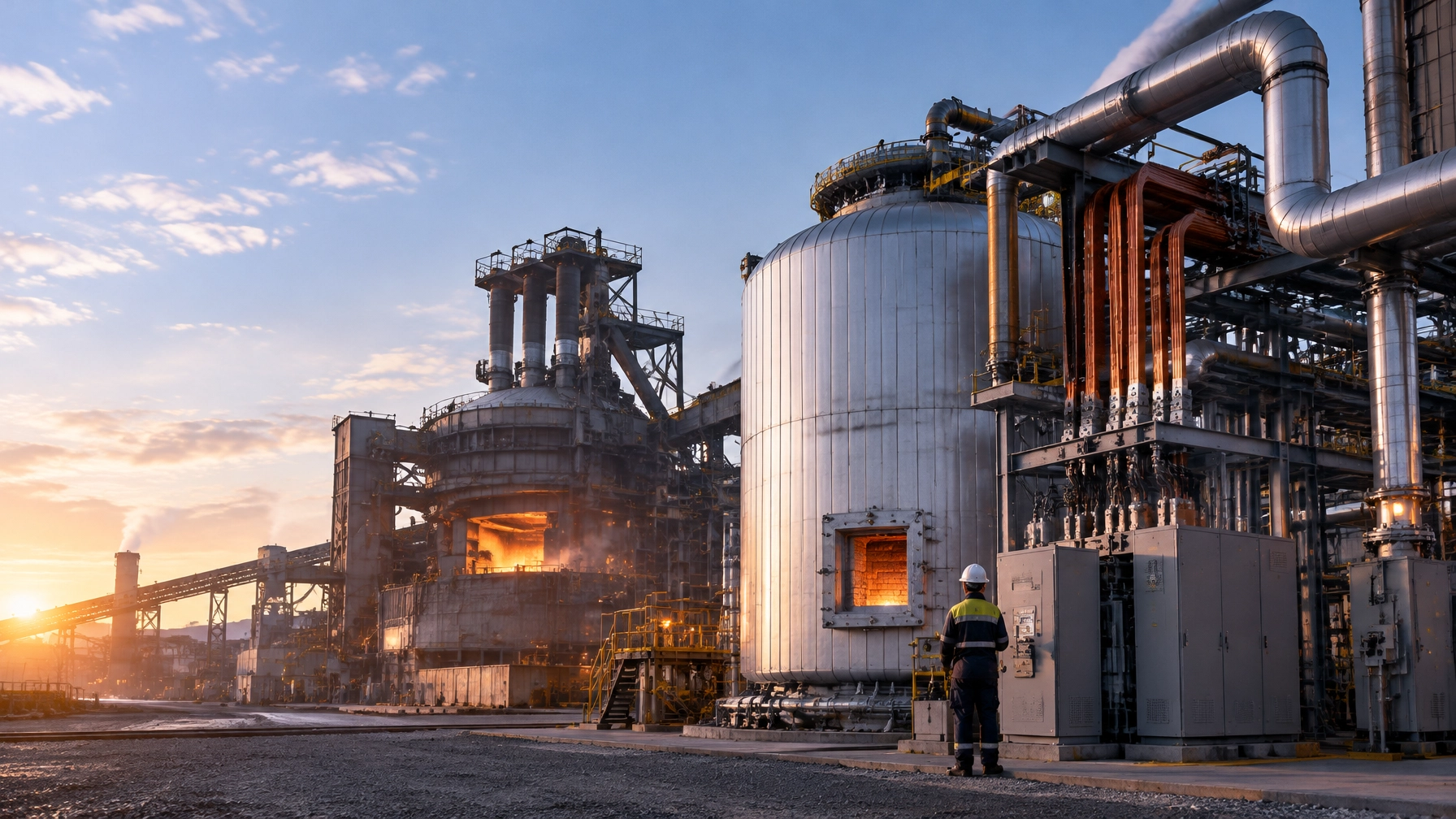
A thermal battery charges a storage medium, often refractory brick, using electricity, then releases heat when required. In a plant with a compatible heat demand, this can shift the timing of electricity use while maintaining heat delivery.
The 2019 Applied Energy study of Firebrick Resistance-Heated Energy Storage (FIRES) examined firebrick systems storing heat at approximately 1,000–1,700°C. It presented a modeled concept, not a universal commercial specification. The paper and related academic estimates place firebrick storage costs in the vicinity of $10–11 per kWh-thermal, with actual installed cost dependent on design, power rating, insulation, discharge equipment and site integration.
Commercial examples demonstrate the range of applications, but should be read with appropriate sourcing caveats:
- Rondo Energy reported commissioning a 2 MWh brick heat battery at Calgren Renewable Fuels in Pixley, California, in early 2023.
- In October 2025, Rondo announced commercial operation of a 100 MWh installation at Holmes Western Oil Corporation in Kern County, California. The company described it as the world’s largest industrial heat battery; the project uses on-site solar to heat refractory bricks above 1,000°C and supply steam. The project details and performance descriptions are company-reported and covered by Bloomberg and other media. It demonstrates shifting renewable electricity into stored industrial heat; it is not, by itself, proof of grid-arbitrage economics for a steel mill.
Steam accumulators offer a different route where process steam is central. A published model of a steam accumulator paired with an electric boiler estimated approximately €340,000/MW/year in flexibility value with 1,000–1,400 activations annually under its assumptions. Treat such numbers as scenario outputs, not guaranteed returns for a specific site.
4. Demand response and flexibility revenue: build a stack, not a promise
The September 2025 smartEn/Compass Lexecon study models European markets for 2030, including Germany and Italy. For EAFs, it estimates flexibility revenue of up to €50,000/MW/year, or around €15 per tonne of product, with modeled value primarily from mFRR (manual Frequency Restoration Reserve) and capacity mechanisms. The study reports mFRR reservation/activation values of up to €40/kW and capacity-market values of €7–13/kW in its modeled context. These are market- and scenario-specific projections; eligibility, availability, contract terms and actual dispatch determine realized revenue. The study also estimates that flexibility could reduce the cost gap of H₂-DRI-EAF decarbonisation by 4–6% in its modeled case.
Energy procurement can contribute value even without market participation. Zhang, Hug and Harjunkoski’s work on flexible EAF scheduling reports roughly 3% electricity-cost reduction in its studied price-aware scheduling context. Results depend on the price profile, production plan and constraints.
Battery storage is another option. A 2021 NREL/JISEA ERCOT analysis modeled a behind-the-meter lithium-ion battery paired with EAF steelmaking. Under a low battery-cost 2050 scenario, it estimated an optimal battery of approximately 628 MWh / 157 MW, electricity-cost savings near 47%, a roughly seven-year payback, and about 2.2% profit-margin uplift. These are model-based future projections, not current-practice benchmarks or project guarantees.
5. Comparing energy-side strategies
| Strategy | How it changes the energy equation | Main constraint |
|---|---|---|
| Pay flat tariff and operate as usual | No deliberate timing strategy; simplest to manage | Exposed to peak charges and time-varying prices |
| ToD-aware scheduling | Moves flexible activity to lower-cost periods | Production sequence and tariff windows |
| On-site thermal storage | Charges heat storage at selected times; delivers heat later | Capital cost, usable temperature and integration |
| Battery paired with EAF | Shifts electricity and can support peak reduction | Battery economics, power rating and dispatch strategy |
| Demand-response participation | Earns market or contract revenue for available flexibility | Qualification, response obligations and production opportunity cost |
No option wins universally. A plant may combine scheduling with thermal storage or demand response, but each value stream must be checked for overlap, operational conflicts and tariff rules.

6. Five-phase roadmap for a site-specific business case
- Tariff & Baseline Audit: Document contract terms, ToD periods, peak-demand rules, open-access costs and the plant’s normal production schedule.
- Curtailability Assessment: Identify which loads can shift, for how long and at which production stages. Include caster continuity, product commitments and process safeguards.
- Design & Sizing: Compare scheduling, TES, steam accumulation and batteries against the required thermal duty, storage duration and discharge rate.
- Market Integration & Automation: Define who receives dispatch signals, how the plant validates safe response, and how availability and settlement will be handled.
- Verification & Continuous Improvement: Review operational outcomes, market payments, production effects and equipment condition. Update the operating strategy as tariffs and market rules change.
7. Reliability is part of the flexibility business case
A flexibility commitment is only valuable if the plant can deliver it when called. Review the condition and availability of contactors, thyristor/SCR stacks, transformer taps, busbars and power-electronics cooling. Check that control systems can safely execute a scheduled change or demand-response instruction, with clear operator overrides and process interlocks.
A planned operating window should never depend on a critical component with an unacceptable failure risk. Strategic access to furnace spare parts, maintenance support and tested control logic helps protect both production and market commitments.
This is where thermal processing equipment and energy-market planning meet. Whether the site runs heat treatment furnaces, a melting furnace for steel or a metal recycling furnace, or a hot dip galvanizing plant, the right strategy begins with the actual duty cycle and operating constraints.
Plan for flexibility as a long-term operating capability
Thermal storage, price-aware scheduling and demand response can help furnace operators decouple when they buy electricity from when they need heat. The strongest business case is built from site-specific tariffs, realistic process constraints, dependable equipment and clearly defined market participation, not from headline savings alone.
Continental Furnaces brings 35+ years of expertise, ISO-certified quality, customized engineering and prompt service to industrial furnace projects. Consult with our team to assess your load-flexibility opportunity and develop an enduring partnership for sustained competitive advantage. Request a consultation.
For the wire and cable industry, foundries and steel producers alike, a well-engineered industrial furnace system from an experienced industrial furnace manufacturer can turn energy timing into a practical lever for efficiency, yield and profitability.
References
- Zhang, X., Hug, G. & Harjunkoski, I. “Cost-Effective Scheduling of Steel Plants With Flexible EAFs.” IEEE Transactions on Smart Grid (2016). doi:10.1109/TSG.2016.2575000
- Garfield, J. et al. Opportunities for Industry to Provide Flexibility While Increasing Profitability. NREL/JISEA, NREL/TP-6A50-75784 (2021). Report
- smartEn & Compass Lexecon. The Business Case for Flexibility Provision in Energy-Intensive Industries (September 2025). Study
- Stack, D.C., Curtis, D. & Forsberg, C. “Performance of firebrick resistance-heated energy storage for industrial heat applications and round-trip electricity storage.” Applied Energy (2019). doi:10.1016/j.apenergy.2019.03.044
- Rondo Energy. Company announcements on the Calgren and Holmes Western heat battery projects. Holmes Western announcement
- Bloomberg. “In California, the World’s Largest Battery Made of Bricks Turns On” (October 2025). Coverage