Morning Edition | 8 November 2026
The refractory lining is the furnace’s sacrificial component, and one of its quietest energy levers. It contains heat, withstands chemical and mechanical attack, and protects the shell. As it wears and thins, insulation falls, fuel demand can rise, and an unplanned outage can disrupt production. The right answer is rarely one material across the whole furnace: it is an engineered lining matched to each zone’s exposures.
The benchmarks below are published reference values, not universal requirements or performance guarantees. Verify every figure against your furnace data, adopted standards, operating conditions and jurisdiction before using it in a design or purchase specification.
Why one lining choice never fits a furnace
Material selection starts with the dominant wear mechanism, not simply the maximum temperature. A lining may face several forms of attack at once:
- Thermal shock and thermo-mechanical spalling: rapid heating, cooling or temperature gradients initiate cracks and detach hot-face material.
- Chemical attack: FeO in mill scale, alkalis, zinc vapour or magnesium vapour can react with, penetrate or weaken refractory.
- Impact and abrasion: charging, moving stock and handling equipment mechanically damage hot faces.
- Gas and particle erosion: high-velocity burners, combustion products and entrained particles wear surfaces.
- Metal penetration and buildup: in aluminum service, penetration and corundum buildup can damage the lining, especially at the metal-line/atmosphere/refractory interface, the “bellyband.” Non-wetting additives and graded linings can help, but must suit the exposure and process chemistry. [4]
A sound design balances hot-face resistance, insulation, thermal mass, installation method, repairability and campaign life.
Matching materials to zones
The matrix below is a starting point for engineering review, not a substitute for site-specific lining design.
| Furnace zone | Dominant wear mechanism | Typical material families | Watch-outs |
|---|---|---|---|
| Roof/crown | Thermal cycling, flame and gas erosion | Low-cement castable, brick, ceramic-fiber modules in suitable service | Protect fiber from gas velocity, flame impingement and chemical attack |
| Walls | Corrosion, thermal gradients, local abrasion | Dense brick or castable hot face with insulating backup; fiber modules where protected | Check joints, anchors, shell temperature and operating atmosphere |
| Hearth and skids | Scale erosion, impact, abrasion, cooling losses | High-alumina castables or blocks; castable/fiber hybrid skid insulation | Match skid design to beam movement, vibration, scale loading and heat shielding |
| Preheat zone | Scale, dust, abrasion and thermal cycling | Castables, gunning mixes or protected fiber insulation | Charging impact and deposits can rule out exposed fiber |
| Firing/soaking zone | High temperature, flame, FeO and erosion | Dense monolithics, high-alumina materials, protected fiber where appropriate | Review flame pattern, scale chemistry and hot-face strength |
| Burner blocks | Flame impingement, thermal shock, gas velocity | Dense castable; coated or densified fiber designs in qualified applications | Regenerative-burner velocity can damage exposed fiber |
| Doors and seals | Repeated cycling, abrasion and leakage | Fiber modules, blankets, rope or tougher castable at contact points | Compression, alignment and replacement access affect sealing |
| Exhaust and flue ducts | Gas/particle erosion, deposits, chemical attack | Dense or insulating castable; gunning mixes | Account for gas chemistry, temperature profile and dust loading |
Dense linings, monolithics and ceramic fiber: the three-way trade-off
Dense brick and castable provide a robust hot face against abrasion, impact and chemical attack. Their greater mass and heat storage can, however, slow cyclic operation and increase heat absorbed by the lining. Monolithics, including castables and gunning mixes, offer joint-free or complex-shaped installations, with precast components and shotcrete methods supporting faster relining and repair. A US DOE/Oak Ridge National Laboratory report states monolithics comprise at least 60% of refractories used in US iron and steelmaking, with use exceeding 70% in Japan. [1]
Ceramic fiber (CF) has low thermal mass and strong insulating capability, making it useful where rapid cycle response and lower heat storage matter. A US university heat-loss paper reports CF stores only 10–15% of the heat stored by brick. Published case references report fuel-saving ranges of 15–41% for modular fiber-block retrofits and, in some cycle-based heat-treating applications, up to 40–57%. These are application-specific published outcomes, not promised results. [3]
Shinagawa’s reheating-furnace report gives CF conductivity values of 0.25–0.38 W/m·K at 1000°C, compared with about 1.0 W/m·K for dense cement castable. In its skid-post thermal-transfer calculation, a CF-based design reduced heat flux from about 19,000 W/m to 2,000–2,300 W/m, roughly a 90% reduction, and lowered outlet cooling-water temperature by about 10°C versus the castable arrangement. CF’s main limitation is mill-scale erosion; coatings, densified products and hybrid hot-face protection address that weakness. Coated or densified CF burner blocks are also emerging for appropriate burner conditions. [2]

Monolithic installation methods can also reduce relining disruption. Shinagawa reports its PA-607G gunning plastic reduced permanent curing shrinkage from roughly −0.6% for a conventional unprotected material to better than −0.2%, with installation rates of 3–4 tonnes per hour. The method needs no forming frames and suits complex surfaces. For localized reheating-furnace damage, published practice includes half-yearly inspections and dry-gunning repairs using portable equipment rather than automatically committing to a full reline. [2]
Zone discipline by operation
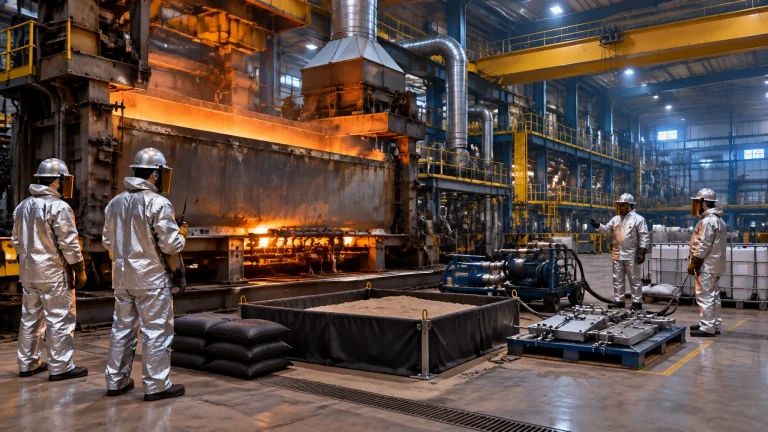
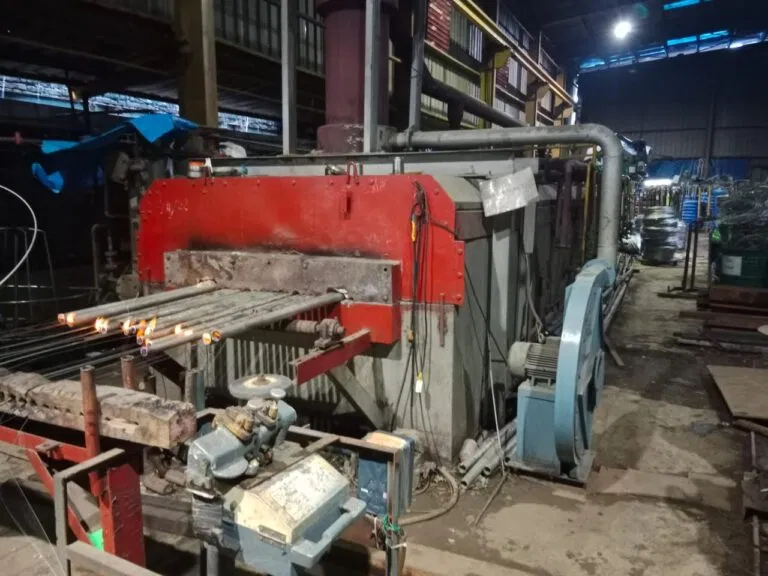
A steel rolling mill reheating furnace must manage FeO erosion, walking-beam impact and the special demands of water-cooled skid posts and beams. Shinagawa reports that a colloidal-silica chemical-bond castable resisted FeO erosion better than a conventional alumina-cement castable in a 1500°C crucible test; practical use showed only minor cracking or peeling after more than four years. Its report describes reheating-furnace operation from roughly 900°C to over 1300°C. These test and service figures are reference evidence, not a guarantee for another installation. [2]
For heat treatment furnaces, cyclic duty can favor fiber modules where the atmosphere, temperature and mechanical exposure permit. See Continental Furnaces’ heat-treatment furnace solutions.
An aluminum melting furnace needs zone-specific protection against metal penetration and corundum buildup, particularly at the bellyband; match non-wetting grades to contact surfaces and consider abrasion at charging and scraping areas. A melting furnace for steel demands compatibility with basic slag and molten-metal exposure; magnesia-carbon and other basic families are selected according to service conditions. DOE/ORNL cites steel ladle lining lives of 30–50 heats, runners lasting one to two weeks, and weekly repairs to some refractory-enclosed water-cooled pipes and stirrers. [1]
At a hot dip galvanizing plant, evaluate zinc-vapour exposure around kettle-adjacent structures. A metal recycling furnace must accommodate changing scrap-borne contaminants and alkalis. Annealing lines in the wire and cable industry may use fiber modules where clean-atmosphere requirements, temperature and handling conditions are satisfied.
Inspection, repair and relining economics
The lining affects fuel use as well as maintenance. DOE/ORNL estimates that about 85% of iron and steel direct energy consumption occurs in processes affected by refractories. Its report frames near-term savings of 2% and long-term savings of 10% on that refractory-affected energy: 28.4 and 142.1 trillion Btu per year, respectively, for iron and steel. These are historical sector-level estimates, not a plant forecast. The report also notes that corrosion-driven wall thinning reduces insulating ability: refractory wear is an energy issue as well as a maintenance issue. [1]
Build an inspection and repair program around actual exposure and failure history:
- Inspect high-wear zones regularly; a half-yearly inspection cycle is published practice for reheating furnaces, not a universal interval.
- Record thickness, crack patterns, spalling, scale infiltration and repaired areas.
- Repair localized damage promptly where safe and technically appropriate.
- Compare premium materials by expected campaign life, heat loss, installation time and shutdown exposure, not purchase price alone.
Keep the lining program stocked
Planned repairs need compatible materials and hardware ready when the furnace is available. A practical inventory can include:
- Anchors and anchor systems, plus expansion-joint materials.
- Gunning and repair mixes suitable for the installed lining.
- CF modules and blankets for approved insulation zones.
- Bonding agents and colloidal-silica systems specified for the application.
- Lining-thickness sensors and other monitoring components.
Align grades and quantities with your furnace spare parts strategy so a localized repair does not become a prolonged outage.

Five-phase lining roadmap
- Map zones and mechanisms: document temperatures, chemistry, flow, impact and cooling.
- Audit failure history and material records: compare drawings, repairs, postmortems and campaign duration.
- Pilot upgrades in the highest-wear zone first: validate a targeted change before extending it.
- Align inspections and repair inventory: set site-specific intervals and stage compatible materials.
- Track performance: monitor lining life, shell temperature and specific fuel consumption as core KPIs.
Build campaign life through an enduring partnership
Refractory selection is a lifecycle decision across material, installation, inspection and repair, not a one-time specification. As an experienced industrial furnace manufacturer, Continental Furnaces brings 35+ years of expertise, ISO-certified quality, customized engineering and super prompt service to support customer operations. Our integrated industrial furnace systems and thermal processing equipment are designed around plant requirements and lifecycle performance.
Discuss a zone-by-zone lining review with our team and make your next upgrade a strategic move toward sustained competitive advantage. Request a quote.
References
- US DOE/Oak Ridge National Laboratory, “Refractories for Industrial Processing: Opportunities for Improved Energy Efficiency” (2005).
- Shinagawa, “Recent Technical Developments of Refractories and Ceramic Fiber Products for Reheating Furnace,” Technical Report No. 66 (2023).
- Missouri University of Science and Technology Scholars’ Mine, “Reducing Heat Losses with Ceramic Fiber”.
- Plibrico Company, “Extending the Service Life of Refractory Linings” (2024).
- U. Tatic et al., “Refractory Materials for a Reheating Furnaces and their Development in Present Time,” Advanced Technologies & Process Metallurgy (2020).