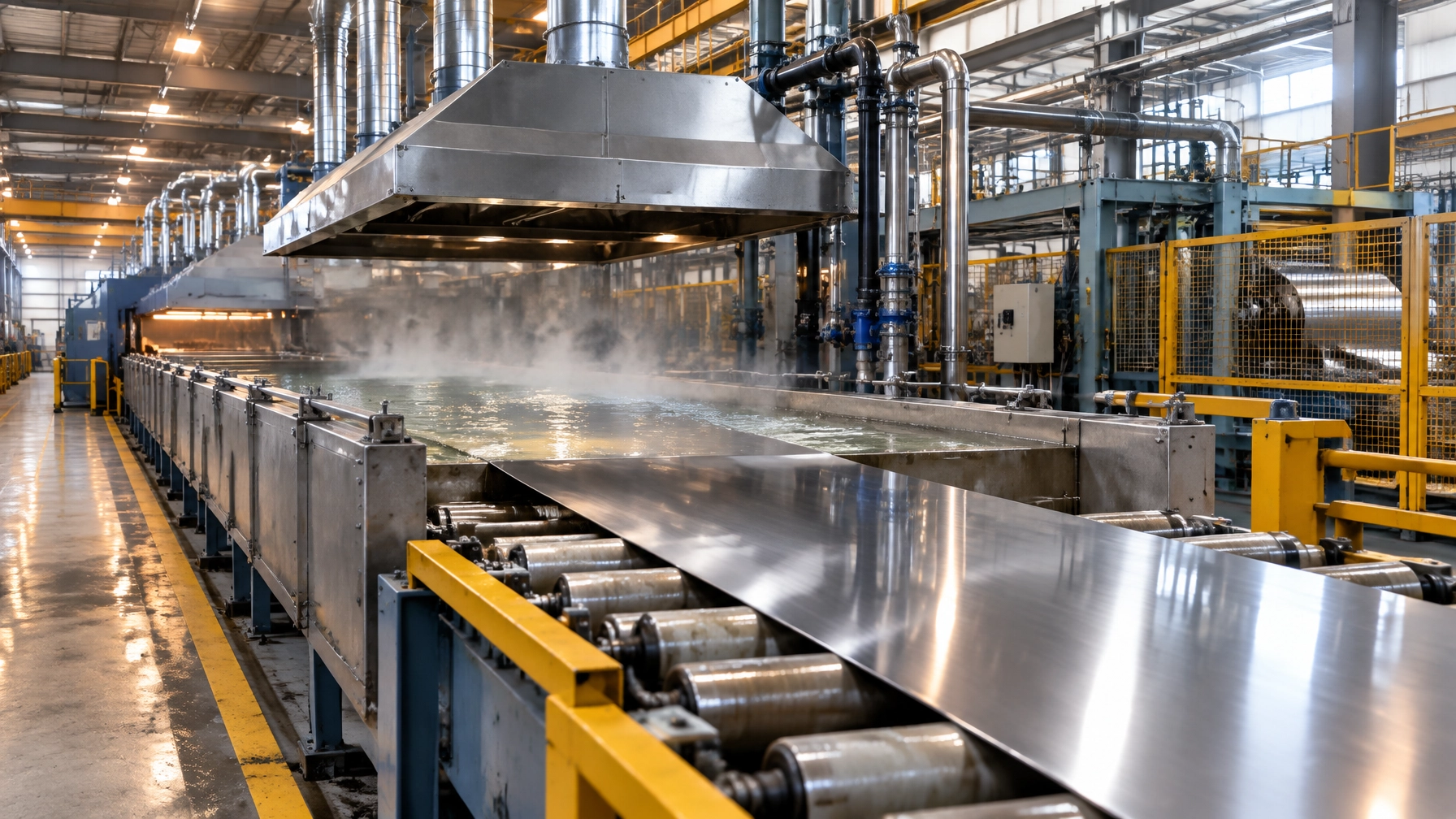
The HF/HNO3 bath is among the most chemically aggressive and expensive liquids in a stainless plant. Unlike carbon-steel HCl pickling, with one principal acid and a well-understood regeneration route, stainless pickling depends on two acids with different functions and recovery behaviour. For plant managers, engineers and maintenance teams, the central principle is this: the bath is a chemical reactor, not a dip tank.
All numerical ranges below are indicative benchmarks drawn from published surveys, supplier references, academic studies and regulatory texts. They vary with steel grade, scale, surface finish, line type, throughput and local regulation. Each plant must validate operating limits through analysis, trials and permit requirements.
Bath Chemistry: What Each Acid Is Doing
Nitric acid (HNO3) provides oxidising power and supports re-passivation; hydrofluoric acid (HF) dissolves chromium-rich oxide scale and complexes dissolved Fe3+, Cr3+ and Ni2+. Fluoride does not remain simply as “free HF”: it binds metals into complexes. An ISIJ study of fluoride speciation found significant iron and chromium complexation in representative pickling liquor, affecting treatment and recovery.
Published operating bands include free HF roughly 5–75 g/L, free HNO3 roughly 70–200 g/L, dissolved iron (often expressed as Fe3+) roughly 1–40 g/L, bath temperature about 20–65°C, and pickling times of about 5–240 minutes. Grade, scale and process configuration drive the actual setpoints. See the Avesta/Outokumpu Pickling Handbook, Metrohm’s online acid and iron analysis note and Leuze Verlag’s monitoring article.
| Mixed-acid bath parameter | Typical indicative band | Why it matters | Drift consequence | Operating discipline |
|---|---|---|---|---|
| Free HF | 5–75 g/L | Dissolves chromium-rich scale | Slow or incomplete descaling | Titrate; verify sampling and replenishment |
| Free HNO3 | 70–200 g/L | Oxidation and passivation | Poor surface quality or greater NOx | Analyse independently from total acidity |
| Dissolved iron / Fe3+ | 1–40 g/L | Tracks dissolved metal loading; Fe3+ can contribute oxidising action | Longer cycles and reduced bath activity | Trend iron with acid and production data |
| Bath temperature | 20–65°C | Controls reaction rate | High temperatures can increase acid decomposition and substrate attack | Set by grade and line; avoid temperature-only compensation |
| Fresh acid use | Roughly 10–30 kg/t pickled, indicative | Links chemistry to cost and yield | Higher purchase and waste-treatment spend | Reconcile acid additions against throughput; see Stainless Steel World |
| Nitric decomposition / NOx | No universal bath indicator band | Signals oxidation losses and fume-control performance | Brown fumes, acid loss and compliance risk | Track stack results, temperature and peroxide response |
The Iron Clock: Why Bath Life Ends
Dissolved metal accumulates with scale loading and drag-out. As iron rises, pickling slows; operators may compensate with more time or heat, while nitric decomposition and sludge increase. The liquor can ultimately be dumped as spent waste. Titration and online analysis replace guesswork by relating free acid, total acid and iron to pickling results. The BFI MACO pilot focuses on online monitoring and control for stainless pickling.
NOx: The Visible Cost of Losing Nitric Acid
Brown NOx fumes signal nitric-acid decomposition: acid bought is leaving as emissions, creating both a compliance concern and a neighbour-relations issue. Hydrogen peroxide can react with nitrous acid as it forms, suppressing NO/NO2 evolution and partially regenerating nitric acid in situ. In contrast, urea can suppress fume while consuming nitric acid. Peroxide-based approaches aim to keep more acid in circulation. See USP Technologies’ NOx abatement overview and the peer-reviewed paper “Environmentally friendly stainless steel pickling”.
Practical control requires:
- Dose peroxide from bath analysis, not a fixed-rate habit; confirm compatibility and safe handling through site procedures.
- Train operators and maintain scrubber packing, pumps and mist eliminators.
- Monitor stack emissions and investigate changes in fume appearance.
- Control temperature: hotter baths can accelerate nitric decomposition.
- Treat NOx trends as a bath-health indicator, not solely an exhaust problem.
Venturi or packed-tower scrubbers, with peroxide injection in the bath or exhaust treatment, remain established controls for continuous lines.
Acid Regeneration: From Bleed-and-Neutralise to a Closed Loop
Partial Regeneration: Diffusion Dialysis
Anion-exchange membranes use a concentration gradient to separate free nitric and hydrofluoric acids from metal salts. Diffusion dialysis operates at ambient temperature with relatively low energy demand. Supplier and literature references commonly report about 80–95% recovery of free acids, although liquor chemistry and configuration matter. A Neosepta-AFN membrane study and KTH review of spent stainless pickling acid discuss the approach. A 2026 study reports 69.5% total acid recovery and over 96% heavy-metal retention for its particular combined diffusion-dialysis and three-step precipitation configuration, not a universal plant guarantee (Jilin University journal paper).

Total Regeneration: Hydropyrolysis
Spray-roasting hydropyrolysis is the mixed-acid analogue of carbon-steel pyrohydrolysis: spent liquor enters a hot reactor, metals leave as oxide powder, and regenerated acids return to the process. ANDRITZ reports indicative PYROMARS recovery of around 80% nitric acid, 99% hydrofluoric acid and up to 99% of metals as oxides for recycling into stainless steelmaking. These are supplier-reported figures, not guaranteed results. See ANDRITZ PYROMARS, its process data PDF and this review of acid-regeneration systems.
Electromembrane Options
Electrodialysis and bipolar-membrane variants can recover nitrate/fluoride salts and acids. Emerging 2025 work explores flow-electrode capacitive deionisation for nitrate and fluoride salts from stainless pickling wastewater (study DOI).
| Route | What it does | Indicative recovery or effect | Main strengths | Main limitations | Indicative best fit |
|---|---|---|---|---|---|
| Bleed-and-neutralise with lime | Neutralises spent liquor; precipitates metals and fluoride | No acid recovery | Familiar, straightforward treatment | Acid purchase continues; sludge and disposal remain | Small or low-volume operations |
| Diffusion dialysis | Separates free acid from metal-rich liquor | Supplier/literature claims typically 80–95% free-acid recovery | Ambient operation; partial loop closure | Residual liquor still needs treatment | Suitable liquor volume and analysis support |
| Hydropyrolysis / PYROMARS-type | Regenerates mixed acids and metal oxides | Supplier claims: ~80% HNO3, 99% HF, up to 99% metals | Acid and oxide recovery; reduced neutralisation burden | Capital, thermal utilities and integration requirements | Larger, continuous throughput |
| Electrodialysis / bipolar membranes | Separates ions to recover acids or salts | Configuration-dependent | Potential for targeted recovery | Membrane fouling, energy and scale-up considerations | Site-specific wastewater and recovery targets |
| Bath-side H2O2 | Suppresses NOx and supports nitric regeneration | Reduced fume; effect depends on controls | Can complement either recovery route | Not a substitute for metal removal or regeneration | NOx reduction alongside bath management |
Recovery figures are supplier, case-study or literature claims; actual performance depends on liquor chemistry and configuration. No route has a guaranteed ROI. Model capital, utilities, maintenance, acid credits and waste costs using plant data.
The Neutralisation Reality Check
Lime treatment of mixed-acid liquor forms calcium fluoride and metal-hydroxide sludge; nitrate generally remains in solution. In Europe, 11 01 05* identifies pickling acids, while 11 01 09* covers sludges and filter cakes containing dangerous substances; classification and codes vary by jurisdiction and waste analysis. Regeneration shifts expenditure from disposal toward recovered acids and oxides. Economic context is discussed in “Economic Benefits of Waste Pickling Solution Valorization” and this nitric-HF diffusion-dialysis case study.

Sludge and Oxide Valorisation: Turning Residue Into Charge
Recovered iron-chromium-nickel oxides can return to the melt shop. Neutralisation sludge may offer routes to recover fluorine, nickel or chromium, but material qualification and permitting are essential. A July 2026 life-cycle assessment of Hydrofluss sludge use in AOD converters reports climate-impact reductions of about 91.6–540.3 kg CO2-equivalent per tonne of sludge, depending on energy sources and configuration (study DOI). This is a published study result, not a site-specific guarantee; see also the 2022 sludge-characterisation paper.
Before valorisation:
- Assay metals, sulphur and fluorine before selecting a route.
- Control sludge dewatering and product consistency.
- Establish chain-of-custody and verify any change in hazardous classification.
- Confirm off-gas, leachability and product-acceptance requirements.
Melting recovered oxides and scrap is thermal-processing work: furnace design and operation influence the practicality of returning secondary materials to production.
A Four-Phase Roadmap to a Closed Mixed-Acid Loop
Phase 1: Audit
Establish a 30-day baseline for titration/online analysis, acid use per tonne, drag-out, NOx observations, sludge mass and classification, and acid, neutralisation and waste spend per tonne.
Phase 2: Control
- Set chemistry SOPs and action limits.
- Tie peroxide dosing to analysis and enforce temperature discipline.
- Reduce drag-out through drain time, jigging and rinse practice.
- Maintain scrubbers, extraction and packing.
Phase 3: Regenerate
Screen diffusion dialysis, total regeneration and electromembrane options against liquor volume, chemistry, utilities and integration needs. Plan rinse-circuit interfaces and oxide/sludge valorisation contracts.
Phase 4: Verify
Assign KPI owners and escalation triggers for fresh acid kg/t, percentage recovered, NOx stack levels, sludge kg/t and hazard status, and total acid-plus-waste cost per tonne.
2026 Technology and Market Updates
- Online control: BFI’s MACO pilot and Metrohm’s online analysis work reflect a shift from periodic sampling toward an instrumented reactor with feedback to plant controls.
- Research direction: The 2026 dialysis-plus-precipitation study and sludge LCA described above add evidence to the drive for measurable closed-loop recovery and carbon benefits.
- Industry visibility: Condoroil presented stainless pickling and acid-recovery technologies with a resource-optimisation focus at Tube China 2026 (event report).
- New line investment: Tata Steel UK reported first tank equipment arriving for Port Talbot’s new pickling line in September 2026 (project update). Integrated lines with acid-regeneration capacity signal that recovery is increasingly planned as core infrastructure, not an afterthought.
What This Means Across the Thermal Processing Plant
Mixed-acid control parallels flux-bath and pickle discipline in a hot dip galvanizing plant. Closed-loop water and acid thinking applies across a steel rolling mill complex. Annealing-pickling lines sit downstream of heat treatment furnaces, so surface quality depends on both thermal history and chemical finishing. Regeneration drives, dosing skids, heat exchangers and reactor internals require a proactive furnace spare parts strategy to protect uptime.
In the wire and cable industry, stainless wire pickling shares the same chemistry; strand annealing and bright-annealing lines also influence finish specifications. Oxide and sludge recycling links pickling to the melting furnace for steel and the metal recycling furnace. As in an aluminum melting furnace, residues represent valuable metal bought twice. Continental Furnaces’ pickling plants and pickling line engineering and metal recycling furnace solutions support this broader thermal-processing perspective.
Build a More Resilient Mixed-Acid Circuit
As an industrial furnace manufacturer with 35+ years of expertise, Continental Furnaces delivers customised, energy-efficient thermal processing equipment and industrial furnace systems across pickling, galvanizing, heat treatment, melting and recycling applications. Our prompt service is focused on keeping downtime minimal.
We invite plant teams to discuss a mixed-acid line review covering bath-chemistry baselines, acid balance, NOx survey and regeneration-route screening. This is the start of an enduring partnership focused on lifecycle value, regulatory compliance and sustained competitive advantage.
Make your next process-improvement step a strategic one: request a quote.