For every steel rolling mill, the next major efficiency gain is no longer located inside one furnace. It is found at the interface between the continuous casting machine, reheating system, rolling mill, and downstream finishing lines.
In 2026, integrated steel producers and mini-mills are connecting CCM/CCR lines with reheating and equalization systems to preserve billet, bloom, or slab temperature from caster exit to rolling-mill entry. The objective is decisive:
- Reduce reheating fuel consumption
- Increase caster-to-mill yield
- Minimize scale formation and decarburisation
- Reduce surface defects and temperature variation
- Improve production flexibility despite variable scrap chemistry
- Support decarbonisation targets and regulatory compliance
A well-engineered hot-charge route can reduce reheating fuel demand by approximately 15–30%. In suitable direct hot-charge rolling configurations, reheating energy can fall from approximately 1.338 GJ/t for cold charging to around 0.335 GJ/t. The exact result depends on transfer distance, product chemistry, charging temperature, rolling schedule, and furnace design.
Why the caster-to-mill interface is now a strategic priority
Steel leaves the continuous caster at approximately 1,200–1,250°C, but it loses thermal energy rapidly during cutting, handling, storage, and transport. If billets, blooms, or slabs cool close to ambient temperature, the reheating furnace must restore nearly the entire rolling temperature range, often 1,100–1,250°C.
That energy penalty affects more than the gas bill. Cold charging also increases:
- Furnace residence time
- Oxidation and scale formation
- Decarburisation risk
- Material handling requirements
- Refractory and burner operating hours
- Exposure to temperature non-uniformity
- Production losses during reheating-furnace bottlenecks
Hot charging preserves the thermal energy already created during casting. Direct rolling goes further by transferring the product to the rolling mill with only short equalization or finishing heating.
As documented by SteelOnTheNet’s analysis of hot charging, charging at approximately 650–700°C can reduce heating time from around 135 minutes to 105 minutes, representing a potential 28% increase in furnace productivity under suitable operating conditions.
Cold charging versus hot charging and direct rolling
The following figures are indicative engineering benchmarks. A plant-specific audit must validate performance against actual steel grades, throughput, fuel, electricity, transfer temperature, and yield data.
| Metric | Traditional cold charging | Hot-charge reheating | Direct hot-charge rolling |
|---|---|---|---|
| Typical charge temperature | Below 200°C | 400–800°C | 600–1,000°C |
| Reheating energy | Approximately 1.3–2.0 GJ/t | Approximately 0.6–1.0 GJ/t | Approximately 0.3–0.5 GJ/t |
| Scale loss | Approximately 0.5–1.0% | Approximately 0.3–0.7% | Approximately 0.1–0.5% |
| Saleable yield | Approximately 97.5–98.5% | Approximately 98.0–99.0% | Approximately 98.5–99.2% |
| Furnace cycle or residence time | Approximately 120–150 minutes | Approximately 90–125 minutes | Equalization or booster heating only |
| Labour requirement | Higher handling and scheduling input | Moderate, with automated transfer | Lowest manual handling when fully integrated |
| Indicative project ROI | Not applicable | Approximately 1–3 years | Approximately 2–5 years |
| Primary limitation | Highest fuel and scale exposure | Requires reliable thermal logistics | Requires close caster–mill synchronization |
Yield improvement is generated by more than one factor. Lower furnace exposure reduces oxidation, while fewer transfers reduce handling damage, cobbles, and off-specification production. In large plants, even a 0.5 percentage-point yield improvement can represent thousands of tonnes of additional saleable steel each year.
Buffer and equalization furnaces: the control point between CCM and CCR
Direct connection between a caster and rolling mill is not always practical. Steel grades, caster sequences, rolling schedules, and maintenance interruptions rarely align perfectly. This is particularly true for automotive, aerospace, and high-strength grades with demanding chemistry and surface-quality specifications.
A buffer or temperature-equalizing furnace provides the required flexibility. It can:
- Receive billets, blooms, or slabs at variable temperatures
- Equalize cross-sectional temperature
- Hold material during short rolling-mill interruptions
- Apply controlled booster heating
- Separate caster and mill operating schedules
- Prevent cold pieces from dictating the entire furnace cycle
- Maintain a defined discharge temperature window
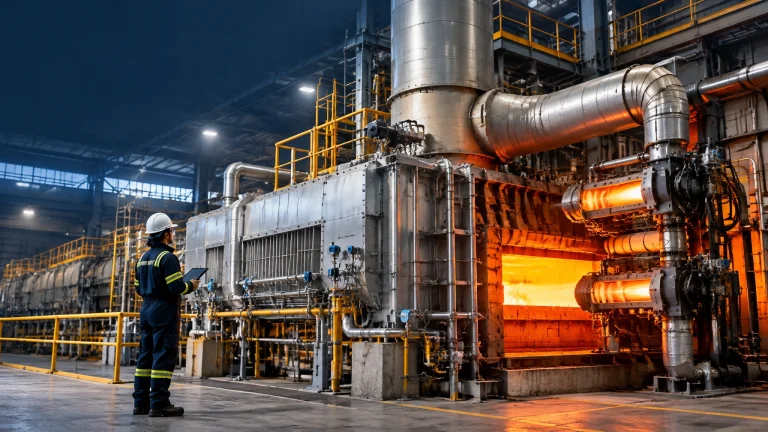
The design must match the product geometry and production route. Long-product mills may use walking-hearth, roller-hearth, or tunnel configurations. Flat-product mills may require covered transfer systems, insulated storage pits, tunnel furnaces, or compact equalization sections.
The correct objective is not simply to “keep steel hot.” It is to deliver a consistent temperature profile at the rolling stand while maintaining production resilience.

Burner zoning must respond to variable charge temperature
A conventional reheating furnace designed for uniformly cold material can perform poorly when hot and cold charges enter the furnace together. The coldest piece often determines furnace speed, forcing already-hot material to remain in the furnace longer than necessary.
Modern thermal processing equipment must therefore include flexible zoning and control logic.
Essential features include:
- Independent control of preheating, heating, and soaking zones
- Variable air-to-fuel ratio control
- Oxygen and furnace-pressure monitoring
- Product-temperature feedback from pyrometers
- Recipe-based control for different grades
- Automatic adjustment for charge-temperature variation
- Low-NOx burner operation where required
- Flue-gas heat recovery and combustion-air preheating
- PLC, SCADA, and MES connectivity
For gas-fired systems, burner zoning must prevent overheating the surface while the core remains cold. Excessive surface temperature increases scale and decarburisation risk. Insufficient soaking creates rolling-load variation, dimensional instability, and metallurgical inconsistency.
For hybrid systems, induction can provide rapid correction after the gas-fired furnace or before the rolling mill. Its approximately 85% equipment-level electrical-to-thermal efficiency makes it particularly valuable for final temperature trimming and variable-grade production.
Managing surface defects, scale, and decarburisation
Scale formation in a conventional gas-fired reheating furnace can consume approximately 0.5–1.0% of slab or billet weight. The financial impact is substantial, especially for high-throughput operations.
Hot charging reduces the time and energy required to reach rolling temperature. Direct rolling reduces exposure further. Induction-assisted heating can also limit oxidation because the heating cycle is shorter and more precisely controlled.
The process-control priorities are clear:
- Minimize unnecessary furnace residence time
- Maintain controlled furnace pressure
- Avoid excessive oxygen and air infiltration
- Use accurate surface and core-temperature models
- Control furnace atmosphere according to steel grade
- Apply descaling at the correct pressure and timing
- Prevent skid marks through uniform support and equalization
- Monitor scale loss as a production KPI, not only a quality issue
The result is improved yield, fewer surface rejections, and better downstream performance in pickling, cold rolling, and coating operations.
Connecting rolling with heat treatment and galvanizing
Caster-to-rolling integration must also consider the finishing route. The temperature and metallurgical history created upstream influence downstream heat treatment furnaces, pickling systems, annealing lines, and coating equipment.
For example:
- Controlled rolling temperatures support more consistent mechanical properties.
- Lower scale reduces acid consumption and improves pickling stability.
- Uniform strip temperature reduces defects during annealing.
- Stable surface quality improves coating performance in a hot dip galvanizing plant.
- Better process data supports traceability and regulatory reporting.
This is especially important for automotive, construction, energy, and wire and cable industry applications, where surface quality and dimensional consistency directly affect customer acceptance.

2026 challenges: scrap quality, labour, energy, and compliance
Integrated CCM/CCR systems must operate under increasingly variable conditions.
Fluctuating scrap quality and chemistry
Mini-mills and recycling-based operations face variation in scrap density, residual elements, moisture, and contamination. A metal recycling furnace or melting furnace for steel must therefore be supported by reliable charge analysis, flexible temperature control, and adaptable rolling recipes.
The same principle applies to non-ferrous production. An aluminum melting furnace must manage changing scrap composition, dross generation, and melt-quality requirements while controlling energy per tonne.
Energy-price volatility
Gas and electricity prices can change the optimal operating mode from one shift to the next. Hybrid gas-electric systems allow the plant to select the lowest-cost and lowest-emission heating mix while maintaining throughput.
Skilled-labour scarcity
Automation is essential, but automation does not remove the need for engineering knowledge. It transfers expertise into standard operating procedures, alarm logic, digital dashboards, predictive maintenance, and robust commissioning documentation.
Decarbonisation and regulatory compliance
Plants must quantify fuel consumption, emissions, waste heat, scale loss, and production yield. Furnace upgrades should therefore be designed with:
- Continuous fuel and oxygen monitoring
- Emissions data logging
- Energy-per-tonne reporting
- Hydrogen-ready burner architecture
- Waste-heat recovery
- Safety interlocks and documented compliance
A practical integration roadmap
Phase 1: Assessment and planning
Measure the existing route before selecting equipment:
- Caster-exit and furnace-entry temperatures
- Transfer time and distance
- Reheating fuel in GJ/t
- Electricity consumption in kWh/t
- Furnace residence time
- Scale loss and saleable yield
- Rolling-mill delays and interruptions
- Grade sequence and chemistry variation
Phase 2: Process synchronization
Coordinate CCM/CCR production planning with furnace and mill schedules.
- Reduce waiting time between casting and reheating.
- Prioritize hot-charge-compatible sequences.
- Establish minimum and maximum temperature windows.
- Create contingency routes for caster or mill stoppages.
- Use insulated transfer and buffer capacity where justified.
Phase 3: Furnace retrofit
Evaluate:
- High-efficiency burners
- Independent burner zoning
- Recuperative or regenerative systems
- Improved refractory and seals
- Temperature measurement upgrades
- Induction booster heating
- Waste-heat recovery
- Hydrogen-ready gas trains and controls
Phase 4: Digital integration and lifecycle support
Connect casting, furnace, rolling, quality, and maintenance data. Maintain critical furnace spare parts, including flame scanners, thermocouples, burner valves, refractory components, PLC modules, drives, bearings, and safety relays.
A furnace that achieves lower fuel consumption but suffers repeated downtime has not delivered true efficiency.
Continental Furnaces: engineering the complete thermal route
A successful CCM-to-rolling project requires more than a furnace supplier. It requires an engineering partner that understands metallurgy, production scheduling, combustion, automation, maintenance, and lifecycle economics.
With more than 35 years of expertise, Continental Furnaces designs customized industrial furnace systems for steel, non-ferrous metals, recycling, galvanizing, heat treatment, and specialized manufacturing operations. Our capabilities include furnace conversion, recycling plant setup, wire plant setup, consulting, retrofit engineering, and responsive service support.

Conclusion: make the caster-to-mill interface a competitive advantage
The 2026 steel plant must treat continuous casting, reheating, rolling, and finishing as one connected thermal system.
The winning sequence is clear:
- Measure the actual temperature and energy baseline.
- Increase hot charging wherever product and layout permit.
- Use buffer and equalization furnaces to manage variability.
- Apply flexible burner zoning and closed-loop temperature control.
- Deploy induction or hybrid heating for precision and lower emissions.
- Link rolling performance with heat treatment and galvanizing quality.
- Protect uptime through predictive maintenance and planned furnace spare parts.
Consult Continental Furnaces to evaluate your CCM/CCR-to-rolling route, define a phased retrofit or new-build plan, and convert lower energy intensity into sustained competitive advantage.