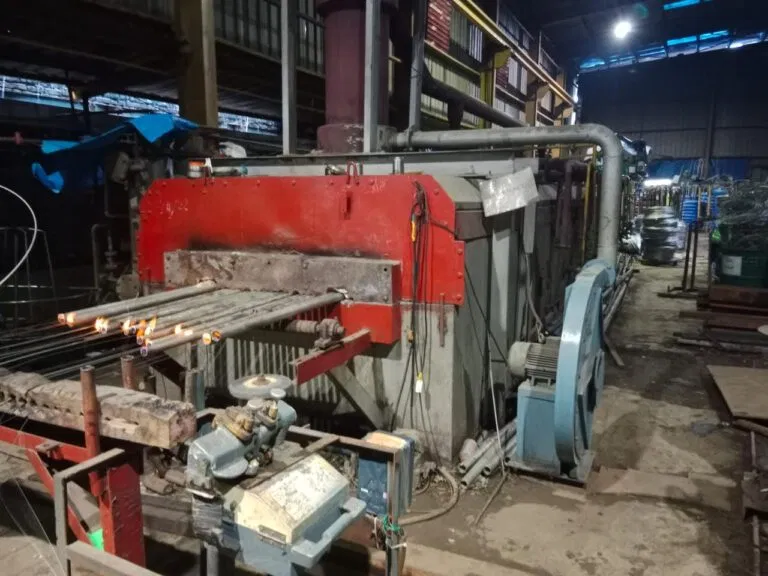
In a modern steel rolling mill, furnace atmosphere is a direct profitability variable. Excess oxygen, uncontrolled air infiltration, poor door sealing and unstable air-to-fuel ratios accelerate oxidation, increase scale loss and compromise downstream surface quality.
The commercial impact is substantial. Steel reheating commonly loses 0.5–2% of heated steel as scale, with higher losses resulting from long residence times, excessive furnace temperature and excess air. For a plant heating 500,000 tonnes annually, a 1% avoidable loss represents 5,000 tonnes of saleable material before accounting for descaling, disposal, maintenance and quality-related costs.
For 2026, atmosphere control is no longer limited to an oxygen analyser on the flue. It is an integrated operating discipline connecting combustion control, furnace pressure, temperature profiles, sealing, process gases, predictive monitoring and the correct furnace spare parts.
Why Atmosphere Control Determines Yield and Surface Quality
Scale forms when hot steel reacts with oxygen-bearing gases, primarily:
- Free oxygen, O₂
- Water vapour, H₂O
- Carbon dioxide, CO₂
- Excess air entering through doors, cracks and damaged seals
The oxidation rate increases sharply with:
- Steel surface temperature, particularly above approximately 760°C
- Residence time at peak temperature
- Oxygen and water-vapour partial pressure
- Furnace pressure fluctuations
- Repeated door openings and production delays
The result is not merely material loss. Heavy or tightly adherent scale can cause:
- Rolled-in scale and surface defects
- Higher descaling and pickling demand
- Non-uniform heating
- Increased furnace-bottom accumulation
- Reduced throughput during cleaning
- Greater wear on rolls, fans, burner blocks and exhaust equipment
- Decarburization of critical steel grades during heat treatment
A practical control objective is to maintain the lowest oxygen level compatible with complete combustion and metallurgical requirements. Industrial references commonly identify approximately 1–1.5% flue-gas O₂ as a useful starting benchmark for controlled reheating zones, compared with historical operation near 3% or higher. Final setpoints must be established from furnace design, fuel composition, steel grade and temperature profile.
The Atmosphere-Control Architecture
1. Oxygen trim and air-to-fuel ratio control
Oxygen-trim systems continuously measure flue-gas oxygen and adjust combustion air. Their value is greatest when they respond to real process variation rather than relying on fixed damper positions.
A modern control architecture should combine:
- Continuous O₂ measurement in suitable flue-gas locations
- Fuel-flow and combustion-air-flow measurement
- Automatic air-to-fuel ratio correction
- Fuel calorific-value compensation where gas quality varies
- Zone-by-zone control rather than one plant-wide setpoint
- Trend recording for oxygen, pressure, temperature and scale indicators
Research and industrial trials indicate that reducing free oxygen from approximately 3% to 1.5% can reduce scale formation by roughly 30–35% when temperature and residence time remain controlled. A China Steel implementation reported average fuel-consumption improvement of 1.292% and an average scale-loss improvement of 0.0321 percentage points across tested reheating furnaces.
2. Furnace pressure and door integrity
Atmosphere control fails when ambient air enters through charging doors, discharge doors, inspection ports or damaged seals. Door openings can create transient oxygen spikes precisely when high-temperature steel is most vulnerable.
A stable pressure-control programme includes:
- Slight positive pressure in conventional combustion zones
- Predictive pressure correction before scheduled door opening
- Correctly balanced exhaust dampers and fans
- Door seals that remain resilient at operating temperature
- Inspection of roller openings, charging apertures and expansion joints
- Pressure trending during charging and discharge cycles
The correct pressure strategy depends on the atmosphere. A conventional oxidizing furnace generally operates slightly positive to prevent infiltration. A deliberately reducing or combustible atmosphere requires a fully engineered pressure and containment approach. It cannot be managed by operator adjustment alone.

Legacy Practice Versus Modern Atmosphere and Scaling Control
| Performance area | Legacy practice | Modern controlled practice |
|---|---|---|
| Air-to-fuel ratio | Fixed manual ratio | Closed-loop oxygen trim with zone correction |
| Flue-gas oxygen | Often 2.5–5% | Common starting benchmark of 1–1.5%, subject to validation |
| Furnace pressure | Reactive damper adjustment | Predictive pressure control during door cycles |
| Scale loss | Typically 0.5–2%, higher during delays | Measured, trended and reduced through atmosphere optimisation |
| Residence time | Long soak used as a quality safeguard | Recipe-based heating with minimum time at peak temperature |
| Burner system | Standard recuperative or conventional firing | Recuperative or regenerative system selected by duty and control range |
| Atmosphere measurement | Periodic checks | Continuous O₂, CO/CO₂, temperature and pressure monitoring |
| Maintenance response | Replace failed components | Condition-based replacement of probes, seals, fans and valves |
| Business result | Yield leakage and variable quality | Higher yield, repeatability and lower cost per tonne |
Recuperative, Regenerative and Low-Oxygen Burner Systems
A recuperative burner transfers heat from exhaust gases to incoming combustion air. It is suitable where stable preheated-air performance, moderate capital complexity and reliable zone control are priorities.
A regenerative burner alternates flow through ceramic storage media and can achieve very high combustion-air preheat. This supports strong thermal efficiency and uniform heat distribution, particularly in high-throughput reheating applications.
Neither technology automatically prevents scale. High air preheat can improve fuel utilisation while still producing excessive oxidation if the final oxygen potential is uncontrolled. Burner selection must therefore consider:
- Required turndown range
- Zone temperature and heat flux
- Combustion-air preheat
- Fuel variability
- Target oxygen concentration
- Door and exhaust configuration
- Product residence time
For specialised heat treatment, low-oxygen or protective atmospheres may be more appropriate than direct-fired combustion. Nitrogen, nitrogen-methanol, exothermic gas and endothermic gas are selected according to the required carbon potential, surface finish and steel grade.
Batch, Continuous and Bright-Annealing Strategies
Batch heat treatment furnaces
Batch systems require disciplined purge, loading and recipe control. Their atmosphere must remain stable through heating, soaking, cooling and door opening. Excessive idle time at temperature is a major source of oxidation and decarburization.
Key practices include:
- Use a defined purge and atmosphere-change sequence
- Match gas flow to actual load and furnace volume
- Avoid unnecessary high-temperature holding
- Verify atmosphere uniformity at representative load locations
- Record oxygen and dew-point trends by recipe
Continuous furnaces
A continuous furnace requires coordinated atmosphere zoning. The preheating zone may tolerate a more oxidizing condition, while heating and soaking zones require tighter oxygen control. Upstream residual fuel or air can materially affect downstream combustion, so each zone must be calculated as part of the total gas-flow system.
Bright annealing for wire and cable
In the wire and cable industry, bright annealing demands an exceptionally clean surface. Nitrogen-hydrogen or other protective atmospheres are used where oxidation must be minimised and brightness, conductivity and drawability must be protected.

Control priorities include:
- Low and stable oxygen ingress
- Correct dew point and gas flow
- Reliable furnace seals around wire entry and exit
- Uniform temperature along the wire path
- Accurate line-speed synchronisation
- Fast detection of probe or flow-control failure
Galvanizing and Melting Applications
In a hot dip galvanizing plant, surface preparation begins before the zinc bath. Excess oxidation in the preheating section increases pickling demand and can interfere with wetting, coating uniformity and adhesion. Atmosphere control should be coordinated with:
- Strip temperature and line speed
- Flux chemistry and moisture management
- Zinc-bath temperature and surface condition
- Air infiltration at entry and exit sections
- Dross generation and coating thickness stability
In an aluminum melting furnace, oxidation appears as bath-surface dross rather than conventional steel scale. Low turbulence, controlled flame impingement, sound furnace sealing and carefully managed oxygen potential protect metal recovery. A dedicated melting furnace for steel requires a different atmosphere strategy, focused on oxidation control, slag behaviour, temperature uniformity and charge chemistry.
Continental Furnaces’ melting furnaces and recycling projects are designed around the specific metal, charge mix, throughput and recovery objective.
Predictive Monitoring and Atmosphere-Related Furnace Spares
Atmosphere-related failures often begin as small deviations:
- A drifting O₂ probe
- A blocked sampling line
- A leaking door seal
- A sluggish control valve
- A fan losing capacity
- A damper failing to reach position
- A pressure transmitter producing unstable readings
These components should be connected to a predictive monitoring programme. Track:
- O₂ and CO/CO₂ trend stability
- Pressure deviation during door opening
- Valve response time
- Fan vibration and static pressure
- Probe calibration drift
- Scale collected per tonne
- Surface-defect frequency
- Yield loss by furnace recipe
Continental Furnaces supplies furnace spares and accessories, including components supporting reliable atmosphere measurement, pressure control and furnace operation.
A Four-Phase Atmosphere-Control Roadmap
Phase 1: Assessment and baseline
Measure current scale loss, oxygen concentration, pressure variation, residence time, fuel consumption and surface-quality rejects. Establish the cost of every lost percentage point of yield.
Phase 2: Control stabilisation
Calibrate analysers, correct air leaks, inspect seals, verify flow meters and establish zone-specific operating windows. Do not reduce oxygen setpoints until combustion completeness and equipment response are confirmed.
Phase 3: Process optimisation
Optimise temperature profiles, residence time, door-cycle pressure and burner operation. Evaluate recuperative or regenerative solutions where the furnace duty justifies the investment.
Phase 4: Predictive operation
Connect atmosphere data to production records. Set alarms for oxygen spikes, pressure instability, probe drift and abnormal scale generation. Review performance by product grade and operating shift.
The Continental Furnaces Advantage
For more than 35 years, Continental Furnaces has engineered customised thermal processing solutions for steel, non-ferrous metals, galvanizing, wire processing and recycling operations. As an experienced industrial furnace manufacturer, we combine furnace design, combustion integration, atmosphere control and lifecycle support into dependable industrial furnace systems.
The objective is clear: protect every tonne of saleable metal, stabilise surface quality and convert atmosphere control into measurable profitability.
Review your furnace with Continental Furnaces through our consulting service, explore heat treatment furnace solutions, or contact our engineering team for a site-specific assessment.
Atmosphere control is an essential step toward sustained competitive advantage. Begin the consultation now.