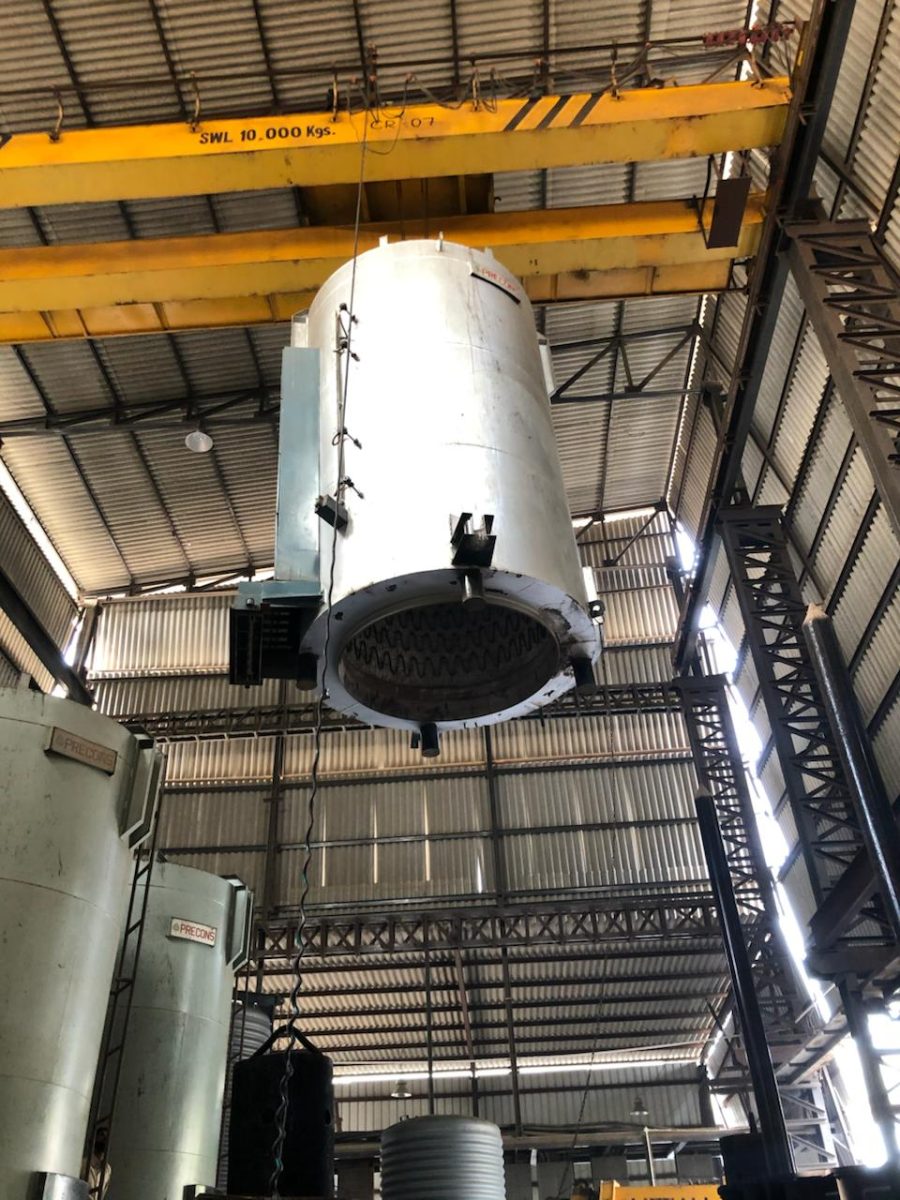
For plant heads and reliability leaders, furnace spare parts are no longer a procurement afterthought. They are a strategic lever for availability, yield, energy performance and regulatory compliance.
A failed burner valve, thermocouple, refractory module or obsolete PLC can stop an entire steel rolling mill, heat treatment line, hot dip galvanizing plant or wire-drawing operation. The financial impact extends beyond repair cost: production losses, delayed dispatches, off-specification material, overtime labour and accelerated equipment damage quickly compound the loss.
In 2026, the leading maintenance strategy is clear: combine asset criticality ranking, condition monitoring, planned shutdowns and OEM-backed lifecycle support into one predictive-spares model.
The Economics of Planned Versus Unplanned Furnace Downtime
Downtime economics vary by industry, product mix and production rate. As a practical planning benchmark:
- A batch heat treatment line may expose a facility to US$2,000–US$10,000 per hour in lost contribution margin.
- A continuous steel rolling mill or high-throughput wire and cable plant can face US$10,000–US$50,000 or more per hour.
- Melt shops using an aluminum melting furnace, melting furnace for steel or metal recycling furnace may also incur scrap, melt-loss and restart costs.
- A critical furnace should generally be managed toward 98–99.5% mechanical availability, depending on process design and redundancy.
These values must be validated against each plant’s actual throughput, margin, energy consumption and contractual obligations. However, they demonstrate why holding a critical spare valued at US$5,000–US$20,000 can be commercially rational when its absence could create a 24–72-hour outage.
| Maintenance model | Typical response | Downtime exposure | Labour profile | Inventory position | Business impact |
|---|---|---|---|---|---|
| Reactive | Repair after failure | 8–72 hours for critical failures | Emergency overtime and specialist call-outs | Low apparent stock, high emergency purchasing | Unstable output, quality risk and high total cost |
| Time-based preventive | Replace at fixed intervals | 2–16 hours planned | Scheduled maintenance team | Often excessive or poorly balanced | Better control, but premature replacement is possible |
| Risk-based planned | Replace according to criticality, condition and lead time | 2–8 hours during coordinated shutdowns | Prepared internal and OEM teams | Optimised min/max stock | Higher availability and predictable maintenance cost |
| Predictive spares model | Forecast failure and reserve parts before the next outage | Designed around planned intervention | Data-led, specialist support | Condition-linked inventory | Maximum uptime with lower obsolescence exposure |
Inventory carrying costs commonly represent 20–30% of annual spare-parts value when capital, storage, insurance, handling and obsolescence are included. The correct objective is not the lowest inventory value. It is the lowest combined cost of inventory ownership plus production interruption.
Phase 1: Rank Furnace Assets and Parts by Criticality
A reliable spares strategy begins with a documented asset hierarchy. Each furnace should be mapped from the complete system level down to replaceable components.
For every furnace, evaluate:
- Production role: bottleneck, standby or non-critical.
- Safety consequence of failure.
- Environmental and emissions-control impact.
- Quality consequence, including temperature uniformity and atmosphere control.
- Mean time between failures and mean time to repair.
- Supplier lead time and availability.
- Interchangeability with other industrial furnace systems.
- Shelf life and obsolescence risk.
- Requirement for specialist installation or commissioning.
A practical classification is:
Class A: Mission-critical components
These parts can stop production, compromise safety or cause major quality losses:
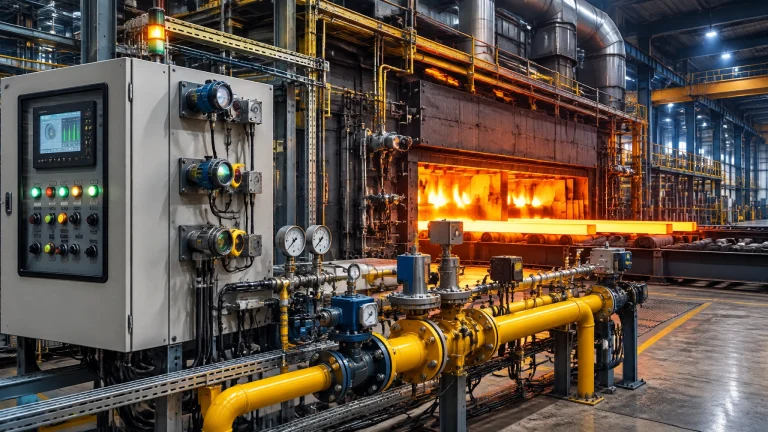
- Main burners and burner management components.
- Gas trains, safety shut-off valves and flame scanners.
- Critical thermocouples and temperature controllers.
- Hot-face refractory modules and burner tiles.
- Recuperator cores, tubes and specialist seals.
- PLC CPUs, HMI units, communication modules and proprietary control cards.
Stocking policy: on-site spare, pre-kitted rebuild set or vendor-managed inventory with a confirmed emergency response.
Class B: Important operating components
These parts reduce efficiency or restrict output but may not stop the furnace immediately:
- Secondary burners.
- Fans, belts and motor components.
- Insulation panels and door seals.
- Non-critical sensors.
- Standard relays, contactors and pneumatic components.
Stocking policy: controlled min/max levels with scheduled replenishment.
Class C: Standard consumables
These are widely available and normally replaceable during routine maintenance:
- Fasteners and gaskets.
- Standard cables and fittings.
- General-purpose electrical accessories.
- Non-specialist mechanical hardware.
Stocking policy: low local inventory or framework agreement with approved suppliers.
Component-Specific Replacement Strategy
Burners and Combustion Systems
Burner performance directly affects energy consumption, temperature uniformity and emissions. A deteriorating burner may continue operating while producing an unstable flame, poor air-fuel ratio or localized overheating.
Recommended controls include:
- Daily or weekly review of flame stability, gas pressure and alarm history.
- Monthly inspection of burner nozzles, pilots, flame scanners and connections.
- Quarterly combustion analysis and air-fuel ratio verification.
- Annual burner tuning and inspection of fans, valves and actuators.
- Planned overhaul typically every 2–4 years, depending on fuel quality, duty cycle and operating temperature.
Maintain a complete burner rebuild kit for each bottleneck furnace. Standardizing burner families across multiple furnaces can reduce inventory variety and improve technician familiarity.

Refractory and Insulation
Refractory failure is rarely instantaneous. Cracking, spalling, moisture penetration and hot spots usually develop progressively.
A 2026 refractory-monitoring programme should combine:
- Monthly visual inspection where access is safe.
- Infrared thermography at defined measurement points.
- Furnace-shell temperature trending.
- Inspection of burner tiles and high-wear zones during every planned outage.
- Historical tracking of repair areas and relining intervals.
For planning purposes, hot-face repairs may be required annually in severe service, while major relining intervals can range from 3–7 years. These are starting benchmarks, not fixed guarantees. Process chemistry, thermal cycling, mechanical impact and operator practice determine actual life.
Pre-kit refractory shapes, anchors, castable, insulation and installation hardware before a shutdown. This avoids extending an outage while materials are sourced.
Thermocouples and Temperature Sensors
A failed thermocouple can stop a furnace, degrade metallurgical quality or create a false sense of process stability. Maintain multiple calibrated spares for critical zones.
Monitor:
- Calibration drift.
- Response time.
- Noise and intermittent readings.
- Difference between redundant sensors.
- Number of heat cycles and operating hours.
A replacement interval of 6–18 months may be appropriate for heavily exposed sensors, while protected or redundant sensors may operate longer. The correct trigger is the combination of drift, condition and process consequence, not the calendar alone.
Recuperators and Heat-Recovery Equipment
Recuperators influence fuel consumption, exhaust temperature and overall thermal efficiency. Monitor:
- Inlet and outlet air or flue-gas temperature.
- Pressure drop.
- Heat-transfer effectiveness.
- Fouling and plugging indicators.
- Leakage and casing condition.
A rising pressure drop combined with falling outlet temperature is a clear reason to plan inspection. Major recuperator elements can have 8–16-week lead times, with custom assemblies requiring longer. For high-consequence equipment, maintain replacement cores, tubes or seals through an OEM-backed agreement.
Obsolescence Management for Legacy Controls
Legacy PLCs, HMIs, drives, flame controllers and proprietary electronic modules represent one of the highest lifecycle risks in older industrial furnace systems. A component may still function yet become impossible to source within weeks of failure.
A robust 2026 obsolescence programme should include:
-
Create a control-system register
Record manufacturer, model, firmware, revision, installed quantity and current supplier status. -
Identify end-of-life exposure
Flag components with discontinued production, limited technical support or long lead times. -
Protect critical data
Back up PLC logic, HMI projects, parameter sets, alarm databases and electrical drawings. -
Standardise retrofit platforms
Where practical, use common PLC, HMI, sensor and communication families across the site. -
Design retrofit-ready panels
Allow spare DIN-rail capacity, accessible terminals, modular I/O and clear cable identification. -
Plan migration during a controlled outage
Do not wait for a failed control card to become the first stage of an emergency automation project.
A retrofit should preserve validated furnace recipes, interlocks, safety functions and production records. It must also be verified against applicable electrical, combustion and process-safety requirements.
The ISO 55000 asset management family provides a useful framework for aligning equipment risk, lifecycle value and business objectives.
Phase 2: Build a Predictive-Spares Model
Condition monitoring converts spare-parts planning from a static warehouse exercise into a forward-looking operational system.
Connect furnace data to the CMMS or maintenance platform, including:
- Burner pressure and flame signals.
- Motor vibration and current.
- Shell temperature and infrared images.
- Thermocouple drift.
- Recuperator pressure drop.
- Gas consumption per production unit.
- Furnace cycle count and operating hours.
- Alarm frequency and reset history.
- Part consumption by asset and failure mode.
The target is to forecast a replacement window 3–6 months ahead, then align purchasing with the next planned outage. Industry guidance on predictive maintenance, including the IBM overview of predictive maintenance, supports this shift from failure response to condition-led intervention.
Key 2026 KPI targets should include:
- 98–99.5% availability for critical furnaces.
- 95% or higher planned-maintenance compliance.
- Less than 5% emergency work on critical thermal assets.
- 20–30% lower excess inventory after part standardisation and data cleansing.
- 100% documented obsolescence status for safety and control components.
- Zero critical spare shortages during planned shutdowns.
Phase 3: Establish OEM-Backed Lifecycle Support
Spares strategy is strongest when the original equipment manufacturer remains involved throughout the asset lifecycle. An experienced industrial furnace manufacturer understands the interaction between combustion, refractory, temperature control, atmosphere, material handling and production quality.
Continental Furnaces supports customers with:
- OEM-quality furnace spares and accessories.
- Customised heat treatment furnaces.
- Melting furnaces and recycling projects.
- Solutions for steel, non-ferrous metals and the circular economy.
- Technical assessment and consulting support.
- Retrofit planning for legacy controls and combustion systems.
- Prompt service designed to minimise production interruption.
The same lifecycle discipline applies across a steel rolling mill, aluminum melting furnace, metal recycling furnace, hot dip galvanizing plant or wire and cable industry production line. Each operation requires a different duty profile, but every operation benefits from the same fundamentals: risk-based stocking, condition-led maintenance and verified component compatibility.
The 2026 Maintenance Roadmap
Phase 1: Assessment and Planning, 0 to 30 days
- Map all furnaces and associated thermal processing equipment.
- Calculate actual downtime cost per hour.
- Rank assets and components by criticality.
- Audit existing inventory, part numbers and supplier lead times.
- Identify obsolete PLCs, HMIs, burners and sensors.
Phase 2: Risk Reduction, 31 to 90 days
- Purchase Class A critical spares.
- Create burner, refractory and thermocouple maintenance kits.
- Back up control-system software and documentation.
- Define inspection routes and alarm thresholds.
- Establish minimum, maximum and reorder levels.
Phase 3: Predictive Integration, 91 to 180 days
- Connect condition data to the CMMS.
- Trend combustion, vibration, temperature and recuperator performance.
- Forecast replacement demand before planned outages.
- Standardise interchangeable components.
- Review supplier agreements and emergency-response commitments.
Phase 4: Lifecycle Optimisation, 6 to 12 months
- Measure availability, MTBF, MTTR and emergency-work percentage.
- Reduce excess stock without weakening critical coverage.
- Schedule retrofit projects for obsolete systems.
- Conduct quarterly OEM performance reviews.
- Update the spares strategy from real failure and consumption data.
Secure Uptime Before the Next Failure
A furnace spare-parts strategy is an investment in sustained production, not a warehouse expense. The plants that outperform in 2026 will be those that connect criticality ranking, predictive condition monitoring, retrofit planning and OEM expertise before a failure creates commercial pressure.
Request a furnace spares audit from Continental Furnaces and review your critical burners, refractory, thermocouples, recuperators, controls and long-lead components with an experienced engineering team. Take this step now to protect uptime, improve lifecycle profitability and build a sustained competitive advantage.