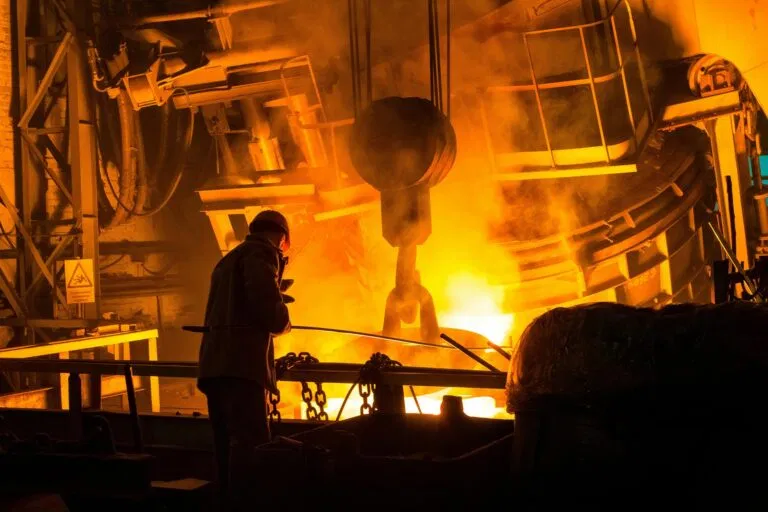
The 2026 agenda for non-ferrous and surface-treatment operations is defined by five commercial priorities: lower specific energy consumption, higher material yield, emissions compliance, Industry 4.0 visibility, and maximum uptime.
For aluminum producers, recyclers, galvanizing lines, and the wire and cable industry, modern thermal processing equipment is no longer a standalone utility function. It is a strategic production system that determines cost per tonne, coating quality, metallurgical consistency, and customer acceptance.
The same principle applies across the wider metals landscape. A steel rolling mill, a non-ferrous casting facility, and a surface-treatment plant all depend on controlled temperature, reliable material movement, robust refractory design, and responsive service support.
As an industrial furnace manufacturer with more than 35 years of engineering experience, Continental Furnaces approaches this agenda as a consultant-partner: combining customized design, energy-efficient technology, ISO-certified quality, and prompt lifecycle support.
The 2026 operating challenge: energy, emissions, and uptime
Energy cost volatility is forcing plant directors to measure furnace performance more rigorously. Fuel consumption must be evaluated against actual throughput rather than rated furnace capacity.
At the broader steel-industry level, the World Steel Association’s energy-use data reports 2024 average energy intensity of approximately 20.95 GJ per tonne of crude steel, with scrap-EAF production near 9.84 GJ/t. These figures do not replace a plant-level audit, but they demonstrate the scale of the efficiency gap between production routes.
Key performance indicators for 2026 include:
- Specific energy consumption in kWh/t, MJ/t, or GJ/t
- Melt loss, dross generation, and scale formation
- Furnace availability and mean time between failures
- Temperature uniformity across the working zone
- Burner efficiency, excess oxygen, and flue-gas temperature
- CO₂, NOx, SOx, and particulate emissions
- Product rejection and rework rates
- Planned versus unplanned downtime
- Critical spare-part availability
A furnace that reaches temperature but consumes excessive energy or creates inconsistent metal is not performing competitively.
Modern aluminum melting furnaces: the efficiency benchmark
Aluminum melting is especially sensitive to oxidation, dross formation, holding time, and charge quality. A modern aluminum melting furnace must therefore deliver more than high heat output. It must protect metal yield while maintaining stable temperature for casting, extrusion, or downstream forming.
For 2026 planning, practical benchmark ranges for aluminum melting are:
- 500–650 kWh/t: good practice for a well-optimized regenerative, shaft, or heat-recovery gas furnace
- Around 500–550 kWh/t: strong target for modern induction or high-efficiency systems, depending on process conditions
- Above 700 kWh/t: clear indication of potential improvement in insulation, combustion, charge preparation, or holding discipline
- 1–2% melt loss: achievable benchmark for optimized recycling systems with suitable charge preparation
- Approximately 660–760°C: common operating region for aluminum melting and holding, depending on alloy and process specification
The theoretical energy required to heat and melt aluminum is substantially lower than actual plant consumption. The difference is lost through flue gas, furnace walls, open doors, poor charge preparation, excessive holding, and inefficient combustion.
Technology priorities for aluminum operations
A high-performance furnace project should evaluate:
- Separate melting and holding chambers
- Recuperative or regenerative burners
- High-quality refractory and insulation systems
- Automated charging and tilting mechanisms
- Closed-loop temperature control
- Dross-reduction practices
- Flue-gas heat recovery
- Real-time kWh/t or fuel-per-tonne monitoring
- Alloy recipe and charge tracking
Continental Furnaces’ aluminum melting and holding furnace solutions are engineered around production capacity, alloy requirements, fuel availability, temperature control, and automation compatibility.
Metal recycling furnace systems and the circular economy
The circular economy is now a direct profitability strategy. Every tonne of recovered metal can reduce virgin-material dependence, disposal expense, and supply-chain exposure.
A properly specified metal recycling furnace must be matched to the characteristics of the scrap stream. Clean aluminum returns, coated scrap, mixed non-ferrous scrap, lead-bearing materials, and steel scrap each impose different requirements for combustion, refractory selection, pollution control, charging, and tapping.
| Performance area | Traditional recycling operation | Modern recycling furnace system |
|---|---|---|
| Charge preparation | Variable scrap quality and manual sorting | Defined charge recipes and contamination control |
| Energy use | Often above 700–1,000 kWh/t for inefficient aluminum systems | Target range of approximately 500–650 kWh/t for optimized systems |
| Melt loss | Higher oxidation and dross formation | Improved yield through controlled atmosphere and shorter holding |
| Emissions | Limited monitoring and unstable combustion | Low-NOx burners, exhaust control, and digital records |
| Labour | Manual charging, temperature checks, and tapping | Mechanized handling and PLC-assisted operation |
| Maintenance | Reactive refractory and burner replacement | Condition-based maintenance and planned interventions |
| Business result | Unpredictable cost per tonne | Higher recovery, traceability, and profitability |
The correct solution is not always a new furnace. In many plants, the fastest gains come from a structured upgrade involving burner tuning, insulation renewal, charge preheating, improved extraction, and digital monitoring.
Hot-dip galvanizing: surface treatment becomes a thermal-control discipline
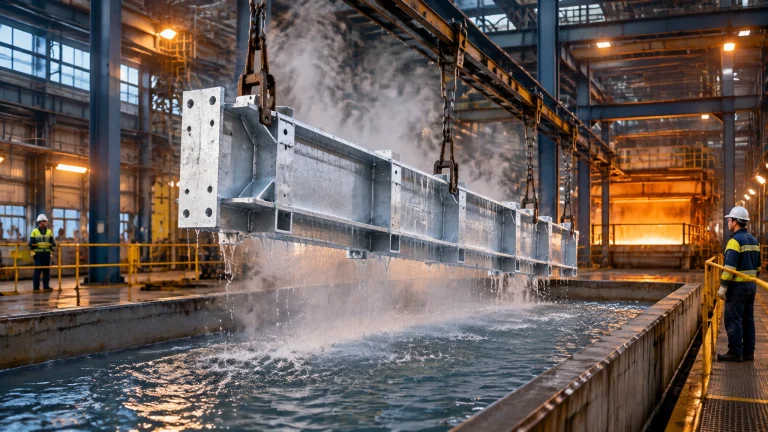
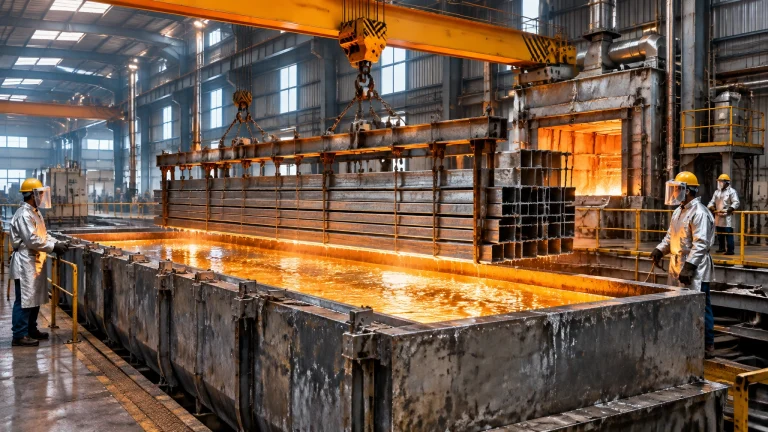
A hot dip galvanizing plant is a connected process rather than a single zinc bath. Pre-treatment, rinsing, fluxing, drying, galvanizing, wiping, cooling, and finishing must work as one controlled sequence.
Typical zinc-bath operation is maintained near 445–465°C, subject to coating specification, steel chemistry, bath composition, line speed, and product geometry. Stability in this range supports consistent coating formation while avoiding unnecessary zinc consumption and thermal fluctuation.
Operational priorities include:
- Uniform preheating and drying before immersion
- Stable zinc-bath temperature
- Accurate line-speed and immersion-time control
- Effective fume extraction and environmental control
- Reliable bath heating and insulation
- Controlled coating thickness
- Safe handling of ash, dross, and process chemicals
- Accessible maintenance points and critical components

Continental Furnaces provides hot-dip galvanizing plant solutions designed around product dimensions, throughput, bath capacity, fuel system, fume-management requirements, and available plant space.
Wire and cable industry: precision at continuous line speed
The wire and cable industry faces a different thermal challenge: the process must remain stable while material moves continuously through the line.
For steel wire, copper wire, aluminum wire, and coated products, thermal variation can affect:
- Tensile strength
- Elongation
- Conductivity
- Surface finish
- Coating adhesion
- Dimensional consistency
- Tension stability
- Downstream drawing performance
Vertical annealing furnaces, bell furnaces, continuous annealing systems, galvanizing lines, tinning lines, and wire-coating plants require coordinated control of temperature, atmosphere, line speed, and material tension.

The priority is not simply faster throughput. It is repeatable throughput with documented process control. Industry 4.0 controls can record each production recipe, alarm condition, temperature trend, and maintenance event, giving plant managers the evidence required for quality assurance and regulatory compliance.
Connecting non-ferrous systems with the steel-processing landscape
Investment in non-ferrous thermal systems should not be isolated from the wider plant strategy. Many manufacturers operate multiple thermal assets, including:
- A melting furnace for steel or induction melting unit
- Billet reheating systems
- Continuous or batch heat treatment furnaces
- Galvanizing and pickling plants
- Wire annealing and coating lines
- Ingot casting and recycling equipment
- Cooling, handling, and extraction systems
For example, a steel rolling mill can reduce total energy intensity by synchronizing billet charging, reheating residence time, rolling demand, and maintenance planning. Billet reheating commonly requires approximately 1,200–1,250°C, but the commercial objective is not the highest furnace temperature. It is uniform heating with minimum scale and minimum residence time.
This is where integrated industrial furnace systems deliver a quantum leap over isolated equipment decisions.
The 2026 modernization roadmap
Phase 1: Assessment and planning
Start with a complete thermal and production audit:
- Record fuel or electricity consumption by tonne
- Measure flue-gas temperature and oxygen levels
- Map temperature uniformity and hot spots
- Review dross, scale, and rejection rates
- Quantify planned and unplanned downtime
- Inspect refractory, burners, heating elements, and doors
- Review existing PLC, SCADA, and data-logging capability
Phase 2: Engineering and technology selection
Develop a performance specification linked to business outcomes:
- Define target energy consumption
- Select furnace type, capacity, and fuel system
- Specify heat recovery and emission-control requirements
- Integrate charging, tapping, coating, or wire-handling systems
- Build safety interlocks and operator access into the design
- Identify critical furnace spare parts before commissioning
Phase 3: Installation and validation
Installation should be coordinated with planned shutdowns to protect production continuity. Commissioning must verify:
- Thermal profile and uniformity
- Combustion stability and air-fuel ratio
- Temperature response and cycle repeatability
- Mechanical handling and line synchronization
- Safety systems and emergency shutdowns
- Product quality at defined production rates
- Actual energy consumption against the baseline
Phase 4: Continuous improvement
After commissioning, weekly KPI reviews should track energy, yield, uptime, emissions, and maintenance performance. A critical inventory of furnace spare parts and accessories should cover burners, heating elements, thermocouples, seals, refractories, sensors, drives, and control components.
Prompt service is a production asset. The right component, delivered at the right time, can prevent a short maintenance intervention from becoming a multi-day shutdown.
Continental Furnaces: an enduring engineering partnership
The 2026 non-ferrous and surface-treatment agenda is decisive: energy efficiency, circular production, digital control, regulatory compliance, and uptime must be engineered together.
Continental Furnaces brings more than 35 years of expertise, ISO-certified quality systems, customized engineering, and responsive service support to aluminum melting, metal recycling, galvanizing, wire processing, heat treatment, steel rolling, and allied applications.
Review your present energy intensity, yield losses, emissions profile, and downtime exposure with an experienced industrial furnace manufacturer. Contact Continental Furnaces to begin a practical modernization roadmap and convert thermal performance into sustained competitive advantage.