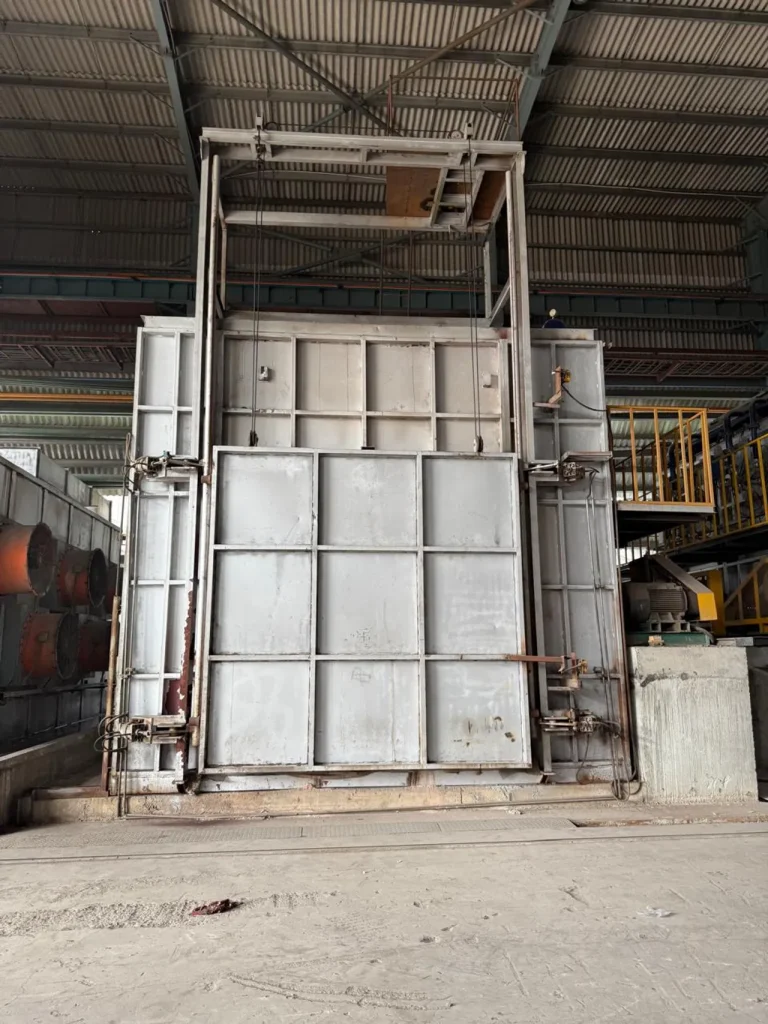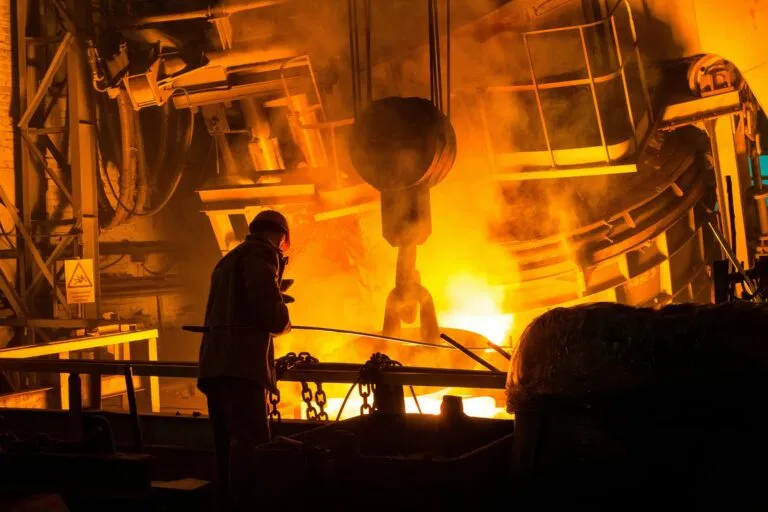
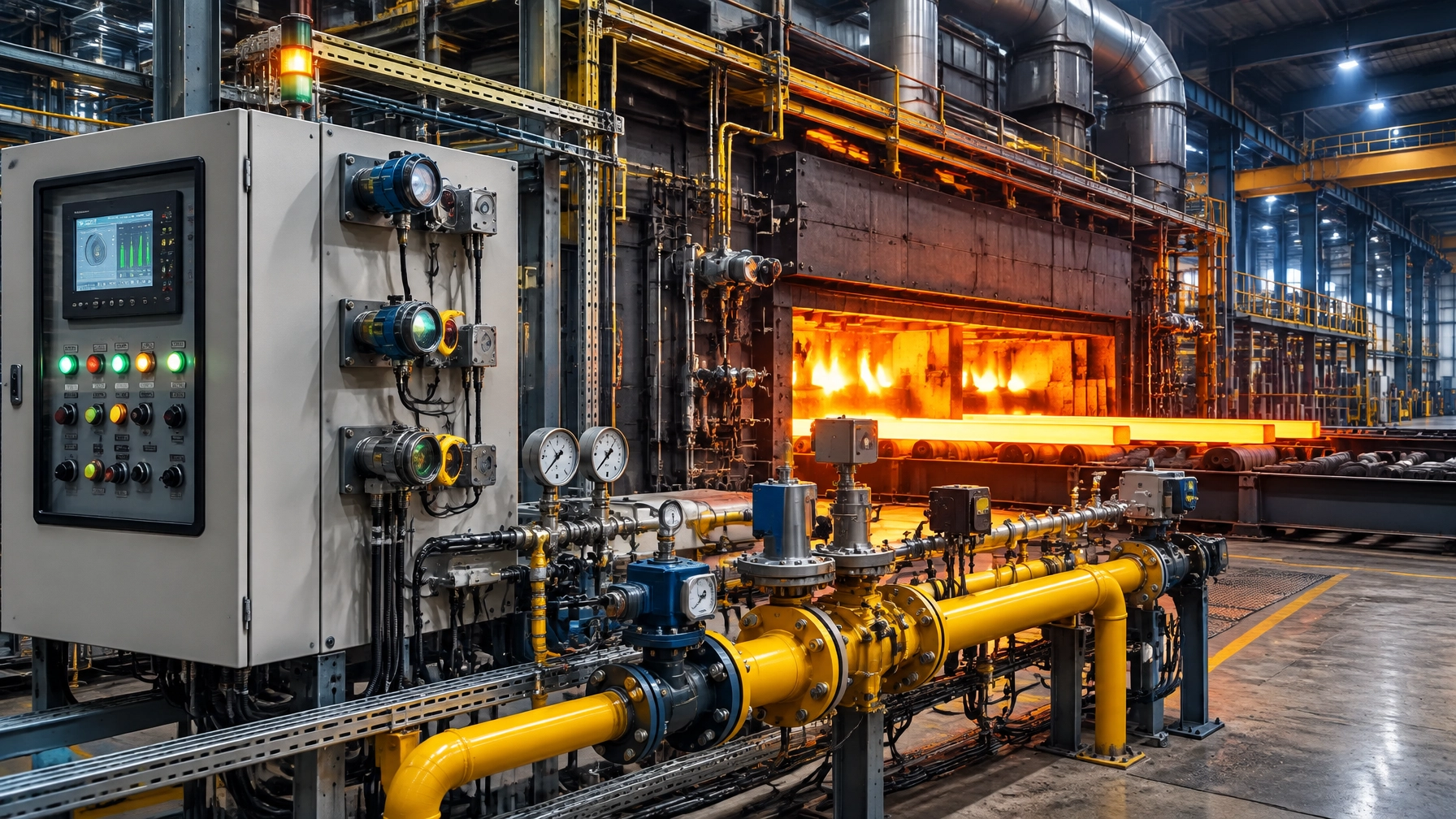
In 2026, furnace safety is no longer only a compliance obligation. It is an uptime, insurance and profitability strategy.
A burner trip on a steel rolling mill can interrupt material flow, create restart losses and disrupt downstream production. On a continuous galvanizing line, a combustion fault can affect strip temperature, coating consistency and delivery commitments. In a heat treatment operation, an unsafe ignition sequence can place personnel, equipment and production assets at risk.
For plant managers and maintenance leaders, the objective is clear: establish a combustion system that is safe by design, demonstrably compliant and stable across the full operating range.
This requires disciplined burner management, verified flame supervision, correctly engineered purge cycles, accurate combustion tuning and a documented lifecycle support plan.
Important: NFPA 86 and EN 746-style requirements must be applied according to the equipment classification, jurisdiction, adopted edition and authority having jurisdiction. A qualified combustion-safety engineer should approve final setpoints, logic, hardware and commissioning procedures.
Why Combustion Safety Is an Operations and Cost Issue
A furnace does not need to experience a major incident to create financial exposure. Repeated nuisance trips, unstable flames and unreliable safety components generate costs through:
- Lost production and delayed dispatches
- Scrap, rework and off-specification material
- Excessive fuel consumption during unstable operation
- Emergency contractor and component procurement
- Extended restart and purge times
- Insurance inspections, audit findings and corrective-action requirements
- Unplanned stress on refractory, burners, fans and fuel trains
The commercial value of a modern burner management system (BMS) is therefore measured in more than protection against fire or explosion. Stable combustion improves energy consumed per tonne, process availability and confidence during audits.
In a well-engineered installation, the BMS remains separate from normal temperature and production control. The process PLC or DCS manages recipes, zone temperatures, line speed and production sequencing. The BMS manages the safety envelope: permissives, purge, ignition, flame supervision, fuel isolation and emergency shutdown.
The BMS Safety Chain: What Must Be Proven
A robust industrial furnace system should verify each condition before fuel is admitted. Typical permissives include:
- Combustion-air fan operation and airflow
- Fuel pressure within the approved range
- Furnace or combustion-chamber pressure
- Exhaust or flue-gas path availability
- Safety shutoff valve position and proof of closure
- Flame scanner health and safe-start status
- High-temperature limit status
- Emergency-stop and master fuel-trip circuit status
- Correct damper and burner position
The sequence then follows a controlled order:
- Pre-start checks confirm that no unsafe flame or fuel condition exists.
- Pre-ignition purge clears residual fuel or combustible atmosphere.
- The pilot or igniter is energized for a defined trial-for-ignition period.
- The flame detector proves the pilot or main flame.
- The main fuel valve opens only after the required permissives are satisfied.
- The burner stabilizes at low fire before modulation.
- Any flame failure, airflow loss or critical interlock trip causes automatic fuel isolation and lockout.
NFPA 86 committee materials describe pre-ignition purge as a fundamental safeguard and reference the introduction of at least four system volumes of fresh air or inert gas during the purging cycle. The actual purge duration must be calculated from furnace volume, verified airflow and the specific heating-system design; it must never be selected as an arbitrary timer.
Flame Monitoring for Long Burner Arrays
Flame monitoring is particularly important in a steel rolling mill, where wide furnaces may use multiple burners across several heating zones. It is equally important in continuous annealing and galvanizing equipment, where long line or radiant burners can experience shadowing, turbulence and uneven flame propagation.
Common detection technologies include:
- UV flame scanners for strong response to ultraviolet radiation
- IR scanners for flame flicker and infrared energy
- Flame rods using flame rectification for suitable burner geometries
- Multi-spectrum detectors where fuel composition or flame visibility changes
The detector must suit the burner, fuel, furnace atmosphere and optical conditions. Hydrogen-containing fuels can produce less luminous flames than conventional natural gas, making detector selection and field validation essential.
For long line burners, safety design should address:
- Flame detection at the end of the assembly farthest from the ignition source
- Verified flame propagation across the complete burner length
- Independent supervision of zones or burner groups
- Protection against scanner contamination, heat and vibration
- Correct scanner sighting, shielding and self-check functionality
- A defined flame-failure response time, commonly engineered toward approximately 2 seconds for high-input systems where permitted by the approved design
A scanner that is installed but poorly aimed is not a safety system. Commissioning must verify detection under minimum fire, maximum fire, low-load, hot-furnace and abnormal operating conditions.

Combustion Tuning: Efficiency Without Compromising Safety
Combustion tuning must never defeat a safety permissive. The correct approach is to place optimization inside a protected operating envelope.
Key tuning variables include:
- Fuel pressure and fuel-train stability
- Combustion-air pressure and flow
- Air-to-fuel ratio across the firing range
- Furnace pressure and draft
- Exhaust oxygen and carbon-monoxide trends
- Burner turndown and low-fire stability
- Zone-to-zone temperature balance
- Fuel quality and composition changes
For many fuel-fired applications, an exhaust oxygen target in the range of 2–4% is used as an initial engineering reference. The final value depends on burner design, furnace atmosphere, infiltration, product loading and emissions requirements. A low oxygen reading is not automatically efficient; it can indicate incomplete combustion, unstable firing or insufficient excess air.
| Operating area | Traditional practice | Controlled 2026 approach |
|---|---|---|
| Burner start-up | Manual sequencing and operator judgment | Automated permissives, purge and trial-for-ignition logic |
| Flame supervision | Limited visual observation | Continuous scanner-based monitoring with lockout |
| Fuel response | Fixed settings or manual adjustment | Modulating ratio control with defined safe limits |
| Safety logic | General-purpose controls | Listed combustion safeguard or suitable SIL-capable safety architecture |
| Fault finding | Delayed troubleshooting | First-out diagnostics and documented trip history |
| Maintenance | Replace after failure | Test, calibrate and renew safety-critical devices to schedule |
| Business impact | Higher restart risk and variable fuel use | Better uptime, audit readiness and energy per tonne |
The benefit is not simply a lower fuel bill. Stable combustion reduces thermal variation, prevents avoidable trips and protects production yield.
Fuel Flexibility: Natural Gas, LPG and Hydrogen Blending
Many plants are evaluating natural gas, LPG, mixed-gas operation or hydrogen blending. Fuel flexibility is valuable, but it changes the combustion risk profile.
Before introducing a new fuel or blend, the engineering review should assess:
- Flammability limits and ignition characteristics
- Flame speed and flashback risk
- Burner port velocity and mixing arrangement
- Pressure regulator, valve, seal and gasket compatibility
- Flame-detector response
- NOx formation and emissions limits
- Fuel-train venting and overpressure protection
- Purge and ignition timing
- Required Process Hazard Analysis (PHA)
NFPA 86 development materials specifically identify additional considerations for hydrogen gas and hydrogen mixtures, including piping requirements and equipment-enclosure protection. One proposal also addresses limitations on mixing blowers for fuel gases containing more than 10% free hydrogen; because code language and adoption status can change, every project must verify the applicable final edition and local requirements before procurement.
The safe principle is straightforward: a fuel change is a combustion-system change, not merely a fuel-supply adjustment.
Application Across Industrial Furnace Systems
Steel rolling mills
Reheat furnaces require reliable ignition, stable zone control and fast recovery from abnormal conditions. A properly engineered BMS prevents fuel admission when airflow, flame or pressure conditions are not proven.
Heat treatment furnaces
Batch and continuous heat treatment furnaces require repeatable start-up and shutdown sequences. Flame supervision protects both the equipment and the material recipe, particularly during low-load cycles and frequent production changeovers.
Melting and recycling operations
A melting furnace for steel, an aluminum melting furnace and a metal recycling furnace must manage high heat input, variable charge conditions and demanding operator environments. Fuel isolation, airflow proving and flame failure response are essential around charging, holding and pouring operations.

Hot dip galvanizing plants
A hot dip galvanizing plant may include preheating, annealing, atmosphere control and zinc-pot heating systems. Combustion reliability directly supports strip temperature stability and coating-line continuity. Long burners require particular attention to scanner placement, propagation and zone isolation.
Wire and cable industry
The wire and cable industry depends on consistent thermal processing across continuous lines. Burner trips can damage throughput and create coil-handling disruption. Safety controls should be integrated with line-stop logic without allowing production controls to override the BMS.
A Practical 2026 Safety Roadmap
Phase 1: Assessment and documentation
- List every burner, fuel train, scanner, valve and interlock.
- Identify the applicable NFPA 86, EN 746-2 and local requirements.
- Review cause-and-effect logic and trip history.
- Confirm furnace classification and explosion-control provisions.
- Record current fuel consumption per tonne and restart duration.
Phase 2: Engineering and risk reduction
- Separate process control from combustion safety logic.
- Verify purge calculations and airflow measurement.
- Reassess scanner technology and sighting.
- Confirm valve proving, proof-of-closure and leakage-test provisions.
- Complete a PHA for new fuels, unusual atmospheres or modified processes.
- Select listed or appropriately certified safety components.
Phase 3: Commissioning and validation
- Test every permissive individually.
- Test flame failure at minimum and maximum firing rates.
- Verify automatic fuel isolation and manual reset requirements.
- Confirm purge airflow, duration and interlock operation.
- Record trip cause, response time and corrective action.
- Train operators and maintenance personnel using written procedures.
Phase 4: Lifecycle support
A safety-critical component should never be replaced with an unverified substitute simply because it is available faster. Genuine furnace spare parts preserve compatibility with the original burner, scanner, valve train and control philosophy.
Continental Furnaces supports customers with OEM-quality components, engineering guidance and prompt service to reduce downtime and keep safety systems current.
The 2026 Direction: Safer, More Measurable Combustion
The next generation of thermal processing equipment will combine:
- Digital combustion monitoring and first-out diagnostics
- Fuel-flexible burner platforms
- Hydrogen-blend validation
- Electrification where process conditions permit
- Energy-performance tracking aligned with ISO 50001-style management principles
- Secure integration between BMS, PLC, DCS and plant reporting systems
- Formal audit trails for testing, calibration and corrective action
Safety and efficiency are not opposing objectives. A correctly tuned and correctly protected combustion system delivers both.
As an experienced industrial furnace manufacturer, Continental Furnaces works with plant managers and maintenance teams to engineer safer, more reliable industrial furnace systems across rolling mills, heat treatment, melting, recycling, galvanizing and wire processing.
Review your furnace safety chain before the next trip becomes an outage. Speak with Continental Furnaces engineers about BMS assessment, combustion tuning, fuel-flexibility planning, genuine spares and lifecycle support: an essential step toward sustained competitive advantage.
Technical References
- NFPA 86 development materials and public input
- Emerson: Modern Burner Management Control and Optimization
- Continental Furnaces Heat Treatment Furnaces
- Continental Furnaces Melting Furnaces and Recycling Projects
- Continental Furnaces Hot Dip Galvanizing Plant Gallery
- Continental Furnaces Furnace Spares and Accessories