Published: 18 September 2026
For industrial furnace operators, reliability is no longer measured only by whether a furnace starts each morning. The decisive question is whether the complete thermal process can sustain stable temperature, predictable throughput, metallurgical quality, and safe operation without unplanned interruption.
In 2026, condition-based maintenance, Industrial Internet of Things (IIoT) sensor architecture, edge analytics, and digital twins are transforming how plants manage critical thermal assets. These technologies enable maintenance teams to identify developing faults before they become production stoppages.
For a steel rolling mill, hot dip galvanizing plant, or wire and cable industry production line, this represents a quantum leap from reactive maintenance to risk-based reliability engineering.
Why traditional furnace maintenance is no longer sufficient
Reactive maintenance waits for failure. Calendar-based maintenance replaces components according to elapsed time, regardless of their actual condition. Both approaches create avoidable cost.
A burner, thermocouple, cooling pump, refractory zone, drive, fan, or heating element may fail earlier than expected: or continue operating well beyond its scheduled replacement date. Without condition data, maintenance teams are forced to choose between excessive intervention and unacceptable risk.
The consequences include:
- Unplanned furnace shutdowns and lost production hours
- Emergency procurement of critical furnace spare parts
- Premature replacement of serviceable components
- Secondary damage to refractory, controls, or handling systems
- Increased safety exposure during urgent repairs
- Quality variation caused by unstable thermal profiles
- Higher maintenance labour requirements
- Weak evidence for ISO, customer, and regulatory audits
A modern reliability programme replaces assumptions with measured asset health.
The 2026 predictive-maintenance architecture
A reliable digital maintenance programme combines four layers: sensing, connectivity, analytics, and action.
1. IIoT sensor architecture
The sensor network must be designed around failure modes rather than installed as a collection of disconnected devices. Typical monitoring points include:
- Thermocouples and temperature transmitters across heating, soaking, cooling, and exhaust zones
- Fixed or mobile infrared cameras for shell hot spots and refractory degradation
- Vibration sensors on fans, blowers, pumps, gearboxes, drives, and material-handling equipment
- Pressure, flow, and differential-pressure sensors on combustion and cooling circuits
- Electrical-current and power-quality monitoring for heating elements, motors, and induction equipment
- Acoustic sensors for leaks, cavitation, mechanical impact, and abnormal combustion
- Door-position, line-speed, tension, and cycle-state signals
- Refractory thickness measurements from ultrasonic inspection or planned surveys
In a heat treatment furnace, the objective is to detect temperature non-uniformity, fan degradation, element ageing, and door-seal deterioration. In a melting furnace for steel or an aluminum melting furnace, the focus expands to refractory wear, cooling performance, crucible or hearth condition, tilting mechanisms, and charging systems.
2. Edge analytics
Edge computing places analytics close to the furnace rather than depending entirely on a remote cloud connection. This is essential where a fast local response is required.
Edge systems can:
- Filter and compress high-frequency vibration and thermal data
- Detect abnormal trends even when external connectivity is interrupted
- Trigger local alarms and interlocks
- Compare live readings against operating baselines
- Forward validated events to the plant historian, CMMS, or cloud platform
- Reduce unnecessary data traffic and improve cybersecurity
The 2026 direction is clear: local anomaly detection combined with centralized engineering intelligence.
3. Digital twin deployment
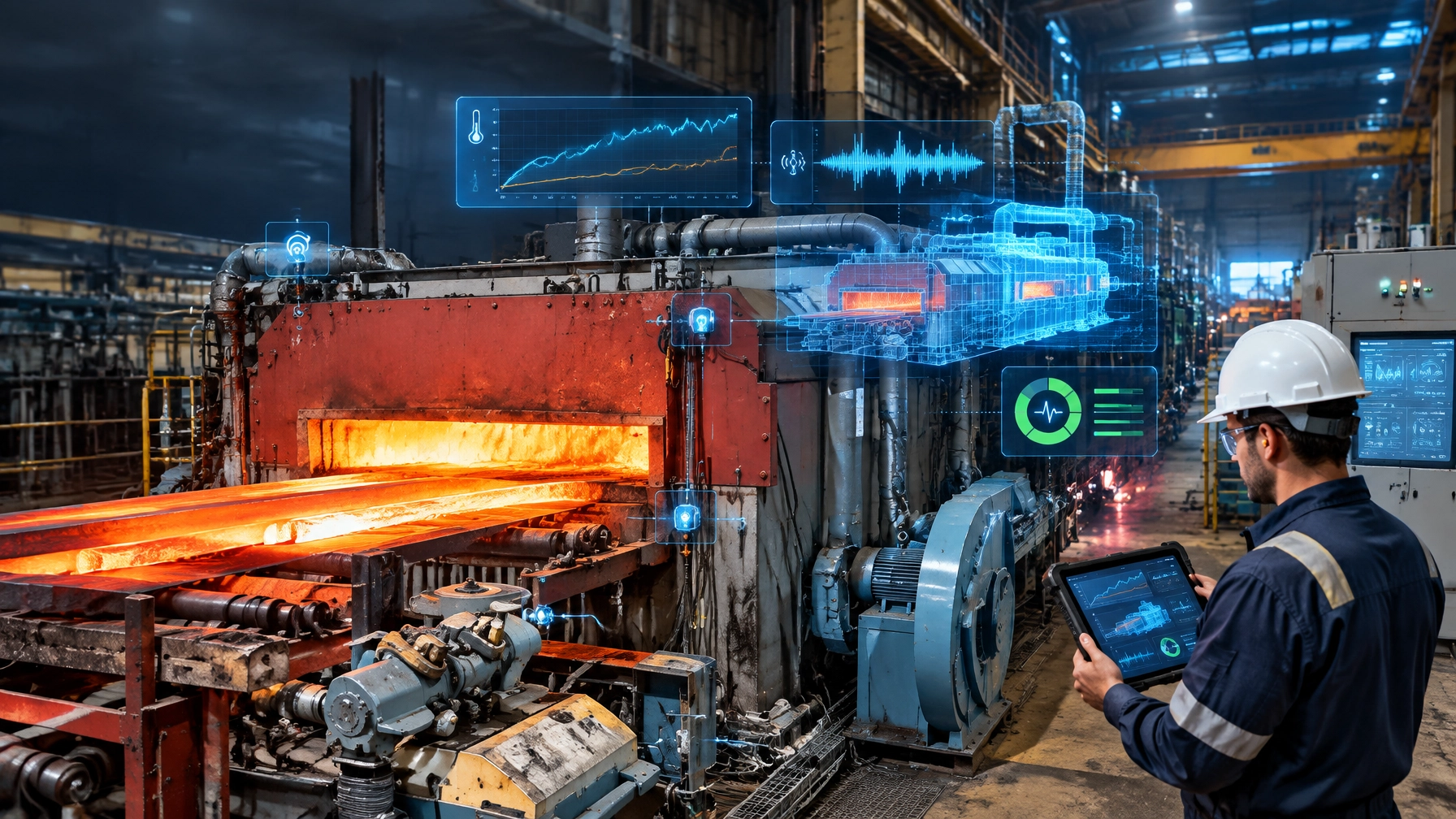
A furnace digital twin is a continuously updated virtual representation of the physical asset. It combines:
- Design data and equipment configuration
- PLC, SCADA, and historian data
- Production recipes and operating states
- Maintenance history and failure records
- Thermal, vibration, pressure, and electrical measurements
- Physics-based models for heat transfer, flow, and degradation
- Machine-learning models for anomaly detection and prognosis
The twin does not merely display data. It estimates the current condition of critical components and projects likely future states.
For refractory systems, thermal gradients and historical thermal cycling can support a remaining-life model. For rotating equipment, vibration signatures can identify imbalance, misalignment, bearing wear, and looseness. For a galvanizing line, the twin can correlate zinc-bath temperature, heating response, line speed, fume extraction, and coating-quality events.

Predictive maintenance versus traditional maintenance
The following figures are planning benchmarks, not guaranteed outcomes. Each plant must establish its own baseline before approving a business case.
| Metric | Reactive or calendar-based maintenance | Modern predictive-maintenance programme |
|---|---|---|
| Unplanned downtime | Baseline exposure; failures often discovered during production | 20–40% reduction is a practical planning target |
| Maintenance labour | High emergency response and inspection burden | 15–25% lower through risk-based work allocation |
| Mean time between failures | Limited learning from repeated faults | 15–30% improvement through root-cause correction |
| Spare-parts consumption | Frequent premature or emergency replacement | 10–20% reduction through condition-based replacement |
| Failure warning horizon | Minutes to days | Several days to 2–6 weeks, depending on failure mode |
| Indicative ROI period | Difficult to quantify | Common project planning range: 12–24 months |
The financial case becomes stronger when downtime affects high-value production, customer delivery commitments, or continuous-process operations.
Reliability priorities across furnace applications
Steel rolling mills
A steel rolling mill depends on furnace availability and repeatable billet temperature. Predictive monitoring should prioritize:
- Burner and combustion-train condition
- Furnace-zone temperature balance
- Refractory hot spots and shell-temperature drift
- Roller, drive, gearbox, and hydraulic-system vibration
- Charging and discharge alignment
- Scale formation linked to thermal instability
- Emergency-stop and safety-interlock health
The result is better synchronization between reheating, rolling schedules, and planned maintenance windows.
Galvanizing and wire-processing lines
A hot dip galvanizing plant operates as an integrated chain of pre-treatment, fluxing, drying, zinc-bath heating, wiping, cooling, extraction, and handling. Condition monitoring should track:
- Zinc-bath temperature stability, commonly around 445–465°C depending on process requirements
- Heating response and insulation condition
- Kettle-wall temperature trends
- Fume-extraction performance
- Hoists, cranes, pumps, and line drives
- Wire tension, line speed, and annealing-zone uniformity
For the wire and cable industry, even a short interruption can create scrap, coil-rejection issues, and downstream delivery delays. Early detection of a drive or heating-zone problem protects both uptime and product consistency.
Melting and recycling systems
A metal recycling furnace faces variable charge composition, thermal shock, oxidation, slag or dross formation, and severe refractory duty. A digital reliability model should connect:
- Charge type and recipe
- Melt-cycle duration
- Burner or induction-system response
- Furnace pressure and exhaust conditions
- Refractory temperature maps
- Cooling-water flow and temperature
- Tilting, tapping, or charging mechanism condition
Continental Furnaces’ melting furnaces and recycling projects can be evaluated alongside a condition-monitoring strategy from the design stage.
The four-phase reliability roadmap
Phase 1: Asset Criticality and Sensor Readiness
Rank assets according to safety consequence, production impact, replacement lead time, and quality risk.
Create a criticality register covering:
- Furnace chambers and refractory zones
- Burners, heating elements, and transformers
- Fans, pumps, drives, and gearboxes
- Thermocouples, controllers, and safety interlocks
- Cooling and extraction systems
- Charging, tapping, hoisting, and conveying equipment
Then audit installed sensors, signal quality, calibration status, sampling intervals, and communication protocols.
Phase 2: Data Architecture and Baseline Modelling
Connect PLC, SCADA, historians, CMMS, and quality records through a controlled data architecture. OPC-UA and equivalent industrial protocols can support secure interoperability.
Establish normal operating envelopes for:
- Temperature and thermal uniformity
- Vibration and rotating-equipment speed
- Pressure, flow, and current
- Cycle duration and production rate
- Alarm frequency and maintenance history
A reliable model requires clean data. Six to twenty-four months of historical information is valuable, but a focused pilot can begin with a shorter verified dataset.
Phase 3: Digital Twin Deployment
Start with one high-criticality asset rather than attempting to digitize the entire plant at once.
The first twin should provide:
- Live asset-health indicators
- Thermal and vibration trend analysis
- Refractory-wear estimation
- Fault detection and confidence scoring
- Remaining-useful-life estimates where data supports them
- Recommended maintenance windows
- Automatic CMMS work-order generation
A centralized control room can then compare multiple assets and prioritize work according to risk.

Phase 4: Closed-Loop Optimization
The mature stage links prediction to action. When the system identifies rising vibration, a refractory hot spot, or declining burner response, it should support a documented decision:
- Continue under controlled monitoring
- Reduce operating risk through a setpoint or load adjustment
- Schedule inspection during the next planned stoppage
- Reserve the required furnace spare parts
- Create a work order and track completion
- Verify the repair through post-maintenance measurements
This closed loop converts data into availability, yield, and lifecycle value.
Standards, compliance, and engineering governance
A predictive-maintenance programme must be technically useful and auditable. ISO 17359:2018 provides general guidance for machine condition monitoring and diagnostics, including parameter selection, baseline creation, alarm criteria, diagnosis, prognosis, and maintenance feedback.
Asset-intensive plants should also align the programme with the principles of ISO 55001 asset management. Thermal imaging procedures, vibration limits, electrical safety, refractory inspection, environmental permits, and customer-specific quality requirements must be documented within the plant’s management system.
The ASTM standards catalogue is a relevant authority for selecting applicable testing and measurement methods. The precise standard set should be confirmed according to furnace type, material, jurisdiction, and inspection scope.
Build reliability into the enduring partnership
Predictive maintenance cannot compensate for unsuitable furnace design, poor sensor placement, weak documentation, or unavailable critical components. Reliability begins with engineering and continues through commissioning, operator training, diagnostics, service, and spares support.
Continental Furnaces brings more than 35 years of thermal-processing expertise to heat treatment, melting, recycling, galvanizing, rolling-mill, and wire-processing applications. Explore our heat treatment furnaces, hot dip galvanizing plants, and furnace spare parts and accessories as part of a complete uptime strategy.
Do not wait for the next refractory failure, burner trip, or drive breakdown to expose the cost of reactive maintenance. Contact the Continental Furnaces engineering team today through our consultation and contact page to assess asset criticality, sensor readiness, and digital-twin potential: and convert furnace reliability into sustained competitive advantage.