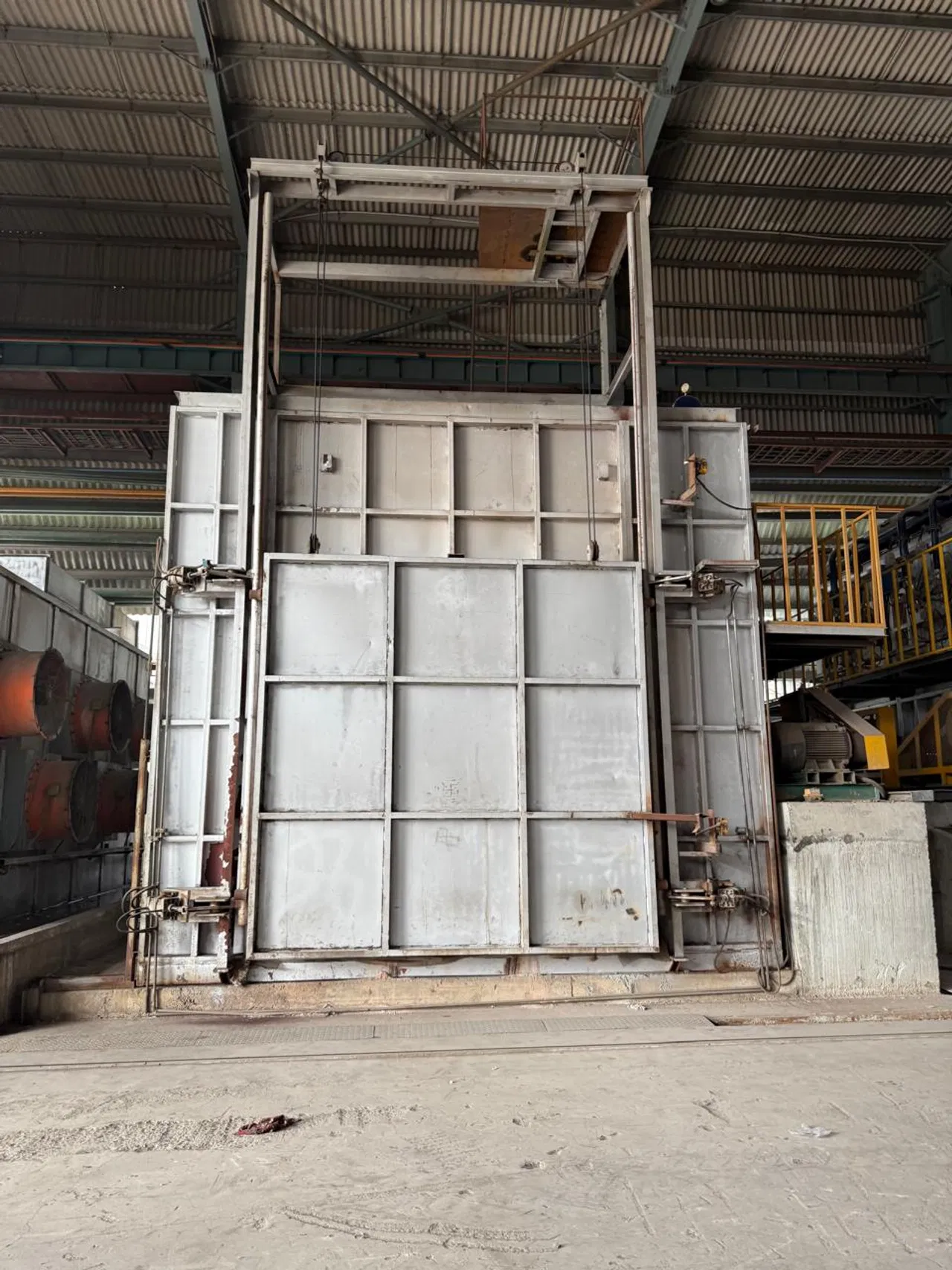
Continental Furnaces Industrial Insights: Morning Edition | September 2026
For every steel rolling mill, furnace performance now determines more than heating quality. It directly affects energy cost, material yield, production uptime, emissions compliance, maintenance exposure, and long-term profitability.
In 2026, steel and metal processors are modernizing around a clear principle: thermal equipment must operate as an integrated production system, not as an isolated utility. Hot charging, advanced combustion control, waste-heat recovery, electrification, hydrogen readiness, and Industry 4.0 monitoring are converging to create a new generation of industrial furnace systems.
According to the World Steel Association, average energy consumption in steel production declined from approximately 50 GJ per tonne in the 1960s to 20.95 GJ per tonne in 2024. The next gains will come from integrated engineering, process discipline, and intelligent modernization.
The 2026 energy-efficiency agenda
Plant managers, procurement heads, and operations directors should prioritize six connected areas:
- Hot charging and direct rolling
- High-efficiency burners and automated combustion control
- Waste-heat recovery
- Electric, hybrid, and hydrogen-ready heating
- Digital monitoring and predictive maintenance
- Planned retrofit programs supported by critical furnace spare parts
These priorities apply across reheating furnaces, heat treatment furnaces, melting shops, galvanizing lines, recycling projects, and continuous processing equipment for the wire and cable industry.
1. Hot charging is reducing reheating demand in steel mills
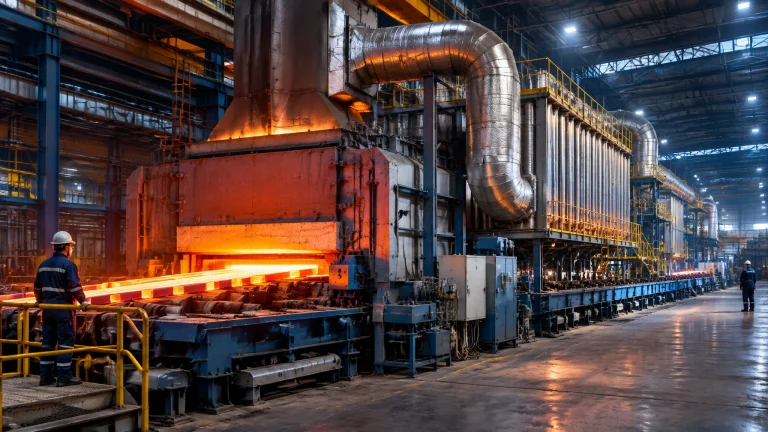
Hot charging transfers billets, blooms, or slabs from continuous casting to the reheating furnace while the material remains at an elevated temperature. Depending on the product route and transfer distance, charging temperatures commonly range from 600°C to 1,000°C.
The reheating furnace then supplies only the energy needed to reach rolling temperature, typically around 1,100°C to 1,250°C for many steel products.
A well-integrated hot-charging system can deliver:
- 15–30% lower reheating fuel demand
- Approximately 0.3–1.0 GJ/t energy savings
- Reduced scale formation and oxidation losses
- Lower furnace residence time
- Improved material yield
- Reduced thermal cycling and restart losses
Direct rolling extends the opportunity by minimizing intermediate cooling between casting and rolling. It requires close coordination between caster speed, transfer logistics, product sequencing, furnace equalization, and mill availability.
This is not simply a furnace replacement project. It is a production-architecture decision. Continental Furnaces explains the operating principles in its guidance on hot charging and direct rolling.

2. Combustion optimization delivers immediate savings
High furnace temperature does not automatically indicate high efficiency. The objective is uniform heat transfer at the lowest safe fuel input, while protecting metallurgical quality and emissions performance.
Modern thermal processing equipment should incorporate:
- Automated air-to-fuel ratio control
- Oxygen and furnace-pressure monitoring
- High-performance refractory and insulation
- Low-infiltration doors and seals
- Recipe-based temperature control
- Variable-speed combustion-air fans
- Automated billet or slab temperature measurement
- Flue-gas monitoring
- Low-NOx burner technology
Older furnaces can lose 30–40% of input energy through exhaust gases, wall losses, radiation, skid systems, and uncontrolled air infiltration. In suitable installations, combustion optimization and heat recovery can reduce fuel consumption by 15–30%.
Recuperative and regenerative burners commonly provide 10–20% fuel savings, with higher reductions available where the existing plant has poor burner balance, excessive air, damaged refractory, or unstable furnace pressure.
A practical retrofit sequence
- Calibrate temperature, oxygen, and pressure sensors.
- Balance burners across all heating zones.
- Correct excess air and furnace-pressure deviations.
- Repair doors, seals, and refractory hot spots.
- Install heat recovery where the exhaust profile supports it.
- Verify savings using energy-per-tonne measurements.
3. Waste-heat recovery is becoming a core investment case
Flue gas leaving an industrial furnace contains valuable thermal energy. Depending on furnace design and operating conditions, exhaust temperatures can reach several hundred degrees Celsius.
Recovered heat can support:
- Combustion-air preheating
- Billet, slab, or scrap preheating
- Process-water heating
- Steam generation
- Adjacent production areas
- Thermal storage systems
A feasibility study should measure:
- Exhaust temperature and flow
- Oxygen concentration
- Pressure drop
- Furnace operating hours
- Seasonal production patterns
- Available plant heat sinks
- Particulate and corrosive content
Projects combining heat recovery, improved sealing, insulation, and combustion control can achieve approximately 0.3–0.5 GJ/t savings in suitable installations. Indicative payback periods range from 18 months to four years, depending on energy prices, utilization, operating hours, and the condition of the existing furnace.
4. Electrification, EAF growth, and hydrogen readiness
Electric arc furnaces and induction systems are central to the low-carbon transition because scrap-based production generally requires substantially less energy than primary steelmaking from iron ore. The International Energy Agency identifies energy efficiency, increased scrap use, electrification, hydrogen, and carbon management as major transition pathways.
For steel producers, this means evaluating:
- Electric arc furnace capacity
- Scrap availability and quality
- Renewable electricity access
- Grid stability and tariff structure
- Melting productivity
- Off-gas management
- Future hydrogen-based direct reduction routes
A future-ready furnace must also account for:
- Hydrogen blending and fuel composition
- Higher flame speed
- Gas-train sizing and pressure regulation
- Flame detection and safety interlocks
- Purge and ventilation logic
- NOx formation and mitigation
- Burner turndown
- Heat-flux distribution
A melting furnace for steel should therefore be specified against the plant’s complete decarbonization roadmap. Hybrid gas-electric systems provide a practical transition where fuel availability, electricity cost, and grid capacity vary by operating period.
For non-ferrous processors, an aluminum melting furnace can benefit from electric or regenerative heating, improved insulation, separated melting and holding chambers, and precise temperature control. Optimized aluminum systems commonly target approximately 500–650 kWh/t, depending on furnace design, charge quality, alloy, and operating conditions.
5. Industry 4.0 turns furnace data into operating profit
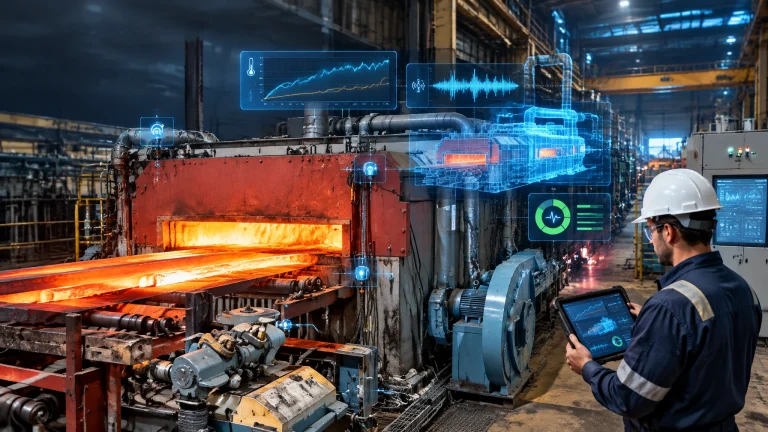
Digitalization is reshaping how plants measure and manage thermal performance. A connected furnace records process conditions continuously instead of relying on periodic manual checks.
Key performance indicators include:
- GJ/t and kWh/t by product, grade, and shift
- Zone temperature and discharge temperature
- Fuel flow and oxygen concentration
- Furnace pressure and burner status
- Fan vibration and motor current
- Refractory hot spots
- Door leakage
- Scale, dross, and melt loss
- Unplanned stops and restart energy
Advanced controls can connect furnace setpoints with production planning, rolling schedules, steel grades, and material-tracking systems. Predictive maintenance identifies deteriorating burners, fans, sensors, refractory sections, and drives before they create energy waste or an unplanned shutdown.

Conventional versus modern integrated furnace operations
| Performance metric | Conventional approach | Modern integrated approach |
|---|---|---|
| Charging temperature | 20–40°C | 600–1,000°C with hot charging |
| Reheating demand | Higher | Reduced through process integration |
| Fuel-saving potential | Baseline | Approximately 15–40% |
| Temperature control | Periodic manual checks | Continuous sensor-based control |
| Labour requirement | Higher manual intervention | Automated handling and monitoring |
| Maintenance model | Reactive | Predictive and condition-based |
| Downtime exposure | Higher | Reduced through monitoring and critical spares |
| Indicative retrofit payback | Not applicable | Approximately 1.5–4 years |
These are engineering benchmarks rather than universal guarantees. Actual results depend on throughput, product mix, furnace condition, fuel prices, operating hours, and automation maturity.
A practical 2026 modernization roadmap
Phase 1: Assessment and planning, 0 to 4 weeks
Establish a verified plant baseline before approving capital expenditure.
Measure:
- Current GJ/t and kWh/t
- Charging, soaking, and discharge temperatures
- Furnace residence time
- Fuel and electricity consumption
- Exhaust temperature and oxygen level
- Scale loss, dross generation, and saleable yield
- Downtime and restart frequency
- Existing PLC, SCADA, and MES capability
Phase 2: Operational optimization, 1 to 3 months
Implement low-capital improvements first:
- Correct furnace recipes
- Eliminate unnecessary holding
- Balance burners
- Reduce excess air
- Repair doors, seals, and refractory hot spots
- Calibrate sensors
- Synchronize casting and rolling schedules
- Avoid low-load operation where practical
Controls and energy-monitoring projects can deliver payback in approximately 6–18 months when they identify avoidable operating losses.
Phase 3: Thermal retrofit, 3 to 12 months
Evaluate:
- Recuperative or regenerative burners
- Variable-speed combustion-air fans
- Refractory and insulation upgrades
- Automated temperature measurement
- Exhaust heat recovery
- Hydrogen-ready gas trains
- Modern safety and control systems
A suitable burner and combustion-control retrofit may achieve 10–30% fuel reduction, with indicative payback of 1.5–3 years in qualifying plants.
Phase 4: Full process integration, 12 to 36 months
For suitable facilities, integrate:
- Continuous casting
- Insulated transfer routes
- Tunnel or equalization heating
- Automated production sequencing
- Caster-to-mill MES coordination
- Digital temperature models
- Predictive maintenance platforms
This phase delivers the greatest reduction in energy intensity but requires detailed engineering and close collaboration between operations, maintenance, quality, and procurement.
Protecting uptime with lifecycle support
Energy efficiency must never compromise reliability. A failed sensor, burner component, refractory section, or PLC module can quickly become a production stoppage.
A robust inventory of furnace spare parts should include:
- Flame scanners and ignition electrodes
- Thermocouples and temperature sensors
- Burner nozzles and control valves
- PLC modules and safety relays
- Refractory components
- Door seals and bearings
- Fan and VFD components
- Hydraulic and pneumatic parts
The same lifecycle strategy supports heat treatment furnaces, an aluminum melting furnace, a metal recycling furnace, a hot dip galvanizing plant, and specialized equipment for the wire and cable industry.

A high-efficiency metal recycling furnace also supports the Circular Economy by improving recovered-metal yield, reducing dependence on virgin materials, and lowering disposal exposure. Charge preparation, controlled atmosphere, shorter holding time, and accurate temperature measurement are essential to profitability.
Continental Furnaces: an enduring engineering partnership
The 2026 furnace agenda is not about purchasing one machine. It is about building a more efficient, measurable, and resilient production system.
Continental Furnaces combines 35+ years of expertise, energy-efficient technology, customized engineering, ISO-certified quality, and prompt service support. As an experienced industrial furnace manufacturer, we design and support complete industrial furnace systems for steel, non-ferrous metals, recycling, galvanizing, heat treatment, rolling mills, and other demanding industries.
Explore Continental Furnaces’ heat treatment furnace solutions, hot-dip galvanizing plant solutions, and furnace spares and accessories.
Conclusion: make energy efficiency a competitive standard
The winning sequence for 2026 is decisive:
- Measure the baseline
- Maximize hot charging
- Optimize combustion
- Recover waste heat
- Prepare for hydrogen and electrification
- Connect furnace data with production planning
- Protect uptime with predictive maintenance and critical furnace spare parts
Plants that act now will reduce operating costs, improve yield, strengthen regulatory compliance, and build resilience against energy-price volatility.
Consult Continental Furnaces to define your plant-specific energy roadmap and secure sustained competitive advantage.