Published: 9 September 2026
For plant managers, maintenance engineers and operations directors, furnace reliability is no longer measured by how quickly a team responds to breakdowns. It is measured by how effectively the organization detects degradation, plans intervention and protects production before failure occurs.
The maintenance model for industrial thermal processing is moving through four stages:
- Reactive: Repair after failure.
- Preventive: Service according to fixed calendars or operating hours.
- Predictive: Use condition data to forecast degradation.
- Prescriptive: Combine analytics, engineering rules and business priorities to recommend the best action.
This transition is essential across steel rolling mills, heat treatment lines, melting operations, galvanizing facilities and the wire and cable industry. The objective is clear: higher availability, lower maintenance cost, improved yield and safer regulatory compliance.
The Reliability Economics of Furnace Maintenance
A furnace failure rarely affects one component only. A failed burner can cause an emergency shutdown, metallurgical non-conformance, missed dispatches and secondary damage to refractory or handling equipment. The correct maintenance strategy therefore evaluates the total cost of lost production, not merely the price of the replacement part.
| Maintenance strategy | Typical trigger | Planning visibility | Labour profile | Downtime exposure | Economic outcome |
|---|---|---|---|---|---|
| Reactive | Component failure or trip | Minutes to hours | Emergency response and overtime | Highest | Lowest short-term spend, highest lifecycle risk |
| Preventive | Calendar or runtime interval | Days to weeks | Scheduled routine labour | Moderate | Predictable but may replace healthy parts |
| Predictive | Condition deviation and degradation trend | Often weeks for monitorable failure modes | Targeted inspection and planned repair | Low to moderate | Lower unplanned downtime and better parts utilisation |
| Prescriptive | Validated analytics plus engineering recommendation | Weeks to planned outage | Optimised labour, spares and production scheduling | Lowest when correctly governed | Best lifecycle value and risk-adjusted profitability |
These are planning benchmarks rather than universal guarantees. Actual returns depend on furnace design, operating hours, sensor quality, failure history and the cost of lost production. However, DOE guidance consistently supports condition monitoring, energy baselining and data-led maintenance as tools for improving industrial equipment performance.
The U.S. Department of Energy process-heating sourcebook also emphasises the importance of combustion management, furnace pressure control and systematic operating discipline.
Thermal Asset Analytics: From Sensor Data to Maintenance Decisions
A predictive maintenance programme is not simply a collection of IoT devices. It is an information architecture that connects the furnace, the process, the maintenance team and the commercial impact of downtime.
1. Condition monitoring at the asset layer
A practical sensor set for industrial furnace systems can include:
- Zone temperature and furnace-exit temperature
- Refractory hot-spot and shell-temperature measurements
- Fuel, combustion-air and flue-gas flow
- Oxygen, carbon monoxide and carbon dioxide levels
- Furnace pressure and draft
- Burner modulation, flame status and valve position
- Vibration and motor current on fans, pumps and conveyors
- Hydraulic pressure, actuator position and door-cycle data
- Electricity consumption and energy per tonne or batch
For heat treatment furnaces, this data supports temperature uniformity, cycle repeatability and component-quality assurance. In a steel rolling mill, the same approach can monitor reheating zones, walking beams, charging systems and discharge-temperature stability.
2. Smart refractory monitoring
Refractory failure develops through thermal cycling, chemical attack, mechanical impact and localised overheating. Smart refractory sensors, embedded thermocouples and infrared inspection can identify:
- Rising shell temperatures
- Abnormal thermal gradients
- Insulation degradation
- Burner impingement
- Local hot spots
- Accelerated lining wear
The commercial benefit is substantial: a planned patch or partial repair during a scheduled outage is fundamentally different from an emergency campaign termination.

3. IoT combustion analytics
Combustion analytics compares fuel input, air delivery, flame behaviour, furnace pressure and flue-gas composition. It can identify:
- Burner imbalance
- Excess-air drift
- Incomplete combustion
- Fan or damper degradation
- Fuel-valve response problems
- Abnormal exhaust temperature
- Increasing energy intensity for the same production rate
These insights apply to a melting furnace for steel, a continuous heat-treatment line and an aluminum melting furnace. In aluminium recycling, analytics can protect recovery and melt quality; in steel processing, it can protect throughput and metallurgical consistency.
Digital Twins and CMMS Integration
A digital twin is a live engineering representation of a furnace and its operating environment. It combines process data, historical performance, equipment design information and physics-based relationships.
For a thermal asset, the digital twin can estimate:
- Remaining refractory or component condition
- Expected energy consumption
- Temperature distribution by zone
- Impact of production delays
- Burner and fan performance
- Maintenance risk under different operating loads
- Consequences of hydrogen or electric heating scenarios
The twin creates value only when its output becomes an action. This requires integration with a CMMS or enterprise asset-management platform.
A robust workflow is:
- Sensor detects a deviation.
- Analytics classifies severity and probable cause.
- Engineer validates the alert.
- CMMS generates an inspection or work order.
- Planner checks labour, access and furnace spare parts.
- Intervention is scheduled around production.
- Technician records the finding and corrective action.
- The result is returned to the model for continuous improvement.
This closes the loop between condition monitoring and execution. Without CMMS integration, predictive analytics becomes another dashboard that maintenance teams must manually interpret.
High-Value Predictive Use Cases Across Thermal Processing
Steel rolling mill operations
Prioritise:
- Walking-beam and conveyor vibration
- Burner and air-fan condition
- Furnace-pressure stability
- Discharge-temperature deviation
- Refractory hot-spot detection
- Hydraulic and mechanical drive health
Heat treatment and wire production
For the wire and cable industry, reliability must protect continuous throughput and product consistency. Monitor:
- Heating-element resistance and current
- Thermocouple drift
- Atmosphere-control performance
- Cooling-system flow
- Line speed and residence time
- Door, seal and conveyor condition
Melting and recycling
For a metal recycling furnace or aluminium plant, focus on:
- Melt-rate changes
- Fuel or electrical energy per tonne
- Charging-system reliability
- Burner and furnace-pressure performance
- Slag and oxidation trends
- Tilting, lifting and tapping mechanisms
Continental Furnaces’ recycling experience demonstrates how better process monitoring can support the circular economy by improving yield and reducing avoidable material loss.
Galvanizing operations
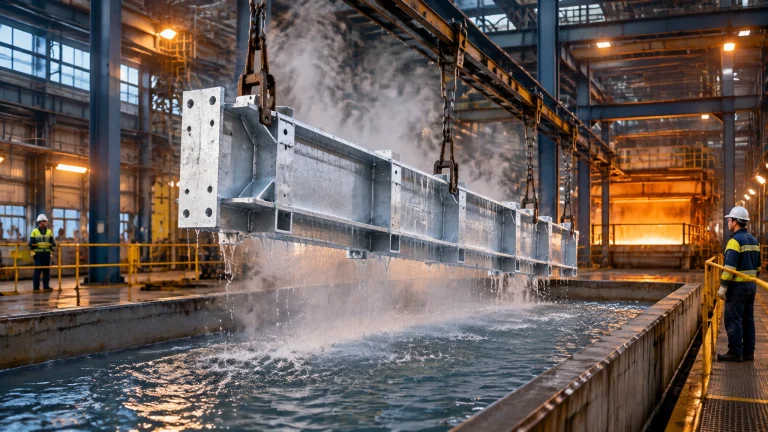
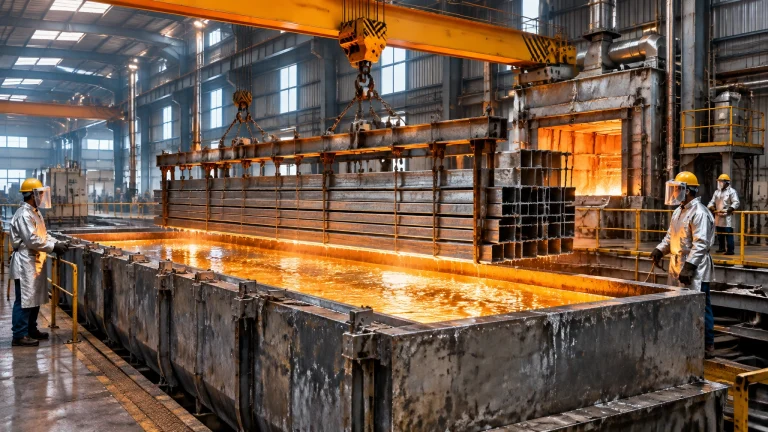
A hot dip galvanizing plant requires dependable heating, material handling and process control to maintain uniform coating quality. Predictive monitoring should cover:
- Furnace temperature stability
- Bath-heating performance
- Crane and handling equipment
- Burner, fan and exhaust systems
- Pickling and pre-treatment support equipment
- Zinc-bath temperature and process trends
The 2026 Reliability Roadmap
Phase 1: Assessment and criticality ranking : Weeks 1–4
Rank each furnace and auxiliary asset by:
- Safety consequence
- Production-loss cost per hour
- Quality impact
- Energy intensity
- Historical failure frequency
- Spare-part lead time
- Regulatory significance
Select the five to ten highest-criticality assets for the initial pilot.
Phase 2: Data foundation : Months 1–3
Validate existing instrumentation before purchasing new devices. Establish:
- Sensor calibration standards
- Time synchronisation
- Data historian structure
- Asset naming conventions
- Alarm priorities
- Baseline KPIs such as kWh or GJ per tonne, availability, mean time between failure and maintenance cost
Phase 3: Predictive pilot : Months 3–6
Begin with high-value, monitorable failure modes:
- Burner degradation
- Fan and motor vibration
- Refractory hot spots
- Thermocouple failure
- Conveyor or hydraulic deterioration
Run analytics alongside existing preventive maintenance for at least one operating cycle. Do not remove established safety inspections until alert quality is proven.
Phase 4: Prescriptive workflow : Months 6–12
Connect validated alerts to the CMMS. Define response rules:
- Advisory: Review during the next maintenance meeting.
- Priority: Inspect within 72 hours.
- Critical: Escalate immediately and apply safe operating procedures.
Every work order must document the predicted failure, actual finding, parts used and production impact.
Phase 5: 2026–2030 readiness : Months 12–24
Use the accumulated data to prepare for:
- AI-assisted diagnostics
- Smart refractory sensors
- Automated combustion analytics
- Hydrogen-blend or hydrogen-ready burner evaluation
- Electrification and hybrid-heating scenarios
- Digital-twin lifecycle planning
Any future combustion-system change must preserve safety interlocks, flame supervision and protective functions. The ISO 13577 series provides an important reference for industrial furnace safety, including general requirements, combustion and fuel-handling systems, atmosphere gases and protective systems. Plants must confirm the applicable edition and scope for their equipment and jurisdiction.
The Continental Furnaces Approach
Predictive maintenance is not a software purchase. It is a long-term reliability programme requiring furnace engineering, instrumentation, analytics, operator training, spare-parts planning and responsive technical support.
With more than 35 years of experience as an industrial furnace manufacturer, Continental Furnaces designs thermal processing equipment around the client’s throughput, alloy range, production schedule, safety obligations and future energy strategy. The objective is an enduring partnership that protects asset value long after commissioning.
Whether the requirement involves a steel rolling mill, heat treatment furnaces, a metal recycling furnace, galvanizing equipment or a high-temperature melting line, the next step is to establish the reliability baseline and identify the failure modes with the greatest financial consequence.
Contact Continental Furnaces to build a predictive and prescriptive maintenance roadmap that converts thermal asset analytics into sustained competitive advantage.
Authoritative references
- U.S. Department of Energy : Improving Process Heating System Performance
- DOE Energy Technology Infrastructure Playbook : Condition Monitoring and Predictive Maintenance
- ISO 13577-1 : Industrial furnaces and associated processing equipment: General requirements
- ISO 13577-4 ( Protective systems for industrial furnaces)